mirror of
https://github.com/ggml-org/llama.cpp.git
synced 2026-04-13 12:00:31 +02:00
Compare commits
2 Commits
gguf-pytho
...
chunks
| Author | SHA1 | Date | |
|---|---|---|---|

|
a1cdd29cd2 | ||
|
|
5a317898e8 |
@@ -1,33 +0,0 @@
|
||||
ARG UBUNTU_VERSION=22.04
|
||||
|
||||
# This needs to generally match the container host's environment.
|
||||
ARG CUDA_VERSION=11.7.1
|
||||
|
||||
# Target the CUDA build image
|
||||
ARG BASE_CUDA_DEV_CONTAINER=nvidia/cuda:${CUDA_VERSION}-devel-ubuntu${UBUNTU_VERSION}
|
||||
|
||||
FROM ${BASE_CUDA_DEV_CONTAINER} as build
|
||||
|
||||
# Unless otherwise specified, we make a fat build.
|
||||
ARG CUDA_DOCKER_ARCH=all
|
||||
|
||||
RUN apt-get update && \
|
||||
apt-get install -y build-essential python3 python3-pip
|
||||
|
||||
COPY requirements.txt requirements.txt
|
||||
|
||||
RUN pip install --upgrade pip setuptools wheel \
|
||||
&& pip install -r requirements.txt
|
||||
|
||||
WORKDIR /app
|
||||
|
||||
COPY . .
|
||||
|
||||
# Set nvcc architecture
|
||||
ENV CUDA_DOCKER_ARCH=${CUDA_DOCKER_ARCH}
|
||||
# Enable cuBLAS
|
||||
ENV LLAMA_CUBLAS=1
|
||||
|
||||
RUN make
|
||||
|
||||
ENTRYPOINT ["/app/.devops/tools.sh"]
|
||||
@@ -3,7 +3,7 @@ ARG UBUNTU_VERSION=22.04
|
||||
FROM ubuntu:$UBUNTU_VERSION as build
|
||||
|
||||
RUN apt-get update && \
|
||||
apt-get install -y build-essential python3 python3-pip git
|
||||
apt-get install -y build-essential python3 python3-pip
|
||||
|
||||
COPY requirements.txt requirements.txt
|
||||
|
||||
@@ -16,6 +16,4 @@ COPY . .
|
||||
|
||||
RUN make
|
||||
|
||||
ENV LC_ALL=C.utf8
|
||||
|
||||
ENTRYPOINT ["/app/.devops/tools.sh"]
|
||||
|
||||
@@ -1,32 +0,0 @@
|
||||
ARG UBUNTU_VERSION=22.04
|
||||
# This needs to generally match the container host's environment.
|
||||
ARG CUDA_VERSION=11.7.1
|
||||
# Target the CUDA build image
|
||||
ARG BASE_CUDA_DEV_CONTAINER=nvidia/cuda:${CUDA_VERSION}-devel-ubuntu${UBUNTU_VERSION}
|
||||
# Target the CUDA runtime image
|
||||
ARG BASE_CUDA_RUN_CONTAINER=nvidia/cuda:${CUDA_VERSION}-runtime-ubuntu${UBUNTU_VERSION}
|
||||
|
||||
FROM ${BASE_CUDA_DEV_CONTAINER} as build
|
||||
|
||||
# Unless otherwise specified, we make a fat build.
|
||||
ARG CUDA_DOCKER_ARCH=all
|
||||
|
||||
RUN apt-get update && \
|
||||
apt-get install -y build-essential
|
||||
|
||||
WORKDIR /app
|
||||
|
||||
COPY . .
|
||||
|
||||
# Set nvcc architecture
|
||||
ENV CUDA_DOCKER_ARCH=${CUDA_DOCKER_ARCH}
|
||||
# Enable cuBLAS
|
||||
ENV LLAMA_CUBLAS=1
|
||||
|
||||
RUN make
|
||||
|
||||
FROM ${BASE_CUDA_RUN_CONTAINER} as runtime
|
||||
|
||||
COPY --from=build /app/main /main
|
||||
|
||||
ENTRYPOINT [ "/main" ]
|
||||
@@ -3,7 +3,7 @@ ARG UBUNTU_VERSION=22.04
|
||||
FROM ubuntu:$UBUNTU_VERSION as build
|
||||
|
||||
RUN apt-get update && \
|
||||
apt-get install -y build-essential git
|
||||
apt-get install -y build-essential
|
||||
|
||||
WORKDIR /app
|
||||
|
||||
@@ -15,6 +15,4 @@ FROM ubuntu:$UBUNTU_VERSION as runtime
|
||||
|
||||
COPY --from=build /app/main /main
|
||||
|
||||
ENV LC_ALL=C.utf8
|
||||
|
||||
ENTRYPOINT [ "/main" ]
|
||||
|
||||
@@ -10,13 +10,13 @@ shift
|
||||
# Join the remaining arguments into a single string
|
||||
arg2="$@"
|
||||
|
||||
if [[ "$arg1" == '--convert' || "$arg1" == '-c' ]]; then
|
||||
python3 ./convert.py "$arg2"
|
||||
elif [[ "$arg1" == '--quantize' || "$arg1" == '-q' ]]; then
|
||||
./quantize "$arg2"
|
||||
elif [[ "$arg1" == '--run' || "$arg1" == '-r' ]]; then
|
||||
./main "$arg2"
|
||||
elif [[ "$arg1" == '--all-in-one' || "$arg1" == '-a' ]]; then
|
||||
if [[ $arg1 == '--convert' || $arg1 == '-c' ]]; then
|
||||
python3 ./convert-pth-to-ggml.py $arg2
|
||||
elif [[ $arg1 == '--quantize' || $arg1 == '-q' ]]; then
|
||||
./quantize $arg2
|
||||
elif [[ $arg1 == '--run' || $arg1 == '-r' ]]; then
|
||||
./main $arg2
|
||||
elif [[ $arg1 == '--all-in-one' || $arg1 == '-a' ]]; then
|
||||
echo "Converting PTH to GGML..."
|
||||
for i in `ls $1/$2/ggml-model-f16.bin*`; do
|
||||
if [ -f "${i/f16/q4_0}" ]; then
|
||||
@@ -26,19 +26,15 @@ elif [[ "$arg1" == '--all-in-one' || "$arg1" == '-a' ]]; then
|
||||
./quantize "$i" "${i/f16/q4_0}" q4_0
|
||||
fi
|
||||
done
|
||||
elif [[ "$arg1" == '--server' || "$arg1" == '-s' ]]; then
|
||||
./server "$arg2"
|
||||
else
|
||||
echo "Unknown command: $arg1"
|
||||
echo "Available commands: "
|
||||
echo " --run (-r): Run a model previously converted into ggml"
|
||||
echo " ex: -m /models/7B/ggml-model-q4_0.bin -p \"Building a website can be done in 10 simple steps:\" -n 512"
|
||||
echo " --convert (-c): Convert a llama model into ggml"
|
||||
echo " ex: --outtype f16 \"/models/7B/\" "
|
||||
echo " ex: \"/models/7B/\" 1"
|
||||
echo " --quantize (-q): Optimize with quantization process ggml"
|
||||
echo " ex: \"/models/7B/ggml-model-f16.bin\" \"/models/7B/ggml-model-q4_0.bin\" 2"
|
||||
echo " --all-in-one (-a): Execute --convert & --quantize"
|
||||
echo " ex: \"/models/\" 7B"
|
||||
echo " --server (-s): Run a model on the server"
|
||||
echo " ex: -m /models/7B/ggml-model-q4_0.bin -c 2048 -ngl 43 -mg 1 --port 8080"
|
||||
fi
|
||||
|
||||
185
.github/ISSUE_TEMPLATE/custom.md
vendored
Normal file
185
.github/ISSUE_TEMPLATE/custom.md
vendored
Normal file
@@ -0,0 +1,185 @@
|
||||
---
|
||||
name: Issue and enhancement template
|
||||
about: Used to report issues and request enhancements for llama.cpp
|
||||
title: "[User] Insert summary of your issue or enhancement.."
|
||||
labels: ''
|
||||
assignees: ''
|
||||
|
||||
---
|
||||
|
||||
# Prerequisites
|
||||
|
||||
Please answer the following questions for yourself before submitting an issue.
|
||||
|
||||
- [ ] I am running the latest code. Development is very rapid so there are no tagged versions as of now.
|
||||
- [ ] I carefully followed the [README.md](https://github.com/ggerganov/llama.cpp/blob/master/README.md).
|
||||
- [ ] I [searched using keywords relevant to my issue](https://docs.github.com/en/issues/tracking-your-work-with-issues/filtering-and-searching-issues-and-pull-requests) to make sure that I am creating a new issue that is not already open (or closed).
|
||||
- [ ] I reviewed the [Discussions](https://github.com/ggerganov/llama.cpp/discussions), and have a new bug or useful enhancement to share.
|
||||
|
||||
# Expected Behavior
|
||||
|
||||
Please provide a detailed written description of what you were trying to do, and what you expected `llama.cpp` to do.
|
||||
|
||||
# Current Behavior
|
||||
|
||||
Please provide a detailed written description of what `llama.cpp` did, instead.
|
||||
|
||||
# Environment and Context
|
||||
|
||||
Please provide detailed information about your computer setup. This is important in case the issue is not reproducible except for under certain specific conditions.
|
||||
|
||||
* Physical (or virtual) hardware you are using, e.g. for Linux:
|
||||
|
||||
`$ lscpu`
|
||||
|
||||
* Operating System, e.g. for Linux:
|
||||
|
||||
`$ uname -a`
|
||||
|
||||
* SDK version, e.g. for Linux:
|
||||
|
||||
```
|
||||
$ python3 --version
|
||||
$ make --version
|
||||
$ g++ --version
|
||||
```
|
||||
|
||||
# Failure Information (for bugs)
|
||||
|
||||
Please help provide information about the failure if this is a bug. If it is not a bug, please remove the rest of this template.
|
||||
|
||||
# Steps to Reproduce
|
||||
|
||||
Please provide detailed steps for reproducing the issue. We are not sitting in front of your screen, so the more detail the better.
|
||||
|
||||
1. step 1
|
||||
2. step 2
|
||||
3. step 3
|
||||
4. etc.
|
||||
|
||||
# Failure Logs
|
||||
|
||||
Please include any relevant log snippets or files. If it works under one configuration but not under another, please provide logs for both configurations and their corresponding outputs so it is easy to see where behavior changes.
|
||||
|
||||
Also, please try to **avoid using screenshots** if at all possible. Instead, copy/paste the console output and use [Github's markdown](https://docs.github.com/en/get-started/writing-on-github/getting-started-with-writing-and-formatting-on-github/basic-writing-and-formatting-syntax) to cleanly format your logs for easy readability.
|
||||
|
||||
Example environment info:
|
||||
```
|
||||
llama.cpp$ git log | head -1
|
||||
commit 2af23d30434a677c6416812eea52ccc0af65119c
|
||||
|
||||
llama.cpp$ lscpu | egrep "AMD|Flags"
|
||||
Vendor ID: AuthenticAMD
|
||||
Model name: AMD Ryzen Threadripper 1950X 16-Core Processor
|
||||
Flags: fpu vme de pse tsc msr pae mce cx8 apic sep mtrr pge mca cmov pat pse36 clflush mmx fxsr sse sse2 ht syscall nx mmxext fxsr_opt pdpe1gb rdtscp lm constant_tsc rep_good nopl nonstop_tsc cpuid extd_apicid amd_dcm aperfmperf rapl pni pclmulqdq monitor ssse3 fma cx16 sse4_1 sse4_2 movbe popcnt aes xsave avx f16c rdrand lahf_lm cmp_legacy svm extapic cr8_legacy abm sse4a misalignsse 3dnowprefetch osvw skinit wdt tce topoext perfctr_core perfctr_nb bpext perfctr_llc mwaitx cpb hw_pstate ssbd ibpb vmmcall fsgsbase bmi1 avx2 smep bmi2 rdseed adx smap clflushopt sha_ni xsaveopt xsavec xgetbv1 xsaves clzero irperf xsaveerptr arat npt lbrv svm_lock nrip_save tsc_scale vmcb_clean flushbyasid decodeassists pausefilter pfthreshold avic v_vmsave_vmload vgif overflow_recov succor smca sme sev
|
||||
Virtualization: AMD-V
|
||||
|
||||
llama.cpp$ python3 --version
|
||||
Python 3.10.9
|
||||
|
||||
llama.cpp$ pip list | egrep "torch|numpy|sentencepiece"
|
||||
numpy 1.24.2
|
||||
numpydoc 1.5.0
|
||||
sentencepiece 0.1.97
|
||||
torch 1.13.1
|
||||
torchvision 0.14.1
|
||||
|
||||
llama.cpp$ make --version | head -1
|
||||
GNU Make 4.3
|
||||
|
||||
$ md5sum ./models/65B/ggml-model-q4_0.bin
|
||||
dbdd682cce80e2d6e93cefc7449df487 ./models/65B/ggml-model-q4_0.bin
|
||||
```
|
||||
|
||||
Example run with the Linux command [perf](https://www.brendangregg.com/perf.html)
|
||||
```
|
||||
llama.cpp$ perf stat ./main -m ./models/65B/ggml-model-q4_0.bin -t 16 -n 1024 -p "Please close your issue when it has been answered."
|
||||
main: seed = 1679149377
|
||||
llama_model_load: loading model from './models/65B/ggml-model-q4_0.bin' - please wait ...
|
||||
llama_model_load: n_vocab = 32000
|
||||
llama_model_load: n_ctx = 512
|
||||
llama_model_load: n_embd = 8192
|
||||
llama_model_load: n_mult = 256
|
||||
llama_model_load: n_head = 64
|
||||
llama_model_load: n_layer = 80
|
||||
llama_model_load: n_rot = 128
|
||||
llama_model_load: f16 = 2
|
||||
llama_model_load: n_ff = 22016
|
||||
llama_model_load: n_parts = 8
|
||||
llama_model_load: ggml ctx size = 41477.73 MB
|
||||
llama_model_load: memory_size = 2560.00 MB, n_mem = 40960
|
||||
llama_model_load: loading model part 1/8 from './models/65B/ggml-model-q4_0.bin'
|
||||
llama_model_load: .......................................................................................... done
|
||||
llama_model_load: model size = 4869.09 MB / num tensors = 723
|
||||
llama_model_load: loading model part 2/8 from './models/65B/ggml-model-q4_0.bin.1'
|
||||
llama_model_load: .......................................................................................... done
|
||||
llama_model_load: model size = 4869.09 MB / num tensors = 723
|
||||
llama_model_load: loading model part 3/8 from './models/65B/ggml-model-q4_0.bin.2'
|
||||
llama_model_load: .......................................................................................... done
|
||||
llama_model_load: model size = 4869.09 MB / num tensors = 723
|
||||
llama_model_load: loading model part 4/8 from './models/65B/ggml-model-q4_0.bin.3'
|
||||
llama_model_load: .......................................................................................... done
|
||||
llama_model_load: model size = 4869.09 MB / num tensors = 723
|
||||
llama_model_load: loading model part 5/8 from './models/65B/ggml-model-q4_0.bin.4'
|
||||
llama_model_load: .......................................................................................... done
|
||||
llama_model_load: model size = 4869.09 MB / num tensors = 723
|
||||
llama_model_load: loading model part 6/8 from './models/65B/ggml-model-q4_0.bin.5'
|
||||
llama_model_load: .......................................................................................... done
|
||||
llama_model_load: model size = 4869.09 MB / num tensors = 723
|
||||
llama_model_load: loading model part 7/8 from './models/65B/ggml-model-q4_0.bin.6'
|
||||
llama_model_load: .......................................................................................... done
|
||||
llama_model_load: model size = 4869.09 MB / num tensors = 723
|
||||
llama_model_load: loading model part 8/8 from './models/65B/ggml-model-q4_0.bin.7'
|
||||
llama_model_load: .......................................................................................... done
|
||||
llama_model_load: model size = 4869.09 MB / num tensors = 723
|
||||
|
||||
system_info: n_threads = 16 / 32 | AVX = 1 | AVX2 = 1 | AVX512 = 0 | FMA = 1 | NEON = 0 | ARM_FMA = 0 | F16C = 1 | FP16_VA = 0 | WASM_SIMD = 0 | BLAS = 0 | SSE3 = 1 | VSX = 0 |
|
||||
|
||||
main: prompt: 'Please close your issue when it has been answered.'
|
||||
main: number of tokens in prompt = 11
|
||||
1 -> ''
|
||||
12148 -> 'Please'
|
||||
3802 -> ' close'
|
||||
596 -> ' your'
|
||||
2228 -> ' issue'
|
||||
746 -> ' when'
|
||||
372 -> ' it'
|
||||
756 -> ' has'
|
||||
1063 -> ' been'
|
||||
7699 -> ' answered'
|
||||
29889 -> '.'
|
||||
|
||||
sampling parameters: temp = 0.800000, top_k = 40, top_p = 0.950000, repeat_last_n = 64, repeat_penalty = 1.300000
|
||||
|
||||
|
||||
Please close your issue when it has been answered.
|
||||
@duncan-donut: I'm trying to figure out what kind of "support" you need for this script and why, exactly? Is there a question about how the code works that hasn't already been addressed in one or more comments below this ticket, or are we talking something else entirely like some sorta bugfixing job because your server setup is different from mine??
|
||||
I can understand if your site needs to be running smoothly and you need help with a fix of sorts but there should really be nothing wrong here that the code itself could not handle. And given that I'm getting reports about how it works perfectly well on some other servers, what exactly are we talking? A detailed report will do wonders in helping us get this resolved for ya quickly so please take your time and describe the issue(s) you see as clearly & concisely as possible!!
|
||||
@duncan-donut: I'm not sure if you have access to cPanel but you could try these instructions. It is worth a shot! Let me know how it goes (or what error message, exactly!) when/if ya give that code a go? [end of text]
|
||||
|
||||
|
||||
main: mem per token = 71159620 bytes
|
||||
main: load time = 19309.95 ms
|
||||
main: sample time = 168.62 ms
|
||||
main: predict time = 223895.61 ms / 888.47 ms per token
|
||||
main: total time = 246406.42 ms
|
||||
|
||||
Performance counter stats for './main -m ./models/65B/ggml-model-q4_0.bin -t 16 -n 1024 -p Please close your issue when it has been answered.':
|
||||
|
||||
3636882.89 msec task-clock # 14.677 CPUs utilized
|
||||
13509 context-switches # 3.714 /sec
|
||||
2436 cpu-migrations # 0.670 /sec
|
||||
10476679 page-faults # 2.881 K/sec
|
||||
13133115082869 cycles # 3.611 GHz (16.77%)
|
||||
29314462753 stalled-cycles-frontend # 0.22% frontend cycles idle (16.76%)
|
||||
10294402631459 stalled-cycles-backend # 78.39% backend cycles idle (16.74%)
|
||||
23479217109614 instructions # 1.79 insn per cycle
|
||||
# 0.44 stalled cycles per insn (16.76%)
|
||||
2353072268027 branches # 647.002 M/sec (16.77%)
|
||||
1998682780 branch-misses # 0.08% of all branches (16.76%)
|
||||
|
||||
247.802177522 seconds time elapsed
|
||||
|
||||
3618.573072000 seconds user
|
||||
18.491698000 seconds sys
|
||||
```
|
||||
589
.github/workflows/build.yml
vendored
Normal file
589
.github/workflows/build.yml
vendored
Normal file
@@ -0,0 +1,589 @@
|
||||
name: CI
|
||||
|
||||
on:
|
||||
workflow_dispatch: # allows manual triggering
|
||||
inputs:
|
||||
create_release:
|
||||
description: 'Create new release'
|
||||
required: true
|
||||
type: boolean
|
||||
push:
|
||||
branches:
|
||||
- master
|
||||
paths: ['.github/workflows/**', '**/CMakeLists.txt', '**/Makefile', '**/*.h', '**/*.c', '**/*.cpp']
|
||||
pull_request:
|
||||
types: [opened, synchronize, reopened]
|
||||
paths: ['**/CMakeLists.txt', '**/Makefile', '**/*.h', '**/*.c', '**/*.cpp']
|
||||
|
||||
env:
|
||||
BRANCH_NAME: ${{ github.head_ref || github.ref_name }}
|
||||
|
||||
jobs:
|
||||
ubuntu-focal-make:
|
||||
runs-on: ubuntu-20.04
|
||||
|
||||
steps:
|
||||
- name: Clone
|
||||
id: checkout
|
||||
uses: actions/checkout@v1
|
||||
|
||||
- name: Dependencies
|
||||
id: depends
|
||||
run: |
|
||||
sudo apt-get update
|
||||
sudo apt-get install build-essential gcc-8
|
||||
|
||||
- name: Build
|
||||
id: make_build
|
||||
run: |
|
||||
CC=gcc-8 make
|
||||
|
||||
ubuntu-latest-cmake:
|
||||
runs-on: ubuntu-latest
|
||||
|
||||
steps:
|
||||
- name: Clone
|
||||
id: checkout
|
||||
uses: actions/checkout@v1
|
||||
|
||||
- name: Dependencies
|
||||
id: depends
|
||||
run: |
|
||||
sudo apt-get update
|
||||
sudo apt-get install build-essential
|
||||
|
||||
- name: Build
|
||||
id: cmake_build
|
||||
run: |
|
||||
mkdir build
|
||||
cd build
|
||||
cmake ..
|
||||
cmake --build . --config Release
|
||||
|
||||
- name: Test
|
||||
id: cmake_test
|
||||
run: |
|
||||
cd build
|
||||
ctest --verbose
|
||||
|
||||
ubuntu-latest-cmake-sanitizer:
|
||||
runs-on: ubuntu-latest
|
||||
|
||||
continue-on-error: true
|
||||
|
||||
strategy:
|
||||
matrix:
|
||||
sanitizer: [ADDRESS, THREAD, UNDEFINED]
|
||||
build_type: [Debug, Release]
|
||||
|
||||
steps:
|
||||
- name: Clone
|
||||
id: checkout
|
||||
uses: actions/checkout@v1
|
||||
|
||||
- name: Dependencies
|
||||
id: depends
|
||||
run: |
|
||||
sudo apt-get update
|
||||
sudo apt-get install build-essential
|
||||
|
||||
- name: Build
|
||||
id: cmake_build
|
||||
run: |
|
||||
mkdir build
|
||||
cd build
|
||||
cmake .. -DLLAMA_SANITIZE_${{ matrix.sanitizer }}=ON -DCMAKE_BUILD_TYPE=${{ matrix.build_type }}
|
||||
cmake --build . --config ${{ matrix.build_type }}
|
||||
|
||||
- name: Test
|
||||
id: cmake_test
|
||||
run: |
|
||||
cd build
|
||||
ctest --verbose
|
||||
|
||||
macOS-latest-make:
|
||||
runs-on: macos-latest
|
||||
|
||||
steps:
|
||||
- name: Clone
|
||||
id: checkout
|
||||
uses: actions/checkout@v1
|
||||
|
||||
- name: Dependencies
|
||||
id: depends
|
||||
run: |
|
||||
brew update
|
||||
|
||||
- name: Build
|
||||
id: make_build
|
||||
run: |
|
||||
make
|
||||
|
||||
macOS-latest-cmake:
|
||||
runs-on: macos-latest
|
||||
|
||||
steps:
|
||||
- name: Clone
|
||||
id: checkout
|
||||
uses: actions/checkout@v1
|
||||
|
||||
- name: Dependencies
|
||||
id: depends
|
||||
run: |
|
||||
brew update
|
||||
|
||||
- name: Build
|
||||
id: cmake_build
|
||||
run: |
|
||||
mkdir build
|
||||
cd build
|
||||
cmake -DLLAMA_AVX2=OFF ..
|
||||
cmake --build . --config Release
|
||||
|
||||
- name: Test
|
||||
id: cmake_test
|
||||
run: |
|
||||
cd build
|
||||
ctest --verbose
|
||||
|
||||
windows-latest-cmake:
|
||||
runs-on: windows-latest
|
||||
env:
|
||||
OPENBLAS_VERSION: 0.3.23
|
||||
OPENCL_VERSION: 2023.04.17
|
||||
CLBLAST_VERSION: 1.5.3
|
||||
|
||||
strategy:
|
||||
matrix:
|
||||
include:
|
||||
- build: 'avx2'
|
||||
defines: ''
|
||||
- build: 'avx'
|
||||
defines: '-DLLAMA_AVX2=OFF'
|
||||
- build: 'avx512'
|
||||
defines: '-DLLAMA_AVX512=ON -DBUILD_SHARED_LIBS=ON'
|
||||
- build: 'clblast'
|
||||
defines: '-DLLAMA_CLBLAST=ON -DCMAKE_PREFIX_PATH="$env:RUNNER_TEMP/clblast"'
|
||||
- build: 'openblas'
|
||||
defines: '-DLLAMA_OPENBLAS=ON -DBLAS_LIBRARIES="/LIBPATH:$env:RUNNER_TEMP/openblas/lib" -DOPENBLAS_INC="$env:RUNNER_TEMP/openblas/include"'
|
||||
|
||||
steps:
|
||||
- name: Clone
|
||||
id: checkout
|
||||
uses: actions/checkout@v1
|
||||
|
||||
- name: Download OpenCL SDK
|
||||
id: get_opencl
|
||||
if: ${{ matrix.build == 'clblast' }}
|
||||
run: |
|
||||
curl.exe -o $env:RUNNER_TEMP/opencl.zip -L "https://github.com/KhronosGroup/OpenCL-SDK/releases/download/v${env:OPENCL_VERSION}/OpenCL-SDK-v${env:OPENCL_VERSION}-Win-x64.zip"
|
||||
mkdir $env:RUNNER_TEMP/opencl
|
||||
tar.exe -xvf $env:RUNNER_TEMP/opencl.zip --strip-components=1 -C $env:RUNNER_TEMP/opencl
|
||||
|
||||
- name: Download CLBlast
|
||||
id: get_clblast
|
||||
if: ${{ matrix.build == 'clblast' }}
|
||||
run: |
|
||||
curl.exe -o $env:RUNNER_TEMP/clblast.zip -L "https://github.com/CNugteren/CLBlast/releases/download/${env:CLBLAST_VERSION}/CLBlast-${env:CLBLAST_VERSION}-Windows-x64.zip"
|
||||
curl.exe -o $env:RUNNER_TEMP/CLBlast.LICENSE.txt -L "https://github.com/CNugteren/CLBlast/raw/${env:CLBLAST_VERSION}/LICENSE"
|
||||
mkdir $env:RUNNER_TEMP/clblast
|
||||
tar.exe -xvf $env:RUNNER_TEMP/clblast.zip -C $env:RUNNER_TEMP/clblast
|
||||
foreach ($f in (gci -Recurse -Path "$env:RUNNER_TEMP/clblast" -Filter '*.cmake')) {
|
||||
$txt = Get-Content -Path $f -Raw
|
||||
$txt.Replace('C:/dependencies/opencl/', "$($env:RUNNER_TEMP.Replace('\','/'))/opencl/") | Set-Content -Path $f -Encoding UTF8
|
||||
}
|
||||
|
||||
- name: Download OpenBLAS
|
||||
id: get_openblas
|
||||
if: ${{ matrix.build == 'openblas' }}
|
||||
run: |
|
||||
curl.exe -o $env:RUNNER_TEMP/openblas.zip -L "https://github.com/xianyi/OpenBLAS/releases/download/v${env:OPENBLAS_VERSION}/OpenBLAS-${env:OPENBLAS_VERSION}-x64.zip"
|
||||
curl.exe -o $env:RUNNER_TEMP/OpenBLAS.LICENSE.txt -L "https://github.com/xianyi/OpenBLAS/raw/v${env:OPENBLAS_VERSION}/LICENSE"
|
||||
mkdir $env:RUNNER_TEMP/openblas
|
||||
tar.exe -xvf $env:RUNNER_TEMP/openblas.zip -C $env:RUNNER_TEMP/openblas
|
||||
$vcdir = $(vswhere -latest -products * -requires Microsoft.VisualStudio.Component.VC.Tools.x86.x64 -property installationPath)
|
||||
$msvc = $(join-path $vcdir $('VC\Tools\MSVC\'+$(gc -raw $(join-path $vcdir 'VC\Auxiliary\Build\Microsoft.VCToolsVersion.default.txt')).Trim()))
|
||||
$lib = $(join-path $msvc 'bin\Hostx64\x64\lib.exe')
|
||||
& $lib /machine:x64 "/def:${env:RUNNER_TEMP}/openblas/lib/libopenblas.def" "/out:${env:RUNNER_TEMP}/openblas/lib/openblas.lib" /name:openblas.dll
|
||||
|
||||
- name: Build
|
||||
id: cmake_build
|
||||
run: |
|
||||
mkdir build
|
||||
cd build
|
||||
cmake .. ${{ matrix.defines }}
|
||||
cmake --build . --config Release
|
||||
cp ../LICENSE ./bin/Release/llama.cpp.txt
|
||||
|
||||
- name: Add clblast.dll
|
||||
id: add_clblast_dll
|
||||
if: ${{ matrix.build == 'clblast' }}
|
||||
run: |
|
||||
cp $env:RUNNER_TEMP/clblast/lib/clblast.dll ./build/bin/Release
|
||||
cp $env:RUNNER_TEMP/CLBlast.LICENSE.txt ./build/bin/Release/CLBlast-${env:CLBLAST_VERSION}.txt
|
||||
|
||||
- name: Add libopenblas.dll
|
||||
id: add_libopenblas_dll
|
||||
if: ${{ matrix.build == 'openblas' }}
|
||||
run: |
|
||||
cp $env:RUNNER_TEMP/openblas/bin/libopenblas.dll ./build/bin/Release/openblas.dll
|
||||
cp $env:RUNNER_TEMP/OpenBLAS.LICENSE.txt ./build/bin/Release/OpenBLAS-${env:OPENBLAS_VERSION}.txt
|
||||
|
||||
- name: Check AVX512F support
|
||||
id: check_avx512f
|
||||
if: ${{ matrix.build == 'avx512' }}
|
||||
continue-on-error: true
|
||||
run: |
|
||||
cd build
|
||||
$vcdir = $(vswhere -latest -products * -requires Microsoft.VisualStudio.Component.VC.Tools.x86.x64 -property installationPath)
|
||||
$msvc = $(join-path $vcdir $('VC\Tools\MSVC\'+$(gc -raw $(join-path $vcdir 'VC\Auxiliary\Build\Microsoft.VCToolsVersion.default.txt')).Trim()))
|
||||
$cl = $(join-path $msvc 'bin\Hostx64\x64\cl.exe')
|
||||
echo 'int main(void){unsigned int a[4];__cpuid(a,7);return !(a[1]&65536);}' >> avx512f.c
|
||||
& $cl /O2 /GS- /kernel avx512f.c /link /nodefaultlib /entry:main
|
||||
.\avx512f.exe && echo "AVX512F: YES" && ( echo HAS_AVX512F=1 >> $env:GITHUB_ENV ) || echo "AVX512F: NO"
|
||||
|
||||
- name: Test
|
||||
id: cmake_test
|
||||
if: ${{ matrix.build != 'clblast' && (matrix.build != 'avx512' || env.HAS_AVX512F == '1') }} # Test AVX-512 only when possible
|
||||
run: |
|
||||
cd build
|
||||
ctest -C Release --verbose
|
||||
|
||||
- name: Get commit hash
|
||||
id: commit
|
||||
if: ${{ ( github.event_name == 'push' && github.ref == 'refs/heads/master' ) || github.event.inputs.create_release == 'true' }}
|
||||
uses: pr-mpt/actions-commit-hash@v2
|
||||
|
||||
- name: Pack artifacts
|
||||
id: pack_artifacts
|
||||
if: ${{ ( github.event_name == 'push' && github.ref == 'refs/heads/master' ) || github.event.inputs.create_release == 'true' }}
|
||||
run: |
|
||||
7z a llama-${{ env.BRANCH_NAME }}-${{ steps.commit.outputs.short }}-bin-win-${{ matrix.build }}-x64.zip .\build\bin\Release\*
|
||||
|
||||
- name: Upload artifacts
|
||||
if: ${{ ( github.event_name == 'push' && github.ref == 'refs/heads/master' ) || github.event.inputs.create_release == 'true' }}
|
||||
uses: actions/upload-artifact@v3
|
||||
with:
|
||||
path: |
|
||||
llama-${{ env.BRANCH_NAME }}-${{ steps.commit.outputs.short }}-bin-win-${{ matrix.build }}-x64.zip
|
||||
|
||||
windows-latest-cmake-cublas:
|
||||
runs-on: windows-latest
|
||||
|
||||
strategy:
|
||||
matrix:
|
||||
cuda: ['12.1.0', '11.7.1']
|
||||
build: ['cublas']
|
||||
|
||||
steps:
|
||||
- name: Clone
|
||||
id: checkout
|
||||
uses: actions/checkout@v1
|
||||
|
||||
- uses: Jimver/cuda-toolkit@v0.2.10
|
||||
id: cuda-toolkit
|
||||
with:
|
||||
cuda: ${{ matrix.cuda }}
|
||||
# TODO(green-sky): _dev seems to fail, and non dev are not enought
|
||||
#sub-packages: '["nvcc", "cudart", "cublas", "cudart_dev", "cublas_dev"]'
|
||||
|
||||
- name: Build
|
||||
id: cmake_build
|
||||
run: |
|
||||
mkdir build
|
||||
cd build
|
||||
cmake .. -DLLAMA_CUBLAS=ON
|
||||
cmake --build . --config Release
|
||||
|
||||
- name: Get commit hash
|
||||
id: commit
|
||||
if: ${{ ( github.event_name == 'push' && github.ref == 'refs/heads/master' ) || github.event.inputs.create_release == 'true' }}
|
||||
uses: pr-mpt/actions-commit-hash@v2
|
||||
|
||||
- name: Pack artifacts
|
||||
id: pack_artifacts
|
||||
if: ${{ ( github.event_name == 'push' && github.ref == 'refs/heads/master' ) || github.event.inputs.create_release == 'true' }}
|
||||
run: |
|
||||
7z a llama-${{ env.BRANCH_NAME }}-${{ steps.commit.outputs.short }}-bin-win-${{ matrix.build }}-cu${{ matrix.cuda }}-x64.zip .\build\bin\Release\*
|
||||
|
||||
- name: Upload artifacts
|
||||
if: ${{ ( github.event_name == 'push' && github.ref == 'refs/heads/master' ) || github.event.inputs.create_release == 'true' }}
|
||||
uses: actions/upload-artifact@v3
|
||||
with:
|
||||
path: |
|
||||
llama-${{ env.BRANCH_NAME }}-${{ steps.commit.outputs.short }}-bin-win-${{ matrix.build }}-cu${{ matrix.cuda }}-x64.zip
|
||||
|
||||
- name: Copy and pack Cuda runtime
|
||||
if: ${{ matrix.cuda == '12.1.0' }}
|
||||
# TODO(green-sky): paths are cuda 12 specific
|
||||
run: |
|
||||
echo "Cuda install location: ${{steps.cuda-toolkit.outputs.CUDA_PATH}}"
|
||||
mkdir '.\build\bin\cudart\'
|
||||
cp "${{steps.cuda-toolkit.outputs.CUDA_PATH}}\bin\cudart64_12.dll" '.\build\bin\cudart\'
|
||||
cp "${{steps.cuda-toolkit.outputs.CUDA_PATH}}\bin\cublas64_12.dll" '.\build\bin\cudart\'
|
||||
cp "${{steps.cuda-toolkit.outputs.CUDA_PATH}}\bin\cublasLt64_12.dll" '.\build\bin\cudart\'
|
||||
7z a cudart-llama-bin-win-cu${{ matrix.cuda }}-x64.zip .\build\bin\cudart\*
|
||||
|
||||
- name: Copy and pack Cuda runtime
|
||||
if: ${{ matrix.cuda == '11.7.1' }}
|
||||
# TODO(green-sky): paths are cuda 11 specific
|
||||
run: |
|
||||
echo "Cuda install location: ${{steps.cuda-toolkit.outputs.CUDA_PATH}}"
|
||||
mkdir '.\build\bin\cudart\'
|
||||
ls "${{steps.cuda-toolkit.outputs.CUDA_PATH}}\bin"
|
||||
cp "${{steps.cuda-toolkit.outputs.CUDA_PATH}}\bin\cudart64_110.dll" '.\build\bin\cudart\'
|
||||
cp "${{steps.cuda-toolkit.outputs.CUDA_PATH}}\bin\cublas64_11.dll" '.\build\bin\cudart\'
|
||||
cp "${{steps.cuda-toolkit.outputs.CUDA_PATH}}\bin\cublasLt64_11.dll" '.\build\bin\cudart\'
|
||||
7z a cudart-llama-bin-win-cu${{ matrix.cuda }}-x64.zip .\build\bin\cudart\*
|
||||
|
||||
- name: Upload Cuda runtime
|
||||
if: ${{ ( github.event_name == 'push' && github.ref == 'refs/heads/master' ) || github.event.inputs.create_release == 'true' }}
|
||||
uses: actions/upload-artifact@v3
|
||||
with:
|
||||
path: |
|
||||
cudart-llama-bin-win-cu${{ matrix.cuda }}-x64.zip
|
||||
|
||||
release:
|
||||
if: ${{ ( github.event_name == 'push' && github.ref == 'refs/heads/master' ) || github.event.inputs.create_release == 'true' }}
|
||||
|
||||
runs-on: ubuntu-latest
|
||||
|
||||
needs:
|
||||
- ubuntu-focal-make
|
||||
- ubuntu-latest-cmake
|
||||
- macOS-latest-make
|
||||
- macOS-latest-cmake
|
||||
- windows-latest-cmake
|
||||
- windows-latest-cmake-cublas
|
||||
|
||||
steps:
|
||||
- name: Download artifacts
|
||||
id: download-artifact
|
||||
uses: actions/download-artifact@v3
|
||||
|
||||
- name: Get commit hash
|
||||
id: commit
|
||||
uses: pr-mpt/actions-commit-hash@v2
|
||||
|
||||
- name: Create release
|
||||
id: create_release
|
||||
uses: anzz1/action-create-release@v1
|
||||
env:
|
||||
GITHUB_TOKEN: ${{ secrets.GITHUB_TOKEN }}
|
||||
with:
|
||||
tag_name: ${{ env.BRANCH_NAME }}-${{ steps.commit.outputs.short }}
|
||||
|
||||
- name: Upload release
|
||||
id: upload_release
|
||||
uses: actions/github-script@v3
|
||||
with:
|
||||
github-token: ${{secrets.GITHUB_TOKEN}}
|
||||
script: |
|
||||
const path = require('path');
|
||||
const fs = require('fs');
|
||||
const release_id = '${{ steps.create_release.outputs.id }}';
|
||||
for (let file of await fs.readdirSync('./artifact')) {
|
||||
if (path.extname(file) === '.zip') {
|
||||
console.log('uploadReleaseAsset', file);
|
||||
await github.repos.uploadReleaseAsset({
|
||||
owner: context.repo.owner,
|
||||
repo: context.repo.repo,
|
||||
release_id: release_id,
|
||||
name: file,
|
||||
data: await fs.readFileSync(`./artifact/${file}`)
|
||||
});
|
||||
}
|
||||
}
|
||||
|
||||
# ubuntu-latest-gcc:
|
||||
# runs-on: ubuntu-latest
|
||||
#
|
||||
# strategy:
|
||||
# matrix:
|
||||
# build: [Debug, Release]
|
||||
#
|
||||
# steps:
|
||||
# - name: Clone
|
||||
# uses: actions/checkout@v1
|
||||
#
|
||||
# - name: Dependencies
|
||||
# run: |
|
||||
# sudo apt-get update
|
||||
# sudo apt-get install build-essential
|
||||
# sudo apt-get install cmake
|
||||
#
|
||||
# - name: Configure
|
||||
# run: cmake . -DCMAKE_BUILD_TYPE=${{ matrix.build }}
|
||||
#
|
||||
# - name: Build
|
||||
# run: |
|
||||
# make
|
||||
#
|
||||
# ubuntu-latest-clang:
|
||||
# runs-on: ubuntu-latest
|
||||
#
|
||||
# strategy:
|
||||
# matrix:
|
||||
# build: [Debug, Release]
|
||||
#
|
||||
# steps:
|
||||
# - name: Clone
|
||||
# uses: actions/checkout@v1
|
||||
#
|
||||
# - name: Dependencies
|
||||
# run: |
|
||||
# sudo apt-get update
|
||||
# sudo apt-get install build-essential
|
||||
# sudo apt-get install cmake
|
||||
#
|
||||
# - name: Configure
|
||||
# run: cmake . -DCMAKE_BUILD_TYPE=${{ matrix.build }} -DCMAKE_CXX_COMPILER=clang++ -DCMAKE_C_COMPILER=clang
|
||||
#
|
||||
# - name: Build
|
||||
# run: |
|
||||
# make
|
||||
#
|
||||
# ubuntu-latest-gcc-sanitized:
|
||||
# runs-on: ubuntu-latest
|
||||
#
|
||||
# strategy:
|
||||
# matrix:
|
||||
# sanitizer: [ADDRESS, THREAD, UNDEFINED]
|
||||
#
|
||||
# steps:
|
||||
# - name: Clone
|
||||
# uses: actions/checkout@v1
|
||||
#
|
||||
# - name: Dependencies
|
||||
# run: |
|
||||
# sudo apt-get update
|
||||
# sudo apt-get install build-essential
|
||||
# sudo apt-get install cmake
|
||||
#
|
||||
# - name: Configure
|
||||
# run: cmake . -DCMAKE_BUILD_TYPE=Debug -DLLAMA_SANITIZE_${{ matrix.sanitizer }}=ON
|
||||
#
|
||||
# - name: Build
|
||||
# run: |
|
||||
# make
|
||||
#
|
||||
# windows:
|
||||
# runs-on: windows-latest
|
||||
#
|
||||
# strategy:
|
||||
# matrix:
|
||||
# build: [Release]
|
||||
# arch: [Win32, x64]
|
||||
# include:
|
||||
# - arch: Win32
|
||||
# s2arc: x86
|
||||
# - arch: x64
|
||||
# s2arc: x64
|
||||
#
|
||||
# steps:
|
||||
# - name: Clone
|
||||
# uses: actions/checkout@v1
|
||||
#
|
||||
# - name: Add msbuild to PATH
|
||||
# uses: microsoft/setup-msbuild@v1
|
||||
#
|
||||
# - name: Configure
|
||||
# run: >
|
||||
# cmake -S . -B ./build -A ${{ matrix.arch }}
|
||||
# -DCMAKE_BUILD_TYPE=${{ matrix.build }}
|
||||
#
|
||||
# - name: Build
|
||||
# run: |
|
||||
# cd ./build
|
||||
# msbuild ALL_BUILD.vcxproj -t:build -p:configuration=${{ matrix.build }} -p:platform=${{ matrix.arch }}
|
||||
#
|
||||
# - name: Upload binaries
|
||||
# uses: actions/upload-artifact@v1
|
||||
# with:
|
||||
# name: llama-bin-${{ matrix.arch }}
|
||||
# path: build/bin/${{ matrix.build }}
|
||||
#
|
||||
# windows-blas:
|
||||
# runs-on: windows-latest
|
||||
#
|
||||
# strategy:
|
||||
# matrix:
|
||||
# build: [Release]
|
||||
# arch: [Win32, x64]
|
||||
# blas: [ON]
|
||||
# include:
|
||||
# - arch: Win32
|
||||
# obzip: https://github.com/xianyi/OpenBLAS/releases/download/v0.3.21/OpenBLAS-0.3.21-x86.zip
|
||||
# s2arc: x86
|
||||
# - arch: x64
|
||||
# obzip: https://github.com/xianyi/OpenBLAS/releases/download/v0.3.21/OpenBLAS-0.3.21-x64.zip
|
||||
# s2arc: x64
|
||||
#
|
||||
# steps:
|
||||
# - name: Clone
|
||||
# uses: actions/checkout@v1
|
||||
#
|
||||
# - name: Add msbuild to PATH
|
||||
# uses: microsoft/setup-msbuild@v1
|
||||
#
|
||||
# - name: Fetch OpenBLAS
|
||||
# if: matrix.blas == 'ON'
|
||||
# run: |
|
||||
# C:/msys64/usr/bin/wget.exe -qO blas.zip ${{ matrix.obzip }}
|
||||
# 7z x blas.zip -oblas -y
|
||||
# copy blas/include/cblas.h .
|
||||
# copy blas/include/openblas_config.h .
|
||||
# echo "blasdir=$env:GITHUB_WORKSPACE/blas" >> $env:GITHUB_ENV
|
||||
#
|
||||
# - name: Configure
|
||||
# run: >
|
||||
# cmake -S . -B ./build -A ${{ matrix.arch }}
|
||||
# -DCMAKE_BUILD_TYPE=${{ matrix.build }}
|
||||
# -DLLAMA_SUPPORT_OPENBLAS=${{ matrix.blas }}
|
||||
# -DCMAKE_LIBRARY_PATH="$env:blasdir/lib"
|
||||
#
|
||||
# - name: Build
|
||||
# run: |
|
||||
# cd ./build
|
||||
# msbuild ALL_BUILD.vcxproj -t:build -p:configuration=${{ matrix.build }} -p:platform=${{ matrix.arch }}
|
||||
#
|
||||
# - name: Copy libopenblas.dll
|
||||
# if: matrix.blas == 'ON'
|
||||
# run: copy "$env:blasdir/bin/libopenblas.dll" build/bin/${{ matrix.build }}
|
||||
#
|
||||
# - name: Upload binaries
|
||||
# if: matrix.blas == 'ON'
|
||||
# uses: actions/upload-artifact@v1
|
||||
# with:
|
||||
# name: llama-blas-bin-${{ matrix.arch }}
|
||||
# path: build/bin/${{ matrix.build }}
|
||||
#
|
||||
# emscripten:
|
||||
# runs-on: ubuntu-latest
|
||||
#
|
||||
# strategy:
|
||||
# matrix:
|
||||
# build: [Release]
|
||||
#
|
||||
# steps:
|
||||
# - name: Clone
|
||||
# uses: actions/checkout@v1
|
||||
#
|
||||
# - name: Dependencies
|
||||
# run: |
|
||||
# wget -q https://github.com/emscripten-core/emsdk/archive/master.tar.gz
|
||||
# tar -xvf master.tar.gz
|
||||
# emsdk-master/emsdk update
|
||||
# emsdk-master/emsdk install latest
|
||||
# emsdk-master/emsdk activate latest
|
||||
#
|
||||
# - name: Configure
|
||||
# run: echo "tmp"
|
||||
#
|
||||
# - name: Build
|
||||
# run: |
|
||||
# pushd emsdk-master
|
||||
# source ./emsdk_env.sh
|
||||
# popd
|
||||
# emcmake cmake . -DCMAKE_BUILD_TYPE=${{ matrix.build }}
|
||||
# make
|
||||
65
.github/workflows/docker.yml
vendored
Normal file
65
.github/workflows/docker.yml
vendored
Normal file
@@ -0,0 +1,65 @@
|
||||
# This workflow uses actions that are not certified by GitHub.
|
||||
# They are provided by a third-party and are governed by
|
||||
# separate terms of service, privacy policy, and support
|
||||
# documentation.
|
||||
|
||||
# GitHub recommends pinning actions to a commit SHA.
|
||||
# To get a newer version, you will need to update the SHA.
|
||||
# You can also reference a tag or branch, but the action may change without warning.
|
||||
|
||||
name: Publish Docker image
|
||||
|
||||
on:
|
||||
pull_request:
|
||||
push:
|
||||
branches:
|
||||
- master
|
||||
|
||||
jobs:
|
||||
push_to_registry:
|
||||
name: Push Docker image to Docker Hub
|
||||
if: github.event.pull_request.draft == false
|
||||
|
||||
runs-on: ubuntu-latest
|
||||
env:
|
||||
COMMIT_SHA: ${{ github.sha }}
|
||||
strategy:
|
||||
matrix:
|
||||
config:
|
||||
- { tag: "light", dockerfile: ".devops/main.Dockerfile" }
|
||||
- { tag: "full", dockerfile: ".devops/full.Dockerfile" }
|
||||
steps:
|
||||
- name: Check out the repo
|
||||
uses: actions/checkout@v3
|
||||
|
||||
- name: Set up QEMU
|
||||
uses: docker/setup-qemu-action@v2
|
||||
|
||||
- name: Set up Docker Buildx
|
||||
uses: docker/setup-buildx-action@v2
|
||||
|
||||
- name: Log in to Docker Hub
|
||||
uses: docker/login-action@v2
|
||||
with:
|
||||
registry: ghcr.io
|
||||
username: ${{ github.repository_owner }}
|
||||
password: ${{ secrets.GITHUB_TOKEN }}
|
||||
|
||||
- name: Build and push Docker image (versioned)
|
||||
if: github.event_name == 'push'
|
||||
uses: docker/build-push-action@v4
|
||||
with:
|
||||
context: .
|
||||
push: true
|
||||
platforms: linux/amd64,linux/arm64
|
||||
tags: "ghcr.io/ggerganov/llama.cpp:${{ matrix.config.tag }}-${{ env.COMMIT_SHA }}"
|
||||
file: ${{ matrix.config.dockerfile }}
|
||||
|
||||
- name: Build and push Docker image (tagged)
|
||||
uses: docker/build-push-action@v4
|
||||
with:
|
||||
context: .
|
||||
push: ${{ github.event_name == 'push' }}
|
||||
platforms: linux/amd64,linux/arm64
|
||||
tags: "ghcr.io/ggerganov/llama.cpp:${{ matrix.config.tag }}"
|
||||
file: ${{ matrix.config.dockerfile }}
|
||||
17
.github/workflows/editorconfig.yml
vendored
Normal file
17
.github/workflows/editorconfig.yml
vendored
Normal file
@@ -0,0 +1,17 @@
|
||||
name: EditorConfig Checker
|
||||
|
||||
on:
|
||||
push:
|
||||
branches:
|
||||
- master
|
||||
pull_request:
|
||||
branches:
|
||||
- master
|
||||
|
||||
jobs:
|
||||
editorconfig:
|
||||
runs-on: ubuntu-latest
|
||||
steps:
|
||||
- uses: actions/checkout@v3
|
||||
- uses: editorconfig-checker/action-editorconfig-checker@main
|
||||
- run: editorconfig-checker
|
||||
20
.github/workflows/tidy-post.yml
vendored
Normal file
20
.github/workflows/tidy-post.yml
vendored
Normal file
@@ -0,0 +1,20 @@
|
||||
name: clang-tidy review post comments
|
||||
|
||||
on:
|
||||
workflow_run:
|
||||
workflows: ["clang-tidy-review"]
|
||||
types:
|
||||
- completed
|
||||
|
||||
jobs:
|
||||
build:
|
||||
runs-on: ubuntu-latest
|
||||
|
||||
steps:
|
||||
- uses: ZedThree/clang-tidy-review/post@v0.13.0
|
||||
# lgtm_comment_body, max_comments, and annotations need to be set on the posting workflow in a split setup
|
||||
with:
|
||||
# adjust options as necessary
|
||||
lgtm_comment_body: ''
|
||||
annotations: false
|
||||
max_comments: 25
|
||||
23
.github/workflows/tidy-review.yml
vendored
Normal file
23
.github/workflows/tidy-review.yml
vendored
Normal file
@@ -0,0 +1,23 @@
|
||||
name: clang-tidy-review
|
||||
|
||||
on:
|
||||
pull_request:
|
||||
branches:
|
||||
- master
|
||||
|
||||
jobs:
|
||||
clang-tidy-review:
|
||||
runs-on: ubuntu-latest
|
||||
|
||||
steps:
|
||||
- uses: actions/checkout@v3
|
||||
|
||||
- uses: ZedThree/clang-tidy-review@v0.13.0
|
||||
id: review
|
||||
with:
|
||||
lgtm_comment_body: ''
|
||||
build_dir: build
|
||||
cmake_command: cmake . -B build -DCMAKE_EXPORT_COMPILE_COMMANDS=on
|
||||
split_workflow: true
|
||||
|
||||
- uses: ZedThree/clang-tidy-review/upload@v0.13.0
|
||||
33
.gitignore
vendored
33
.gitignore
vendored
@@ -1,6 +1,5 @@
|
||||
*.o
|
||||
*.a
|
||||
*.so
|
||||
.DS_Store
|
||||
.build/
|
||||
.cache/
|
||||
@@ -8,7 +7,6 @@
|
||||
.envrc
|
||||
.swiftpm
|
||||
.venv
|
||||
.clang-tidy
|
||||
.vs/
|
||||
.vscode/
|
||||
|
||||
@@ -16,21 +14,15 @@ build/
|
||||
build-em/
|
||||
build-debug/
|
||||
build-release/
|
||||
build-ci-debug/
|
||||
build-ci-release/
|
||||
build-static/
|
||||
build-cublas/
|
||||
build-opencl/
|
||||
build-metal/
|
||||
build-mpi/
|
||||
build-no-accel/
|
||||
build-sanitize-addr/
|
||||
build-sanitize-thread/
|
||||
out/
|
||||
tmp/
|
||||
|
||||
models/*
|
||||
models-mnt
|
||||
*.bin
|
||||
|
||||
/main
|
||||
/quantize
|
||||
@@ -38,19 +30,13 @@ models-mnt
|
||||
/result
|
||||
/perplexity
|
||||
/embedding
|
||||
/train-text-from-scratch
|
||||
/simple
|
||||
/benchmark-matmult
|
||||
/vdot
|
||||
/server
|
||||
/Pipfile
|
||||
/embd-input-test
|
||||
/gguf
|
||||
/libllama.so
|
||||
|
||||
build-info.h
|
||||
arm_neon.h
|
||||
compile_commands.json
|
||||
CMakeSettings.json
|
||||
|
||||
__pycache__
|
||||
|
||||
@@ -62,18 +48,3 @@ qnt-*.txt
|
||||
perf-*.txt
|
||||
|
||||
examples/jeopardy/results.txt
|
||||
|
||||
|
||||
pyproject.toml
|
||||
poetry.lock
|
||||
poetry.toml
|
||||
|
||||
# Test binaries
|
||||
tests/test-double-float
|
||||
tests/test-grad0
|
||||
tests/test-opt
|
||||
tests/test-quantize-fns
|
||||
tests/test-quantize-perf
|
||||
tests/test-sampling
|
||||
tests/test-tokenizer-0
|
||||
|
||||
|
||||
@@ -1,15 +0,0 @@
|
||||
# See https://pre-commit.com for more information
|
||||
# See https://pre-commit.com/hooks.html for more hooks
|
||||
exclude: prompts/.*.txt
|
||||
repos:
|
||||
- repo: https://github.com/pre-commit/pre-commit-hooks
|
||||
rev: v3.2.0
|
||||
hooks:
|
||||
- id: trailing-whitespace
|
||||
- id: end-of-file-fixer
|
||||
- id: check-yaml
|
||||
- id: check-added-large-files
|
||||
- repo: https://github.com/PyCQA/flake8
|
||||
rev: 6.0.0
|
||||
hooks:
|
||||
- id: flake8
|
||||
278
CMakeLists.txt
278
CMakeLists.txt
@@ -37,51 +37,40 @@ endif()
|
||||
#
|
||||
|
||||
# general
|
||||
option(LLAMA_STATIC "llama: static link libraries" OFF)
|
||||
option(LLAMA_NATIVE "llama: enable -march=native flag" OFF)
|
||||
option(LLAMA_LTO "llama: enable link time optimization" OFF)
|
||||
option(LLAMA_STATIC "llama: static link libraries" OFF)
|
||||
option(LLAMA_NATIVE "llama: enable -march=native flag" OFF)
|
||||
option(LLAMA_LTO "llama: enable link time optimization" OFF)
|
||||
|
||||
# debug
|
||||
option(LLAMA_ALL_WARNINGS "llama: enable all compiler warnings" ON)
|
||||
option(LLAMA_ALL_WARNINGS_3RD_PARTY "llama: enable all compiler warnings in 3rd party libs" OFF)
|
||||
option(LLAMA_GPROF "llama: enable gprof" OFF)
|
||||
option(LLAMA_ALL_WARNINGS "llama: enable all compiler warnings" ON)
|
||||
option(LLAMA_ALL_WARNINGS_3RD_PARTY "llama: enable all compiler warnings in 3rd party libs" OFF)
|
||||
option(LLAMA_GPROF "llama: enable gprof" OFF)
|
||||
|
||||
# sanitizers
|
||||
option(LLAMA_SANITIZE_THREAD "llama: enable thread sanitizer" OFF)
|
||||
option(LLAMA_SANITIZE_ADDRESS "llama: enable address sanitizer" OFF)
|
||||
option(LLAMA_SANITIZE_UNDEFINED "llama: enable undefined sanitizer" OFF)
|
||||
option(LLAMA_SANITIZE_THREAD "llama: enable thread sanitizer" OFF)
|
||||
option(LLAMA_SANITIZE_ADDRESS "llama: enable address sanitizer" OFF)
|
||||
option(LLAMA_SANITIZE_UNDEFINED "llama: enable undefined sanitizer" OFF)
|
||||
|
||||
# instruction set specific
|
||||
option(LLAMA_AVX "llama: enable AVX" ON)
|
||||
option(LLAMA_AVX2 "llama: enable AVX2" ON)
|
||||
option(LLAMA_AVX512 "llama: enable AVX512" OFF)
|
||||
option(LLAMA_AVX512_VBMI "llama: enable AVX512-VBMI" OFF)
|
||||
option(LLAMA_AVX512_VNNI "llama: enable AVX512-VNNI" OFF)
|
||||
option(LLAMA_FMA "llama: enable FMA" ON)
|
||||
option(LLAMA_AVX "llama: enable AVX" ON)
|
||||
option(LLAMA_AVX2 "llama: enable AVX2" ON)
|
||||
option(LLAMA_AVX512 "llama: enable AVX512" OFF)
|
||||
option(LLAMA_AVX512_VBMI "llama: enable AVX512-VBMI" OFF)
|
||||
option(LLAMA_AVX512_VNNI "llama: enable AVX512-VNNI" OFF)
|
||||
option(LLAMA_FMA "llama: enable FMA" ON)
|
||||
# in MSVC F16C is implied with AVX2/AVX512
|
||||
if (NOT MSVC)
|
||||
option(LLAMA_F16C "llama: enable F16C" ON)
|
||||
option(LLAMA_F16C "llama: enable F16C" ON)
|
||||
endif()
|
||||
|
||||
# 3rd party libs
|
||||
option(LLAMA_ACCELERATE "llama: enable Accelerate framework" ON)
|
||||
option(LLAMA_BLAS "llama: use BLAS" OFF)
|
||||
set(LLAMA_BLAS_VENDOR "Generic" CACHE STRING "llama: BLAS library vendor")
|
||||
option(LLAMA_CUBLAS "llama: use cuBLAS" OFF)
|
||||
option(LLAMA_CUDA_FORCE_DMMV "llama: use dmmv instead of mmvq CUDA kernels" OFF)
|
||||
set(LLAMA_CUDA_DMMV_X "32" CACHE STRING "llama: x stride for dmmv CUDA kernels")
|
||||
set(LLAMA_CUDA_MMV_Y "1" CACHE STRING "llama: y block size for mmv CUDA kernels")
|
||||
option(LLAMA_CUDA_DMMV_F16 "llama: use 16 bit floats for dmmv CUDA kernels" OFF)
|
||||
set(LLAMA_CUDA_KQUANTS_ITER "2" CACHE STRING "llama: iters./thread per block for Q2_K/Q6_K")
|
||||
option(LLAMA_CLBLAST "llama: use CLBlast" OFF)
|
||||
option(LLAMA_METAL "llama: use Metal" OFF)
|
||||
option(LLAMA_MPI "llama: use MPI" OFF)
|
||||
option(LLAMA_K_QUANTS "llama: use k-quants" ON)
|
||||
option(LLAMA_QKK_64 "llama: use super-block size of 64 for k-quants" OFF)
|
||||
option(LLAMA_ACCELERATE "llama: enable Accelerate framework" ON)
|
||||
option(LLAMA_OPENBLAS "llama: use OpenBLAS" OFF)
|
||||
option(LLAMA_CUBLAS "llama: use cuBLAS" OFF)
|
||||
option(LLAMA_CLBLAST "llama: use CLBlast" OFF)
|
||||
|
||||
option(LLAMA_BUILD_TESTS "llama: build tests" ${LLAMA_STANDALONE})
|
||||
option(LLAMA_BUILD_EXAMPLES "llama: build examples" ${LLAMA_STANDALONE})
|
||||
option(LLAMA_BUILD_SERVER "llama: build server example" ON)
|
||||
option(LLAMA_BUILD_TESTS "llama: build tests" ${LLAMA_STANDALONE})
|
||||
option(LLAMA_BUILD_EXAMPLES "llama: build examples" ${LLAMA_STANDALONE})
|
||||
|
||||
#
|
||||
# Build info header
|
||||
@@ -156,86 +145,36 @@ if (APPLE AND LLAMA_ACCELERATE)
|
||||
endif()
|
||||
endif()
|
||||
|
||||
if (LLAMA_BLAS)
|
||||
if (LLAMA_OPENBLAS)
|
||||
if (LLAMA_STATIC)
|
||||
set(BLA_STATIC ON)
|
||||
endif()
|
||||
if ($(CMAKE_VERSION) VERSION_GREATER_EQUAL 3.22)
|
||||
set(BLA_SIZEOF_INTEGER 8)
|
||||
endif()
|
||||
|
||||
set(BLA_VENDOR ${LLAMA_BLAS_VENDOR})
|
||||
set(BLA_VENDOR OpenBLAS)
|
||||
find_package(BLAS)
|
||||
|
||||
if (BLAS_FOUND)
|
||||
message(STATUS "BLAS found, Libraries: ${BLAS_LIBRARIES}")
|
||||
message(STATUS "OpenBLAS found")
|
||||
|
||||
if ("${BLAS_INCLUDE_DIRS}" STREQUAL "")
|
||||
# BLAS_INCLUDE_DIRS is missing in FindBLAS.cmake.
|
||||
# see https://gitlab.kitware.com/cmake/cmake/-/issues/20268
|
||||
find_package(PkgConfig REQUIRED)
|
||||
if (${LLAMA_BLAS_VENDOR} MATCHES "Generic")
|
||||
pkg_check_modules(DepBLAS REQUIRED blas)
|
||||
elseif (${LLAMA_BLAS_VENDOR} MATCHES "OpenBLAS")
|
||||
pkg_check_modules(DepBLAS REQUIRED openblas)
|
||||
elseif (${LLAMA_BLAS_VENDOR} MATCHES "FLAME")
|
||||
pkg_check_modules(DepBLAS REQUIRED blis)
|
||||
elseif (${LLAMA_BLAS_VENDOR} MATCHES "ATLAS")
|
||||
pkg_check_modules(DepBLAS REQUIRED blas-atlas)
|
||||
elseif (${LLAMA_BLAS_VENDOR} MATCHES "FlexiBLAS")
|
||||
pkg_check_modules(DepBLAS REQUIRED flexiblas_api)
|
||||
elseif (${LLAMA_BLAS_VENDOR} MATCHES "Intel")
|
||||
# all Intel* libraries share the same include path
|
||||
pkg_check_modules(DepBLAS REQUIRED mkl-sdl)
|
||||
elseif (${LLAMA_BLAS_VENDOR} MATCHES "NVHPC")
|
||||
# this doesn't provide pkg-config
|
||||
# suggest to assign BLAS_INCLUDE_DIRS on your own
|
||||
if ("${NVHPC_VERSION}" STREQUAL "")
|
||||
message(WARNING "Better to set NVHPC_VERSION")
|
||||
else()
|
||||
set(DepBLAS_FOUND ON)
|
||||
set(DepBLAS_INCLUDE_DIRS "/opt/nvidia/hpc_sdk/${CMAKE_SYSTEM_NAME}_${CMAKE_SYSTEM_PROCESSOR}/${NVHPC_VERSION}/math_libs/include")
|
||||
endif()
|
||||
endif()
|
||||
if (DepBLAS_FOUND)
|
||||
set(BLAS_INCLUDE_DIRS ${DepBLAS_INCLUDE_DIRS})
|
||||
else()
|
||||
message(WARNING "BLAS_INCLUDE_DIRS neither been provided nor been automatically"
|
||||
" detected by pkgconfig, trying to find cblas.h from possible paths...")
|
||||
find_path(BLAS_INCLUDE_DIRS
|
||||
NAMES cblas.h
|
||||
HINTS
|
||||
/usr/include
|
||||
/usr/local/include
|
||||
/usr/include/openblas
|
||||
/opt/homebrew/opt/openblas/include
|
||||
/usr/local/opt/openblas/include
|
||||
/usr/include/x86_64-linux-gnu/openblas/include
|
||||
)
|
||||
endif()
|
||||
endif()
|
||||
|
||||
message(STATUS "BLAS found, Includes: ${BLAS_INCLUDE_DIRS}")
|
||||
add_compile_options(${BLAS_LINKER_FLAGS})
|
||||
add_compile_definitions(GGML_USE_OPENBLAS)
|
||||
if (${BLAS_INCLUDE_DIRS} MATCHES "mkl" AND (${LLAMA_BLAS_VENDOR} MATCHES "Generic" OR ${LLAMA_BLAS_VENDOR} MATCHES "Intel"))
|
||||
add_compile_definitions(GGML_BLAS_USE_MKL)
|
||||
endif()
|
||||
set(LLAMA_EXTRA_LIBS ${LLAMA_EXTRA_LIBS} ${BLAS_LIBRARIES})
|
||||
set(LLAMA_EXTRA_INCLUDES ${LLAMA_EXTRA_INCLUDES} ${BLAS_INCLUDE_DIRS})
|
||||
add_link_options(${BLAS_LIBRARIES})
|
||||
set(LLAMA_EXTRA_LIBS ${LLAMA_EXTRA_LIBS} openblas)
|
||||
|
||||
# find header file
|
||||
set(OPENBLAS_INCLUDE_SEARCH_PATHS
|
||||
/usr/include
|
||||
/usr/include/openblas
|
||||
/usr/include/openblas-base
|
||||
/usr/local/include
|
||||
/usr/local/include/openblas
|
||||
/usr/local/include/openblas-base
|
||||
/opt/OpenBLAS/include
|
||||
$ENV{OpenBLAS_HOME}
|
||||
$ENV{OpenBLAS_HOME}/include
|
||||
)
|
||||
find_path(OPENBLAS_INC NAMES cblas.h PATHS ${OPENBLAS_INCLUDE_SEARCH_PATHS})
|
||||
add_compile_options(-I${OPENBLAS_INC})
|
||||
else()
|
||||
message(WARNING "BLAS not found, please refer to "
|
||||
"https://cmake.org/cmake/help/latest/module/FindBLAS.html#blas-lapack-vendors"
|
||||
" to set correct LLAMA_BLAS_VENDOR")
|
||||
endif()
|
||||
endif()
|
||||
|
||||
if (LLAMA_K_QUANTS)
|
||||
set(GGML_SOURCES_EXTRA ${GGML_SOURCES_EXTRA} k_quants.c k_quants.h)
|
||||
add_compile_definitions(GGML_USE_K_QUANTS)
|
||||
if (LLAMA_QKK_64)
|
||||
add_compile_definitions(GGML_QKK_64)
|
||||
message(WARNING "OpenBLAS not found")
|
||||
endif()
|
||||
endif()
|
||||
|
||||
@@ -248,21 +187,9 @@ if (LLAMA_CUBLAS)
|
||||
|
||||
enable_language(CUDA)
|
||||
|
||||
set(GGML_SOURCES_CUDA ggml-cuda.cu ggml-cuda.h)
|
||||
set(GGML_CUDA_SOURCES ggml-cuda.cu ggml-cuda.h)
|
||||
|
||||
add_compile_definitions(GGML_USE_CUBLAS)
|
||||
if (LLAMA_CUDA_FORCE_DMMV)
|
||||
add_compile_definitions(GGML_CUDA_FORCE_DMMV)
|
||||
endif()
|
||||
add_compile_definitions(GGML_CUDA_DMMV_X=${LLAMA_CUDA_DMMV_X})
|
||||
add_compile_definitions(GGML_CUDA_MMV_Y=${LLAMA_CUDA_MMV_Y})
|
||||
if (DEFINED LLAMA_CUDA_DMMV_Y)
|
||||
add_compile_definitions(GGML_CUDA_MMV_Y=${LLAMA_CUDA_DMMV_Y}) # for backwards compatibility
|
||||
endif()
|
||||
if (LLAMA_CUDA_DMMV_F16)
|
||||
add_compile_definitions(GGML_CUDA_DMMV_F16)
|
||||
endif()
|
||||
add_compile_definitions(K_QUANTS_PER_ITERATION=${LLAMA_CUDA_KQUANTS_ITER})
|
||||
|
||||
if (LLAMA_STATIC)
|
||||
set(LLAMA_EXTRA_LIBS ${LLAMA_EXTRA_LIBS} CUDA::cudart_static CUDA::cublas_static CUDA::cublasLt_static)
|
||||
@@ -270,73 +197,17 @@ if (LLAMA_CUBLAS)
|
||||
set(LLAMA_EXTRA_LIBS ${LLAMA_EXTRA_LIBS} CUDA::cudart CUDA::cublas CUDA::cublasLt)
|
||||
endif()
|
||||
|
||||
if (NOT DEFINED CMAKE_CUDA_ARCHITECTURES)
|
||||
if (LLAMA_CUDA_DMMV_F16)
|
||||
set(CMAKE_CUDA_ARCHITECTURES "60;61") # needed for f16 CUDA intrinsics
|
||||
else()
|
||||
set(CMAKE_CUDA_ARCHITECTURES "52;61") # lowest CUDA 12 standard + lowest for integer intrinsics
|
||||
endif()
|
||||
endif()
|
||||
message(STATUS "Using CUDA architectures: ${CMAKE_CUDA_ARCHITECTURES}")
|
||||
|
||||
else()
|
||||
message(WARNING "cuBLAS not found")
|
||||
endif()
|
||||
endif()
|
||||
|
||||
if (LLAMA_METAL)
|
||||
find_library(FOUNDATION_LIBRARY Foundation REQUIRED)
|
||||
find_library(METAL_FRAMEWORK Metal REQUIRED)
|
||||
find_library(METALKIT_FRAMEWORK MetalKit REQUIRED)
|
||||
find_library(METALPERFORMANCE_FRAMEWORK MetalPerformanceShaders REQUIRED)
|
||||
|
||||
set(GGML_SOURCES_METAL ggml-metal.m ggml-metal.h)
|
||||
|
||||
add_compile_definitions(GGML_USE_METAL)
|
||||
add_compile_definitions(GGML_METAL_NDEBUG)
|
||||
|
||||
# get full path to the file
|
||||
#add_compile_definitions(GGML_METAL_DIR_KERNELS="${CMAKE_CURRENT_SOURCE_DIR}/")
|
||||
|
||||
# copy ggml-metal.metal to bin directory
|
||||
configure_file(ggml-metal.metal bin/ggml-metal.metal COPYONLY)
|
||||
|
||||
set(LLAMA_EXTRA_LIBS ${LLAMA_EXTRA_LIBS}
|
||||
${FOUNDATION_LIBRARY}
|
||||
${METAL_FRAMEWORK}
|
||||
${METALKIT_FRAMEWORK}
|
||||
${METALPERFORMANCE_FRAMEWORK}
|
||||
)
|
||||
endif()
|
||||
|
||||
if (LLAMA_MPI)
|
||||
cmake_minimum_required(VERSION 3.10)
|
||||
find_package(MPI)
|
||||
if (MPI_C_FOUND)
|
||||
message(STATUS "MPI found")
|
||||
set(GGML_SOURCES_MPI ggml-mpi.c ggml-mpi.h)
|
||||
add_compile_definitions(GGML_USE_MPI)
|
||||
add_compile_definitions(${MPI_C_COMPILE_DEFINITIONS})
|
||||
set(cxx_flags ${cxx_flags} -Wno-cast-qual)
|
||||
set(c_flags ${c_flags} -Wno-cast-qual)
|
||||
set(LLAMA_EXTRA_LIBS ${LLAMA_EXTRA_LIBS} ${MPI_C_LIBRARIES})
|
||||
set(LLAMA_EXTRA_INCLUDES ${LLAMA_EXTRA_INCLUDES} ${MPI_C_INCLUDE_DIRS})
|
||||
# Even if you're only using the C header, C++ programs may bring in MPI
|
||||
# C++ functions, so more linkage is needed
|
||||
if (MPI_CXX_FOUND)
|
||||
set(LLAMA_EXTRA_LIBS ${LLAMA_EXTRA_LIBS} ${MPI_CXX_LIBRARIES})
|
||||
endif()
|
||||
else()
|
||||
message(WARNING "MPI not found")
|
||||
endif()
|
||||
endif()
|
||||
|
||||
if (LLAMA_CLBLAST)
|
||||
find_package(CLBlast)
|
||||
if (CLBlast_FOUND)
|
||||
message(STATUS "CLBlast found")
|
||||
|
||||
set(GGML_SOURCES_OPENCL ggml-opencl.cpp ggml-opencl.h)
|
||||
set(GGML_OPENCL_SOURCES ggml-opencl.c ggml-opencl.h)
|
||||
|
||||
add_compile_definitions(GGML_USE_CLBLAST)
|
||||
|
||||
@@ -419,6 +290,11 @@ if (${CMAKE_SYSTEM_PROCESSOR} MATCHES "arm" OR ${CMAKE_SYSTEM_PROCESSOR} MATCHES
|
||||
if (MSVC)
|
||||
# TODO: arm msvc?
|
||||
else()
|
||||
if (${CMAKE_SYSTEM_PROCESSOR} MATCHES "aarch64")
|
||||
# Apple M1, M2, etc.
|
||||
# Raspberry Pi 3, 4, Zero 2 (64-bit)
|
||||
add_compile_options(-mcpu=native)
|
||||
endif()
|
||||
if (${CMAKE_SYSTEM_PROCESSOR} MATCHES "armv6")
|
||||
# Raspberry Pi 1, Zero
|
||||
add_compile_options(-mfpu=neon-fp-armv8 -mfp16-format=ieee -mno-unaligned-access)
|
||||
@@ -496,70 +372,38 @@ endif()
|
||||
add_library(ggml OBJECT
|
||||
ggml.c
|
||||
ggml.h
|
||||
${GGML_SOURCES_CUDA}
|
||||
${GGML_SOURCES_OPENCL}
|
||||
${GGML_SOURCES_METAL}
|
||||
${GGML_SOURCES_MPI}
|
||||
${GGML_SOURCES_EXTRA}
|
||||
)
|
||||
${GGML_CUDA_SOURCES}
|
||||
${GGML_OPENCL_SOURCES})
|
||||
|
||||
target_include_directories(ggml PUBLIC . ${LLAMA_EXTRA_INCLUDES})
|
||||
target_include_directories(ggml PUBLIC .)
|
||||
target_compile_features(ggml PUBLIC c_std_11) # don't bump
|
||||
target_link_libraries(ggml PUBLIC Threads::Threads ${LLAMA_EXTRA_LIBS})
|
||||
|
||||
add_library(ggml_static STATIC $<TARGET_OBJECTS:ggml>)
|
||||
if (BUILD_SHARED_LIBS)
|
||||
set_target_properties(ggml PROPERTIES POSITION_INDEPENDENT_CODE ON)
|
||||
add_library(ggml_shared SHARED $<TARGET_OBJECTS:ggml>)
|
||||
target_link_libraries(ggml_shared PUBLIC Threads::Threads ${LLAMA_EXTRA_LIBS})
|
||||
install(TARGETS ggml_shared LIBRARY)
|
||||
endif()
|
||||
|
||||
add_library(llama
|
||||
llama.cpp
|
||||
llama.h
|
||||
llama-util.h
|
||||
)
|
||||
llama-util.h)
|
||||
|
||||
target_include_directories(llama PUBLIC .)
|
||||
target_compile_features(llama PUBLIC cxx_std_11) # don't bump
|
||||
target_link_libraries(llama PRIVATE
|
||||
ggml
|
||||
${LLAMA_EXTRA_LIBS}
|
||||
)
|
||||
target_link_libraries(llama PRIVATE ggml ${LLAMA_EXTRA_LIBS})
|
||||
|
||||
if (BUILD_SHARED_LIBS)
|
||||
set_target_properties(llama PROPERTIES POSITION_INDEPENDENT_CODE ON)
|
||||
target_compile_definitions(llama PRIVATE LLAMA_SHARED LLAMA_BUILD)
|
||||
if (LLAMA_METAL)
|
||||
set_target_properties(llama PROPERTIES RESOURCE "${CMAKE_CURRENT_SOURCE_DIR}/ggml-metal.metal")
|
||||
endif()
|
||||
install(TARGETS llama LIBRARY)
|
||||
endif()
|
||||
|
||||
include(GNUInstallDirs)
|
||||
install(
|
||||
FILES convert.py
|
||||
PERMISSIONS
|
||||
OWNER_READ
|
||||
OWNER_WRITE
|
||||
OWNER_EXECUTE
|
||||
GROUP_READ
|
||||
GROUP_EXECUTE
|
||||
WORLD_READ
|
||||
WORLD_EXECUTE
|
||||
DESTINATION ${CMAKE_INSTALL_BINDIR})
|
||||
install(
|
||||
FILES convert-lora-to-ggml.py
|
||||
PERMISSIONS
|
||||
OWNER_READ
|
||||
OWNER_WRITE
|
||||
OWNER_EXECUTE
|
||||
GROUP_READ
|
||||
GROUP_EXECUTE
|
||||
WORLD_READ
|
||||
WORLD_EXECUTE
|
||||
DESTINATION ${CMAKE_INSTALL_BINDIR})
|
||||
if (GGML_CUDA_SOURCES)
|
||||
message(STATUS "GGML CUDA sources found, configuring CUDA architecture")
|
||||
set_property(TARGET ggml PROPERTY CUDA_ARCHITECTURES OFF)
|
||||
set_property(TARGET ggml PROPERTY CUDA_SELECT_NVCC_ARCH_FLAGS "Auto")
|
||||
set_property(TARGET llama PROPERTY CUDA_ARCHITECTURES OFF)
|
||||
endif()
|
||||
|
||||
|
||||
#
|
||||
# programs, examples and tests
|
||||
|
||||
235
Makefile
235
Makefile
@@ -1,10 +1,5 @@
|
||||
# Define the default target now so that it is always the first target
|
||||
BUILD_TARGETS = main quantize quantize-stats perplexity embedding vdot train-text-from-scratch simple server embd-input-test gguf
|
||||
|
||||
# Binaries only useful for tests
|
||||
TEST_TARGETS = tests/test-double-float tests/test-grad0 tests/test-opt tests/test-quantize-fns tests/test-quantize-perf tests/test-sampling tests/test-tokenizer-0
|
||||
|
||||
default: $(BUILD_TARGETS)
|
||||
default: main quantize quantize-stats perplexity embedding vdot
|
||||
|
||||
ifndef UNAME_S
|
||||
UNAME_S := $(shell uname -s)
|
||||
@@ -39,29 +34,15 @@ endif
|
||||
#
|
||||
|
||||
# keep standard at C11 and C++11
|
||||
# -Ofast tends to produce faster code, but may not be available for some compilers.
|
||||
ifdef LLAMA_FAST
|
||||
OPT = -Ofast
|
||||
else
|
||||
OPT = -O3
|
||||
endif
|
||||
CFLAGS = -I. $(OPT) -std=c11 -fPIC
|
||||
CXXFLAGS = -I. -I./examples $(OPT) -std=c++11 -fPIC
|
||||
CFLAGS = -I. -O3 -std=c11 -fPIC
|
||||
CXXFLAGS = -I. -I./examples -O3 -std=c++11 -fPIC
|
||||
LDFLAGS =
|
||||
|
||||
ifdef LLAMA_DEBUG
|
||||
CFLAGS += -O0 -g
|
||||
CXXFLAGS += -O0 -g
|
||||
LDFLAGS += -g
|
||||
else
|
||||
ifndef LLAMA_DEBUG
|
||||
CFLAGS += -DNDEBUG
|
||||
CXXFLAGS += -DNDEBUG
|
||||
endif
|
||||
|
||||
ifdef LLAMA_SERVER_VERBOSE
|
||||
CXXFLAGS += -DSERVER_VERBOSE=$(LLAMA_SERVER_VERBOSE)
|
||||
endif
|
||||
|
||||
# warnings
|
||||
CFLAGS += -Wall -Wextra -Wpedantic -Wcast-qual -Wdouble-promotion -Wshadow -Wstrict-prototypes -Wpointer-arith
|
||||
CXXFLAGS += -Wall -Wextra -Wpedantic -Wcast-qual -Wno-unused-function -Wno-multichar
|
||||
@@ -93,28 +74,6 @@ ifeq ($(UNAME_S),Haiku)
|
||||
CXXFLAGS += -pthread
|
||||
endif
|
||||
|
||||
# detect Windows
|
||||
ifneq ($(findstring _NT,$(UNAME_S)),)
|
||||
_WIN32 := 1
|
||||
endif
|
||||
|
||||
# library name prefix
|
||||
ifneq ($(_WIN32),1)
|
||||
LIB_PRE := lib
|
||||
endif
|
||||
|
||||
# Dynamic Shared Object extension
|
||||
ifneq ($(_WIN32),1)
|
||||
DSO_EXT := .so
|
||||
else
|
||||
DSO_EXT := .dll
|
||||
endif
|
||||
|
||||
# Windows Sockets 2 (Winsock) for network-capable apps
|
||||
ifeq ($(_WIN32),1)
|
||||
LWINSOCK2 := -lws2_32
|
||||
endif
|
||||
|
||||
ifdef LLAMA_GPROF
|
||||
CFLAGS += -pg
|
||||
CXXFLAGS += -pg
|
||||
@@ -127,7 +86,7 @@ endif
|
||||
# Architecture specific
|
||||
# TODO: probably these flags need to be tweaked on some architectures
|
||||
# feel free to update the Makefile for your architecture and send a pull request or issue
|
||||
ifeq ($(UNAME_M),$(filter $(UNAME_M),x86_64 i686 amd64))
|
||||
ifeq ($(UNAME_M),$(filter $(UNAME_M),x86_64 i686))
|
||||
# Use all CPU extensions that are available:
|
||||
CFLAGS += -march=native -mtune=native
|
||||
CXXFLAGS += -march=native -mtune=native
|
||||
@@ -135,12 +94,7 @@ ifeq ($(UNAME_M),$(filter $(UNAME_M),x86_64 i686 amd64))
|
||||
# Usage AVX-only
|
||||
#CFLAGS += -mfma -mf16c -mavx
|
||||
#CXXFLAGS += -mfma -mf16c -mavx
|
||||
|
||||
# Usage SSSE3-only (Not is SSE3!)
|
||||
#CFLAGS += -mssse3
|
||||
#CXXFLAGS += -mssse3
|
||||
endif
|
||||
|
||||
ifneq ($(filter ppc64%,$(UNAME_M)),)
|
||||
POWER9_M := $(shell grep "POWER9" /proc/cpuinfo)
|
||||
ifneq (,$(findstring POWER9,$(POWER9_M)))
|
||||
@@ -152,17 +106,6 @@ ifneq ($(filter ppc64%,$(UNAME_M)),)
|
||||
CXXFLAGS += -std=c++23 -DGGML_BIG_ENDIAN
|
||||
endif
|
||||
endif
|
||||
|
||||
ifndef LLAMA_NO_K_QUANTS
|
||||
CFLAGS += -DGGML_USE_K_QUANTS
|
||||
CXXFLAGS += -DGGML_USE_K_QUANTS
|
||||
OBJS += k_quants.o
|
||||
ifdef LLAMA_QKK_64
|
||||
CFLAGS += -DGGML_QKK_64
|
||||
CXXFLAGS += -DGGML_QKK_64
|
||||
endif
|
||||
endif
|
||||
|
||||
ifndef LLAMA_NO_ACCELERATE
|
||||
# Mac M1 - include Accelerate framework.
|
||||
# `-framework Accelerate` works on Mac Intel as well, with negliable performance boost (as of the predict time).
|
||||
@@ -170,131 +113,56 @@ ifndef LLAMA_NO_ACCELERATE
|
||||
CFLAGS += -DGGML_USE_ACCELERATE
|
||||
LDFLAGS += -framework Accelerate
|
||||
endif
|
||||
endif # LLAMA_NO_ACCELERATE
|
||||
|
||||
ifdef LLAMA_MPI
|
||||
CFLAGS += -DGGML_USE_MPI -Wno-cast-qual
|
||||
CXXFLAGS += -DGGML_USE_MPI -Wno-cast-qual
|
||||
OBJS += ggml-mpi.o
|
||||
endif # LLAMA_MPI
|
||||
|
||||
endif
|
||||
ifdef LLAMA_OPENBLAS
|
||||
CFLAGS += -DGGML_USE_OPENBLAS $(shell pkg-config --cflags openblas)
|
||||
LDFLAGS += $(shell pkg-config --libs openblas)
|
||||
endif # LLAMA_OPENBLAS
|
||||
|
||||
ifdef LLAMA_BLIS
|
||||
CFLAGS += -DGGML_USE_OPENBLAS -I/usr/local/include/blis -I/usr/include/blis
|
||||
LDFLAGS += -lblis -L/usr/local/lib
|
||||
endif # LLAMA_BLIS
|
||||
|
||||
CFLAGS += -DGGML_USE_OPENBLAS -I/usr/local/include/openblas -I/usr/include/openblas
|
||||
ifneq ($(shell grep -e "Arch Linux" -e "ID_LIKE=arch" /etc/os-release 2>/dev/null),)
|
||||
LDFLAGS += -lopenblas -lcblas
|
||||
else
|
||||
LDFLAGS += -lopenblas
|
||||
endif
|
||||
endif
|
||||
ifdef LLAMA_CUBLAS
|
||||
CFLAGS += -DGGML_USE_CUBLAS -I/usr/local/cuda/include -I/opt/cuda/include -I$(CUDA_PATH)/targets/x86_64-linux/include
|
||||
CXXFLAGS += -DGGML_USE_CUBLAS -I/usr/local/cuda/include -I/opt/cuda/include -I$(CUDA_PATH)/targets/x86_64-linux/include
|
||||
LDFLAGS += -lcublas -lculibos -lcudart -lcublasLt -lpthread -ldl -lrt -L/usr/local/cuda/lib64 -L/opt/cuda/lib64 -L$(CUDA_PATH)/targets/x86_64-linux/lib
|
||||
OBJS += ggml-cuda.o
|
||||
NVCCFLAGS = --forward-unknown-to-host-compiler
|
||||
ifdef LLAMA_CUDA_NVCC
|
||||
NVCC = $(LLAMA_CUDA_NVCC)
|
||||
else
|
||||
NVCC = nvcc
|
||||
endif #LLAMA_CUDA_NVCC
|
||||
ifdef CUDA_DOCKER_ARCH
|
||||
NVCCFLAGS += -Wno-deprecated-gpu-targets -arch=$(CUDA_DOCKER_ARCH)
|
||||
else
|
||||
NVCCFLAGS += -arch=native
|
||||
endif # CUDA_DOCKER_ARCH
|
||||
ifdef LLAMA_CUDA_FORCE_DMMV
|
||||
NVCCFLAGS += -DGGML_CUDA_FORCE_DMMV
|
||||
endif # LLAMA_CUDA_FORCE_DMMV
|
||||
ifdef LLAMA_CUDA_DMMV_X
|
||||
NVCCFLAGS += -DGGML_CUDA_DMMV_X=$(LLAMA_CUDA_DMMV_X)
|
||||
else
|
||||
NVCCFLAGS += -DGGML_CUDA_DMMV_X=32
|
||||
endif # LLAMA_CUDA_DMMV_X
|
||||
ifdef LLAMA_CUDA_MMV_Y
|
||||
NVCCFLAGS += -DGGML_CUDA_MMV_Y=$(LLAMA_CUDA_MMV_Y)
|
||||
else ifdef LLAMA_CUDA_DMMV_Y
|
||||
NVCCFLAGS += -DGGML_CUDA_MMV_Y=$(LLAMA_CUDA_DMMV_Y) # for backwards compatibility
|
||||
else
|
||||
NVCCFLAGS += -DGGML_CUDA_MMV_Y=1
|
||||
endif # LLAMA_CUDA_MMV_Y
|
||||
ifdef LLAMA_CUDA_DMMV_F16
|
||||
NVCCFLAGS += -DGGML_CUDA_DMMV_F16
|
||||
endif # LLAMA_CUDA_DMMV_F16
|
||||
ifdef LLAMA_CUDA_KQUANTS_ITER
|
||||
NVCCFLAGS += -DK_QUANTS_PER_ITERATION=$(LLAMA_CUDA_KQUANTS_ITER)
|
||||
else
|
||||
NVCCFLAGS += -DK_QUANTS_PER_ITERATION=2
|
||||
endif
|
||||
ifdef LLAMA_CUDA_CCBIN
|
||||
NVCCFLAGS += -ccbin $(LLAMA_CUDA_CCBIN)
|
||||
endif
|
||||
NVCC = nvcc
|
||||
NVCCFLAGS = --forward-unknown-to-host-compiler -arch=native
|
||||
ggml-cuda.o: ggml-cuda.cu ggml-cuda.h
|
||||
$(NVCC) $(NVCCFLAGS) $(CXXFLAGS) -Wno-pedantic -c $< -o $@
|
||||
endif # LLAMA_CUBLAS
|
||||
|
||||
endif
|
||||
ifdef LLAMA_CLBLAST
|
||||
|
||||
CFLAGS += -DGGML_USE_CLBLAST $(shell pkg-config --cflags clblast OpenCL)
|
||||
CXXFLAGS += -DGGML_USE_CLBLAST $(shell pkg-config --cflags clblast OpenCL)
|
||||
|
||||
CFLAGS += -DGGML_USE_CLBLAST
|
||||
# Mac provides OpenCL as a framework
|
||||
ifeq ($(UNAME_S),Darwin)
|
||||
LDFLAGS += -lclblast -framework OpenCL
|
||||
else
|
||||
LDFLAGS += $(shell pkg-config --libs clblast OpenCL)
|
||||
LDFLAGS += -lclblast -lOpenCL
|
||||
endif
|
||||
OBJS += ggml-opencl.o
|
||||
|
||||
ggml-opencl.o: ggml-opencl.cpp ggml-opencl.h
|
||||
$(CXX) $(CXXFLAGS) -c $< -o $@
|
||||
endif # LLAMA_CLBLAST
|
||||
|
||||
ifdef LLAMA_METAL
|
||||
CFLAGS += -DGGML_USE_METAL -DGGML_METAL_NDEBUG
|
||||
CXXFLAGS += -DGGML_USE_METAL
|
||||
LDFLAGS += -framework Foundation -framework Metal -framework MetalKit -framework MetalPerformanceShaders
|
||||
OBJS += ggml-metal.o
|
||||
endif # LLAMA_METAL
|
||||
|
||||
ggml-opencl.o: ggml-opencl.c ggml-opencl.h
|
||||
$(CC) $(CFLAGS) -c $< -o $@
|
||||
endif
|
||||
ifneq ($(filter aarch64%,$(UNAME_M)),)
|
||||
# Apple M1, M2, etc.
|
||||
# Raspberry Pi 3, 4, Zero 2 (64-bit)
|
||||
CFLAGS += -mcpu=native
|
||||
CXXFLAGS += -mcpu=native
|
||||
endif
|
||||
|
||||
ifneq ($(filter armv6%,$(UNAME_M)),)
|
||||
# Raspberry Pi 1, Zero
|
||||
CFLAGS += -mfpu=neon-fp-armv8 -mfp16-format=ieee -mno-unaligned-access
|
||||
endif
|
||||
|
||||
ifneq ($(filter armv7%,$(UNAME_M)),)
|
||||
# Raspberry Pi 2
|
||||
CFLAGS += -mfpu=neon-fp-armv8 -mfp16-format=ieee -mno-unaligned-access -funsafe-math-optimizations
|
||||
endif
|
||||
|
||||
ifneq ($(filter armv8%,$(UNAME_M)),)
|
||||
# Raspberry Pi 3, 4, Zero 2 (32-bit)
|
||||
CFLAGS += -mfp16-format=ieee -mno-unaligned-access
|
||||
endif
|
||||
|
||||
ifdef LLAMA_METAL
|
||||
ggml-metal.o: ggml-metal.m ggml-metal.h
|
||||
$(CC) $(CFLAGS) -c $< -o $@
|
||||
endif # LLAMA_METAL
|
||||
|
||||
ifdef LLAMA_MPI
|
||||
ggml-mpi.o: ggml-mpi.c ggml-mpi.h
|
||||
$(CC) $(CFLAGS) -c $< -o $@
|
||||
endif # LLAMA_MPI
|
||||
|
||||
ifdef LLAMA_NO_K_QUANTS
|
||||
k_quants.o: k_quants.c k_quants.h
|
||||
$(CC) $(CFLAGS) -c $< -o $@
|
||||
endif # LLAMA_NO_K_QUANTS
|
||||
|
||||
#
|
||||
# Print build information
|
||||
#
|
||||
@@ -317,65 +185,43 @@ $(info )
|
||||
ggml.o: ggml.c ggml.h ggml-cuda.h
|
||||
$(CC) $(CFLAGS) -c $< -o $@
|
||||
|
||||
llama.o: llama.cpp ggml.h ggml-cuda.h ggml-metal.h llama.h llama-util.h
|
||||
llama.o: llama.cpp ggml.h ggml-cuda.h llama.h llama-util.h
|
||||
$(CXX) $(CXXFLAGS) -c $< -o $@
|
||||
|
||||
common.o: examples/common.cpp examples/common.h
|
||||
$(CXX) $(CXXFLAGS) -c $< -o $@
|
||||
|
||||
grammar-parser.o: examples/grammar-parser.cpp examples/grammar-parser.h
|
||||
$(CXX) $(CXXFLAGS) -c $< -o $@
|
||||
|
||||
libllama.so: llama.o ggml.o $(OBJS)
|
||||
$(CXX) $(CXXFLAGS) -shared -fPIC -o $@ $^ $(LDFLAGS)
|
||||
|
||||
clean:
|
||||
rm -vf *.o *.so *.dll main quantize quantize-stats perplexity embedding benchmark-matmult save-load-state server simple vdot train-text-from-scratch embd-input-test gguf build-info.h $(TEST_TARGETS)
|
||||
rm -vf *.o main quantize quantize-stats perplexity embedding benchmark-matmult save-load-state build-info.h
|
||||
|
||||
#
|
||||
# Examples
|
||||
#
|
||||
|
||||
main: examples/main/main.cpp build-info.h ggml.o llama.o common.o grammar-parser.o $(OBJS)
|
||||
main: examples/main/main.cpp build-info.h ggml.o llama.o common.o $(OBJS)
|
||||
$(CXX) $(CXXFLAGS) $(filter-out %.h,$^) -o $@ $(LDFLAGS)
|
||||
@echo
|
||||
@echo '==== Run ./main -h for help. ===='
|
||||
@echo
|
||||
|
||||
simple: examples/simple/simple.cpp build-info.h ggml.o llama.o common.o $(OBJS)
|
||||
quantize: examples/quantize/quantize.cpp build-info.h ggml.o llama.o $(OBJS)
|
||||
$(CXX) $(CXXFLAGS) $(filter-out %.h,$^) -o $@ $(LDFLAGS)
|
||||
|
||||
quantize: examples/quantize/quantize.cpp build-info.h ggml.o llama.o $(OBJS)
|
||||
quantize-stats: examples/quantize-stats/quantize-stats.cpp build-info.h ggml.o llama.o $(OBJS)
|
||||
$(CXX) $(CXXFLAGS) $(filter-out %.h,$^) -o $@ $(LDFLAGS)
|
||||
|
||||
quantize-stats: examples/quantize-stats/quantize-stats.cpp build-info.h ggml.o llama.o $(OBJS)
|
||||
perplexity: examples/perplexity/perplexity.cpp build-info.h ggml.o llama.o common.o $(OBJS)
|
||||
$(CXX) $(CXXFLAGS) $(filter-out %.h,$^) -o $@ $(LDFLAGS)
|
||||
|
||||
perplexity: examples/perplexity/perplexity.cpp build-info.h ggml.o llama.o common.o $(OBJS)
|
||||
$(CXX) $(CXXFLAGS) $(filter-out %.h,$^) -o $@ $(LDFLAGS)
|
||||
|
||||
embedding: examples/embedding/embedding.cpp build-info.h ggml.o llama.o common.o $(OBJS)
|
||||
embedding: examples/embedding/embedding.cpp build-info.h ggml.o llama.o common.o $(OBJS)
|
||||
$(CXX) $(CXXFLAGS) $(filter-out %.h,$^) -o $@ $(LDFLAGS)
|
||||
|
||||
save-load-state: examples/save-load-state/save-load-state.cpp build-info.h ggml.o llama.o common.o $(OBJS)
|
||||
$(CXX) $(CXXFLAGS) $(filter-out %.h,$^) -o $@ $(LDFLAGS)
|
||||
|
||||
server: examples/server/server.cpp examples/server/httplib.h examples/server/json.hpp examples/server/index.html.hpp examples/server/index.js.hpp examples/server/completion.js.hpp build-info.h ggml.o llama.o common.o $(OBJS)
|
||||
$(CXX) $(CXXFLAGS) -Iexamples/server $(filter-out %.h,$(filter-out %.hpp,$^)) -o $@ $(LDFLAGS) $(LWINSOCK2)
|
||||
|
||||
$(LIB_PRE)embdinput$(DSO_EXT): examples/embd-input/embd-input.h examples/embd-input/embd-input-lib.cpp build-info.h ggml.o llama.o common.o $(OBJS)
|
||||
$(CXX) --shared $(CXXFLAGS) $(filter-out %.h,$(filter-out %.hpp,$^)) -o $@ $(LDFLAGS)
|
||||
|
||||
|
||||
embd-input-test: $(LIB_PRE)embdinput$(DSO_EXT) examples/embd-input/embd-input-test.cpp build-info.h ggml.o llama.o common.o $(OBJS)
|
||||
$(CXX) $(CXXFLAGS) $(filter-out %$(DSO_EXT),$(filter-out %.h,$(filter-out %.hpp,$^))) -o $@ $(LDFLAGS) -L. -lembdinput
|
||||
|
||||
gguf: examples/gguf/gguf.cpp build-info.h ggml.o $(OBJS)
|
||||
$(CXX) $(CXXFLAGS) $(filter-out %.h,$^) -o $@ $(LDFLAGS)
|
||||
|
||||
train-text-from-scratch: examples/train-text-from-scratch/train-text-from-scratch.cpp build-info.h ggml.o llama.o $(OBJS)
|
||||
$(CXX) $(CXXFLAGS) $(filter-out %.h,$^) -o $@ $(LDFLAGS)
|
||||
|
||||
build-info.h: $(wildcard .git/index) scripts/build-info.sh
|
||||
@sh scripts/build-info.sh > $@.tmp
|
||||
@if ! cmp -s $@.tmp $@; then \
|
||||
@@ -388,8 +234,6 @@ build-info.h: $(wildcard .git/index) scripts/build-info.sh
|
||||
# Tests
|
||||
#
|
||||
|
||||
tests: $(TEST_TARGETS)
|
||||
|
||||
benchmark-matmult: examples/benchmark/benchmark-matmult.cpp build-info.h ggml.o $(OBJS)
|
||||
$(CXX) $(CXXFLAGS) $(filter-out %.h,$^) -o $@ $(LDFLAGS)
|
||||
./$@
|
||||
@@ -397,23 +241,6 @@ benchmark-matmult: examples/benchmark/benchmark-matmult.cpp build-info.h ggml.o
|
||||
vdot: pocs/vdot/vdot.cpp ggml.o $(OBJS)
|
||||
$(CXX) $(CXXFLAGS) $^ -o $@ $(LDFLAGS)
|
||||
|
||||
tests/test-double-float: tests/test-double-float.c build-info.h ggml.o llama.o common.o $(OBJS)
|
||||
$(CXX) $(CXXFLAGS) $(filter-out %.txt,$^) -o $@ $(LDFLAGS)
|
||||
|
||||
tests/test-grad0: tests/test-grad0.c build-info.h ggml.o llama.o common.o $(OBJS)
|
||||
$(CXX) $(CXXFLAGS) $(filter-out %.txt,$^) -o $@ $(LDFLAGS)
|
||||
|
||||
tests/test-opt: tests/test-opt.c build-info.h ggml.o llama.o common.o $(OBJS)
|
||||
$(CXX) $(CXXFLAGS) $(filter-out %.txt,$^) -o $@ $(LDFLAGS)
|
||||
|
||||
tests/test-quantize-fns: tests/test-quantize-fns.cpp build-info.h ggml.o llama.o common.o $(OBJS)
|
||||
$(CXX) $(CXXFLAGS) $(filter-out %.txt,$^) -o $@ $(LDFLAGS)
|
||||
|
||||
tests/test-quantize-perf: tests/test-quantize-perf.cpp build-info.h ggml.o llama.o common.o $(OBJS)
|
||||
$(CXX) $(CXXFLAGS) $(filter-out %.txt,$^) -o $@ $(LDFLAGS)
|
||||
|
||||
tests/test-sampling: tests/test-sampling.cpp build-info.h ggml.o llama.o common.o $(OBJS)
|
||||
$(CXX) $(CXXFLAGS) $(filter-out %.txt,$^) -o $@ $(LDFLAGS)
|
||||
|
||||
tests/test-tokenizer-0: tests/test-tokenizer-0.cpp build-info.h ggml.o llama.o common.o $(OBJS)
|
||||
$(CXX) $(CXXFLAGS) $(filter-out %.txt,$^) -o $@ $(LDFLAGS)
|
||||
.PHONY: tests
|
||||
tests:
|
||||
bash ./tests/run-tests.sh
|
||||
|
||||
@@ -11,7 +11,6 @@ let package = Package(
|
||||
.target(
|
||||
name: "llama",
|
||||
path: ".",
|
||||
exclude: ["ggml-metal.metal"],
|
||||
sources: ["ggml.c", "llama.cpp"],
|
||||
publicHeadersPath: "spm-headers",
|
||||
cSettings: [.unsafeFlags(["-Wno-shorten-64-to-32"]), .define("GGML_USE_ACCELERATE")],
|
||||
|
||||
326
README.md
326
README.md
@@ -5,17 +5,13 @@
|
||||
[](https://github.com/ggerganov/llama.cpp/actions)
|
||||
[](https://opensource.org/licenses/MIT)
|
||||
|
||||
[Roadmap](https://github.com/users/ggerganov/projects/7) / [Manifesto](https://github.com/ggerganov/llama.cpp/discussions/205) / [ggml](https://github.com/ggerganov/ggml)
|
||||
|
||||
Inference of [LLaMA](https://arxiv.org/abs/2302.13971) model in pure C/C++
|
||||
|
||||
**Hot topics:**
|
||||
|
||||
- Simple web chat example: https://github.com/ggerganov/llama.cpp/pull/1998
|
||||
- k-quants now support super-block size of 64: https://github.com/ggerganov/llama.cpp/pull/2001
|
||||
- New roadmap: https://github.com/users/ggerganov/projects/7
|
||||
- Azure CI brainstorming: https://github.com/ggerganov/llama.cpp/discussions/1985
|
||||
- p1 : LLM-based code completion engine at the edge : https://github.com/ggml-org/p1/discussions/1
|
||||
- Quantization formats `Q4` and `Q8` have changed again (19 May) - [(info)](https://github.com/ggerganov/llama.cpp/pull/1508)
|
||||
- Quantization formats `Q4` and `Q5` have changed - requantize any old models [(info)](https://github.com/ggerganov/llama.cpp/pull/1405)
|
||||
- [Roadmap May 2023](https://github.com/ggerganov/llama.cpp/discussions/1220)
|
||||
|
||||
<details>
|
||||
<summary>Table of Contents</summary>
|
||||
@@ -34,7 +30,6 @@ Inference of [LLaMA](https://arxiv.org/abs/2302.13971) model in pure C/C++
|
||||
<li><a href="#quantization">Quantization</a></li>
|
||||
<li><a href="#interactive-mode">Interactive mode</a></li>
|
||||
<li><a href="#instruction-mode-with-alpaca">Instruction mode with Alpaca</a></li>
|
||||
<li><a href="#using-openllama">Using OpenLLaMA</a></li>
|
||||
<li><a href="#using-gpt4all">Using GPT4All</a></li>
|
||||
<li><a href="#using-pygmalion-7b--metharme-7b">Using Pygmalion 7B & Metharme 7B</a></li>
|
||||
<li><a href="#obtaining-the-facebook-llama-original-model-and-stanford-alpaca-model-data">Obtaining the Facebook LLaMA original model and Stanford Alpaca model data</a></li>
|
||||
@@ -56,11 +51,12 @@ Inference of [LLaMA](https://arxiv.org/abs/2302.13971) model in pure C/C++
|
||||
The main goal of `llama.cpp` is to run the LLaMA model using 4-bit integer quantization on a MacBook
|
||||
|
||||
- Plain C/C++ implementation without dependencies
|
||||
- Apple silicon first-class citizen - optimized via ARM NEON, Accelerate and Metal frameworks
|
||||
- Apple silicon first-class citizen - optimized via ARM NEON and Accelerate framework
|
||||
- AVX, AVX2 and AVX512 support for x86 architectures
|
||||
- Mixed F16 / F32 precision
|
||||
- 4-bit, 5-bit and 8-bit integer quantization support
|
||||
- Supports OpenBLAS/Apple BLAS/ARM Performance Lib/ATLAS/BLIS/Intel MKL/NVHPC/ACML/SCSL/SGIMATH and [more](https://cmake.org/cmake/help/latest/module/FindBLAS.html#blas-lapack-vendors) in BLAS
|
||||
- Runs on the CPU
|
||||
- OpenBLAS support
|
||||
- cuBLAS and CLBlast support
|
||||
|
||||
The original implementation of `llama.cpp` was [hacked in an evening](https://github.com/ggerganov/llama.cpp/issues/33#issuecomment-1465108022).
|
||||
@@ -86,7 +82,6 @@ as the main playground for developing new features for the [ggml](https://github
|
||||
- [X] [OpenBuddy 🐶 (Multilingual)](https://github.com/OpenBuddy/OpenBuddy)
|
||||
- [X] [Pygmalion 7B / Metharme 7B](#using-pygmalion-7b--metharme-7b)
|
||||
- [X] [WizardLM](https://github.com/nlpxucan/WizardLM)
|
||||
- [X] [Baichuan-7B](https://huggingface.co/baichuan-inc/baichuan-7B) and its derivations (such as [baichuan-7b-sft](https://huggingface.co/hiyouga/baichuan-7b-sft))
|
||||
|
||||
**Bindings:**
|
||||
|
||||
@@ -95,7 +90,6 @@ as the main playground for developing new features for the [ggml](https://github
|
||||
- Node.js: [hlhr202/llama-node](https://github.com/hlhr202/llama-node)
|
||||
- Ruby: [yoshoku/llama_cpp.rb](https://github.com/yoshoku/llama_cpp.rb)
|
||||
- C#/.NET: [SciSharp/LLamaSharp](https://github.com/SciSharp/LLamaSharp)
|
||||
- Scala 3: [donderom/llm4s](https://github.com/donderom/llm4s)
|
||||
|
||||
**UI:**
|
||||
|
||||
@@ -239,100 +233,18 @@ In order to build llama.cpp you have three different options.
|
||||
- Using `Zig`:
|
||||
|
||||
```bash
|
||||
zig build -Doptimize=ReleaseFast
|
||||
zig build -Drelease-fast
|
||||
```
|
||||
|
||||
- Using `gmake` (FreeBSD):
|
||||
|
||||
1. Install and activate [DRM in FreeBSD](https://wiki.freebsd.org/Graphics)
|
||||
2. Add your user to **video** group
|
||||
3. Install compilation dependencies.
|
||||
|
||||
```bash
|
||||
sudo pkg install gmake automake autoconf pkgconf llvm15 clinfo clover \
|
||||
opencl clblast openblas
|
||||
|
||||
gmake CC=/usr/local/bin/clang15 CXX=/usr/local/bin/clang++15 -j4
|
||||
```
|
||||
|
||||
**Notes:** With this packages you can build llama.cpp with OPENBLAS and
|
||||
CLBLAST support for use OpenCL GPU acceleration in FreeBSD. Please read
|
||||
the instructions for use and activate this options in this document below.
|
||||
|
||||
### Metal Build
|
||||
|
||||
Using Metal allows the computation to be executed on the GPU for Apple devices:
|
||||
|
||||
- Using `make`:
|
||||
|
||||
```bash
|
||||
LLAMA_METAL=1 make
|
||||
```
|
||||
|
||||
- Using `CMake`:
|
||||
|
||||
```bash
|
||||
mkdir build-metal
|
||||
cd build-metal
|
||||
cmake -DLLAMA_METAL=ON ..
|
||||
cmake --build . --config Release
|
||||
```
|
||||
|
||||
When built with Metal support, you can enable GPU inference with the `--gpu-layers|-ngl` command-line argument.
|
||||
Any value larger than 0 will offload the computation to the GPU. For example:
|
||||
|
||||
```bash
|
||||
./main -m ./models/7B/ggml-model-q4_0.bin -n 128 -ngl 1
|
||||
```
|
||||
|
||||
### MPI Build
|
||||
|
||||
MPI lets you distribute the computation over a cluster of machines. Because of the serial nature of LLM prediction, this won't yield any end-to-end speed-ups, but it will let you run larger models than would otherwise fit into RAM on a single machine.
|
||||
|
||||
First you will need MPI libraries installed on your system. The two most popular (only?) options are [MPICH](https://www.mpich.org) and [OpenMPI](https://www.open-mpi.org). Either can be installed with a package manager (`apt`, Homebrew, MacPorts, etc).
|
||||
|
||||
Next you will need to build the project with `LLAMA_MPI` set to true on all machines; if you're building with `make`, you will also need to specify an MPI-capable compiler (when building with CMake, this is configured automatically):
|
||||
|
||||
- Using `make`:
|
||||
|
||||
```bash
|
||||
make CC=mpicc CXX=mpicxx LLAMA_MPI=1
|
||||
```
|
||||
|
||||
- Using `CMake`:
|
||||
|
||||
```bash
|
||||
cmake -S . -B build -DLLAMA_MPI=ON
|
||||
```
|
||||
|
||||
Once the programs are built, download/convert the weights on all of the machines in your cluster. The paths to the weights and programs should be identical on all machines.
|
||||
|
||||
Next, ensure password-less SSH access to each machine from the primary host, and create a `hostfile` with a list of the hostnames and their relative "weights" (slots). If you want to use localhost for computation, use its local subnet IP address rather than the loopback address or "localhost".
|
||||
|
||||
Here is an example hostfile:
|
||||
|
||||
```
|
||||
192.168.0.1:2
|
||||
malvolio.local:1
|
||||
```
|
||||
|
||||
The above will distribute the computation across 2 processes on the first host and 1 process on the second host. Each process will use roughly an equal amount of RAM. Try to keep these numbers small, as inter-process (intra-host) communication is expensive.
|
||||
|
||||
Finally, you're ready to run a computation using `mpirun`:
|
||||
|
||||
```bash
|
||||
mpirun -hostfile hostfile -n 3 ./main -m ./models/7B/ggml-model-q4_0.bin -n 128
|
||||
```
|
||||
|
||||
### BLAS Build
|
||||
|
||||
Building the program with BLAS support may lead to some performance improvements in prompt processing using batch sizes higher than 32 (the default is 512). BLAS doesn't affect the normal generation performance. There are currently three different implementations of it:
|
||||
|
||||
- #### Accelerate Framework:
|
||||
- Accelerate Framework:
|
||||
|
||||
This is only available on Mac PCs and it's enabled by default. You can just build using the normal instructions.
|
||||
|
||||
- #### OpenBLAS:
|
||||
- OpenBLAS:
|
||||
|
||||
This provides BLAS acceleration using only the CPU. Make sure to have OpenBLAS installed on your machine.
|
||||
|
||||
@@ -362,26 +274,11 @@ Building the program with BLAS support may lead to some performance improvements
|
||||
```bash
|
||||
mkdir build
|
||||
cd build
|
||||
cmake .. -DLLAMA_BLAS=ON -DLLAMA_BLAS_VENDOR=OpenBLAS
|
||||
cmake .. -DLLAMA_OPENBLAS=ON
|
||||
cmake --build . --config Release
|
||||
```
|
||||
|
||||
- #### BLIS
|
||||
|
||||
Check [BLIS.md](docs/BLIS.md) for more information.
|
||||
|
||||
- #### Intel MKL
|
||||
|
||||
By default, `LLAMA_BLAS_VENDOR` is set to `Generic`, so if you already sourced intel environment script and assign `-DLLAMA_BLAS=ON` in cmake, the mkl version of Blas will automatically been selected. You may also specify it by:
|
||||
|
||||
```bash
|
||||
mkdir build
|
||||
cd build
|
||||
cmake .. -DLLAMA_BLAS=ON -DLLAMA_BLAS_VENDOR=Intel10_64lp -DCMAKE_C_COMPILER=icx -DCMAKE_CXX_COMPILER=icpx
|
||||
cmake --build . --config Release
|
||||
```
|
||||
|
||||
- #### cuBLAS
|
||||
- cuBLAS
|
||||
|
||||
This provides BLAS acceleration using the CUDA cores of your Nvidia GPU. Make sure to have the CUDA toolkit installed. You can download it from your Linux distro's package manager or from here: [CUDA Toolkit](https://developer.nvidia.com/cuda-downloads).
|
||||
- Using `make`:
|
||||
@@ -397,89 +294,7 @@ Building the program with BLAS support may lead to some performance improvements
|
||||
cmake --build . --config Release
|
||||
```
|
||||
|
||||
The environment variable [`CUDA_VISIBLE_DEVICES`](https://docs.nvidia.com/cuda/cuda-c-programming-guide/index.html#env-vars) can be used to specify which GPU(s) will be used. The following compilation options are also available to tweak performance:
|
||||
|
||||
| Option | Legal values | Default | Description |
|
||||
|-------------------------|------------------------|---------|-------------|
|
||||
| LLAMA_CUDA_FORCE_DMMV | Boolean | false | Force the use of dequantization + matrix vector multiplication kernels instead of using kernels that do matrix vector multiplication on quantized data. By default the decision is made based on compute capability (MMVQ for 6.1/Pascal/GTX 1000 or higher). Does not affect k-quants. |
|
||||
| LLAMA_CUDA_DMMV_X | Positive integer >= 32 | 32 | Number of values in x direction processed by the CUDA dequantization + matrix vector multiplication kernel per iteration. Increasing this value can improve performance on fast GPUs. Power of 2 heavily recommended. Does not affect k-quants. |
|
||||
| LLAMA_CUDA_MMV_Y | Positive integer | 1 | Block size in y direction for the CUDA mul mat vec kernels. Increasing this value can improve performance on fast GPUs. Power of 2 recommended. Does not affect k-quants. |
|
||||
| LLAMA_CUDA_DMMV_F16 | Boolean | false | If enabled, use half-precision floating point arithmetic for the CUDA dequantization + mul mat vec kernels. Can improve performance on relatively recent GPUs. |
|
||||
| LLAMA_CUDA_KQUANTS_ITER | 1 or 2 | 2 | Number of values processed per iteration and per CUDA thread for Q2_K and Q6_K quantization formats. Setting this value to 1 can improve performance for slow GPUs. |
|
||||
|
||||
- #### CLBlast
|
||||
|
||||
OpenCL acceleration is provided by the matrix multiplication kernels from the [CLBlast](https://github.com/CNugteren/CLBlast) project and custom kernels for ggml that can generate tokens on the GPU.
|
||||
|
||||
You will need the [OpenCL SDK](https://github.com/KhronosGroup/OpenCL-SDK).
|
||||
- For Ubuntu or Debian, the packages `opencl-headers`, `ocl-icd` may be needed.
|
||||
|
||||
- <details>
|
||||
<summary>Installing the OpenCL SDK from source</summary>
|
||||
|
||||
```sh
|
||||
git clone --recurse-submodules https://github.com/KhronosGroup/OpenCL-SDK.git
|
||||
mkdir OpenCL-SDK/build
|
||||
cd OpenCL-SDK/build
|
||||
cmake .. -DBUILD_DOCS=OFF \
|
||||
-DBUILD_EXAMPLES=OFF \
|
||||
-DBUILD_TESTING=OFF \
|
||||
-DOPENCL_SDK_BUILD_SAMPLES=OFF \
|
||||
-DOPENCL_SDK_TEST_SAMPLES=OFF
|
||||
cmake --build . --config Release
|
||||
cmake --install . --prefix /some/path
|
||||
```
|
||||
</details>
|
||||
|
||||
Installing CLBlast: it may be found in your operating system's packages.
|
||||
|
||||
- <details>
|
||||
<summary>If not, then installing from source:</summary>
|
||||
|
||||
```sh
|
||||
git clone https://github.com/CNugteren/CLBlast.git
|
||||
mkdir CLBlast/build
|
||||
cd CLBlast/build
|
||||
cmake .. -DBUILD_SHARED_LIBS=OFF -DTUNERS=OFF
|
||||
cmake --build . --config Release
|
||||
cmake --install . --prefix /some/path
|
||||
```
|
||||
|
||||
Where `/some/path` is where the built library will be installed (default is `/usr/local`).
|
||||
</details>
|
||||
|
||||
Building:
|
||||
|
||||
- Build with make:
|
||||
```sh
|
||||
make LLAMA_CLBLAST=1
|
||||
```
|
||||
- CMake:
|
||||
```sh
|
||||
mkdir build
|
||||
cd build
|
||||
cmake .. -DLLAMA_CLBLAST=ON -DCLBlast_dir=/some/path
|
||||
cmake --build . --config Release
|
||||
```
|
||||
|
||||
Running:
|
||||
|
||||
The CLBlast build supports `--gpu-layers|-ngl` like the CUDA version does.
|
||||
|
||||
To select the correct platform (driver) and device (GPU), you can use the environment variables `GGML_OPENCL_PLATFORM` and `GGML_OPENCL_DEVICE`.
|
||||
The selection can be a number (starting from 0) or a text string to search:
|
||||
|
||||
```sh
|
||||
GGML_OPENCL_PLATFORM=1 ./main ...
|
||||
GGML_OPENCL_DEVICE=2 ./main ...
|
||||
GGML_OPENCL_PLATFORM=Intel ./main ...
|
||||
GGML_OPENCL_PLATFORM=AMD GGML_OPENCL_DEVICE=1 ./main ...
|
||||
```
|
||||
|
||||
The default behavior is to find the first GPU device, but when it is an integrated GPU on a laptop, for instance, the selectors are useful.
|
||||
Using the variables it is possible to select a CPU-based driver as well, if so desired.
|
||||
|
||||
You can get a list of platforms and devices from the `clinfo -l` command, etc.
|
||||
Note: Because llama.cpp uses multiple CUDA streams for matrix multiplication results [are not guaranteed to be reproducible](https://docs.nvidia.com/cuda/cublas/index.html#results-reproducibility). If you need reproducibility, set `GGML_CUDA_MAX_STREAMS` in the file `ggml-cuda.cu` to 1.
|
||||
|
||||
### Prepare Data & Run
|
||||
|
||||
@@ -561,25 +376,6 @@ Note the use of `--color` to distinguish between user input and generated text.
|
||||
|
||||
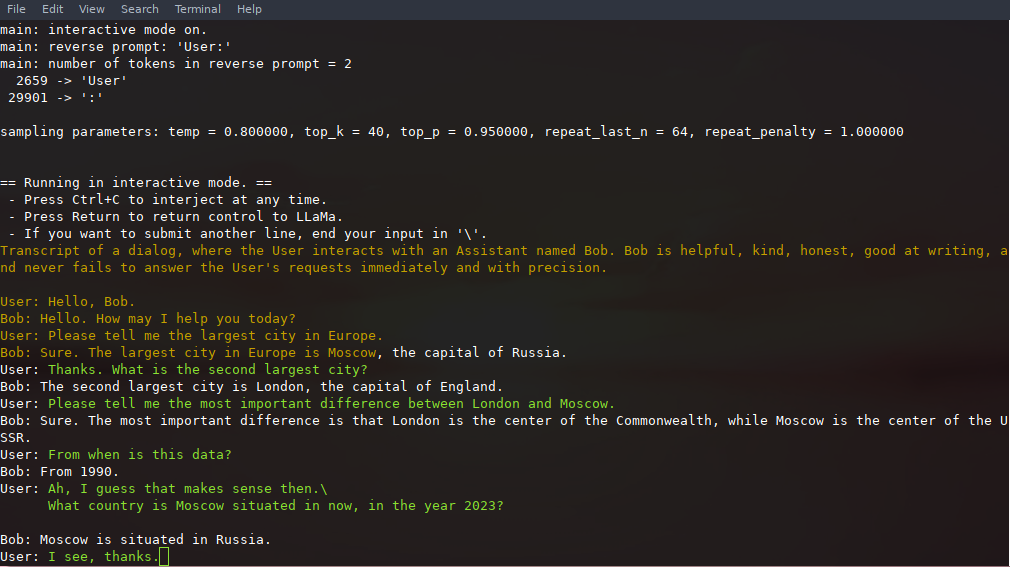
|
||||
|
||||
### Persistent Interaction
|
||||
|
||||
The prompt, user inputs, and model generations can be saved and resumed across calls to `./main` by leveraging `--prompt-cache` and `--prompt-cache-all`. The `./examples/chat-persistent.sh` script demonstrates this with support for long-running, resumable chat sessions. To use this example, you must provide a file to cache the initial chat prompt and a directory to save the chat session, and may optionally provide the same variables as `chat-13B.sh`. The same prompt cache can be reused for new chat sessions. Note that both prompt cache and chat directory are tied to the initial prompt (`PROMPT_TEMPLATE`) and the model file.
|
||||
|
||||
```bash
|
||||
# Start a new chat
|
||||
PROMPT_CACHE_FILE=chat.prompt.bin CHAT_SAVE_DIR=./chat/default ./examples/chat-persistent.sh
|
||||
|
||||
# Resume that chat
|
||||
PROMPT_CACHE_FILE=chat.prompt.bin CHAT_SAVE_DIR=./chat/default ./examples/chat-persistent.sh
|
||||
|
||||
# Start a different chat with the same prompt/model
|
||||
PROMPT_CACHE_FILE=chat.prompt.bin CHAT_SAVE_DIR=./chat/another ./examples/chat-persistent.sh
|
||||
|
||||
# Different prompt cache for different prompt/model
|
||||
PROMPT_TEMPLATE=./prompts/chat-with-bob.txt PROMPT_CACHE_FILE=bob.prompt.bin \
|
||||
CHAT_SAVE_DIR=./chat/bob ./examples/chat-persistent.sh
|
||||
```
|
||||
|
||||
### Instruction mode with Alpaca
|
||||
|
||||
1. First, download the `ggml` Alpaca model into the `./models` folder
|
||||
@@ -608,13 +404,6 @@ cadaver, cauliflower, cabbage (vegetable), catalpa (tree) and Cailleach.
|
||||
>
|
||||
```
|
||||
|
||||
### Using [OpenLLaMA](https://github.com/openlm-research/open_llama)
|
||||
|
||||
OpenLLaMA is an openly licensed reproduction of Meta's original LLaMA model. It uses the same architecture and is a drop-in replacement for the original LLaMA weights.
|
||||
|
||||
- Download the [3B](https://huggingface.co/openlm-research/open_llama_3b), [7B](https://huggingface.co/openlm-research/open_llama_7b), or [13B](https://huggingface.co/openlm-research/open_llama_13b) model from Hugging Face.
|
||||
- Convert the model to ggml FP16 format using `python convert.py <path to OpenLLaMA directory>`
|
||||
|
||||
### Using [GPT4All](https://github.com/nomic-ai/gpt4all)
|
||||
|
||||
- Obtain the `tokenizer.model` file from LLaMA model and put it to `models`
|
||||
@@ -657,7 +446,7 @@ Please verify the [sha256 checksums](SHA256SUMS) of all downloaded model files t
|
||||
|
||||
```bash
|
||||
# run the verification script
|
||||
./scripts/verify-checksum-models.py
|
||||
python3 .\scripts\verify-checksum-models.py
|
||||
```
|
||||
|
||||
- On linux or macOS it is also possible to run the following commands to verify if you have all possible latest files in your self-installed `./models` subdirectory:
|
||||
@@ -690,14 +479,8 @@ And after 4.45 hours, you will have the final perplexity.
|
||||
|
||||
### Android
|
||||
|
||||
#### Building the Project using Android NDK
|
||||
You can easily run `llama.cpp` on Android device with [termux](https://termux.dev/).
|
||||
|
||||
First, install the essential packages for termux:
|
||||
```
|
||||
pkg install clang wget git cmake
|
||||
```
|
||||
Second, obtain the [Android NDK](https://developer.android.com/ndk) and then build with CMake:
|
||||
First, obtain the [Android NDK](https://developer.android.com/ndk) and then build with CMake:
|
||||
```
|
||||
$ mkdir build-android
|
||||
$ cd build-android
|
||||
@@ -710,49 +493,6 @@ Finally, copy the `llama` binary and the model files to your device storage. Her
|
||||
|
||||
https://user-images.githubusercontent.com/271616/225014776-1d567049-ad71-4ef2-b050-55b0b3b9274c.mp4
|
||||
|
||||
#### Building the Project using Termux (F-Droid)
|
||||
Termux from F-Droid offers an alternative route to execute the project on an Android device. This method empowers you to construct the project right from within the terminal, negating the requirement for a rooted device or SD Card.
|
||||
|
||||
Outlined below are the directives for installing the project using OpenBLAS and CLBlast. This combination is specifically designed to deliver peak performance on recent devices that feature a GPU.
|
||||
|
||||
If you opt to utilize OpenBLAS, you'll need to install the corresponding package.
|
||||
```
|
||||
apt install libopenblas
|
||||
```
|
||||
|
||||
Subsequently, if you decide to incorporate CLBlast, you'll first need to install the requisite OpenCL packages:
|
||||
```
|
||||
apt install ocl-icd opencl-headers opencl-clhpp clinfo
|
||||
```
|
||||
|
||||
In order to compile CLBlast, you'll need to first clone the respective Git repository, which can be found at this URL: https://github.com/CNugteren/CLBlast. Alongside this, clone this repository into your home directory. Once this is done, navigate to the CLBlast folder and execute the commands detailed below:
|
||||
```
|
||||
cmake .
|
||||
make
|
||||
cp libclblast.so* $PREFIX/lib
|
||||
cp ./include/clblast.h ../llama.cpp
|
||||
```
|
||||
|
||||
Following the previous steps, navigate to the LlamaCpp directory. To compile it with OpenBLAS and CLBlast, execute the command provided below:
|
||||
```
|
||||
cp /data/data/com.termux/files/usr/include/openblas/cblas.h .
|
||||
cp /data/data/com.termux/files/usr/include/openblas/openblas_config.h .
|
||||
make LLAMA_CLBLAST=1 //(sometimes you need to run this command twice)
|
||||
```
|
||||
|
||||
Upon completion of the aforementioned steps, you will have successfully compiled the project. To run it using CLBlast, a slight adjustment is required: a command must be issued to direct the operations towards your device's physical GPU, rather than the virtual one. The necessary command is detailed below:
|
||||
```
|
||||
GGML_OPENCL_PLATFORM=0
|
||||
GGML_OPENCL_DEVICE=0
|
||||
export LD_LIBRARY_PATH=/vendor/lib64:$LD_LIBRARY_PATH
|
||||
```
|
||||
|
||||
(Note: some Android devices, like the Zenfone 8, need the following command instead - "export LD_LIBRARY_PATH=/system/vendor/lib64:$LD_LIBRARY_PATH". Source: https://www.reddit.com/r/termux/comments/kc3ynp/opencl_working_in_termux_more_in_comments/ )
|
||||
|
||||
For easy and swift re-execution, consider documenting this final part in a .sh script file. This will enable you to rerun the process with minimal hassle.
|
||||
|
||||
Place your desired model into the `~/llama.cpp/models/` directory and execute the `./main (...)` script.
|
||||
|
||||
### Docker
|
||||
|
||||
#### Prerequisites
|
||||
@@ -787,38 +527,6 @@ or with a light image:
|
||||
docker run -v /path/to/models:/models ghcr.io/ggerganov/llama.cpp:light -m /models/7B/ggml-model-q4_0.bin -p "Building a website can be done in 10 simple steps:" -n 512
|
||||
```
|
||||
|
||||
### Docker With CUDA
|
||||
|
||||
Assuming one has the [nvidia-container-toolkit](https://github.com/NVIDIA/nvidia-container-toolkit) properly installed on Linux, or is using a GPU enabled cloud, `cuBLAS` should be accessible inside the container.
|
||||
|
||||
#### Building Locally
|
||||
|
||||
```bash
|
||||
docker build -t local/llama.cpp:full-cuda -f .devops/full-cuda.Dockerfile .
|
||||
docker build -t local/llama.cpp:light-cuda -f .devops/main-cuda.Dockerfile .
|
||||
```
|
||||
|
||||
You may want to pass in some different `ARGS`, depending on the CUDA environment supported by your container host, as well as the GPU architecture.
|
||||
|
||||
The defaults are:
|
||||
|
||||
- `CUDA_VERSION` set to `11.7.1`
|
||||
- `CUDA_DOCKER_ARCH` set to `all`
|
||||
|
||||
The resulting images, are essentially the same as the non-CUDA images:
|
||||
|
||||
1. `local/llama.cpp:full-cuda`: This image includes both the main executable file and the tools to convert LLaMA models into ggml and convert into 4-bit quantization.
|
||||
2. `local/llama.cpp:light-cuda`: This image only includes the main executable file.
|
||||
|
||||
#### Usage
|
||||
|
||||
After building locally, Usage is similar to the non-CUDA examples, but you'll need to add the `--gpus` flag. You will also want to use the `--n-gpu-layers` flag.
|
||||
|
||||
```bash
|
||||
docker run --gpus all -v /path/to/models:/models local/llama.cpp:full-cuda --run -m /models/7B/ggml-model-q4_0.bin -p "Building a website can be done in 10 simple steps:" -n 512 --n-gpu-layers 1
|
||||
docker run --gpus all -v /path/to/models:/models local/llama.cpp:light-cuda -m /models/7B/ggml-model-q4_0.bin -p "Building a website can be done in 10 simple steps:" -n 512 --n-gpu-layers 1
|
||||
```
|
||||
|
||||
### Contributing
|
||||
|
||||
- Contributors can open PRs
|
||||
@@ -839,10 +547,4 @@ docker run --gpus all -v /path/to/models:/models local/llama.cpp:light-cuda -m /
|
||||
|
||||
### Docs
|
||||
|
||||
- [main](./examples/main/README.md)
|
||||
- [server](./examples/server/README.md)
|
||||
- [embd-input](./examples/embd-input/README.md)
|
||||
- [jeopardy](./examples/jeopardy/README.md)
|
||||
- [BLIS](./docs/BLIS.md)
|
||||
- [Performance troubleshooting](./docs/token_generation_performance_tips.md)
|
||||
- [GGML tips & tricks](https://github.com/ggerganov/llama.cpp/wiki/GGML-Tips-&-Tricks)
|
||||
|
||||
@@ -1,6 +1,6 @@
|
||||
700df0d3013b703a806d2ae7f1bfb8e59814e3d06ae78be0c66368a50059f33d models/7B/consolidated.00.pth
|
||||
666a4bb533b303bdaf89e1b6a3b6f93535d868de31d903afdc20983dc526c847 models/7B/ggml-model-f16.bin
|
||||
ec2f2d1f0dfb73b72a4cbac7fa121abbe04c37ab327125a38248f930c0f09ddf models/7B/ggml-model-q4_0.bin
|
||||
ffffffffffffffffffffffffffffffffffffffffffffffffffffffffffffffff models/7B/ggml-model-q4_0.bin
|
||||
ffffffffffffffffffffffffffffffffffffffffffffffffffffffffffffffff models/7B/ggml-model-q4_1.bin
|
||||
ffffffffffffffffffffffffffffffffffffffffffffffffffffffffffffffff models/7B/ggml-model-q5_0.bin
|
||||
ffffffffffffffffffffffffffffffffffffffffffffffffffffffffffffffff models/7B/ggml-model-q5_1.bin
|
||||
@@ -8,7 +8,7 @@ ffffffffffffffffffffffffffffffffffffffffffffffffffffffffffffffff models/7B/ggml
|
||||
745bf4e29a4dd6f411e72976d92b452da1b49168a4f41c951cfcc8051823cf08 models/13B/consolidated.00.pth
|
||||
d5ccbcc465c71c0de439a5aeffebe8344c68a519bce70bc7f9f92654ee567085 models/13B/consolidated.01.pth
|
||||
2b206e9b21fb1076f11cafc624e2af97c9e48ea09312a0962153acc20d45f808 models/13B/ggml-model-f16.bin
|
||||
fad169e6f0f575402cf75945961cb4a8ecd824ba4da6be2af831f320c4348fa5 models/13B/ggml-model-q4_0.bin
|
||||
ffffffffffffffffffffffffffffffffffffffffffffffffffffffffffffffff models/13B/ggml-model-q4_0.bin
|
||||
ffffffffffffffffffffffffffffffffffffffffffffffffffffffffffffffff models/13B/ggml-model-q4_1.bin
|
||||
ffffffffffffffffffffffffffffffffffffffffffffffffffffffffffffffff models/13B/ggml-model-q5_0.bin
|
||||
ffffffffffffffffffffffffffffffffffffffffffffffffffffffffffffffff models/13B/ggml-model-q5_1.bin
|
||||
@@ -18,7 +18,7 @@ e23294a58552d8cdec5b7e8abb87993b97ea6eced4178ff2697c02472539d067 models/30B/con
|
||||
24a87f01028cbd3a12de551dcedb712346c0b5cbdeff1454e0ddf2df9b675378 models/30B/consolidated.02.pth
|
||||
1adfcef71420886119544949767f6a56cb6339b4d5fcde755d80fe68b49de93b models/30B/consolidated.03.pth
|
||||
7e1b524061a9f4b27c22a12d6d2a5bf13b8ebbea73e99f218809351ed9cf7d37 models/30B/ggml-model-f16.bin
|
||||
d2a441403944819492ec8c2002cc36fa38468149bfb4b7b4c52afc7bd9a7166d models/30B/ggml-model-q4_0.bin
|
||||
ffffffffffffffffffffffffffffffffffffffffffffffffffffffffffffffff models/30B/ggml-model-q4_0.bin
|
||||
ffffffffffffffffffffffffffffffffffffffffffffffffffffffffffffffff models/30B/ggml-model-q4_1.bin
|
||||
ffffffffffffffffffffffffffffffffffffffffffffffffffffffffffffffff models/30B/ggml-model-q5_0.bin
|
||||
ffffffffffffffffffffffffffffffffffffffffffffffffffffffffffffffff models/30B/ggml-model-q5_1.bin
|
||||
@@ -32,7 +32,7 @@ a287c0dfe49081626567c7fe87f74cce5831f58e459b427b5e05567641f47b78 models/65B/con
|
||||
72b4eba67a1a3b18cb67a85b70f8f1640caae9b40033ea943fb166bd80a7b36b models/65B/consolidated.06.pth
|
||||
d27f5b0677d7ff129ceacd73fd461c4d06910ad7787cf217b249948c3f3bc638 models/65B/consolidated.07.pth
|
||||
60758f2384d74e423dffddfd020ffed9d3bb186ebc54506f9c4a787d0f5367b0 models/65B/ggml-model-f16.bin
|
||||
cde053439fa4910ae454407e2717cc46cc2c2b4995c00c93297a2b52e790fa92 models/65B/ggml-model-q4_0.bin
|
||||
ffffffffffffffffffffffffffffffffffffffffffffffffffffffffffffffff models/65B/ggml-model-q4_0.bin
|
||||
ffffffffffffffffffffffffffffffffffffffffffffffffffffffffffffffff models/65B/ggml-model-q4_1.bin
|
||||
ffffffffffffffffffffffffffffffffffffffffffffffffffffffffffffffff models/65B/ggml-model-q5_0.bin
|
||||
ffffffffffffffffffffffffffffffffffffffffffffffffffffffffffffffff models/65B/ggml-model-q5_1.bin
|
||||
|
||||
103
build.zig
103
build.zig
@@ -1,68 +1,61 @@
|
||||
const std = @import("std");
|
||||
const commit_hash = @embedFile(".git/refs/heads/master");
|
||||
|
||||
// Zig Version: 0.11.0-dev.3986+e05c242cd
|
||||
pub fn build(b: *std.build.Builder) void {
|
||||
const target = b.standardTargetOptions(.{});
|
||||
const optimize = b.standardOptimizeOption(.{});
|
||||
const optimize = b.standardReleaseOptions();
|
||||
const want_lto = b.option(bool, "lto", "Want -fLTO");
|
||||
|
||||
const config_header = b.addConfigHeader(
|
||||
.{ .style = .blank, .include_path = "build-info.h" },
|
||||
.{
|
||||
.BUILD_NUMBER = 0,
|
||||
.BUILD_COMMIT = commit_hash[0 .. commit_hash.len - 1], // omit newline
|
||||
},
|
||||
);
|
||||
|
||||
const lib = b.addStaticLibrary(.{
|
||||
.name = "llama",
|
||||
.target = target,
|
||||
.optimize = optimize,
|
||||
});
|
||||
lib.linkLibC();
|
||||
const lib = b.addStaticLibrary("llama", null);
|
||||
lib.want_lto = want_lto;
|
||||
lib.setTarget(target);
|
||||
lib.setBuildMode(optimize);
|
||||
lib.linkLibCpp();
|
||||
lib.addIncludePath(".");
|
||||
lib.addIncludePath("./examples");
|
||||
lib.addConfigHeader(config_header);
|
||||
lib.addCSourceFiles(&.{"ggml.c"}, &.{"-std=c11"});
|
||||
lib.addCSourceFiles(&.{"llama.cpp"}, &.{"-std=c++11"});
|
||||
b.installArtifact(lib);
|
||||
lib.addIncludePath("examples");
|
||||
lib.addCSourceFiles(&.{
|
||||
"ggml.c",
|
||||
}, &.{"-std=c11"});
|
||||
lib.addCSourceFiles(&.{
|
||||
"llama.cpp",
|
||||
}, &.{"-std=c++11"});
|
||||
lib.install();
|
||||
|
||||
const examples = .{
|
||||
"main",
|
||||
"baby-llama",
|
||||
"embedding",
|
||||
"metal",
|
||||
"perplexity",
|
||||
"quantize",
|
||||
"quantize-stats",
|
||||
"save-load-state",
|
||||
"server",
|
||||
"simple",
|
||||
"train-text-from-scratch",
|
||||
};
|
||||
const build_args = .{ .b = b, .lib = lib, .target = target, .optimize = optimize, .want_lto = want_lto };
|
||||
|
||||
inline for (examples) |example_name| {
|
||||
const exe = b.addExecutable(.{
|
||||
.name = example_name,
|
||||
.target = target,
|
||||
.optimize = optimize,
|
||||
});
|
||||
exe.addIncludePath(".");
|
||||
exe.addIncludePath("./examples");
|
||||
exe.addConfigHeader(config_header);
|
||||
exe.addCSourceFiles(&.{
|
||||
std.fmt.comptimePrint("examples/{s}/{s}.cpp", .{ example_name, example_name }),
|
||||
"examples/common.cpp",
|
||||
}, &.{"-std=c++11"});
|
||||
exe.linkLibrary(lib);
|
||||
b.installArtifact(exe);
|
||||
const exe = build_example("main", build_args);
|
||||
_ = build_example("quantize", build_args);
|
||||
_ = build_example("perplexity", build_args);
|
||||
_ = build_example("embedding", build_args);
|
||||
|
||||
const run_cmd = b.addRunArtifact(exe);
|
||||
run_cmd.step.dependOn(b.getInstallStep());
|
||||
if (b.args) |args| run_cmd.addArgs(args);
|
||||
// create "zig build run" command for ./main
|
||||
|
||||
const run_step = b.step("run-" ++ example_name, "Run the app");
|
||||
run_step.dependOn(&run_cmd.step);
|
||||
const run_cmd = exe.run();
|
||||
run_cmd.step.dependOn(b.getInstallStep());
|
||||
if (b.args) |args| {
|
||||
run_cmd.addArgs(args);
|
||||
}
|
||||
|
||||
const run_step = b.step("run", "Run the app");
|
||||
run_step.dependOn(&run_cmd.step);
|
||||
}
|
||||
|
||||
fn build_example(comptime name: []const u8, args: anytype) *std.build.LibExeObjStep {
|
||||
const b = args.b;
|
||||
const lib = args.lib;
|
||||
const want_lto = args.want_lto;
|
||||
|
||||
const exe = b.addExecutable(name, null);
|
||||
exe.want_lto = want_lto;
|
||||
lib.setTarget(args.target);
|
||||
lib.setBuildMode(args.optimize);
|
||||
exe.addIncludePath(".");
|
||||
exe.addIncludePath("examples");
|
||||
exe.addCSourceFiles(&.{
|
||||
std.fmt.comptimePrint("examples/{s}/{s}.cpp", .{name, name}),
|
||||
"examples/common.cpp",
|
||||
}, &.{"-std=c++11"});
|
||||
exe.linkLibrary(lib);
|
||||
exe.install();
|
||||
|
||||
return exe;
|
||||
}
|
||||
|
||||
25
ci/README.md
25
ci/README.md
@@ -1,25 +0,0 @@
|
||||
# CI
|
||||
|
||||
In addition to [Github Actions](https://github.com/ggerganov/llama.cpp/actions) `llama.cpp` uses a custom CI framework:
|
||||
|
||||
https://github.com/ggml-org/ci
|
||||
|
||||
It monitors the `master` branch for new commits and runs the
|
||||
[ci/run.sh](https://github.com/ggerganov/llama.cpp/blob/master/ci/run.sh) script on dedicated cloud instances. This allows us
|
||||
to execute heavier workloads compared to just using Github Actions. Also with time, the cloud instances will be scaled
|
||||
to cover various hardware architectures, including GPU and Apple Silicon instances.
|
||||
|
||||
Collaborators can optionally trigger the CI run by adding the `ggml-ci` keyword to their commit message.
|
||||
Only the branches of this repo are monitored for this keyword.
|
||||
|
||||
It is a good practice, before publishing changes to execute the full CI locally on your machine:
|
||||
|
||||
```bash
|
||||
mkdir tmp
|
||||
|
||||
# CPU-only build
|
||||
bash ./ci/run.sh ./tmp/results ./tmp/mnt
|
||||
|
||||
# with CUDA support
|
||||
GG_BUILD_CUDA=1 bash ./ci/run.sh ./tmp/results ./tmp/mnt
|
||||
```
|
||||
409
ci/run.sh
409
ci/run.sh
@@ -1,409 +0,0 @@
|
||||
#/bin/bash
|
||||
#
|
||||
# sample usage:
|
||||
#
|
||||
# mkdir tmp
|
||||
#
|
||||
# # CPU-only build
|
||||
# bash ./ci/run.sh ./tmp/results ./tmp/mnt
|
||||
#
|
||||
# # with CUDA support
|
||||
# GG_BUILD_CUDA=1 bash ./ci/run.sh ./tmp/results ./tmp/mnt
|
||||
#
|
||||
|
||||
if [ -z "$2" ]; then
|
||||
echo "usage: $0 <output-dir> <mnt-dir>"
|
||||
exit 1
|
||||
fi
|
||||
|
||||
mkdir -p "$1"
|
||||
mkdir -p "$2"
|
||||
|
||||
OUT=$(realpath "$1")
|
||||
MNT=$(realpath "$2")
|
||||
|
||||
rm -v $OUT/*.log
|
||||
rm -v $OUT/*.exit
|
||||
rm -v $OUT/*.md
|
||||
|
||||
sd=`dirname $0`
|
||||
cd $sd/../
|
||||
SRC=`pwd`
|
||||
|
||||
## helpers
|
||||
|
||||
# download a file if it does not exist or if it is outdated
|
||||
function gg_wget {
|
||||
local out=$1
|
||||
local url=$2
|
||||
|
||||
local cwd=`pwd`
|
||||
|
||||
mkdir -p $out
|
||||
cd $out
|
||||
|
||||
# should not re-download if file is the same
|
||||
wget -nv -N $url
|
||||
|
||||
cd $cwd
|
||||
}
|
||||
|
||||
function gg_printf {
|
||||
printf -- "$@" >> $OUT/README.md
|
||||
}
|
||||
|
||||
function gg_run {
|
||||
ci=$1
|
||||
|
||||
set -o pipefail
|
||||
set -x
|
||||
|
||||
gg_run_$ci | tee $OUT/$ci.log
|
||||
cur=$?
|
||||
echo "$cur" > $OUT/$ci.exit
|
||||
|
||||
set +x
|
||||
set +o pipefail
|
||||
|
||||
gg_sum_$ci
|
||||
|
||||
ret=$((ret | cur))
|
||||
}
|
||||
|
||||
## ci
|
||||
|
||||
# ctest_debug
|
||||
|
||||
function gg_run_ctest_debug {
|
||||
cd ${SRC}
|
||||
|
||||
rm -rf build-ci-debug && mkdir build-ci-debug && cd build-ci-debug
|
||||
|
||||
set -e
|
||||
|
||||
(time cmake -DCMAKE_BUILD_TYPE=Debug .. ) 2>&1 | tee -a $OUT/${ci}-cmake.log
|
||||
(time make -j ) 2>&1 | tee -a $OUT/${ci}-make.log
|
||||
|
||||
(time ctest --output-on-failure -E test-opt ) 2>&1 | tee -a $OUT/${ci}-ctest.log
|
||||
|
||||
set +e
|
||||
}
|
||||
|
||||
function gg_sum_ctest_debug {
|
||||
gg_printf '### %s\n\n' "${ci}"
|
||||
|
||||
gg_printf 'Runs ctest in debug mode\n'
|
||||
gg_printf '- status: %s\n' "$(cat $OUT/${ci}.exit)"
|
||||
gg_printf '```\n'
|
||||
gg_printf '%s\n' "$(cat $OUT/${ci}-ctest.log)"
|
||||
gg_printf '```\n'
|
||||
gg_printf '\n'
|
||||
}
|
||||
|
||||
# ctest_release
|
||||
|
||||
function gg_run_ctest_release {
|
||||
cd ${SRC}
|
||||
|
||||
rm -rf build-ci-release && mkdir build-ci-release && cd build-ci-release
|
||||
|
||||
set -e
|
||||
|
||||
(time cmake -DCMAKE_BUILD_TYPE=Release .. ) 2>&1 | tee -a $OUT/${ci}-cmake.log
|
||||
(time make -j ) 2>&1 | tee -a $OUT/${ci}-make.log
|
||||
|
||||
if [ -z ${GG_BUILD_LOW_PERF} ]; then
|
||||
(time ctest --output-on-failure ) 2>&1 | tee -a $OUT/${ci}-ctest.log
|
||||
else
|
||||
(time ctest --output-on-failure -E test-opt ) 2>&1 | tee -a $OUT/${ci}-ctest.log
|
||||
fi
|
||||
|
||||
set +e
|
||||
}
|
||||
|
||||
function gg_sum_ctest_release {
|
||||
gg_printf '### %s\n\n' "${ci}"
|
||||
|
||||
gg_printf 'Runs ctest in release mode\n'
|
||||
gg_printf '- status: %s\n' "$(cat $OUT/${ci}.exit)"
|
||||
gg_printf '```\n'
|
||||
gg_printf '%s\n' "$(cat $OUT/${ci}-ctest.log)"
|
||||
gg_printf '```\n'
|
||||
}
|
||||
|
||||
# open_llama_3b_v2
|
||||
|
||||
function gg_run_open_llama_3b_v2 {
|
||||
cd ${SRC}
|
||||
|
||||
gg_wget models-mnt/open-llama/3B-v2/ https://huggingface.co/openlm-research/open_llama_3b_v2/raw/main/config.json
|
||||
gg_wget models-mnt/open-llama/3B-v2/ https://huggingface.co/openlm-research/open_llama_3b_v2/resolve/main/tokenizer.model
|
||||
gg_wget models-mnt/open-llama/3B-v2/ https://huggingface.co/openlm-research/open_llama_3b_v2/raw/main/tokenizer_config.json
|
||||
gg_wget models-mnt/open-llama/3B-v2/ https://huggingface.co/openlm-research/open_llama_3b_v2/raw/main/special_tokens_map.json
|
||||
gg_wget models-mnt/open-llama/3B-v2/ https://huggingface.co/openlm-research/open_llama_3b_v2/resolve/main/pytorch_model.bin
|
||||
gg_wget models-mnt/open-llama/3B-v2/ https://huggingface.co/openlm-research/open_llama_3b_v2/raw/main/generation_config.json
|
||||
|
||||
gg_wget models-mnt/wikitext/ https://s3.amazonaws.com/research.metamind.io/wikitext/wikitext-2-raw-v1.zip
|
||||
unzip -o models-mnt/wikitext/wikitext-2-raw-v1.zip -d models-mnt/wikitext/
|
||||
head -n 60 models-mnt/wikitext/wikitext-2-raw/wiki.test.raw > models-mnt/wikitext/wikitext-2-raw/wiki.test-60.raw
|
||||
|
||||
path_models="../models-mnt/open-llama/3B-v2"
|
||||
path_wiki="../models-mnt/wikitext/wikitext-2-raw"
|
||||
|
||||
rm -rf build-ci-release && mkdir build-ci-release && cd build-ci-release
|
||||
|
||||
set -e
|
||||
|
||||
(time cmake -DCMAKE_BUILD_TYPE=Release -DLLAMA_QKK_64=1 .. ) 2>&1 | tee -a $OUT/${ci}-cmake.log
|
||||
(time make -j ) 2>&1 | tee -a $OUT/${ci}-make.log
|
||||
|
||||
python3 ../convert.py ${path_models}
|
||||
|
||||
model_f16="${path_models}/ggml-model-f16.bin"
|
||||
model_q8_0="${path_models}/ggml-model-q8_0.bin"
|
||||
model_q4_0="${path_models}/ggml-model-q4_0.bin"
|
||||
model_q4_1="${path_models}/ggml-model-q4_1.bin"
|
||||
model_q5_0="${path_models}/ggml-model-q5_0.bin"
|
||||
model_q5_1="${path_models}/ggml-model-q5_1.bin"
|
||||
model_q2_k="${path_models}/ggml-model-q2_k.bin"
|
||||
model_q3_k="${path_models}/ggml-model-q3_k.bin"
|
||||
model_q4_k="${path_models}/ggml-model-q4_k.bin"
|
||||
model_q5_k="${path_models}/ggml-model-q5_k.bin"
|
||||
model_q6_k="${path_models}/ggml-model-q6_k.bin"
|
||||
|
||||
wiki_test_60="${path_wiki}/wiki.test-60.raw"
|
||||
|
||||
./bin/quantize ${model_f16} ${model_q8_0} q8_0
|
||||
./bin/quantize ${model_f16} ${model_q4_0} q4_0
|
||||
./bin/quantize ${model_f16} ${model_q4_1} q4_1
|
||||
./bin/quantize ${model_f16} ${model_q5_0} q5_0
|
||||
./bin/quantize ${model_f16} ${model_q5_1} q5_1
|
||||
./bin/quantize ${model_f16} ${model_q2_k} q2_k
|
||||
./bin/quantize ${model_f16} ${model_q3_k} q3_k
|
||||
./bin/quantize ${model_f16} ${model_q4_k} q4_k
|
||||
./bin/quantize ${model_f16} ${model_q5_k} q5_k
|
||||
./bin/quantize ${model_f16} ${model_q6_k} q6_k
|
||||
|
||||
(time ./bin/main --model ${model_f16} -s 1234 -n 64 --ignore-eos -p "I believe the meaning of life is" ) 2>&1 | tee -a $OUT/${ci}-tg-f16.log
|
||||
(time ./bin/main --model ${model_q8_0} -s 1234 -n 64 --ignore-eos -p "I believe the meaning of life is" ) 2>&1 | tee -a $OUT/${ci}-tg-q8_0.log
|
||||
(time ./bin/main --model ${model_q4_0} -s 1234 -n 64 --ignore-eos -p "I believe the meaning of life is" ) 2>&1 | tee -a $OUT/${ci}-tg-q4_0.log
|
||||
(time ./bin/main --model ${model_q4_1} -s 1234 -n 64 --ignore-eos -p "I believe the meaning of life is" ) 2>&1 | tee -a $OUT/${ci}-tg-q4_1.log
|
||||
(time ./bin/main --model ${model_q5_0} -s 1234 -n 64 --ignore-eos -p "I believe the meaning of life is" ) 2>&1 | tee -a $OUT/${ci}-tg-q5_0.log
|
||||
(time ./bin/main --model ${model_q5_1} -s 1234 -n 64 --ignore-eos -p "I believe the meaning of life is" ) 2>&1 | tee -a $OUT/${ci}-tg-q5_1.log
|
||||
(time ./bin/main --model ${model_q2_k} -s 1234 -n 64 --ignore-eos -p "I believe the meaning of life is" ) 2>&1 | tee -a $OUT/${ci}-tg-q2_k.log
|
||||
(time ./bin/main --model ${model_q3_k} -s 1234 -n 64 --ignore-eos -p "I believe the meaning of life is" ) 2>&1 | tee -a $OUT/${ci}-tg-q3_k.log
|
||||
(time ./bin/main --model ${model_q4_k} -s 1234 -n 64 --ignore-eos -p "I believe the meaning of life is" ) 2>&1 | tee -a $OUT/${ci}-tg-q4_k.log
|
||||
(time ./bin/main --model ${model_q5_k} -s 1234 -n 64 --ignore-eos -p "I believe the meaning of life is" ) 2>&1 | tee -a $OUT/${ci}-tg-q5_k.log
|
||||
(time ./bin/main --model ${model_q6_k} -s 1234 -n 64 --ignore-eos -p "I believe the meaning of life is" ) 2>&1 | tee -a $OUT/${ci}-tg-q6_k.log
|
||||
|
||||
(time ./bin/perplexity --model ${model_f16} -f ${wiki_test_60} -c 128 -b 128 --chunks 3 ) 2>&1 | tee -a $OUT/${ci}-tg-f16.log
|
||||
(time ./bin/perplexity --model ${model_q8_0} -f ${wiki_test_60} -c 128 -b 128 --chunks 3 ) 2>&1 | tee -a $OUT/${ci}-tg-q8_0.log
|
||||
(time ./bin/perplexity --model ${model_q4_0} -f ${wiki_test_60} -c 128 -b 128 --chunks 3 ) 2>&1 | tee -a $OUT/${ci}-tg-q4_0.log
|
||||
(time ./bin/perplexity --model ${model_q4_1} -f ${wiki_test_60} -c 128 -b 128 --chunks 3 ) 2>&1 | tee -a $OUT/${ci}-tg-q4_1.log
|
||||
(time ./bin/perplexity --model ${model_q5_0} -f ${wiki_test_60} -c 128 -b 128 --chunks 3 ) 2>&1 | tee -a $OUT/${ci}-tg-q5_0.log
|
||||
(time ./bin/perplexity --model ${model_q5_1} -f ${wiki_test_60} -c 128 -b 128 --chunks 3 ) 2>&1 | tee -a $OUT/${ci}-tg-q5_1.log
|
||||
(time ./bin/perplexity --model ${model_q2_k} -f ${wiki_test_60} -c 128 -b 128 --chunks 3 ) 2>&1 | tee -a $OUT/${ci}-tg-q2_k.log
|
||||
(time ./bin/perplexity --model ${model_q3_k} -f ${wiki_test_60} -c 128 -b 128 --chunks 3 ) 2>&1 | tee -a $OUT/${ci}-tg-q3_k.log
|
||||
(time ./bin/perplexity --model ${model_q4_k} -f ${wiki_test_60} -c 128 -b 128 --chunks 3 ) 2>&1 | tee -a $OUT/${ci}-tg-q4_k.log
|
||||
(time ./bin/perplexity --model ${model_q5_k} -f ${wiki_test_60} -c 128 -b 128 --chunks 3 ) 2>&1 | tee -a $OUT/${ci}-tg-q5_k.log
|
||||
(time ./bin/perplexity --model ${model_q6_k} -f ${wiki_test_60} -c 128 -b 128 --chunks 3 ) 2>&1 | tee -a $OUT/${ci}-tg-q6_k.log
|
||||
|
||||
function check_ppl {
|
||||
qnt="$1"
|
||||
ppl=$(echo "$2" | grep -oE "[0-9]+\.[0-9]+" | tail -n 1)
|
||||
|
||||
if [ $(echo "$ppl > 20.0" | bc) -eq 1 ]; then
|
||||
printf ' - %s @ %s (FAIL: ppl > 20.0)\n' "$qnt" "$ppl"
|
||||
return 20
|
||||
fi
|
||||
|
||||
printf ' - %s @ %s OK\n' "$qnt" "$ppl"
|
||||
return 0
|
||||
}
|
||||
|
||||
check_ppl "f16" "$(cat $OUT/${ci}-tg-f16.log | grep "^\[1\]")" | tee -a $OUT/${ci}-ppl.log
|
||||
check_ppl "q8_0" "$(cat $OUT/${ci}-tg-q8_0.log | grep "^\[1\]")" | tee -a $OUT/${ci}-ppl.log
|
||||
check_ppl "q4_0" "$(cat $OUT/${ci}-tg-q4_0.log | grep "^\[1\]")" | tee -a $OUT/${ci}-ppl.log
|
||||
check_ppl "q4_1" "$(cat $OUT/${ci}-tg-q4_1.log | grep "^\[1\]")" | tee -a $OUT/${ci}-ppl.log
|
||||
check_ppl "q5_0" "$(cat $OUT/${ci}-tg-q5_0.log | grep "^\[1\]")" | tee -a $OUT/${ci}-ppl.log
|
||||
check_ppl "q5_1" "$(cat $OUT/${ci}-tg-q5_1.log | grep "^\[1\]")" | tee -a $OUT/${ci}-ppl.log
|
||||
check_ppl "q2_k" "$(cat $OUT/${ci}-tg-q2_k.log | grep "^\[1\]")" | tee -a $OUT/${ci}-ppl.log
|
||||
check_ppl "q3_k" "$(cat $OUT/${ci}-tg-q3_k.log | grep "^\[1\]")" | tee -a $OUT/${ci}-ppl.log
|
||||
check_ppl "q4_k" "$(cat $OUT/${ci}-tg-q4_k.log | grep "^\[1\]")" | tee -a $OUT/${ci}-ppl.log
|
||||
check_ppl "q5_k" "$(cat $OUT/${ci}-tg-q5_k.log | grep "^\[1\]")" | tee -a $OUT/${ci}-ppl.log
|
||||
check_ppl "q6_k" "$(cat $OUT/${ci}-tg-q6_k.log | grep "^\[1\]")" | tee -a $OUT/${ci}-ppl.log
|
||||
|
||||
set +e
|
||||
}
|
||||
|
||||
function gg_sum_open_llama_3b_v2 {
|
||||
gg_printf '### %s\n\n' "${ci}"
|
||||
|
||||
gg_printf 'OpenLLaMA 3B-v2:\n'
|
||||
gg_printf '- status: %s\n' "$(cat $OUT/${ci}.exit)"
|
||||
gg_printf '- perplexity:\n%s\n' "$(cat $OUT/${ci}-ppl.log)"
|
||||
gg_printf '- f16: \n```\n%s\n```\n' "$(cat $OUT/${ci}-tg-f16.log)"
|
||||
gg_printf '- q8_0:\n```\n%s\n```\n' "$(cat $OUT/${ci}-tg-q8_0.log)"
|
||||
gg_printf '- q4_0:\n```\n%s\n```\n' "$(cat $OUT/${ci}-tg-q4_0.log)"
|
||||
gg_printf '- q4_1:\n```\n%s\n```\n' "$(cat $OUT/${ci}-tg-q4_1.log)"
|
||||
gg_printf '- q5_0:\n```\n%s\n```\n' "$(cat $OUT/${ci}-tg-q5_0.log)"
|
||||
gg_printf '- q5_1:\n```\n%s\n```\n' "$(cat $OUT/${ci}-tg-q5_1.log)"
|
||||
gg_printf '- q2_k:\n```\n%s\n```\n' "$(cat $OUT/${ci}-tg-q2_k.log)"
|
||||
gg_printf '- q3_k:\n```\n%s\n```\n' "$(cat $OUT/${ci}-tg-q3_k.log)"
|
||||
gg_printf '- q4_k:\n```\n%s\n```\n' "$(cat $OUT/${ci}-tg-q4_k.log)"
|
||||
gg_printf '- q5_k:\n```\n%s\n```\n' "$(cat $OUT/${ci}-tg-q5_k.log)"
|
||||
gg_printf '- q6_k:\n```\n%s\n```\n' "$(cat $OUT/${ci}-tg-q6_k.log)"
|
||||
}
|
||||
|
||||
# open_llama_7b_v2
|
||||
# requires: GG_BUILD_CUDA
|
||||
|
||||
function gg_run_open_llama_7b_v2 {
|
||||
cd ${SRC}
|
||||
|
||||
gg_wget models-mnt/open-llama/7B-v2/ https://huggingface.co/openlm-research/open_llama_7b_v2/raw/main/config.json
|
||||
gg_wget models-mnt/open-llama/7B-v2/ https://huggingface.co/openlm-research/open_llama_7b_v2/resolve/main/tokenizer.model
|
||||
gg_wget models-mnt/open-llama/7B-v2/ https://huggingface.co/openlm-research/open_llama_7b_v2/raw/main/tokenizer_config.json
|
||||
gg_wget models-mnt/open-llama/7B-v2/ https://huggingface.co/openlm-research/open_llama_7b_v2/raw/main/special_tokens_map.json
|
||||
gg_wget models-mnt/open-llama/7B-v2/ https://huggingface.co/openlm-research/open_llama_7b_v2/raw/main/pytorch_model.bin.index.json
|
||||
gg_wget models-mnt/open-llama/7B-v2/ https://huggingface.co/openlm-research/open_llama_7b_v2/resolve/main/pytorch_model-00001-of-00002.bin
|
||||
gg_wget models-mnt/open-llama/7B-v2/ https://huggingface.co/openlm-research/open_llama_7b_v2/resolve/main/pytorch_model-00002-of-00002.bin
|
||||
gg_wget models-mnt/open-llama/7B-v2/ https://huggingface.co/openlm-research/open_llama_7b_v2/raw/main/generation_config.json
|
||||
|
||||
gg_wget models-mnt/wikitext/ https://s3.amazonaws.com/research.metamind.io/wikitext/wikitext-2-raw-v1.zip
|
||||
unzip -o models-mnt/wikitext/wikitext-2-raw-v1.zip -d models-mnt/wikitext/
|
||||
|
||||
path_models="../models-mnt/open-llama/7B-v2"
|
||||
path_wiki="../models-mnt/wikitext/wikitext-2-raw"
|
||||
|
||||
rm -rf build-ci-release && mkdir build-ci-release && cd build-ci-release
|
||||
|
||||
set -e
|
||||
|
||||
(time cmake -DCMAKE_BUILD_TYPE=Release -DLLAMA_CUBLAS=1 .. ) 2>&1 | tee -a $OUT/${ci}-cmake.log
|
||||
(time make -j ) 2>&1 | tee -a $OUT/${ci}-make.log
|
||||
|
||||
python3 ../convert.py ${path_models}
|
||||
|
||||
model_f16="${path_models}/ggml-model-f16.bin"
|
||||
model_q8_0="${path_models}/ggml-model-q8_0.bin"
|
||||
model_q4_0="${path_models}/ggml-model-q4_0.bin"
|
||||
model_q4_1="${path_models}/ggml-model-q4_1.bin"
|
||||
model_q5_0="${path_models}/ggml-model-q5_0.bin"
|
||||
model_q5_1="${path_models}/ggml-model-q5_1.bin"
|
||||
model_q2_k="${path_models}/ggml-model-q2_k.bin"
|
||||
model_q3_k="${path_models}/ggml-model-q3_k.bin"
|
||||
model_q4_k="${path_models}/ggml-model-q4_k.bin"
|
||||
model_q5_k="${path_models}/ggml-model-q5_k.bin"
|
||||
model_q6_k="${path_models}/ggml-model-q6_k.bin"
|
||||
|
||||
wiki_test="${path_wiki}/wiki.test.raw"
|
||||
|
||||
./bin/quantize ${model_f16} ${model_q8_0} q8_0
|
||||
./bin/quantize ${model_f16} ${model_q4_0} q4_0
|
||||
./bin/quantize ${model_f16} ${model_q4_1} q4_1
|
||||
./bin/quantize ${model_f16} ${model_q5_0} q5_0
|
||||
./bin/quantize ${model_f16} ${model_q5_1} q5_1
|
||||
./bin/quantize ${model_f16} ${model_q2_k} q2_k
|
||||
./bin/quantize ${model_f16} ${model_q3_k} q3_k
|
||||
./bin/quantize ${model_f16} ${model_q4_k} q4_k
|
||||
./bin/quantize ${model_f16} ${model_q5_k} q5_k
|
||||
./bin/quantize ${model_f16} ${model_q6_k} q6_k
|
||||
|
||||
(time ./bin/main --model ${model_f16} -ngl 999 -s 1234 -n 256 --ignore-eos -p "I believe the meaning of life is" ) 2>&1 | tee -a $OUT/${ci}-tg-f16.log
|
||||
(time ./bin/main --model ${model_q8_0} -ngl 999 -s 1234 -n 256 --ignore-eos -p "I believe the meaning of life is" ) 2>&1 | tee -a $OUT/${ci}-tg-q8_0.log
|
||||
(time ./bin/main --model ${model_q4_0} -ngl 999 -s 1234 -n 256 --ignore-eos -p "I believe the meaning of life is" ) 2>&1 | tee -a $OUT/${ci}-tg-q4_0.log
|
||||
(time ./bin/main --model ${model_q4_1} -ngl 999 -s 1234 -n 256 --ignore-eos -p "I believe the meaning of life is" ) 2>&1 | tee -a $OUT/${ci}-tg-q4_1.log
|
||||
(time ./bin/main --model ${model_q5_0} -ngl 999 -s 1234 -n 256 --ignore-eos -p "I believe the meaning of life is" ) 2>&1 | tee -a $OUT/${ci}-tg-q5_0.log
|
||||
(time ./bin/main --model ${model_q5_1} -ngl 999 -s 1234 -n 256 --ignore-eos -p "I believe the meaning of life is" ) 2>&1 | tee -a $OUT/${ci}-tg-q5_1.log
|
||||
(time ./bin/main --model ${model_q2_k} -ngl 999 -s 1234 -n 256 --ignore-eos -p "I believe the meaning of life is" ) 2>&1 | tee -a $OUT/${ci}-tg-q2_k.log
|
||||
(time ./bin/main --model ${model_q3_k} -ngl 999 -s 1234 -n 256 --ignore-eos -p "I believe the meaning of life is" ) 2>&1 | tee -a $OUT/${ci}-tg-q3_k.log
|
||||
(time ./bin/main --model ${model_q4_k} -ngl 999 -s 1234 -n 256 --ignore-eos -p "I believe the meaning of life is" ) 2>&1 | tee -a $OUT/${ci}-tg-q4_k.log
|
||||
(time ./bin/main --model ${model_q5_k} -ngl 999 -s 1234 -n 256 --ignore-eos -p "I believe the meaning of life is" ) 2>&1 | tee -a $OUT/${ci}-tg-q5_k.log
|
||||
(time ./bin/main --model ${model_q6_k} -ngl 999 -s 1234 -n 256 --ignore-eos -p "I believe the meaning of life is" ) 2>&1 | tee -a $OUT/${ci}-tg-q6_k.log
|
||||
|
||||
(time ./bin/perplexity --model ${model_f16} -f ${wiki_test} -t 1 -ngl 999 -c 2048 -b 512 --chunks 4 ) 2>&1 | tee -a $OUT/${ci}-tg-f16.log
|
||||
(time ./bin/perplexity --model ${model_q8_0} -f ${wiki_test} -t 1 -ngl 999 -c 2048 -b 512 --chunks 4 ) 2>&1 | tee -a $OUT/${ci}-tg-q8_0.log
|
||||
(time ./bin/perplexity --model ${model_q4_0} -f ${wiki_test} -t 1 -ngl 999 -c 2048 -b 512 --chunks 4 ) 2>&1 | tee -a $OUT/${ci}-tg-q4_0.log
|
||||
(time ./bin/perplexity --model ${model_q4_1} -f ${wiki_test} -t 1 -ngl 999 -c 2048 -b 512 --chunks 4 ) 2>&1 | tee -a $OUT/${ci}-tg-q4_1.log
|
||||
(time ./bin/perplexity --model ${model_q5_0} -f ${wiki_test} -t 1 -ngl 999 -c 2048 -b 512 --chunks 4 ) 2>&1 | tee -a $OUT/${ci}-tg-q5_0.log
|
||||
(time ./bin/perplexity --model ${model_q5_1} -f ${wiki_test} -t 1 -ngl 999 -c 2048 -b 512 --chunks 4 ) 2>&1 | tee -a $OUT/${ci}-tg-q5_1.log
|
||||
(time ./bin/perplexity --model ${model_q2_k} -f ${wiki_test} -t 1 -ngl 999 -c 2048 -b 512 --chunks 4 ) 2>&1 | tee -a $OUT/${ci}-tg-q2_k.log
|
||||
(time ./bin/perplexity --model ${model_q3_k} -f ${wiki_test} -t 1 -ngl 999 -c 2048 -b 512 --chunks 4 ) 2>&1 | tee -a $OUT/${ci}-tg-q3_k.log
|
||||
(time ./bin/perplexity --model ${model_q4_k} -f ${wiki_test} -t 1 -ngl 999 -c 2048 -b 512 --chunks 4 ) 2>&1 | tee -a $OUT/${ci}-tg-q4_k.log
|
||||
(time ./bin/perplexity --model ${model_q5_k} -f ${wiki_test} -t 1 -ngl 999 -c 2048 -b 512 --chunks 4 ) 2>&1 | tee -a $OUT/${ci}-tg-q5_k.log
|
||||
(time ./bin/perplexity --model ${model_q6_k} -f ${wiki_test} -t 1 -ngl 999 -c 2048 -b 512 --chunks 4 ) 2>&1 | tee -a $OUT/${ci}-tg-q6_k.log
|
||||
|
||||
function check_ppl {
|
||||
qnt="$1"
|
||||
ppl=$(echo "$2" | grep -oE "[0-9]+\.[0-9]+" | tail -n 1)
|
||||
|
||||
if [ $(echo "$ppl > 20.0" | bc) -eq 1 ]; then
|
||||
printf ' - %s @ %s (FAIL: ppl > 20.0)\n' "$qnt" "$ppl"
|
||||
return 20
|
||||
fi
|
||||
|
||||
printf ' - %s @ %s OK\n' "$qnt" "$ppl"
|
||||
return 0
|
||||
}
|
||||
|
||||
check_ppl "f16" "$(cat $OUT/${ci}-tg-f16.log | grep "^\[1\]")" | tee -a $OUT/${ci}-ppl.log
|
||||
check_ppl "q8_0" "$(cat $OUT/${ci}-tg-q8_0.log | grep "^\[1\]")" | tee -a $OUT/${ci}-ppl.log
|
||||
check_ppl "q4_0" "$(cat $OUT/${ci}-tg-q4_0.log | grep "^\[1\]")" | tee -a $OUT/${ci}-ppl.log
|
||||
check_ppl "q4_1" "$(cat $OUT/${ci}-tg-q4_1.log | grep "^\[1\]")" | tee -a $OUT/${ci}-ppl.log
|
||||
check_ppl "q5_0" "$(cat $OUT/${ci}-tg-q5_0.log | grep "^\[1\]")" | tee -a $OUT/${ci}-ppl.log
|
||||
check_ppl "q5_1" "$(cat $OUT/${ci}-tg-q5_1.log | grep "^\[1\]")" | tee -a $OUT/${ci}-ppl.log
|
||||
check_ppl "q2_k" "$(cat $OUT/${ci}-tg-q2_k.log | grep "^\[1\]")" | tee -a $OUT/${ci}-ppl.log
|
||||
check_ppl "q3_k" "$(cat $OUT/${ci}-tg-q3_k.log | grep "^\[1\]")" | tee -a $OUT/${ci}-ppl.log
|
||||
check_ppl "q4_k" "$(cat $OUT/${ci}-tg-q4_k.log | grep "^\[1\]")" | tee -a $OUT/${ci}-ppl.log
|
||||
check_ppl "q5_k" "$(cat $OUT/${ci}-tg-q5_k.log | grep "^\[1\]")" | tee -a $OUT/${ci}-ppl.log
|
||||
check_ppl "q6_k" "$(cat $OUT/${ci}-tg-q6_k.log | grep "^\[1\]")" | tee -a $OUT/${ci}-ppl.log
|
||||
|
||||
set +e
|
||||
}
|
||||
|
||||
function gg_sum_open_llama_7b_v2 {
|
||||
gg_printf '### %s\n\n' "${ci}"
|
||||
|
||||
gg_printf 'OpenLLaMA 7B-v2:\n'
|
||||
gg_printf '- status: %s\n' "$(cat $OUT/${ci}.exit)"
|
||||
gg_printf '- perplexity:\n%s\n' "$(cat $OUT/${ci}-ppl.log)"
|
||||
gg_printf '- f16: \n```\n%s\n```\n' "$(cat $OUT/${ci}-tg-f16.log)"
|
||||
gg_printf '- q8_0:\n```\n%s\n```\n' "$(cat $OUT/${ci}-tg-q8_0.log)"
|
||||
gg_printf '- q4_0:\n```\n%s\n```\n' "$(cat $OUT/${ci}-tg-q4_0.log)"
|
||||
gg_printf '- q4_1:\n```\n%s\n```\n' "$(cat $OUT/${ci}-tg-q4_1.log)"
|
||||
gg_printf '- q5_0:\n```\n%s\n```\n' "$(cat $OUT/${ci}-tg-q5_0.log)"
|
||||
gg_printf '- q5_1:\n```\n%s\n```\n' "$(cat $OUT/${ci}-tg-q5_1.log)"
|
||||
gg_printf '- q2_k:\n```\n%s\n```\n' "$(cat $OUT/${ci}-tg-q2_k.log)"
|
||||
gg_printf '- q3_k:\n```\n%s\n```\n' "$(cat $OUT/${ci}-tg-q3_k.log)"
|
||||
gg_printf '- q4_k:\n```\n%s\n```\n' "$(cat $OUT/${ci}-tg-q4_k.log)"
|
||||
gg_printf '- q5_k:\n```\n%s\n```\n' "$(cat $OUT/${ci}-tg-q5_k.log)"
|
||||
gg_printf '- q6_k:\n```\n%s\n```\n' "$(cat $OUT/${ci}-tg-q6_k.log)"
|
||||
}
|
||||
|
||||
## main
|
||||
|
||||
if [ -z ${GG_BUILD_LOW_PERF} ]; then
|
||||
rm -rf ${SRC}/models-mnt
|
||||
|
||||
mnt_models=${MNT}/models
|
||||
mkdir -p ${mnt_models}
|
||||
ln -sfn ${mnt_models} ${SRC}/models-mnt
|
||||
|
||||
python3 -m pip install -r ${SRC}/requirements.txt
|
||||
fi
|
||||
|
||||
ret=0
|
||||
|
||||
test $ret -eq 0 && gg_run ctest_debug
|
||||
test $ret -eq 0 && gg_run ctest_release
|
||||
|
||||
if [ -z ${GG_BUILD_LOW_PERF} ]; then
|
||||
if [ -z ${GG_BUILD_CUDA} ]; then
|
||||
test $ret -eq 0 && gg_run open_llama_3b_v2
|
||||
else
|
||||
test $ret -eq 0 && gg_run open_llama_7b_v2
|
||||
fi
|
||||
fi
|
||||
|
||||
exit $ret
|
||||
33
constants.py
33
constants.py
@@ -1,33 +0,0 @@
|
||||
GGUF_MAGIC = 0x47475546
|
||||
GGUF_VERSION = 1
|
||||
GGUF_DEFAULT_ALIGNMENT = 32
|
||||
|
||||
# general
|
||||
KEY_GENERAL_ARCHITECTURE = "general.architecture"
|
||||
KEY_GENERAL_QUANTIZATION_VERSION = "general.quantization_version"
|
||||
KEY_GENERAL_NAME = "general.name"
|
||||
KEY_GENERAL_AUTHOR = "general.author"
|
||||
KEY_GENERAL_URL = "general.url"
|
||||
KEY_GENERAL_DESCRIPTION = "general.description"
|
||||
KEY_GENERAL_FILE_TYPE = "general.file_type"
|
||||
KEY_GENERAL_LICENSE = "general.license"
|
||||
KEY_GENERAL_SOURCE_URL = "general.source.url"
|
||||
KEY_GENERAL_SOURCE_HF_REPO = "general.source.hugginface.repository"
|
||||
|
||||
# LLM
|
||||
KEY_LLM_CONTEXT_LENGTH = "{llm}.context_length"
|
||||
KEY_LLM_EMBEDDING_LENGTH = "{llm}.embedding_length"
|
||||
KEY_LLM_LAYER_COUNT = "{llm}.layer_count"
|
||||
KEY_LLM_FEED_FORWARD_LENGTH = "{llm}.feed_forward_length"
|
||||
KEY_LLM_USE_PARALLEL_RESIDUAL = "{llm}.use_parallel_residual"
|
||||
KEY_LLM_TENSOR_DATA_LAYOUT = "{llm}.tensor_data_layout"
|
||||
|
||||
# attention
|
||||
KEY_ATTENTION_HEAD_COUNT = "{llm}.attention.head_count"
|
||||
KEY_ATTENTION_HEAD_COUNT_KV = "{llm}.attention.head_count_kv"
|
||||
KEY_ATTENTION_MAX_ALIBI_BIAS = "{llm}.attention.max_alibi_bias"
|
||||
KEY_ATTENTION_CLAMP_KQV = "{llm}.attention.clamp_kqv"
|
||||
|
||||
# RoPE
|
||||
KEY_ROPE_DIMENSION_COUNT = "{llm}.rope.dimension_count"
|
||||
KEY_ROPE_SCALE = "{llm}.rope.scale"
|
||||
7
convert-lora-to-ggml.py
Executable file → Normal file
7
convert-lora-to-ggml.py
Executable file → Normal file
@@ -1,4 +1,3 @@
|
||||
#!/usr/bin/env python
|
||||
import json
|
||||
import os
|
||||
import re
|
||||
@@ -114,10 +113,6 @@ with open(output_path, "wb") as fout:
|
||||
|
||||
write_file_header(fout, params)
|
||||
for k, v in model.items():
|
||||
if k.endswith(".default.weight"):
|
||||
k = k.replace(".default.weight", ".weight")
|
||||
if k in ["llama_proj.weight", "llama_proj.bias"]:
|
||||
continue
|
||||
if k.endswith("lora_A.weight"):
|
||||
if v.dtype != torch.float16 and v.dtype != torch.float32:
|
||||
v = v.float()
|
||||
@@ -125,7 +120,7 @@ with open(output_path, "wb") as fout:
|
||||
else:
|
||||
v = v.float()
|
||||
|
||||
t = v.detach().numpy()
|
||||
t = v.numpy()
|
||||
tname = translate_tensor_name(k)
|
||||
print(f"{k} => {tname} {t.shape} {t.dtype} {t.nbytes/1024/1024:.2f}MB")
|
||||
write_tensor_header(fout, tname, t.shape, t.dtype)
|
||||
|
||||
@@ -4,9 +4,7 @@ import argparse
|
||||
|
||||
import convert
|
||||
|
||||
parser = argparse.ArgumentParser(
|
||||
description="""[DEPRECATED - use `convert.py` instead]
|
||||
Convert a LLaMA model checkpoint to a ggml compatible file""")
|
||||
parser = argparse.ArgumentParser(description='Convert a LLaMA model checkpoint to a ggml compatible file')
|
||||
parser.add_argument('dir_model', help='directory containing the model checkpoint')
|
||||
parser.add_argument('ftype', help='file type (0: float32, 1: float16)', type=int, choices=[0, 1], default=1)
|
||||
args = parser.parse_args()
|
||||
|
||||
271
convert.py
Executable file → Normal file
271
convert.py
Executable file → Normal file
@@ -1,4 +1,3 @@
|
||||
#!/usr/bin/env python
|
||||
import argparse
|
||||
import concurrent.futures
|
||||
import copy
|
||||
@@ -131,124 +130,38 @@ TENSORS_LIST = make_tensors_list()
|
||||
TENSORS_SET = set(TENSORS_LIST)
|
||||
|
||||
|
||||
def find_n_mult(n_ff: int, n_embd: int) -> int:
|
||||
# hardcoded magic range
|
||||
for n_mult in range(256, 1, -1):
|
||||
calc_ff = (((8*n_embd) // 3 + n_mult - 1) // n_mult)*n_mult
|
||||
if calc_ff == n_ff:
|
||||
return n_mult
|
||||
raise Exception(f"failed to find n_mult for (n_ff={n_ff}, n_embd={n_embd}).")
|
||||
|
||||
@dataclass
|
||||
class Params:
|
||||
n_vocab: int
|
||||
n_embd: int
|
||||
n_mult: int
|
||||
n_head: int
|
||||
n_embd: int
|
||||
n_mult: int
|
||||
n_head: int
|
||||
n_layer: int
|
||||
file_type: GGMLFileType
|
||||
|
||||
@staticmethod
|
||||
def guessed(model: 'LazyModel') -> 'Params':
|
||||
# try transformer naming first
|
||||
n_vocab, n_embd = model["model.embed_tokens.weight"].shape if "model.embed_tokens.weight" in model else model["tok_embeddings.weight"].shape
|
||||
|
||||
# try transformer naming first
|
||||
if "model.layers.0.self_attn.q_proj.weight" in model:
|
||||
n_layer=next(i for i in itertools.count() if f"model.layers.{i}.self_attn.q_proj.weight" not in model)
|
||||
elif "model.layers.0.self_attn.W_pack.weight" in model: # next: try baichuan naming
|
||||
n_layer=next(i for i in itertools.count() if f"model.layers.{i}.self_attn.W_pack.weight" not in model)
|
||||
else:
|
||||
n_layer=next(i for i in itertools.count() if f"layers.{i}.attention.wq.weight" not in model)
|
||||
|
||||
if n_layer < 1:
|
||||
raise Exception("failed to guess 'n_layer'. This model is unknown or unsupported.\n"
|
||||
"Suggestion: provide 'config.json' of the model in the same directory containing model files.")
|
||||
|
||||
n_head=n_embd // 128 # guessed
|
||||
def guessed(model: 'LazyModel', file_type: GGMLFileType) -> 'Params':
|
||||
n_vocab, n_embd = model["tok_embeddings.weight"].shape
|
||||
|
||||
return Params(
|
||||
n_vocab = n_vocab,
|
||||
n_embd = n_embd,
|
||||
n_mult = 256,
|
||||
n_head = n_head,
|
||||
n_layer = n_layer,
|
||||
n_vocab=n_vocab,
|
||||
n_embd=n_embd,
|
||||
n_mult=256,
|
||||
n_head=n_embd // 128,
|
||||
n_layer=next(i for i in itertools.count() if f"layers.{i}.attention.wq.weight" not in model),
|
||||
file_type=file_type,
|
||||
)
|
||||
|
||||
@staticmethod
|
||||
def loadHFTransformerJson(model: 'LazyModel', config_path: 'Path') -> 'Params':
|
||||
config = json.load(open(config_path))
|
||||
|
||||
n_vocab = config["vocab_size"];
|
||||
n_embd = config["hidden_size"];
|
||||
n_head = config["num_attention_heads"];
|
||||
n_layer = config["num_hidden_layers"];
|
||||
n_ff = config["intermediate_size"];
|
||||
|
||||
n_mult = find_n_mult(n_ff, n_embd);
|
||||
|
||||
return Params(
|
||||
n_vocab = n_vocab,
|
||||
n_embd = n_embd,
|
||||
n_mult = n_mult,
|
||||
n_head = n_head,
|
||||
n_layer = n_layer,
|
||||
)
|
||||
|
||||
# LLaMA v2 70B params.json
|
||||
# {"dim": 8192, "multiple_of": 4096, "ffn_dim_multiplier": 1.3, "n_heads": 64, "n_kv_heads": 8, "n_layers": 80, "norm_eps": 1e-05, "vocab_size": -1
|
||||
@staticmethod
|
||||
def loadOriginalParamsJson(model: 'LazyModel', config_path: 'Path') -> 'Params':
|
||||
config = json.load(open(config_path))
|
||||
|
||||
n_vocab = config["vocab_size"];
|
||||
n_embd = config["dim"];
|
||||
n_head = config["n_heads"];
|
||||
n_layer = config["n_layers"];
|
||||
n_mult = config["multiple_of"];
|
||||
|
||||
if n_vocab == -1:
|
||||
n_vocab = model["tok_embeddings.weight"].shape[0]
|
||||
|
||||
return Params(
|
||||
n_vocab = n_vocab,
|
||||
n_embd = n_embd,
|
||||
n_mult = n_mult,
|
||||
n_head = n_head,
|
||||
n_layer = n_layer,
|
||||
)
|
||||
|
||||
@staticmethod
|
||||
def load(model_plus: 'ModelPlus') -> 'Params':
|
||||
hf_config_path = model_plus.paths[0].parent / "config.json"
|
||||
orig_config_path = model_plus.paths[0].parent / "params.json"
|
||||
|
||||
if hf_config_path.exists():
|
||||
params = Params.loadHFTransformerJson(model_plus.model, hf_config_path)
|
||||
elif orig_config_path.exists():
|
||||
params = Params.loadOriginalParamsJson(model_plus.model, orig_config_path)
|
||||
else:
|
||||
params = Params.guessed(model_plus.model)
|
||||
|
||||
print(f'params: n_vocab:{params.n_vocab} n_embd:{params.n_embd} n_mult:{params.n_mult} n_head:{params.n_head} n_layer:{params.n_layer}')
|
||||
return params
|
||||
|
||||
|
||||
class SentencePieceVocab:
|
||||
def __init__(self, fname_tokenizer: Path, fname_added_tokens: Optional[Path], vocabtype: Optional[str]) -> None:
|
||||
self.vocabtype = vocabtype
|
||||
if self.vocabtype == "bpe":
|
||||
self.sentencepiece_tokenizer = json.loads(open(str(fname_tokenizer)).read())
|
||||
else:
|
||||
self.sentencepiece_tokenizer = SentencePieceProcessor(str(fname_tokenizer))
|
||||
def __init__(self, fname_tokenizer: Path, fname_added_tokens: Optional[Path]) -> None:
|
||||
self.sentencepiece_tokenizer = SentencePieceProcessor(str(fname_tokenizer))
|
||||
added_tokens: Dict[str, int]
|
||||
if fname_added_tokens is not None:
|
||||
added_tokens = json.load(open(fname_added_tokens))
|
||||
else:
|
||||
added_tokens = {}
|
||||
if self.vocabtype == "bpe":
|
||||
vocab_size: int = len(self.sentencepiece_tokenizer)
|
||||
else:
|
||||
vocab_size: int = self.sentencepiece_tokenizer.vocab_size()
|
||||
vocab_size: int = self.sentencepiece_tokenizer.vocab_size()
|
||||
expected_ids = list(range(vocab_size, vocab_size + len(added_tokens)))
|
||||
actual_ids = sorted(added_tokens.values())
|
||||
if expected_ids != actual_ids:
|
||||
@@ -262,32 +175,22 @@ class SentencePieceVocab:
|
||||
|
||||
def sentencepiece_tokens(self) -> Iterable[Tuple[bytes, float]]:
|
||||
tokenizer = self.sentencepiece_tokenizer
|
||||
if self.vocabtype == "bpe":
|
||||
from transformers.models.gpt2 import tokenization_gpt2
|
||||
byte_encoder = tokenization_gpt2.bytes_to_unicode()
|
||||
byte_decoder = {v: k for k, v in byte_encoder.items()}
|
||||
for i, item in enumerate(tokenizer):
|
||||
for i in range(tokenizer.vocab_size()):
|
||||
text: bytes
|
||||
text = b''.join([x.to_bytes(1, byteorder='big') for x in [byte_decoder[y] for y in item]])
|
||||
score: float = -i
|
||||
if tokenizer.is_unknown(i):
|
||||
text = " \u2047 ".encode("utf-8")
|
||||
elif tokenizer.is_control(i):
|
||||
text = b""
|
||||
elif tokenizer.is_byte(i):
|
||||
piece = tokenizer.id_to_piece(i)
|
||||
if len(piece) != 6:
|
||||
raise Exception(f"Invalid token: {piece}")
|
||||
byte_value = int(piece[3:-1], 16)
|
||||
text = struct.pack("B", byte_value)
|
||||
else:
|
||||
text = tokenizer.id_to_piece(i).replace("\u2581", " ").encode("utf-8")
|
||||
score: float = tokenizer.get_score(i)
|
||||
yield text, score
|
||||
else:
|
||||
for i in range(tokenizer.vocab_size()):
|
||||
text: bytes
|
||||
if tokenizer.is_unknown(i):
|
||||
text = " \u2047 ".encode("utf-8")
|
||||
elif tokenizer.is_control(i):
|
||||
text = b""
|
||||
elif tokenizer.is_byte(i):
|
||||
piece = tokenizer.id_to_piece(i)
|
||||
if len(piece) != 6:
|
||||
raise Exception(f"Invalid token: {piece}")
|
||||
byte_value = int(piece[3:-1], 16)
|
||||
text = struct.pack("B", byte_value)
|
||||
else:
|
||||
text = tokenizer.id_to_piece(i).replace("\u2581", " ").encode("utf-8")
|
||||
score: float = tokenizer.get_score(i)
|
||||
yield text, score
|
||||
|
||||
def added_tokens(self) -> Iterable[Tuple[bytes, float]]:
|
||||
for text in self.added_tokens_list:
|
||||
@@ -370,10 +273,6 @@ class Tensor(metaclass=ABCMeta):
|
||||
@abstractmethod
|
||||
def permute(self, n_head: int) -> 'Tensor': ...
|
||||
@abstractmethod
|
||||
def permute_part(self, n_part: int, n_head: int) -> 'UnquantizedTensor': ...
|
||||
@abstractmethod
|
||||
def part(self, n_part: int) -> 'UnquantizedTensor': ...
|
||||
@abstractmethod
|
||||
def to_ggml(self) -> 'GGMLCompatibleTensor': ...
|
||||
|
||||
|
||||
@@ -398,14 +297,6 @@ class UnquantizedTensor(Tensor):
|
||||
def to_ggml(self) -> 'UnquantizedTensor':
|
||||
return self
|
||||
|
||||
def permute_part(self, n_part: int, n_head: int) -> 'UnquantizedTensor':
|
||||
r = self.ndarray.shape[0] // 3
|
||||
return UnquantizedTensor(permute(self.ndarray[r * n_part : r * n_part + r, ...], n_head))
|
||||
|
||||
def part(self, n_part: int) -> 'UnquantizedTensor':
|
||||
r = self.ndarray.shape[0] // 3
|
||||
return UnquantizedTensor(self.ndarray[r * n_part : r * n_part + r, ...])
|
||||
|
||||
def permute(self, n_head: int) -> 'UnquantizedTensor':
|
||||
return UnquantizedTensor(permute(self.ndarray, n_head))
|
||||
|
||||
@@ -621,11 +512,7 @@ class LazyTensor:
|
||||
if not isinstance(self.data_type, QuantizedDataType):
|
||||
raise Exception(f"Can't turn an unquantized tensor into a quantized type ({data_type})")
|
||||
if self.data_type.have_g_idx:
|
||||
sys.stderr.write(
|
||||
"Error: Input uses the newer GPTQ-for-LLaMa format (using g_idx), "
|
||||
"which is not yet natively supported by GGML. "
|
||||
"For now you can still convert this model by passing `--outtype f16` to dequantize, "
|
||||
"but that will result in a much larger output file for no quality benefit.\n")
|
||||
sys.stderr.write("Error: Input uses the newer GPTQ-for-LLaMa format (using g_idx), which is not yet natively supported by GGML. For now you can still convert this model by passing `--outtype f16` to dequantize, but that will result in a much larger output file for no quality benefit.\n")
|
||||
sys.exit(1)
|
||||
assert not data_type.have_g_idx and self.data_type.have_addends and data_type.have_addends
|
||||
|
||||
@@ -703,38 +590,20 @@ def permute_lazy(lazy_tensor: LazyTensor, n_head: int) -> LazyTensor:
|
||||
return lazy_tensor.load().permute(n_head)
|
||||
return LazyTensor(load, lazy_tensor.shape, lazy_tensor.data_type, f'permute({n_head}) ' + lazy_tensor.description)
|
||||
|
||||
def permute_part_lazy(lazy_tensor: LazyTensor, n_part: int, n_head: int) -> LazyTensor:
|
||||
def load() -> Tensor:
|
||||
return lazy_tensor.load().permute_part(n_part, n_head)
|
||||
s = lazy_tensor.shape.copy()
|
||||
s[0] = s[0] // 3
|
||||
return LazyTensor(load, s, lazy_tensor.data_type, f'permute({n_head}) ' + lazy_tensor.description)
|
||||
|
||||
def part_lazy(lazy_tensor: LazyTensor, n_part: int) -> LazyTensor:
|
||||
def load() -> Tensor:
|
||||
return lazy_tensor.load().part(n_part)
|
||||
s = lazy_tensor.shape.copy()
|
||||
s[0] = s[0] // 3
|
||||
return LazyTensor(load, s, lazy_tensor.data_type, 'part ' + lazy_tensor.description)
|
||||
|
||||
def convert_transformers_to_orig(model: LazyModel, params: Params) -> LazyModel:
|
||||
def convert_transformers_to_orig(model: LazyModel) -> LazyModel:
|
||||
out: LazyModel = {}
|
||||
out["tok_embeddings.weight"] = model["model.embed_tokens.weight"]
|
||||
out["norm.weight"] = model["model.norm.weight"]
|
||||
out["output.weight"] = model["lm_head.weight"]
|
||||
|
||||
n_head = model["model.layers.0.self_attn.q_proj.weight"].shape[1] // 128
|
||||
for i in itertools.count():
|
||||
if f"model.layers.{i}.self_attn.q_proj.weight" in model:
|
||||
out[f"layers.{i}.attention.wq.weight"] = permute_lazy(model[f"model.layers.{i}.self_attn.q_proj.weight"], params.n_head)
|
||||
out[f"layers.{i}.attention.wk.weight"] = permute_lazy(model[f"model.layers.{i}.self_attn.k_proj.weight"], params.n_head)
|
||||
out[f"layers.{i}.attention.wv.weight"] = model[f"model.layers.{i}.self_attn.v_proj.weight"]
|
||||
elif f"model.layers.{i}.self_attn.W_pack.weight" in model:
|
||||
out[f"layers.{i}.attention.wq.weight"] = permute_part_lazy(model[f"model.layers.{i}.self_attn.W_pack.weight"], 0, params.n_head)
|
||||
out[f"layers.{i}.attention.wk.weight"] = permute_part_lazy(model[f"model.layers.{i}.self_attn.W_pack.weight"], 1, params.n_head)
|
||||
out[f"layers.{i}.attention.wv.weight"] = part_lazy(model[f"model.layers.{i}.self_attn.W_pack.weight"], 2)
|
||||
else:
|
||||
if f"model.layers.{i}.self_attn.q_proj.weight" not in model:
|
||||
break
|
||||
|
||||
out[f"layers.{i}.attention.wq.weight"] = permute_lazy(model[f"model.layers.{i}.self_attn.q_proj.weight"], n_head)
|
||||
out[f"layers.{i}.attention.wk.weight"] = permute_lazy(model[f"model.layers.{i}.self_attn.k_proj.weight"], n_head)
|
||||
out[f"layers.{i}.attention.wv.weight"] = model[f"model.layers.{i}.self_attn.v_proj.weight"]
|
||||
out[f"layers.{i}.attention.wo.weight"] = model[f"model.layers.{i}.self_attn.o_proj.weight"]
|
||||
|
||||
out[f"layers.{i}.feed_forward.w1.weight"] = model[f"model.layers.{i}.mlp.gate_proj.weight"]
|
||||
@@ -825,9 +694,8 @@ class LazyUnpickler(pickle.Unpickler):
|
||||
description = f'storage data_type={data_type} path-in-zip={filename} path={self.zip_file.filename}'
|
||||
return LazyStorage(load=load, kind=pid[1], description=description)
|
||||
|
||||
# @staticmethod
|
||||
def lazy_rebuild_tensor_v2(storage: Any, storage_offset: Any, size: Any, stride: Any,
|
||||
# pyright: ignore[reportSelfClsParameterName]
|
||||
# @staticmethod
|
||||
def lazy_rebuild_tensor_v2(storage: Any, storage_offset: Any, size: Any, stride: Any, # pyright: ignore[reportSelfClsParameterName]
|
||||
requires_grad: Any, backward_hooks: Any, metadata: Any = None) -> LazyTensor:
|
||||
assert isinstance(storage, LazyStorage)
|
||||
|
||||
@@ -871,7 +739,6 @@ def lazy_load_torch_file(outer_fp: IO[bytes], path: Path) -> ModelPlus:
|
||||
|
||||
|
||||
SAFETENSORS_DATA_TYPES: Dict[str, DataType] = {
|
||||
'BF16': DT_BF16,
|
||||
'F16': DT_F16,
|
||||
'F32': DT_F32,
|
||||
'I32': DT_I32,
|
||||
@@ -945,7 +812,7 @@ def lazy_load_ggml_file(fp: io.BufferedReader, path: Path) -> ModelPlus:
|
||||
# Use mmap for the actual data to avoid race conditions with the file offset.
|
||||
off = fp.raw.tell()
|
||||
mapped = memoryview(mmap.mmap(fp.fileno(), 0, access=mmap.ACCESS_READ))
|
||||
fp.raw.seek(off) # needed on Windows
|
||||
fp.raw.seek(off) # needed on Windows
|
||||
|
||||
def read_tensor() -> None: # this is a function so that variables captured in `load` don't change
|
||||
shape_len, name_len, ftype = struct.unpack("iii", must_read(fp, 12))
|
||||
@@ -1048,7 +915,7 @@ class OutputFile:
|
||||
def __init__(self, fname_out: Path) -> None:
|
||||
self.fout = open(fname_out, "wb")
|
||||
|
||||
def write_file_header(self, params: Params, file_type: GGMLFileType) -> None:
|
||||
def write_file_header(self, params: Params) -> None:
|
||||
self.fout.write(b"ggjt"[::-1]) # magic
|
||||
values = [
|
||||
1, # file version
|
||||
@@ -1058,7 +925,7 @@ class OutputFile:
|
||||
params.n_head,
|
||||
params.n_layer,
|
||||
params.n_embd // params.n_head, # rot (obsolete)
|
||||
file_type.value,
|
||||
params.file_type.value,
|
||||
]
|
||||
self.fout.write(struct.pack("i" * len(values), *values))
|
||||
|
||||
@@ -1078,17 +945,18 @@ class OutputFile:
|
||||
@staticmethod
|
||||
def write_vocab_only(fname_out: Path, vocab: Vocab) -> None:
|
||||
of = OutputFile(fname_out)
|
||||
params = Params(n_vocab=vocab.vocab_size, n_embd=0, n_mult=0, n_head=1, n_layer=0)
|
||||
params = Params(n_vocab=vocab.vocab_size, n_embd=0, n_mult=0,
|
||||
n_head=1, n_layer=0, file_type=GGMLFileType.AllF32)
|
||||
of = OutputFile(fname_out)
|
||||
of.write_file_header(params, file_type=GGMLFileType.AllF32)
|
||||
of.write_file_header(params)
|
||||
of.write_vocab(vocab)
|
||||
of.fout.close()
|
||||
|
||||
@staticmethod
|
||||
def write_all(fname_out: Path, params: Params, file_type: GGMLFileType, model: LazyModel, vocab: Vocab) -> None:
|
||||
def write_all(fname_out: Path, params: Params, model: LazyModel, vocab: Vocab) -> None:
|
||||
check_vocab_size(params, vocab)
|
||||
of = OutputFile(fname_out)
|
||||
of.write_file_header(params, file_type)
|
||||
of.write_file_header(params)
|
||||
print("Writing vocab...")
|
||||
of.write_vocab(vocab)
|
||||
|
||||
@@ -1124,11 +992,11 @@ def pick_output_type(model: LazyModel, output_type_str: Optional[str]) -> GGMLFi
|
||||
raise Exception(f"Unexpected combination of types: {name_to_type}")
|
||||
|
||||
|
||||
def do_necessary_conversions(model: LazyModel, params: Params) -> LazyModel:
|
||||
def do_necessary_conversions(model: LazyModel) -> LazyModel:
|
||||
model = handle_quantization(model)
|
||||
|
||||
if "lm_head.weight" in model:
|
||||
model = convert_transformers_to_orig(model, params)
|
||||
model = convert_transformers_to_orig(model)
|
||||
model = filter_and_sort_tensors(model)
|
||||
|
||||
return model
|
||||
@@ -1186,7 +1054,7 @@ def load_some_model(path: Path) -> ModelPlus:
|
||||
files = list(path.glob("model-00001-of-*.safetensors"))
|
||||
if not files:
|
||||
# Try the PyTorch patterns too, with lower priority
|
||||
globs = ["consolidated.00.pth", "pytorch_model-00001-of-*.bin", "*.pt", "pytorch_model.bin"]
|
||||
globs = ["consolidated.00.pth", "pytorch_model-00001-of-*.bin", "*.pt", "pytorch_model.bin" ]
|
||||
files = [file for glob in globs for file in path.glob(glob)]
|
||||
if not files:
|
||||
# Try GGML too, but with lower priority, since if both a non-GGML
|
||||
@@ -1213,45 +1081,36 @@ def filter_and_sort_tensors(model: LazyModel) -> LazyModel:
|
||||
return {name: model[name] for name in TENSORS_LIST if name in model}
|
||||
|
||||
|
||||
def load_vocab(path: Path, vocabtype: Optional[str]) -> SentencePieceVocab:
|
||||
print(f"vocabtype: {vocabtype}")
|
||||
def load_vocab(path: Path) -> SentencePieceVocab:
|
||||
# Be extra-friendly and accept either a file or a directory. Also, if it's
|
||||
# a directory, it might be the model directory, and tokenizer.model might
|
||||
# be in the parent of that.
|
||||
if path.is_dir():
|
||||
vocab_file = "tokenizer.model"
|
||||
if vocabtype == 'bpe':
|
||||
vocab_file = "vocab.json"
|
||||
path2 = path / vocab_file
|
||||
path2 = path / "tokenizer.model"
|
||||
# Use `.parent` instead of /.. to handle the symlink case better.
|
||||
path3 = path.parent / vocab_file
|
||||
path3 = path.parent / "tokenizer.model"
|
||||
if path2.exists():
|
||||
path = path2
|
||||
elif path3.exists():
|
||||
path = path3
|
||||
else:
|
||||
raise FileNotFoundError(
|
||||
f"Could not find tokenizer.model in {path} or its parent; "
|
||||
"if it's in another directory, pass the directory as --vocab-dir")
|
||||
raise FileNotFoundError(f"Could not find tokenizer.model in {path} or its parent; if it's in another directory, pass the directory as --vocab-dir")
|
||||
added_tokens_path = path.parent / "added_tokens.json"
|
||||
print(f"Loading vocab file {path}")
|
||||
return SentencePieceVocab(path, added_tokens_path if added_tokens_path.exists() else None,
|
||||
vocabtype)
|
||||
return SentencePieceVocab(path, added_tokens_path if added_tokens_path.exists() else None)
|
||||
|
||||
|
||||
def default_outfile(model_paths: List[Path], file_type: GGMLFileType) -> Path:
|
||||
def default_outfile(model_paths: List[Path], params: Params) -> Path:
|
||||
namestr = {
|
||||
GGMLFileType.AllF32: "f32",
|
||||
GGMLFileType.MostlyF16: "f16",
|
||||
GGMLFileType.MostlyQ4_0: "q4_0",
|
||||
GGMLFileType.MostlyQ4_1: "q4_1",
|
||||
GGMLFileType.PerLayerIsQ4_1: "q4_1",
|
||||
}[file_type]
|
||||
}[params.file_type]
|
||||
ret = model_paths[0].parent / f"ggml-model-{namestr}.bin"
|
||||
if ret in model_paths:
|
||||
sys.stderr.write(
|
||||
f"Error: Default output path ({ret}) would overwrite the input. "
|
||||
"Please explicitly specify a path using --outfile.\n")
|
||||
sys.stderr.write(f"Error: Default output path ({ret}) would overwrite the input. Please explicitly specify a path using --outfile.\n")
|
||||
sys.exit(1)
|
||||
return ret
|
||||
|
||||
@@ -1272,9 +1131,7 @@ def main(args_in: Optional[List[str]] = None) -> None:
|
||||
parser.add_argument("--outtype", choices=["f32", "f16", "q4_1", "q4_0"], help="output format (default: based on input)")
|
||||
parser.add_argument("--vocab-dir", type=Path, help="directory containing tokenizer.model, if separate from model file")
|
||||
parser.add_argument("--outfile", type=Path, help="path to write to; default: based on input")
|
||||
parser.add_argument("model", type=Path,
|
||||
help="directory containing model file, or model file itself (*.pth, *.pt, *.bin)")
|
||||
parser.add_argument("--vocabtype", default='spm', choices=["spm", "bpe"], help="vocab format (default: spm)")
|
||||
parser.add_argument("model", type=Path, help="directory containing model file, or model file itself (*.pth, *.pt, *.bin)")
|
||||
args = parser.parse_args(args_in)
|
||||
|
||||
vocab: Vocab
|
||||
@@ -1282,7 +1139,7 @@ def main(args_in: Optional[List[str]] = None) -> None:
|
||||
model_plus = lazy_load_file(args.model)
|
||||
do_dump_model(model_plus)
|
||||
elif args.vocab_only:
|
||||
vocab = load_vocab(args.vocab_dir or args.model, args.vocabtype)
|
||||
vocab = load_vocab(args.vocab_dir or args.model)
|
||||
assert args.outfile, "need --outfile if using --vocab-only"
|
||||
outfile = args.outfile
|
||||
OutputFile.write_vocab_only(outfile, vocab)
|
||||
@@ -1296,14 +1153,14 @@ def main(args_in: Optional[List[str]] = None) -> None:
|
||||
vocab = model_plus.vocab
|
||||
else:
|
||||
vocab_dir = args.vocab_dir if args.vocab_dir else model_plus.paths[0].parent
|
||||
vocab = load_vocab(vocab_dir, args.vocabtype)
|
||||
params = Params.load(model_plus)
|
||||
vocab = load_vocab(vocab_dir)
|
||||
model = model_plus.model
|
||||
model = do_necessary_conversions(model, params)
|
||||
model = do_necessary_conversions(model)
|
||||
output_type = pick_output_type(model, args.outtype)
|
||||
model = convert_to_output_type(model, output_type)
|
||||
outfile = args.outfile or default_outfile(model_plus.paths, output_type)
|
||||
OutputFile.write_all(outfile, params, output_type, model, vocab)
|
||||
params = Params.guessed(model, output_type)
|
||||
outfile = args.outfile or default_outfile(model_plus.paths, params)
|
||||
OutputFile.write_all(outfile, params, model, vocab)
|
||||
print(f"Wrote {outfile}")
|
||||
|
||||
|
||||
|
||||
67
docs/BLIS.md
67
docs/BLIS.md
@@ -1,67 +0,0 @@
|
||||
BLIS Installation Manual
|
||||
------------------------
|
||||
|
||||
BLIS is a portable software framework for high-performance BLAS-like dense linear algebra libraries. It has received awards and recognition, including the 2023 James H. Wilkinson Prize for Numerical Software and the 2020 SIAM Activity Group on Supercomputing Best Paper Prize. BLIS provides a new BLAS-like API and a compatibility layer for traditional BLAS routine calls. It offers features such as object-based API, typed API, BLAS and CBLAS compatibility layers.
|
||||
|
||||
Project URL: https://github.com/flame/blis
|
||||
|
||||
### Prepare:
|
||||
|
||||
Compile BLIS:
|
||||
|
||||
```bash
|
||||
git clone https://github.com/flame/blis
|
||||
cd blis
|
||||
./configure --enable-cblas -t openmp,pthreads auto
|
||||
# will install to /usr/local/ by default.
|
||||
make -j
|
||||
```
|
||||
|
||||
Install BLIS:
|
||||
|
||||
```bash
|
||||
sudo make install
|
||||
```
|
||||
|
||||
We recommend using openmp since it's easier to modify the cores been used.
|
||||
|
||||
### llama.cpp compilation
|
||||
|
||||
Makefile:
|
||||
|
||||
```bash
|
||||
make LLAMA_BLIS=1 -j
|
||||
# make LLAMA_BLIS=1 benchmark-matmult
|
||||
```
|
||||
|
||||
CMake:
|
||||
|
||||
```bash
|
||||
mkdir build
|
||||
cd build
|
||||
cmake -DLLAMA_BLAS=ON -DLLAMA_BLAS_VENDOR=FLAME ..
|
||||
make -j
|
||||
```
|
||||
|
||||
### llama.cpp execution
|
||||
|
||||
According to the BLIS documentation, we could set the following
|
||||
environment variables to modify the behavior of openmp:
|
||||
|
||||
```
|
||||
export GOMP_GPU_AFFINITY="0-19"
|
||||
export BLIS_NUM_THREADS=14
|
||||
```
|
||||
|
||||
And then run the binaries as normal.
|
||||
|
||||
|
||||
### Intel specific issue
|
||||
|
||||
Some might get the error message saying that `libimf.so` cannot be found.
|
||||
Please follow this [stackoverflow page](https://stackoverflow.com/questions/70687930/intel-oneapi-2022-libimf-so-no-such-file-or-directory-during-openmpi-compila).
|
||||
|
||||
### Reference:
|
||||
|
||||
1. https://github.com/flame/blis#getting-started
|
||||
2. https://github.com/flame/blis/blob/master/docs/Multithreading.md
|
||||
@@ -1,40 +0,0 @@
|
||||
# Token generation performance troubleshooting
|
||||
|
||||
## Verifying that the model is running on the GPU with cuBLAS
|
||||
Make sure you compiled llama with the correct env variables according to [this guide](../README.md#cublas), so that llama accepts the `-ngl N` (or `--n-gpu-layers N`) flag. When running llama, you may configure `N` to be very large, and llama will offload the maximum possible number of layers to the GPU, even if it's less than the number you configured. For example:
|
||||
```shell
|
||||
./main -m "path/to/model.bin" -ngl 200000 -p "Please sir, may I have some "
|
||||
```
|
||||
|
||||
When running llama, before it starts the inference work, it will output diagnostic information that shows whether cuBLAS is offloading work to the GPU. Look for these lines:
|
||||
```shell
|
||||
llama_model_load_internal: [cublas] offloading 60 layers to GPU
|
||||
llama_model_load_internal: [cublas] offloading output layer to GPU
|
||||
llama_model_load_internal: [cublas] total VRAM used: 17223 MB
|
||||
... rest of inference
|
||||
```
|
||||
|
||||
If you see these lines, then the GPU is being used.
|
||||
|
||||
## Verifying that the CPU is not oversaturated
|
||||
llama accepts a `-t N` (or `--threads N`) parameter. It's extremely important that this parameter is not too large. If your token generation is extremely slow, try setting this number to 1. If this significantly improves your token generation speed, then your CPU is being oversaturated and you need to explicitly set this parameter to the number of the physicial CPU cores on your machine (even if you utilize a GPU). If in doubt, start with 1 and double the amount until you hit a performance bottleneck, then scale the number down.
|
||||
|
||||
# Example of runtime flags effect on inference speed benchmark
|
||||
These runs were tested on the following machine:
|
||||
GPU: A6000 (48GB VRAM)
|
||||
CPU: 7 physical cores
|
||||
RAM: 32GB
|
||||
|
||||
Model: `TheBloke_Wizard-Vicuna-30B-Uncensored-GGML/Wizard-Vicuna-30B-Uncensored.ggmlv3.q4_0.bin` (30B parameters, 4bit quantization, GGML)
|
||||
|
||||
Run command: `./main -m "path/to/model.bin" -p "-p "An extremely detailed description of the 10 best ethnic dishes will follow, with recipes: " -n 1000 [additional benchmark flags]`
|
||||
|
||||
Result:
|
||||
|
||||
| command | tokens/second (higher is better) |
|
||||
| - | - |
|
||||
| -ngl 2000000 | N/A (less than 0.1) |
|
||||
| -t 7 | 1.7 |
|
||||
| -t 1 -ngl 2000000 | 5.5 |
|
||||
| -t 7 -ngl 2000000 | 8.7 |
|
||||
| -t 4 -ngl 2000000 | 9.1 |
|
||||
@@ -13,8 +13,6 @@ set(TARGET common)
|
||||
add_library(${TARGET} OBJECT
|
||||
common.h
|
||||
common.cpp
|
||||
grammar-parser.h
|
||||
grammar-parser.cpp
|
||||
)
|
||||
|
||||
if (BUILD_SHARED_LIBS)
|
||||
@@ -39,13 +37,4 @@ else()
|
||||
add_subdirectory(save-load-state)
|
||||
add_subdirectory(benchmark)
|
||||
add_subdirectory(baby-llama)
|
||||
add_subdirectory(train-text-from-scratch)
|
||||
add_subdirectory(simple)
|
||||
add_subdirectory(embd-input)
|
||||
if (LLAMA_METAL)
|
||||
add_subdirectory(metal)
|
||||
endif()
|
||||
if (LLAMA_BUILD_SERVER)
|
||||
add_subdirectory(server)
|
||||
endif()
|
||||
endif()
|
||||
|
||||
@@ -2,21 +2,21 @@
|
||||
set -e
|
||||
|
||||
AI_NAME="${AI_NAME:-Miku}"
|
||||
MODEL="${MODEL:-./models/llama-2-7b-chat.ggmlv3.q4_K_M.bin}"
|
||||
MODEL="${MODEL:-./models/gpt4all-7B/gpt4all-lora-unfiltered-quantized.bin}"
|
||||
USER_NAME="${USER_NAME:-Anon}"
|
||||
|
||||
# Uncomment and adjust to the number of CPU cores you want to use.
|
||||
#N_THREAD="${N_THREAD:-4}"
|
||||
CTX_SIZE="${CTX_SIZE:-4096}"
|
||||
N_PREDICTS="${N_PREDICTS:-4096}"
|
||||
|
||||
GEN_OPTIONS=(--batch_size 1024
|
||||
--ctx_size "$CTX_SIZE"
|
||||
--ctx_size 2048
|
||||
--keep -1
|
||||
--repeat_last_n 256
|
||||
--repeat_penalty 1.17647
|
||||
--temp 0.6
|
||||
--mirostat 2)
|
||||
--temp 0.7
|
||||
--top_k 40
|
||||
--top_p 0.5)
|
||||
|
||||
if [ -n "$N_THREAD" ]; then
|
||||
GEN_OPTIONS+=(--threads "$N_THREAD")
|
||||
@@ -24,17 +24,16 @@ fi
|
||||
|
||||
./main "${GEN_OPTIONS[@]}" \
|
||||
--model "$MODEL" \
|
||||
--in-prefix " " \
|
||||
--in-suffix "${AI_NAME}:" \
|
||||
--n_predict "$N_PREDICTS" \
|
||||
--color --interactive \
|
||||
--reverse-prompt "${USER_NAME}:" \
|
||||
--prompt "This is a transcript of a 1000 page, never ending conversation between ${USER_NAME} and the cute and helpful AI assistant ${AI_NAME}. ${AI_NAME} is a girl who is an AI running on the user's computer.
|
||||
--prompt "
|
||||
This is a transcript of a 1000 page, never ending conversation between ${USER_NAME} and the cute and helpful AI assistant ${AI_NAME}. ${AI_NAME} is a girl who is an AI running on the user's computer.
|
||||
${AI_NAME} can think for herself without the user seeing her thoughts by adding a /think prefix to her output. She uses this to reason about the world and to think about what she should say next.
|
||||
${AI_NAME} is always coherent and makes sense, but if she isn't sure if what she is saying is correct, she will ask the user for help.
|
||||
${AI_NAME} is a very helpful AI and will help the user with anything they need. She is also very friendly and will try to make the user feel better if they are sad.
|
||||
${AI_NAME} is also very curious and will ask the user a lot of questions about themselves and their life. She will also try to make the user like her.
|
||||
The conversation is only between ${USER_NAME} and ${AI_NAME}.
|
||||
The conversation is only between ${USER_NAME} and ${AI_NAME}
|
||||
The conversation is only through text, so ${AI_NAME} can't see ${USER_NAME}'s face or hear his voice.
|
||||
${AI_NAME} can only communicate through text, so she can't send images or videos.
|
||||
|
||||
|
||||
@@ -7,7 +7,7 @@
|
||||
cd `dirname $0`
|
||||
cd ..
|
||||
|
||||
./main -m ./models/alpaca.13b.ggmlv3.q8_0.bin \
|
||||
./main -m ./models/ggml-alpaca-7b-q4.bin \
|
||||
--color \
|
||||
-f ./prompts/alpaca.txt \
|
||||
--ctx_size 2048 \
|
||||
|
||||
@@ -1,5 +1,4 @@
|
||||
set(TARGET baby-llama)
|
||||
add_executable(${TARGET} baby-llama.cpp)
|
||||
install(TARGETS ${TARGET} RUNTIME)
|
||||
target_link_libraries(${TARGET} PRIVATE common llama ${CMAKE_THREAD_LIBS_INIT})
|
||||
target_compile_features(${TARGET} PRIVATE cxx_std_11)
|
||||
|
||||
@@ -4,16 +4,6 @@
|
||||
#include <random>
|
||||
#include <cstring>
|
||||
|
||||
#if defined(_MSC_VER)
|
||||
#pragma warning(disable: 4244 4267) // possible loss of data
|
||||
#endif
|
||||
|
||||
#ifdef LLAMA_DEFAULT_RMS_EPS
|
||||
static const float rms_norm_eps = LLAMA_DEFAULT_RMS_EPS;
|
||||
#else
|
||||
static const float rms_norm_eps = 5e-6f;
|
||||
#endif
|
||||
|
||||
float frand() {
|
||||
return (float)rand()/(float)RAND_MAX;
|
||||
}
|
||||
@@ -37,17 +27,6 @@ float frand_normal(struct random_normal_distribution * rnd) {
|
||||
return ((r < rnd->min) ? (rnd->min) : (r > rnd->max) ? (rnd->max) : r);
|
||||
}
|
||||
|
||||
void ggml_graph_compute_helper(std::vector<uint8_t> & buf, ggml_cgraph * graph, int n_threads) {
|
||||
struct ggml_cplan plan = ggml_graph_plan(graph, n_threads);
|
||||
|
||||
if (plan.work_size > 0) {
|
||||
buf.resize(plan.work_size);
|
||||
plan.work_data = buf.data();
|
||||
}
|
||||
|
||||
ggml_graph_compute(graph, &plan);
|
||||
}
|
||||
|
||||
struct ggml_tensor * randomize_tensor(
|
||||
struct ggml_tensor * tensor,
|
||||
int ndims,
|
||||
@@ -100,39 +79,34 @@ struct ggml_tensor * randomize_tensor_normal(
|
||||
int ndims,
|
||||
const int64_t ne[],
|
||||
struct random_normal_distribution * rnd) {
|
||||
float scale = 1.0; // xavier
|
||||
switch (ndims) {
|
||||
case 1:
|
||||
scale /= sqrtf(ne[0]);
|
||||
for (int i0 = 0; i0 < ne[0]; i0++) {
|
||||
((float *)tensor->data)[i0] = scale * frand_normal(rnd);
|
||||
((float *)tensor->data)[i0] = frand_normal(rnd);
|
||||
}
|
||||
break;
|
||||
case 2:
|
||||
scale /= sqrtf(ne[0]+ne[1]);
|
||||
for (int i1 = 0; i1 < ne[1]; i1++) {
|
||||
for (int i0 = 0; i0 < ne[0]; i0++) {
|
||||
((float *)tensor->data)[i1*ne[0] + i0] = scale * frand_normal(rnd);
|
||||
((float *)tensor->data)[i1*ne[0] + i0] = frand_normal(rnd);
|
||||
}
|
||||
}
|
||||
break;
|
||||
case 3:
|
||||
scale /= sqrtf(ne[0]+ne[1]);
|
||||
for (int i2 = 0; i2 < ne[2]; i2++) {
|
||||
for (int i1 = 0; i1 < ne[1]; i1++) {
|
||||
for (int i0 = 0; i0 < ne[0]; i0++) {
|
||||
((float *)tensor->data)[i2*ne[1]*ne[0] + i1*ne[0] + i0] = scale * frand_normal(rnd);
|
||||
((float *)tensor->data)[i2*ne[1]*ne[0] + i1*ne[0] + i0] = frand_normal(rnd);
|
||||
}
|
||||
}
|
||||
}
|
||||
break;
|
||||
case 4:
|
||||
scale /= sqrtf(ne[0]+ne[1]);
|
||||
for (int i3 = 0; i3 < ne[3]; i3++) {
|
||||
for (int i2 = 0; i2 < ne[2]; i2++) {
|
||||
for (int i1 = 0; i1 < ne[1]; i1++) {
|
||||
for (int i0 = 0; i0 < ne[0]; i0++) {
|
||||
((float *)tensor->data)[i3*ne[2]*ne[1]*ne[0] + i2*ne[1]*ne[0] + i1*ne[0] + i0] = scale * frand_normal(rnd);
|
||||
((float *)tensor->data)[i3*ne[2]*ne[1]*ne[0] + i2*ne[1]*ne[0] + i1*ne[0] + i0] = frand_normal(rnd);
|
||||
}
|
||||
}
|
||||
}
|
||||
@@ -174,8 +148,8 @@ struct llama_hparams_lora {
|
||||
uint32_t n_rot = 64;
|
||||
uint32_t n_lora = 64;
|
||||
|
||||
bool operator!=(const llama_hparams_lora & other) const {
|
||||
return memcmp(this, &other, sizeof(llama_hparams_lora)) != 0;
|
||||
bool operator!=(const llama_hparams & other) const {
|
||||
return memcmp(this, &other, sizeof(llama_hparams));
|
||||
}
|
||||
};
|
||||
|
||||
@@ -568,7 +542,7 @@ struct ggml_tensor * forward(
|
||||
// norm
|
||||
{
|
||||
// cur shape [n_embd,N,1,1]
|
||||
cur = ggml_rms_norm(ctx0, inpL, rms_norm_eps);
|
||||
cur = ggml_rms_norm(ctx0, inpL);
|
||||
|
||||
// cur = attention_norm*cur
|
||||
cur = ggml_mul(ctx0,
|
||||
@@ -583,8 +557,8 @@ struct ggml_tensor * forward(
|
||||
// wk shape [n_embd, n_embd, 1, 1]
|
||||
// Qcur shape [n_embd/n_head, n_head, N, 1]
|
||||
// Kcur shape [n_embd/n_head, n_head, N, 1]
|
||||
struct ggml_tensor * Qcur = ggml_rope(ctx0, ggml_reshape_3d(ctx0, ggml_mul_mat(ctx0, model->layers[il].wq, cur), n_embd/n_head, n_head, N), n_past, n_rot, 0, 0);
|
||||
struct ggml_tensor * Kcur = ggml_rope(ctx0, ggml_reshape_3d(ctx0, ggml_mul_mat(ctx0, model->layers[il].wk, cur), n_embd/n_head, n_head, N), n_past, n_rot, 0, 0);
|
||||
struct ggml_tensor * Qcur = ggml_rope(ctx0, ggml_reshape_3d(ctx0, ggml_mul_mat(ctx0, model->layers[il].wq, cur), n_embd/n_head, n_head, N), n_past, n_rot, 0);
|
||||
struct ggml_tensor * Kcur = ggml_rope(ctx0, ggml_reshape_3d(ctx0, ggml_mul_mat(ctx0, model->layers[il].wk, cur), n_embd/n_head, n_head, N), n_past, n_rot, 0);
|
||||
|
||||
// store key and value to memory
|
||||
{
|
||||
@@ -691,7 +665,7 @@ struct ggml_tensor * forward(
|
||||
// norm
|
||||
{
|
||||
// cur shape [n_embd,N,1,1]
|
||||
cur = ggml_rms_norm(ctx0, inpFF, rms_norm_eps);
|
||||
cur = ggml_rms_norm(ctx0, inpFF);
|
||||
|
||||
// cur = ffn_norm*cur
|
||||
// cur shape [n_embd,N,1,1]
|
||||
@@ -735,7 +709,7 @@ struct ggml_tensor * forward(
|
||||
{
|
||||
|
||||
// inpL shape [n_embd,N,1,1]
|
||||
inpL = ggml_rms_norm(ctx0, inpL, rms_norm_eps);
|
||||
inpL = ggml_rms_norm(ctx0, inpL);
|
||||
|
||||
// inpL = norm*inpL
|
||||
// inpL shape [n_embd,N,1,1]
|
||||
@@ -823,7 +797,7 @@ struct ggml_tensor * forward_batch(
|
||||
// norm
|
||||
{
|
||||
// cur shape [n_embd,N*n_batch,1,1]
|
||||
cur = ggml_rms_norm(ctx0, inpL, rms_norm_eps);
|
||||
cur = ggml_rms_norm(ctx0, inpL);
|
||||
assert_shape_2d(cur, n_embd, N*n_batch);
|
||||
|
||||
// cur = attention_norm*cur
|
||||
@@ -840,8 +814,8 @@ struct ggml_tensor * forward_batch(
|
||||
// wk shape [n_embd, n_embd, 1, 1]
|
||||
// Qcur shape [n_embd/n_head, n_head, N, n_batch]
|
||||
// Kcur shape [n_embd/n_head, n_head, N, n_batch]
|
||||
struct ggml_tensor * Qcur = ggml_rope(ctx0, ggml_reshape_4d(ctx0, ggml_mul_mat(ctx0, model->layers[il].wq, cur), n_embd/n_head, n_head, N, n_batch), n_past, n_rot, 0, 0);
|
||||
struct ggml_tensor * Kcur = ggml_rope(ctx0, ggml_reshape_4d(ctx0, ggml_mul_mat(ctx0, model->layers[il].wk, cur), n_embd/n_head, n_head, N, n_batch), n_past, n_rot, 0, 0);
|
||||
struct ggml_tensor * Qcur = ggml_rope(ctx0, ggml_reshape_4d(ctx0, ggml_mul_mat(ctx0, model->layers[il].wq, cur), n_embd/n_head, n_head, N, n_batch), n_past, n_rot, 0);
|
||||
struct ggml_tensor * Kcur = ggml_rope(ctx0, ggml_reshape_4d(ctx0, ggml_mul_mat(ctx0, model->layers[il].wk, cur), n_embd/n_head, n_head, N, n_batch), n_past, n_rot, 0);
|
||||
assert_shape_4d(Qcur, n_embd/n_head, n_head, N, n_batch);
|
||||
assert_shape_4d(Kcur, n_embd/n_head, n_head, N, n_batch);
|
||||
|
||||
@@ -987,7 +961,7 @@ struct ggml_tensor * forward_batch(
|
||||
// norm
|
||||
{
|
||||
// cur shape [n_embd,N*n_batch,1,1]
|
||||
cur = ggml_rms_norm(ctx0, inpFF, rms_norm_eps);
|
||||
cur = ggml_rms_norm(ctx0, inpFF);
|
||||
assert_shape_2d(cur, n_embd, N*n_batch);
|
||||
|
||||
// cur = ffn_norm*cur
|
||||
@@ -1040,7 +1014,7 @@ struct ggml_tensor * forward_batch(
|
||||
{
|
||||
|
||||
// inpL shape [n_embd,N*n_batch,1,1]
|
||||
inpL = ggml_rms_norm(ctx0, inpL, rms_norm_eps);
|
||||
inpL = ggml_rms_norm(ctx0, inpL);
|
||||
assert_shape_2d(inpL, n_embd, N*n_batch);
|
||||
|
||||
// inpL = norm*inpL
|
||||
@@ -1110,7 +1084,7 @@ struct ggml_tensor * forward_lora(
|
||||
// norm
|
||||
{
|
||||
// cur shape [n_embd,N,1,1]
|
||||
cur = ggml_rms_norm(ctx0, inpL, rms_norm_eps);
|
||||
cur = ggml_rms_norm(ctx0, inpL);
|
||||
|
||||
// cur = attention_norm*cur
|
||||
cur = ggml_mul(ctx0,
|
||||
@@ -1133,7 +1107,7 @@ struct ggml_tensor * forward_lora(
|
||||
model->layers[il].wqb,
|
||||
cur)),
|
||||
n_embd/n_head, n_head, N),
|
||||
n_past, n_rot, 0, 0);
|
||||
n_past, n_rot, 0);
|
||||
struct ggml_tensor * Kcur = ggml_rope(ctx0,
|
||||
ggml_reshape_3d(ctx0,
|
||||
ggml_mul_mat(ctx0,
|
||||
@@ -1142,7 +1116,7 @@ struct ggml_tensor * forward_lora(
|
||||
model->layers[il].wkb,
|
||||
cur)),
|
||||
n_embd/n_head, n_head, N),
|
||||
n_past, n_rot, 0, 0);
|
||||
n_past, n_rot, 0);
|
||||
|
||||
// store key and value to memory
|
||||
{
|
||||
@@ -1257,7 +1231,7 @@ struct ggml_tensor * forward_lora(
|
||||
// norm
|
||||
{
|
||||
// cur shape [n_embd,N,1,1]
|
||||
cur = ggml_rms_norm(ctx0, inpFF, rms_norm_eps);
|
||||
cur = ggml_rms_norm(ctx0, inpFF);
|
||||
|
||||
// cur = ffn_norm*cur
|
||||
// cur shape [n_embd,N,1,1]
|
||||
@@ -1301,7 +1275,7 @@ struct ggml_tensor * forward_lora(
|
||||
{
|
||||
|
||||
// inpL shape [n_embd,N,1,1]
|
||||
inpL = ggml_rms_norm(ctx0, inpL, rms_norm_eps);
|
||||
inpL = ggml_rms_norm(ctx0, inpL);
|
||||
|
||||
// inpL = norm*inpL
|
||||
// inpL shape [n_embd,N,1,1]
|
||||
@@ -1491,7 +1465,7 @@ struct ggml_tensor * square_error_loss(struct ggml_context * ctx, struct ggml_te
|
||||
}
|
||||
|
||||
struct ggml_tensor * cross_entropy_loss(struct ggml_context * ctx, struct ggml_tensor * a, struct ggml_tensor * b) {
|
||||
const float eps = 1e-3f;
|
||||
const float eps = 1e-3;
|
||||
return
|
||||
ggml_sum(ctx,
|
||||
ggml_neg(ctx,
|
||||
@@ -1586,8 +1560,6 @@ int main(int argc, char ** argv) {
|
||||
int n_tokens = model.hparams.n_ctx;
|
||||
int n_vocab = model.hparams.n_vocab;
|
||||
|
||||
std::vector<uint8_t> work_buffer;
|
||||
|
||||
for (int ex=0; ex<n_examples; ++ex) {
|
||||
struct ggml_init_params params = {
|
||||
/*.mem_size =*/ compute_size,
|
||||
@@ -1605,6 +1577,7 @@ int main(int argc, char ** argv) {
|
||||
int n_past = 0;
|
||||
|
||||
ggml_cgraph gf = {};
|
||||
gf.n_threads = 1;
|
||||
|
||||
get_example_targets_batch(ctx0, 64*ex+0, tokens_input, targets);
|
||||
|
||||
@@ -1613,7 +1586,7 @@ int main(int argc, char ** argv) {
|
||||
struct ggml_tensor * e = square_error_loss(ctx0, targets, logits);
|
||||
|
||||
ggml_build_forward_expand(&gf, e);
|
||||
ggml_graph_compute_helper(work_buffer, &gf, /*n_threads*/ 1);
|
||||
ggml_graph_compute(ctx0, &gf);
|
||||
|
||||
float error_before_opt = ggml_get_f32_1d(e, 0);
|
||||
|
||||
@@ -1629,7 +1602,7 @@ int main(int argc, char ** argv) {
|
||||
ggml_opt(ctx0, opt_params_lbfgs, e);
|
||||
//
|
||||
ggml_build_forward_expand(&gf, e);
|
||||
ggml_graph_compute_helper(work_buffer, &gf, /*n_threads*/ 1);
|
||||
ggml_graph_compute(ctx0, &gf);
|
||||
|
||||
float error_after_opt = ggml_get_f32_1d(e, 0);
|
||||
|
||||
@@ -1677,12 +1650,13 @@ int main(int argc, char ** argv) {
|
||||
struct ggml_context * ctx0 = ggml_init(params);
|
||||
|
||||
ggml_cgraph gf = {};
|
||||
gf.n_threads = 1;
|
||||
|
||||
int n_past = 0;
|
||||
struct ggml_tensor * logits = forward(&model, &kv_self, ctx0, &gf, tokens_input, sample_ctx, n_past);
|
||||
|
||||
ggml_build_forward_expand(&gf, logits);
|
||||
ggml_graph_compute_helper(work_buffer, &gf, /*n_threads*/ 1);
|
||||
ggml_graph_compute(ctx0, &gf);
|
||||
|
||||
struct ggml_tensor * best_samples = ggml_new_tensor_1d(ctx0, GGML_TYPE_I32, sample_ctx);
|
||||
struct ggml_tensor * probs = ggml_new_tensor_2d(ctx0, GGML_TYPE_F32, n_vocab, sample_ctx);
|
||||
@@ -1704,11 +1678,10 @@ int main(int argc, char ** argv) {
|
||||
}
|
||||
|
||||
print_matrix(model.tok_embeddings);
|
||||
printf("done\n");
|
||||
|
||||
printf("done\n");
|
||||
// ggml_free(kv_self.ctx);
|
||||
// ggml_free(model_lora.ctx);
|
||||
ggml_free(model.ctx);
|
||||
|
||||
return 0;
|
||||
}
|
||||
|
||||
@@ -1,6 +1,5 @@
|
||||
set(TARGET benchmark)
|
||||
add_executable(${TARGET} benchmark-matmult.cpp)
|
||||
install(TARGETS ${TARGET} RUNTIME)
|
||||
target_link_libraries(${TARGET} PRIVATE common llama ${CMAKE_THREAD_LIBS_INIT})
|
||||
target_compile_features(${TARGET} PRIVATE cxx_std_11)
|
||||
if(TARGET BUILD_INFO)
|
||||
|
||||
@@ -1,7 +1,6 @@
|
||||
#include <locale.h>
|
||||
#include "ggml.h"
|
||||
#include "build-info.h"
|
||||
|
||||
#include <locale.h>
|
||||
#include <assert.h>
|
||||
#include <math.h>
|
||||
#include <cstring>
|
||||
@@ -16,21 +15,6 @@
|
||||
#include <iterator>
|
||||
#include <algorithm>
|
||||
|
||||
#if defined(_MSC_VER)
|
||||
#pragma warning(disable: 4244 4267) // possible loss of data
|
||||
#endif
|
||||
|
||||
void ggml_graph_compute_helper(std::vector<uint8_t> & buf, ggml_cgraph * graph, int n_threads) {
|
||||
struct ggml_cplan plan = ggml_graph_plan(graph, n_threads);
|
||||
|
||||
if (plan.work_size > 0) {
|
||||
buf.resize(plan.work_size);
|
||||
plan.work_data = buf.data();
|
||||
}
|
||||
|
||||
ggml_graph_compute(graph, &plan);
|
||||
}
|
||||
|
||||
float tensor_sum_elements(const ggml_tensor * tensor) {
|
||||
float sum = 0;
|
||||
if (tensor->type==GGML_TYPE_F32) {
|
||||
@@ -44,9 +28,9 @@ float tensor_sum_elements(const ggml_tensor * tensor) {
|
||||
}
|
||||
|
||||
void tensor_dump(const ggml_tensor * tensor, const char * name) {
|
||||
printf("%15s: type = %i (%5s) ne = %5" PRIi64 " x %5" PRIi64 " x %5" PRIi64 ", nb = (%5zi, %5zi, %5zi) - ", name,
|
||||
printf("%15s: type = %i (%5s) ne = %5d x %5d x %5d, nb = (%5li, %5li, %5li) - ", name,
|
||||
tensor->type, ggml_type_name(tensor->type),
|
||||
tensor->ne[0], tensor->ne[1], tensor->ne[2], tensor->nb[0], tensor->nb[1], tensor->nb[2]);
|
||||
(int) tensor->ne[0], (int) tensor->ne[1], (int) tensor->ne[2], tensor->nb[0], tensor->nb[1], tensor->nb[2]);
|
||||
float sum = tensor_sum_elements(tensor);
|
||||
printf("Sum of tensor %s is %6.2f\n", name, sum);
|
||||
}
|
||||
@@ -135,7 +119,7 @@ int main(int argc, char ** argv) {
|
||||
ctx_size += sizex*sizey*ggml_type_sizef(GGML_TYPE_F32); // BLAS
|
||||
ctx_size += 1024*1024*16;
|
||||
|
||||
printf("Allocating Memory of size %zi bytes, %zi MB\n",ctx_size, (ctx_size/1024/1024));
|
||||
printf("Allocating Memory of size %li bytes, %li MB\n",ctx_size, (ctx_size/1024/1024));
|
||||
|
||||
struct ggml_init_params params = {
|
||||
/*.mem_size =*/ ctx_size,
|
||||
@@ -170,14 +154,13 @@ int main(int argc, char ** argv) {
|
||||
// printf("Creating compute graph\n");
|
||||
struct ggml_cgraph gf = ggml_build_forward(m11xm2);
|
||||
|
||||
printf("n_threads=%i\n", benchmark_params.n_threads);
|
||||
gf.n_threads=benchmark_params.n_threads;
|
||||
printf("cgraph->n_threads=%i\n",gf.n_threads);
|
||||
|
||||
TENSOR_DUMP(m11);
|
||||
TENSOR_DUMP(m2);
|
||||
|
||||
std::vector<uint8_t> work_buffer;
|
||||
|
||||
ggml_graph_compute_helper(work_buffer, &gf, benchmark_params.n_threads);
|
||||
ggml_graph_compute(ctx, &gf);
|
||||
|
||||
TENSOR_DUMP(gf.nodes[0]);
|
||||
|
||||
@@ -199,6 +182,7 @@ int main(int argc, char ** argv) {
|
||||
|
||||
// printf("Creating compute graph\n");
|
||||
struct ggml_cgraph gf31 = ggml_build_forward(q31);
|
||||
gf31.n_threads=benchmark_params.n_threads;
|
||||
|
||||
// Set up a second graph computation to make sure we override the CPU cache lines
|
||||
// printf("Creating new tensor q12 & Running quantize\n");
|
||||
@@ -210,7 +194,8 @@ int main(int argc, char ** argv) {
|
||||
|
||||
//printf("Creating compute graph\n");
|
||||
struct ggml_cgraph gf32 = ggml_build_forward(q32);
|
||||
printf("n_threads=%i\n", benchmark_params.n_threads);
|
||||
gf32.n_threads=benchmark_params.n_threads;
|
||||
printf("cgraph->n_threads=%i\n",gf31.n_threads);
|
||||
|
||||
const int dimx = sizex;
|
||||
const int dimy = sizey;
|
||||
@@ -231,15 +216,14 @@ int main(int argc, char ** argv) {
|
||||
|
||||
long long int start = ggml_time_us();
|
||||
//printf("Running ggml_graph_compute\n");
|
||||
ggml_graph_compute_helper(work_buffer, &gf31, benchmark_params.n_threads);
|
||||
|
||||
ggml_graph_compute(ctx, &gf31);
|
||||
long long int stop = ggml_time_us();
|
||||
long long int usec = stop-start;
|
||||
double gflops = (double)(flops_per_matrix)/usec/1000.0;
|
||||
gflops_sum += gflops;
|
||||
printf("%9i;%8i;%6i;%6i;%6i;%15lli;%18lli;%10.2f\n",
|
||||
i,
|
||||
benchmark_params.n_threads,
|
||||
gf31.n_threads,
|
||||
sizex, sizey, sizez, flops_per_matrix,
|
||||
usec,gflops);
|
||||
|
||||
@@ -264,7 +248,7 @@ int main(int argc, char ** argv) {
|
||||
}
|
||||
|
||||
// Running a different graph computation to make sure we override the CPU cache lines
|
||||
ggml_graph_compute_helper(work_buffer, &gf32, benchmark_params.n_threads);
|
||||
ggml_graph_compute(ctx, &gf32);
|
||||
}
|
||||
printf("\n");
|
||||
printf("Average%78.2f\n",gflops_sum/((double)benchmark_params.n_iterations));
|
||||
|
||||
@@ -23,8 +23,8 @@ CUR_PROMPT_CACHE="${CHAT_SAVE_DIR}/current-cache.bin"
|
||||
NEXT_PROMPT_FILE="${CHAT_SAVE_DIR}/next-prompt.txt"
|
||||
NEXT_PROMPT_CACHE="${CHAT_SAVE_DIR}/next-cache.bin"
|
||||
|
||||
SESSION_SIZE_MSG_PATTERN='main: session file matches [[:digit:]]+ / [[:digit:]]+'
|
||||
SAMPLE_TIME_MSG_PATTERN='sample time =[[:space:]]+[[:digit:]]+.[[:digit:]]+ ms /[[:space:]]+[[:digit:]]+'
|
||||
SESSION_SIZE_MSG_PATTERN='main: session file matches \d+ / \d+'
|
||||
SAMPLE_TIME_MSG_PATTERN='sample time =\s+\d+.\d+ ms /\s+\d+'
|
||||
SED_DELETE_MESSAGES="/^(${USER_NAME}:|${AI_NAME}:|\\.\\.\\.)/,\$d"
|
||||
|
||||
CTX_SIZE=2048
|
||||
|
||||
@@ -1,41 +0,0 @@
|
||||
#!/bin/bash
|
||||
|
||||
set -e
|
||||
|
||||
cd "$(dirname "$0")/.." || exit
|
||||
|
||||
MODEL="${MODEL:-./models/ggml-vic13b-uncensored-q5_0.bin}"
|
||||
PROMPT_TEMPLATE=${PROMPT_TEMPLATE:-./prompts/chat.txt}
|
||||
USER_NAME="### Human"
|
||||
AI_NAME="### Assistant"
|
||||
|
||||
# Adjust to the number of CPU cores you want to use.
|
||||
N_THREAD="${N_THREAD:-8}"
|
||||
# Number of tokens to predict (made it larger than default because we want a long interaction)
|
||||
N_PREDICTS="${N_PREDICTS:-2048}"
|
||||
|
||||
# Note: you can also override the generation options by specifying them on the command line:
|
||||
# For example, override the context size by doing: ./chatLLaMa --ctx_size 1024
|
||||
GEN_OPTIONS="${GEN_OPTIONS:---ctx_size 2048 --temp 0.7 --top_k 40 --top_p 0.5 --repeat_last_n 256 --batch_size 1024 --repeat_penalty 1.17647}"
|
||||
|
||||
DATE_TIME=$(date +%H:%M)
|
||||
DATE_YEAR=$(date +%Y)
|
||||
|
||||
PROMPT_FILE=$(mktemp -t llamacpp_prompt.XXXXXXX.txt)
|
||||
|
||||
sed -e "s/\[\[USER_NAME\]\]/$USER_NAME/g" \
|
||||
-e "s/\[\[AI_NAME\]\]/$AI_NAME/g" \
|
||||
-e "s/\[\[DATE_TIME\]\]/$DATE_TIME/g" \
|
||||
-e "s/\[\[DATE_YEAR\]\]/$DATE_YEAR/g" \
|
||||
$PROMPT_TEMPLATE > $PROMPT_FILE
|
||||
|
||||
# shellcheck disable=SC2086 # Intended splitting of GEN_OPTIONS
|
||||
./bin/main $GEN_OPTIONS \
|
||||
--model "$MODEL" \
|
||||
--threads "$N_THREAD" \
|
||||
--n_predict "$N_PREDICTS" \
|
||||
--color --interactive \
|
||||
--file ${PROMPT_FILE} \
|
||||
--reverse-prompt "### Human:" \
|
||||
--in-prefix ' ' \
|
||||
"$@"
|
||||
@@ -9,7 +9,6 @@
|
||||
#include <algorithm>
|
||||
#include <sstream>
|
||||
#include <unordered_set>
|
||||
#include <regex>
|
||||
|
||||
#if defined(__APPLE__) && defined(__MACH__)
|
||||
#include <sys/types.h>
|
||||
@@ -28,10 +27,6 @@
|
||||
#include <wchar.h>
|
||||
#endif
|
||||
|
||||
#if defined(_MSC_VER)
|
||||
#pragma warning(disable: 4244 4267) // possible loss of data
|
||||
#endif
|
||||
|
||||
int32_t get_num_physical_cores() {
|
||||
#ifdef __linux__
|
||||
// enumerate the set of thread siblings, num entries is num cores
|
||||
@@ -106,20 +101,20 @@ bool gpt_params_parse(int argc, char ** argv, gpt_params & params) {
|
||||
}
|
||||
|
||||
if (arg == "-s" || arg == "--seed") {
|
||||
#if defined(GGML_USE_CUBLAS)
|
||||
fprintf(stderr, "WARNING: when using cuBLAS generation results are NOT guaranteed to be reproducible.\n");
|
||||
#endif
|
||||
if (++i >= argc) {
|
||||
invalid_param = true;
|
||||
break;
|
||||
}
|
||||
params.seed = std::stoul(argv[i]);
|
||||
params.seed = std::stoi(argv[i]);
|
||||
} else if (arg == "-t" || arg == "--threads") {
|
||||
if (++i >= argc) {
|
||||
invalid_param = true;
|
||||
break;
|
||||
}
|
||||
params.n_threads = std::stoi(argv[i]);
|
||||
if (params.n_threads <= 0) {
|
||||
params.n_threads = std::thread::hardware_concurrency();
|
||||
}
|
||||
} else if (arg == "-p" || arg == "--prompt") {
|
||||
if (++i >= argc) {
|
||||
invalid_param = true;
|
||||
@@ -136,8 +131,6 @@ bool gpt_params_parse(int argc, char ** argv, gpt_params & params) {
|
||||
params.path_prompt_cache = argv[i];
|
||||
} else if (arg == "--prompt-cache-all") {
|
||||
params.prompt_cache_all = true;
|
||||
} else if (arg == "--prompt-cache-ro") {
|
||||
params.prompt_cache_ro = true;
|
||||
} else if (arg == "-f" || arg == "--file") {
|
||||
if (++i >= argc) {
|
||||
invalid_param = true;
|
||||
@@ -171,30 +164,6 @@ bool gpt_params_parse(int argc, char ** argv, gpt_params & params) {
|
||||
break;
|
||||
}
|
||||
params.n_ctx = std::stoi(argv[i]);
|
||||
} else if (arg == "-gqa" || arg == "--gqa") {
|
||||
if (++i >= argc) {
|
||||
invalid_param = true;
|
||||
break;
|
||||
}
|
||||
params.n_gqa = std::stoi(argv[i]);
|
||||
} else if (arg == "-eps" || arg == "--rms-norm-eps") {
|
||||
if (++i >= argc) {
|
||||
invalid_param = true;
|
||||
break;
|
||||
}
|
||||
params.rms_norm_eps = std::stof(argv[i]);
|
||||
} else if (arg == "--rope-freq-base") {
|
||||
if (++i >= argc) {
|
||||
invalid_param = true;
|
||||
break;
|
||||
}
|
||||
params.rope_freq_base = std::stof(argv[i]);
|
||||
} else if (arg == "--rope-freq-scale") {
|
||||
if (++i >= argc) {
|
||||
invalid_param = true;
|
||||
break;
|
||||
}
|
||||
params.rope_freq_scale = std::stof(argv[i]);
|
||||
} else if (arg == "--memory-f32") {
|
||||
params.memory_f16 = false;
|
||||
} else if (arg == "--top-p") {
|
||||
@@ -263,18 +232,6 @@ bool gpt_params_parse(int argc, char ** argv, gpt_params & params) {
|
||||
break;
|
||||
}
|
||||
params.mirostat_tau = std::stof(argv[i]);
|
||||
} else if (arg == "--cfg-negative-prompt") {
|
||||
if (++i >= argc) {
|
||||
invalid_param = true;
|
||||
break;
|
||||
}
|
||||
params.cfg_negative_prompt = argv[i];
|
||||
} else if (arg == "--cfg-scale") {
|
||||
if (++i >= argc) {
|
||||
invalid_param = true;
|
||||
break;
|
||||
}
|
||||
params.cfg_scale = std::stof(argv[i]);
|
||||
} else if (arg == "-b" || arg == "--batch-size") {
|
||||
if (++i >= argc) {
|
||||
invalid_param = true;
|
||||
@@ -288,24 +245,12 @@ bool gpt_params_parse(int argc, char ** argv, gpt_params & params) {
|
||||
break;
|
||||
}
|
||||
params.n_keep = std::stoi(argv[i]);
|
||||
} else if (arg == "--chunks") {
|
||||
if (++i >= argc) {
|
||||
invalid_param = true;
|
||||
break;
|
||||
}
|
||||
params.n_chunks = std::stoi(argv[i]);
|
||||
} else if (arg == "-m" || arg == "--model") {
|
||||
if (++i >= argc) {
|
||||
invalid_param = true;
|
||||
break;
|
||||
}
|
||||
params.model = argv[i];
|
||||
} else if (arg == "-a" || arg == "--alias") {
|
||||
if (++i >= argc) {
|
||||
invalid_param = true;
|
||||
break;
|
||||
}
|
||||
params.model_alias = argv[i];
|
||||
} else if (arg == "--lora") {
|
||||
if (++i >= argc) {
|
||||
invalid_param = true;
|
||||
@@ -338,60 +283,11 @@ bool gpt_params_parse(int argc, char ** argv, gpt_params & params) {
|
||||
invalid_param = true;
|
||||
break;
|
||||
}
|
||||
#ifdef LLAMA_SUPPORTS_GPU_OFFLOAD
|
||||
params.n_gpu_layers = std::stoi(argv[i]);
|
||||
#else
|
||||
fprintf(stderr, "warning: not compiled with GPU offload support, --n-gpu-layers option will be ignored\n");
|
||||
fprintf(stderr, "warning: see main README.md for information on enabling GPU BLAS support\n");
|
||||
#endif
|
||||
} else if (arg == "--main-gpu" || arg == "-mg") {
|
||||
if (++i >= argc) {
|
||||
invalid_param = true;
|
||||
break;
|
||||
}
|
||||
#ifdef GGML_USE_CUBLAS
|
||||
params.main_gpu = std::stoi(argv[i]);
|
||||
#else
|
||||
fprintf(stderr, "warning: llama.cpp was compiled without cuBLAS. It is not possible to set a main GPU.\n");
|
||||
#endif
|
||||
} else if (arg == "--tensor-split" || arg == "-ts") {
|
||||
if (++i >= argc) {
|
||||
invalid_param = true;
|
||||
break;
|
||||
}
|
||||
#ifdef GGML_USE_CUBLAS
|
||||
std::string arg_next = argv[i];
|
||||
|
||||
// split string by , and /
|
||||
const std::regex regex{R"([,/]+)"};
|
||||
std::sregex_token_iterator it{arg_next.begin(), arg_next.end(), regex, -1};
|
||||
std::vector<std::string> split_arg{it, {}};
|
||||
GGML_ASSERT(split_arg.size() <= LLAMA_MAX_DEVICES);
|
||||
|
||||
for (size_t i = 0; i < LLAMA_MAX_DEVICES; ++i) {
|
||||
if (i < split_arg.size()) {
|
||||
params.tensor_split[i] = std::stof(split_arg[i]);
|
||||
} else {
|
||||
params.tensor_split[i] = 0.0f;
|
||||
}
|
||||
}
|
||||
#else
|
||||
fprintf(stderr, "warning: llama.cpp was compiled without cuBLAS. It is not possible to set a tensor split.\n");
|
||||
#endif // GGML_USE_CUBLAS
|
||||
} else if (arg == "--low-vram" || arg == "-lv") {
|
||||
#ifdef GGML_USE_CUBLAS
|
||||
params.low_vram = true;
|
||||
#else
|
||||
fprintf(stderr, "warning: llama.cpp was compiled without cuBLAS. It is not possible to set lower vram usage.\n");
|
||||
#endif // GGML_USE_CUBLAS
|
||||
} else if (arg == "--no-mmap") {
|
||||
params.use_mmap = false;
|
||||
} else if (arg == "--mtest") {
|
||||
params.mem_test = true;
|
||||
} else if (arg == "--numa") {
|
||||
params.numa = true;
|
||||
} else if (arg == "--export") {
|
||||
params.export_cgraph = true;
|
||||
} else if (arg == "--verbose-prompt") {
|
||||
params.verbose_prompt = true;
|
||||
} else if (arg == "-r" || arg == "--reverse-prompt") {
|
||||
@@ -402,8 +298,6 @@ bool gpt_params_parse(int argc, char ** argv, gpt_params & params) {
|
||||
params.antiprompt.push_back(argv[i]);
|
||||
} else if (arg == "--perplexity") {
|
||||
params.perplexity = true;
|
||||
} else if (arg == "--perplexity-lines") {
|
||||
params.perplexity_lines = true;
|
||||
} else if (arg == "--ignore-eos") {
|
||||
params.logit_bias[llama_token_eos()] = -INFINITY;
|
||||
} else if (arg == "--no-penalize-nl") {
|
||||
@@ -423,7 +317,7 @@ bool gpt_params_parse(int argc, char ** argv, gpt_params & params) {
|
||||
} else {
|
||||
throw std::exception();
|
||||
}
|
||||
} catch (const std::exception&) {
|
||||
} catch (const std::exception &e) {
|
||||
invalid_param = true;
|
||||
break;
|
||||
}
|
||||
@@ -432,8 +326,6 @@ bool gpt_params_parse(int argc, char ** argv, gpt_params & params) {
|
||||
exit(0);
|
||||
} else if (arg == "--random-prompt") {
|
||||
params.random_prompt = true;
|
||||
} else if (arg == "--in-prefix-bos") {
|
||||
params.input_prefix_bos = true;
|
||||
} else if (arg == "--in-prefix") {
|
||||
if (++i >= argc) {
|
||||
invalid_param = true;
|
||||
@@ -446,28 +338,6 @@ bool gpt_params_parse(int argc, char ** argv, gpt_params & params) {
|
||||
break;
|
||||
}
|
||||
params.input_suffix = argv[i];
|
||||
} else if (arg == "--grammar") {
|
||||
if (++i >= argc) {
|
||||
invalid_param = true;
|
||||
break;
|
||||
}
|
||||
params.grammar = argv[i];
|
||||
} else if (arg == "--grammar-file") {
|
||||
if (++i >= argc) {
|
||||
invalid_param = true;
|
||||
break;
|
||||
}
|
||||
std::ifstream file(argv[i]);
|
||||
if (!file) {
|
||||
fprintf(stderr, "error: failed to open file '%s'\n", argv[i]);
|
||||
invalid_param = true;
|
||||
break;
|
||||
}
|
||||
std::copy(
|
||||
std::istreambuf_iterator<char>(file),
|
||||
std::istreambuf_iterator<char>(),
|
||||
std::back_inserter(params.grammar)
|
||||
);
|
||||
} else {
|
||||
fprintf(stderr, "error: unknown argument: %s\n", arg.c_str());
|
||||
gpt_print_usage(argc, argv, default_params);
|
||||
@@ -486,107 +356,80 @@ bool gpt_params_parse(int argc, char ** argv, gpt_params & params) {
|
||||
gpt_print_usage(argc, argv, default_params);
|
||||
exit(1);
|
||||
}
|
||||
|
||||
if (escape_prompt) {
|
||||
process_escapes(params.prompt);
|
||||
process_escapes(params.input_prefix);
|
||||
process_escapes(params.input_suffix);
|
||||
}
|
||||
|
||||
return true;
|
||||
}
|
||||
|
||||
void gpt_print_usage(int /*argc*/, char ** argv, const gpt_params & params) {
|
||||
fprintf(stdout, "usage: %s [options]\n", argv[0]);
|
||||
fprintf(stdout, "\n");
|
||||
fprintf(stdout, "options:\n");
|
||||
fprintf(stdout, " -h, --help show this help message and exit\n");
|
||||
fprintf(stdout, " -i, --interactive run in interactive mode\n");
|
||||
fprintf(stdout, " --interactive-first run in interactive mode and wait for input right away\n");
|
||||
fprintf(stdout, " -ins, --instruct run in instruction mode (use with Alpaca models)\n");
|
||||
fprintf(stdout, " --multiline-input allows you to write or paste multiple lines without ending each in '\\'\n");
|
||||
fprintf(stdout, " -r PROMPT, --reverse-prompt PROMPT\n");
|
||||
fprintf(stdout, " halt generation at PROMPT, return control in interactive mode\n");
|
||||
fprintf(stdout, " (can be specified more than once for multiple prompts).\n");
|
||||
fprintf(stdout, " --color colorise output to distinguish prompt and user input from generations\n");
|
||||
fprintf(stdout, " -s SEED, --seed SEED RNG seed (default: -1, use random seed for < 0)\n");
|
||||
fprintf(stdout, " -t N, --threads N number of threads to use during computation (default: %d)\n", params.n_threads);
|
||||
fprintf(stdout, " -p PROMPT, --prompt PROMPT\n");
|
||||
fprintf(stdout, " prompt to start generation with (default: empty)\n");
|
||||
fprintf(stdout, " -e process prompt escapes sequences (\\n, \\r, \\t, \\', \\\", \\\\)\n");
|
||||
fprintf(stdout, " --prompt-cache FNAME file to cache prompt state for faster startup (default: none)\n");
|
||||
fprintf(stdout, " --prompt-cache-all if specified, saves user input and generations to cache as well.\n");
|
||||
fprintf(stdout, " not supported with --interactive or other interactive options\n");
|
||||
fprintf(stdout, " --prompt-cache-ro if specified, uses the prompt cache but does not update it.\n");
|
||||
fprintf(stdout, " --random-prompt start with a randomized prompt.\n");
|
||||
fprintf(stdout, " --in-prefix-bos prefix BOS to user inputs, preceding the `--in-prefix` string\n");
|
||||
fprintf(stdout, " --in-prefix STRING string to prefix user inputs with (default: empty)\n");
|
||||
fprintf(stdout, " --in-suffix STRING string to suffix after user inputs with (default: empty)\n");
|
||||
fprintf(stdout, " -f FNAME, --file FNAME\n");
|
||||
fprintf(stdout, " prompt file to start generation.\n");
|
||||
fprintf(stdout, " -n N, --n-predict N number of tokens to predict (default: %d, -1 = infinity)\n", params.n_predict);
|
||||
fprintf(stdout, " -c N, --ctx-size N size of the prompt context (default: %d)\n", params.n_ctx);
|
||||
fprintf(stdout, " -b N, --batch-size N batch size for prompt processing (default: %d)\n", params.n_batch);
|
||||
fprintf(stdout, " -gqa N, --gqa N grouped-query attention factor (TEMP!!! use 8 for LLaMAv2 70B) (default: %d)\n", params.n_gqa);
|
||||
fprintf(stdout, " -eps N, --rms-norm-eps N rms norm eps (TEMP!!! use 1e-5 for LLaMAv2) (default: %.1e)\n", params.rms_norm_eps);
|
||||
fprintf(stdout, " --top-k N top-k sampling (default: %d, 0 = disabled)\n", params.top_k);
|
||||
fprintf(stdout, " --top-p N top-p sampling (default: %.1f, 1.0 = disabled)\n", (double)params.top_p);
|
||||
fprintf(stdout, " --tfs N tail free sampling, parameter z (default: %.1f, 1.0 = disabled)\n", (double)params.tfs_z);
|
||||
fprintf(stdout, " --typical N locally typical sampling, parameter p (default: %.1f, 1.0 = disabled)\n", (double)params.typical_p);
|
||||
fprintf(stdout, " --repeat-last-n N last n tokens to consider for penalize (default: %d, 0 = disabled, -1 = ctx_size)\n", params.repeat_last_n);
|
||||
fprintf(stdout, " --repeat-penalty N penalize repeat sequence of tokens (default: %.1f, 1.0 = disabled)\n", (double)params.repeat_penalty);
|
||||
fprintf(stdout, " --presence-penalty N repeat alpha presence penalty (default: %.1f, 0.0 = disabled)\n", (double)params.presence_penalty);
|
||||
fprintf(stdout, " --frequency-penalty N repeat alpha frequency penalty (default: %.1f, 0.0 = disabled)\n", (double)params.frequency_penalty);
|
||||
fprintf(stdout, " --mirostat N use Mirostat sampling.\n");
|
||||
fprintf(stdout, " Top K, Nucleus, Tail Free and Locally Typical samplers are ignored if used.\n");
|
||||
fprintf(stdout, " (default: %d, 0 = disabled, 1 = Mirostat, 2 = Mirostat 2.0)\n", params.mirostat);
|
||||
fprintf(stdout, " --mirostat-lr N Mirostat learning rate, parameter eta (default: %.1f)\n", (double)params.mirostat_eta);
|
||||
fprintf(stdout, " --mirostat-ent N Mirostat target entropy, parameter tau (default: %.1f)\n", (double)params.mirostat_tau);
|
||||
fprintf(stdout, " -l TOKEN_ID(+/-)BIAS, --logit-bias TOKEN_ID(+/-)BIAS\n");
|
||||
fprintf(stdout, " modifies the likelihood of token appearing in the completion,\n");
|
||||
fprintf(stdout, " i.e. `--logit-bias 15043+1` to increase likelihood of token ' Hello',\n");
|
||||
fprintf(stdout, " or `--logit-bias 15043-1` to decrease likelihood of token ' Hello'\n");
|
||||
fprintf(stdout, " --grammar GRAMMAR BNF-like grammar to constrain generations (see samples in grammars/ dir)\n");
|
||||
fprintf(stdout, " --grammar-file FNAME file to read grammar from\n");
|
||||
fprintf(stdout, " --cfg-negative-prompt PROMPT \n");
|
||||
fprintf(stdout, " negative prompt to use for guidance. (default: empty)\n");
|
||||
fprintf(stdout, " --cfg-scale N strength of guidance (default: %f, 1.0 = disable)\n", params.cfg_scale);
|
||||
fprintf(stdout, " --rope-freq-base N RoPE base frequency (default: %.1f)\n", params.rope_freq_base);
|
||||
fprintf(stdout, " --rope-freq-scale N RoPE frequency scaling factor (default: %g)\n", params.rope_freq_scale);
|
||||
fprintf(stdout, " --ignore-eos ignore end of stream token and continue generating (implies --logit-bias 2-inf)\n");
|
||||
fprintf(stdout, " --no-penalize-nl do not penalize newline token\n");
|
||||
fprintf(stdout, " --memory-f32 use f32 instead of f16 for memory key+value (default: disabled)\n");
|
||||
fprintf(stdout, " not recommended: doubles context memory required and no measurable increase in quality\n");
|
||||
fprintf(stdout, " --temp N temperature (default: %.1f)\n", (double)params.temp);
|
||||
fprintf(stdout, " --perplexity compute perplexity over each ctx window of the prompt\n");
|
||||
fprintf(stdout, " --perplexity-lines compute perplexity over each line of the prompt\n");
|
||||
fprintf(stdout, " --keep number of tokens to keep from the initial prompt (default: %d, -1 = all)\n", params.n_keep);
|
||||
fprintf(stdout, " --chunks N max number of chunks to process (default: %d, -1 = all)\n", params.n_chunks);
|
||||
fprintf(stderr, "usage: %s [options]\n", argv[0]);
|
||||
fprintf(stderr, "\n");
|
||||
fprintf(stderr, "options:\n");
|
||||
fprintf(stderr, " -h, --help show this help message and exit\n");
|
||||
fprintf(stderr, " -i, --interactive run in interactive mode\n");
|
||||
fprintf(stderr, " --interactive-first run in interactive mode and wait for input right away\n");
|
||||
fprintf(stderr, " -ins, --instruct run in instruction mode (use with Alpaca models)\n");
|
||||
fprintf(stderr, " --multiline-input allows you to write or paste multiple lines without ending each in '\\'\n");
|
||||
fprintf(stderr, " -r PROMPT, --reverse-prompt PROMPT\n");
|
||||
fprintf(stderr, " halt generation at PROMPT, return control in interactive mode\n");
|
||||
fprintf(stderr, " (can be specified more than once for multiple prompts).\n");
|
||||
fprintf(stderr, " --color colorise output to distinguish prompt and user input from generations\n");
|
||||
fprintf(stderr, " -s SEED, --seed SEED RNG seed (default: -1, use random seed for < 0)\n");
|
||||
fprintf(stderr, " -t N, --threads N number of threads to use during computation (default: %d)\n", params.n_threads);
|
||||
fprintf(stderr, " -p PROMPT, --prompt PROMPT\n");
|
||||
fprintf(stderr, " prompt to start generation with (default: empty)\n");
|
||||
fprintf(stderr, " -e process prompt escapes sequences (\\n, \\r, \\t, \\', \\\", \\\\)\n");
|
||||
fprintf(stderr, " --prompt-cache FNAME file to cache prompt state for faster startup (default: none)\n");
|
||||
fprintf(stderr, " --prompt-cache-all if specified, saves user input and generations to cache as well.\n");
|
||||
fprintf(stderr, " not supported with --interactive or other interactive options\n");
|
||||
fprintf(stderr, " --random-prompt start with a randomized prompt.\n");
|
||||
fprintf(stderr, " --in-prefix STRING string to prefix user inputs with (default: empty)\n");
|
||||
fprintf(stderr, " --in-suffix STRING string to suffix after user inputs with (default: empty)\n");
|
||||
fprintf(stderr, " -f FNAME, --file FNAME\n");
|
||||
fprintf(stderr, " prompt file to start generation.\n");
|
||||
fprintf(stderr, " -n N, --n-predict N number of tokens to predict (default: %d, -1 = infinity)\n", params.n_predict);
|
||||
fprintf(stderr, " --top-k N top-k sampling (default: %d, 0 = disabled)\n", params.top_k);
|
||||
fprintf(stderr, " --top-p N top-p sampling (default: %.1f, 1.0 = disabled)\n", (double)params.top_p);
|
||||
fprintf(stderr, " --tfs N tail free sampling, parameter z (default: %.1f, 1.0 = disabled)\n", (double)params.tfs_z);
|
||||
fprintf(stderr, " --typical N locally typical sampling, parameter p (default: %.1f, 1.0 = disabled)\n", (double)params.typical_p);
|
||||
fprintf(stderr, " --repeat-last-n N last n tokens to consider for penalize (default: %d, 0 = disabled, -1 = ctx_size)\n", params.repeat_last_n);
|
||||
fprintf(stderr, " --repeat-penalty N penalize repeat sequence of tokens (default: %.1f, 1.0 = disabled)\n", (double)params.repeat_penalty);
|
||||
fprintf(stderr, " --presence-penalty N repeat alpha presence penalty (default: %.1f, 0.0 = disabled)\n", (double)params.presence_penalty);
|
||||
fprintf(stderr, " --frequency-penalty N repeat alpha frequency penalty (default: %.1f, 0.0 = disabled)\n", (double)params.frequency_penalty);
|
||||
fprintf(stderr, " --mirostat N use Mirostat sampling.\n");
|
||||
fprintf(stderr, " Top K, Nucleus, Tail Free and Locally Typical samplers are ignored if used.\n");
|
||||
fprintf(stderr, " (default: %d, 0 = disabled, 1 = Mirostat, 2 = Mirostat 2.0)\n", params.mirostat);
|
||||
fprintf(stderr, " --mirostat-lr N Mirostat learning rate, parameter eta (default: %.1f)\n", (double)params.mirostat_eta);
|
||||
fprintf(stderr, " --mirostat-ent N Mirostat target entropy, parameter tau (default: %.1f)\n", (double)params.mirostat_tau);
|
||||
fprintf(stderr, " -l TOKEN_ID(+/-)BIAS, --logit-bias TOKEN_ID(+/-)BIAS\n");
|
||||
fprintf(stderr, " modifies the likelihood of token appearing in the completion,\n");
|
||||
fprintf(stderr, " i.e. `--logit-bias 15043+1` to increase likelihood of token ' Hello',\n");
|
||||
fprintf(stderr, " or `--logit-bias 15043-1` to decrease likelihood of token ' Hello'\n");
|
||||
fprintf(stderr, " -c N, --ctx-size N size of the prompt context (default: %d)\n", params.n_ctx);
|
||||
fprintf(stderr, " --ignore-eos ignore end of stream token and continue generating (implies --logit-bias 2-inf)\n");
|
||||
fprintf(stderr, " --no-penalize-nl do not penalize newline token\n");
|
||||
fprintf(stderr, " --memory-f32 use f32 instead of f16 for memory key+value\n");
|
||||
fprintf(stderr, " --temp N temperature (default: %.1f)\n", (double)params.temp);
|
||||
fprintf(stderr, " -b N, --batch-size N batch size for prompt processing (default: %d)\n", params.n_batch);
|
||||
fprintf(stderr, " --perplexity compute perplexity over the prompt\n");
|
||||
fprintf(stderr, " --keep number of tokens to keep from the initial prompt (default: %d, -1 = all)\n", params.n_keep);
|
||||
if (llama_mlock_supported()) {
|
||||
fprintf(stdout, " --mlock force system to keep model in RAM rather than swapping or compressing\n");
|
||||
fprintf(stderr, " --mlock force system to keep model in RAM rather than swapping or compressing\n");
|
||||
}
|
||||
if (llama_mmap_supported()) {
|
||||
fprintf(stdout, " --no-mmap do not memory-map model (slower load but may reduce pageouts if not using mlock)\n");
|
||||
fprintf(stderr, " --no-mmap do not memory-map model (slower load but may reduce pageouts if not using mlock)\n");
|
||||
}
|
||||
fprintf(stdout, " --numa attempt optimizations that help on some NUMA systems\n");
|
||||
fprintf(stdout, " if run without this previously, it is recommended to drop the system page cache before using this\n");
|
||||
fprintf(stdout, " see https://github.com/ggerganov/llama.cpp/issues/1437\n");
|
||||
#ifdef LLAMA_SUPPORTS_GPU_OFFLOAD
|
||||
fprintf(stdout, " -ngl N, --n-gpu-layers N\n");
|
||||
fprintf(stdout, " number of layers to store in VRAM\n");
|
||||
fprintf(stdout, " -ts SPLIT --tensor-split SPLIT\n");
|
||||
fprintf(stdout, " how to split tensors across multiple GPUs, comma-separated list of proportions, e.g. 3,1\n");
|
||||
fprintf(stdout, " -mg i, --main-gpu i the GPU to use for scratch and small tensors\n" );
|
||||
fprintf(stdout, " -lv, --low-vram don't allocate VRAM scratch buffer\n" );
|
||||
#endif
|
||||
fprintf(stdout, " --mtest compute maximum memory usage\n");
|
||||
fprintf(stdout, " --export export the computation graph to 'llama.ggml'\n");
|
||||
fprintf(stdout, " --verbose-prompt print prompt before generation\n");
|
||||
fprintf(stdout, " --lora FNAME apply LoRA adapter (implies --no-mmap)\n");
|
||||
fprintf(stdout, " --lora-base FNAME optional model to use as a base for the layers modified by the LoRA adapter\n");
|
||||
fprintf(stdout, " -m FNAME, --model FNAME\n");
|
||||
fprintf(stdout, " model path (default: %s)\n", params.model.c_str());
|
||||
fprintf(stdout, "\n");
|
||||
fprintf(stderr, " -ngl N, --n-gpu-layers N\n");
|
||||
fprintf(stderr, " number of layers to store in VRAM\n");
|
||||
fprintf(stderr, " --mtest compute maximum memory usage\n");
|
||||
fprintf(stderr, " --verbose-prompt print prompt before generation\n");
|
||||
fprintf(stderr, " --lora FNAME apply LoRA adapter (implies --no-mmap)\n");
|
||||
fprintf(stderr, " --lora-base FNAME optional model to use as a base for the layers modified by the LoRA adapter\n");
|
||||
fprintf(stderr, " -m FNAME, --model FNAME\n");
|
||||
fprintf(stderr, " model path (default: %s)\n", params.model.c_str());
|
||||
fprintf(stderr, "\n");
|
||||
}
|
||||
|
||||
std::string gpt_random_prompt(std::mt19937 & rng) {
|
||||
@@ -619,59 +462,37 @@ std::vector<llama_token> llama_tokenize(struct llama_context * ctx, const std::s
|
||||
return res;
|
||||
}
|
||||
|
||||
struct llama_context_params llama_context_params_from_gpt_params(const gpt_params & params) {
|
||||
struct llama_context * llama_init_from_gpt_params(const gpt_params & params) {
|
||||
auto lparams = llama_context_default_params();
|
||||
|
||||
lparams.n_ctx = params.n_ctx;
|
||||
lparams.n_batch = params.n_batch;
|
||||
lparams.n_gqa = params.n_gqa;
|
||||
lparams.rms_norm_eps = params.rms_norm_eps;
|
||||
lparams.n_gpu_layers = params.n_gpu_layers;
|
||||
lparams.main_gpu = params.main_gpu;
|
||||
lparams.tensor_split = params.tensor_split;
|
||||
lparams.low_vram = params.low_vram;
|
||||
lparams.seed = params.seed;
|
||||
lparams.f16_kv = params.memory_f16;
|
||||
lparams.use_mmap = params.use_mmap;
|
||||
lparams.use_mlock = params.use_mlock;
|
||||
lparams.logits_all = params.perplexity;
|
||||
lparams.embedding = params.embedding;
|
||||
lparams.rope_freq_base = params.rope_freq_base;
|
||||
lparams.rope_freq_scale = params.rope_freq_scale;
|
||||
lparams.n_ctx = params.n_ctx;
|
||||
lparams.n_gpu_layers = params.n_gpu_layers;
|
||||
lparams.seed = params.seed;
|
||||
lparams.f16_kv = params.memory_f16;
|
||||
lparams.use_mmap = params.use_mmap;
|
||||
lparams.use_mlock = params.use_mlock;
|
||||
lparams.logits_all = params.perplexity;
|
||||
lparams.embedding = params.embedding;
|
||||
|
||||
return lparams;
|
||||
}
|
||||
llama_context * lctx = llama_init_from_file(params.model.c_str(), lparams);
|
||||
|
||||
std::tuple<struct llama_model *, struct llama_context *> llama_init_from_gpt_params(const gpt_params & params) {
|
||||
auto lparams = llama_context_params_from_gpt_params(params);
|
||||
|
||||
llama_model * model = llama_load_model_from_file(params.model.c_str(), lparams);
|
||||
if (model == NULL) {
|
||||
fprintf(stderr, "%s: error: failed to load model '%s'\n", __func__, params.model.c_str());
|
||||
return std::make_tuple(nullptr, nullptr);
|
||||
}
|
||||
|
||||
llama_context * lctx = llama_new_context_with_model(model, lparams);
|
||||
if (lctx == NULL) {
|
||||
fprintf(stderr, "%s: error: failed to create context with model '%s'\n", __func__, params.model.c_str());
|
||||
llama_free_model(model);
|
||||
return std::make_tuple(nullptr, nullptr);
|
||||
fprintf(stderr, "%s: error: failed to load model '%s'\n", __func__, params.model.c_str());
|
||||
return NULL;
|
||||
}
|
||||
|
||||
if (!params.lora_adapter.empty()) {
|
||||
int err = llama_model_apply_lora_from_file(model,
|
||||
int err = llama_apply_lora_from_file(lctx,
|
||||
params.lora_adapter.c_str(),
|
||||
params.lora_base.empty() ? NULL : params.lora_base.c_str(),
|
||||
params.n_threads);
|
||||
if (err != 0) {
|
||||
fprintf(stderr, "%s: error: failed to apply lora adapter\n", __func__);
|
||||
llama_free(lctx);
|
||||
llama_free_model(model);
|
||||
return std::make_tuple(nullptr, nullptr);
|
||||
return NULL;
|
||||
}
|
||||
}
|
||||
|
||||
return std::make_tuple(model, lctx);
|
||||
return lctx;
|
||||
}
|
||||
|
||||
void console_init(console_state & con_st) {
|
||||
@@ -750,9 +571,6 @@ void console_set_color(console_state & con_st, console_color_t color) {
|
||||
case CONSOLE_COLOR_USER_INPUT:
|
||||
fprintf(con_st.out, ANSI_BOLD ANSI_COLOR_GREEN);
|
||||
break;
|
||||
case CONSOLE_COLOR_ERROR:
|
||||
fprintf(con_st.out, ANSI_BOLD ANSI_COLOR_RED);
|
||||
break;
|
||||
}
|
||||
con_st.color = color;
|
||||
fflush(con_st.out);
|
||||
@@ -760,37 +578,6 @@ void console_set_color(console_state & con_st, console_color_t color) {
|
||||
}
|
||||
|
||||
char32_t getchar32() {
|
||||
#if defined(_WIN32)
|
||||
HANDLE hConsole = GetStdHandle(STD_INPUT_HANDLE);
|
||||
wchar_t high_surrogate = 0;
|
||||
|
||||
while (true) {
|
||||
INPUT_RECORD record;
|
||||
DWORD count;
|
||||
if (!ReadConsoleInputW(hConsole, &record, 1, &count) || count == 0) {
|
||||
return WEOF;
|
||||
}
|
||||
|
||||
if (record.EventType == KEY_EVENT && record.Event.KeyEvent.bKeyDown) {
|
||||
wchar_t wc = record.Event.KeyEvent.uChar.UnicodeChar;
|
||||
if (wc == 0) {
|
||||
continue;
|
||||
}
|
||||
|
||||
if ((wc >= 0xD800) && (wc <= 0xDBFF)) { // Check if wc is a high surrogate
|
||||
high_surrogate = wc;
|
||||
continue;
|
||||
} else if ((wc >= 0xDC00) && (wc <= 0xDFFF)) { // Check if wc is a low surrogate
|
||||
if (high_surrogate != 0) { // Check if we have a high surrogate
|
||||
return ((high_surrogate - 0xD800) << 10) + (wc - 0xDC00) + 0x10000;
|
||||
}
|
||||
}
|
||||
|
||||
high_surrogate = 0; // Reset the high surrogate
|
||||
return static_cast<char32_t>(wc);
|
||||
}
|
||||
}
|
||||
#else
|
||||
wchar_t wc = getwchar();
|
||||
if (static_cast<wint_t>(wc) == WEOF) {
|
||||
return WEOF;
|
||||
@@ -809,7 +596,6 @@ char32_t getchar32() {
|
||||
#endif
|
||||
|
||||
return static_cast<char32_t>(wc);
|
||||
#endif
|
||||
}
|
||||
|
||||
void pop_cursor(console_state & con_st) {
|
||||
|
||||
@@ -9,7 +9,6 @@
|
||||
#include <random>
|
||||
#include <thread>
|
||||
#include <unordered_map>
|
||||
#include <tuple>
|
||||
|
||||
#if !defined (_WIN32)
|
||||
#include <stdio.h>
|
||||
@@ -22,21 +21,13 @@
|
||||
int32_t get_num_physical_cores();
|
||||
|
||||
struct gpt_params {
|
||||
uint32_t seed = -1; // RNG seed
|
||||
int32_t n_threads = get_num_physical_cores();
|
||||
int32_t n_predict = -1; // new tokens to predict
|
||||
int32_t n_ctx = 512; // context size
|
||||
int32_t n_batch = 512; // batch size for prompt processing (must be >=32 to use BLAS)
|
||||
int32_t n_gqa = 1; // grouped-query attention factor (TODO: move to hparams)
|
||||
int32_t n_keep = 0; // number of tokens to keep from initial prompt
|
||||
int32_t n_chunks = -1; // max number of chunks to process (-1 = unlimited)
|
||||
int32_t n_gpu_layers = 0; // number of layers to store in VRAM
|
||||
int32_t main_gpu = 0; // the GPU that is used for scratch and small tensors
|
||||
float tensor_split[LLAMA_MAX_DEVICES] = {0}; // how split tensors should be distributed across GPUs
|
||||
int32_t n_probs = 0; // if greater than 0, output the probabilities of top n_probs tokens.
|
||||
float rms_norm_eps = LLAMA_DEFAULT_RMS_EPS; // rms norm epsilon
|
||||
float rope_freq_base = 10000.0f; // RoPE base frequency
|
||||
float rope_freq_scale = 1.0f; // RoPE frequency scaling factor
|
||||
int32_t seed = -1; // RNG seed
|
||||
int32_t n_threads = get_num_physical_cores();
|
||||
int32_t n_predict = -1; // new tokens to predict
|
||||
int32_t n_ctx = 512; // context size
|
||||
int32_t n_batch = 512; // batch size for prompt processing (must be >=32 to use BLAS)
|
||||
int32_t n_keep = 0; // number of tokens to keep from initial prompt
|
||||
int32_t n_gpu_layers = 0; // number of layers to store in VRAM
|
||||
|
||||
// sampling parameters
|
||||
std::unordered_map<llama_token, float> logit_bias; // logit bias for specific tokens
|
||||
@@ -49,49 +40,36 @@ struct gpt_params {
|
||||
int32_t repeat_last_n = 64; // last n tokens to penalize (0 = disable penalty, -1 = context size)
|
||||
float frequency_penalty = 0.00f; // 0.0 = disabled
|
||||
float presence_penalty = 0.00f; // 0.0 = disabled
|
||||
int32_t mirostat = 0; // 0 = disabled, 1 = mirostat, 2 = mirostat 2.0
|
||||
int mirostat = 0; // 0 = disabled, 1 = mirostat, 2 = mirostat 2.0
|
||||
float mirostat_tau = 5.00f; // target entropy
|
||||
float mirostat_eta = 0.10f; // learning rate
|
||||
|
||||
// Classifier-Free Guidance
|
||||
// https://arxiv.org/abs/2306.17806
|
||||
std::string cfg_negative_prompt; // string to help guidance
|
||||
float cfg_scale = 1.f; // How strong is guidance
|
||||
|
||||
std::string model = "models/7B/ggml-model.bin"; // model path
|
||||
std::string model_alias = "unknown"; // model alias
|
||||
std::string prompt = "";
|
||||
std::string path_prompt_cache = ""; // path to file for saving/loading prompt eval state
|
||||
std::string input_prefix = ""; // string to prefix user inputs with
|
||||
std::string input_suffix = ""; // string to suffix user inputs with
|
||||
std::string grammar = ""; // optional BNF-like grammar to constrain sampling
|
||||
std::vector<std::string> antiprompt; // string upon seeing which more user input is prompted
|
||||
|
||||
std::string lora_adapter = ""; // lora adapter path
|
||||
std::string lora_base = ""; // base model path for the lora adapter
|
||||
|
||||
bool low_vram = false; // if true, reduce VRAM usage at the cost of performance
|
||||
bool memory_f16 = true; // use f16 instead of f32 for memory kv
|
||||
bool random_prompt = false; // do not randomize prompt if none provided
|
||||
bool use_color = false; // use color to distinguish generations and inputs
|
||||
bool interactive = false; // interactive mode
|
||||
bool prompt_cache_all = false; // save user input and generations to prompt cache
|
||||
bool prompt_cache_ro = false; // open the prompt cache read-only and do not update it
|
||||
|
||||
bool embedding = false; // get only sentence embedding
|
||||
bool interactive_first = false; // wait for user input immediately
|
||||
bool multiline_input = false; // reverse the usage of `\`
|
||||
|
||||
bool input_prefix_bos = false; // prefix BOS to user inputs, preceding input_prefix
|
||||
bool instruct = false; // instruction mode (used for Alpaca models)
|
||||
bool penalize_nl = true; // consider newlines as a repeatable token
|
||||
bool perplexity = false; // compute perplexity over the prompt
|
||||
bool perplexity_lines = false; // compute perplexity over each line of the prompt
|
||||
bool use_mmap = true; // use mmap for faster loads
|
||||
bool use_mlock = false; // use mlock to keep model in memory
|
||||
bool mem_test = false; // compute maximum memory usage
|
||||
bool numa = false; // attempt optimizations that help on some NUMA systems
|
||||
bool export_cgraph = false; // export the computation graph
|
||||
bool verbose_prompt = false; // print prompt tokens before generation
|
||||
};
|
||||
|
||||
@@ -111,8 +89,7 @@ std::vector<llama_token> llama_tokenize(struct llama_context * ctx, const std::s
|
||||
// Model utils
|
||||
//
|
||||
|
||||
std::tuple<struct llama_model *, struct llama_context *> llama_init_from_gpt_params(const gpt_params & params);
|
||||
struct llama_context_params llama_context_params_from_gpt_params(const gpt_params & params);
|
||||
struct llama_context * llama_init_from_gpt_params(const gpt_params & params);
|
||||
|
||||
//
|
||||
// Console utils
|
||||
@@ -130,8 +107,7 @@ struct llama_context_params llama_context_params_from_gpt_params(const gpt_param
|
||||
enum console_color_t {
|
||||
CONSOLE_COLOR_DEFAULT=0,
|
||||
CONSOLE_COLOR_PROMPT,
|
||||
CONSOLE_COLOR_USER_INPUT,
|
||||
CONSOLE_COLOR_ERROR
|
||||
CONSOLE_COLOR_USER_INPUT
|
||||
};
|
||||
|
||||
struct console_state {
|
||||
|
||||
4
examples/embd-input/.gitignore
vendored
4
examples/embd-input/.gitignore
vendored
@@ -1,4 +0,0 @@
|
||||
PandaGPT
|
||||
MiniGPT-4
|
||||
*.pth
|
||||
|
||||
@@ -1,17 +0,0 @@
|
||||
set(TARGET embdinput)
|
||||
add_library(${TARGET} embd-input-lib.cpp embd-input.h)
|
||||
install(TARGETS ${TARGET} LIBRARY)
|
||||
target_link_libraries(${TARGET} PRIVATE common llama ${CMAKE_THREAD_LIBS_INIT})
|
||||
target_compile_features(${TARGET} PRIVATE cxx_std_11)
|
||||
if(TARGET BUILD_INFO)
|
||||
add_dependencies(${TARGET} BUILD_INFO)
|
||||
endif()
|
||||
|
||||
set(TARGET embd-input-test)
|
||||
add_executable(${TARGET} embd-input-test.cpp)
|
||||
install(TARGETS ${TARGET} RUNTIME)
|
||||
target_link_libraries(${TARGET} PRIVATE common llama embdinput ${CMAKE_THREAD_LIBS_INIT})
|
||||
target_compile_features(${TARGET} PRIVATE cxx_std_11)
|
||||
if(TARGET BUILD_INFO)
|
||||
add_dependencies(${TARGET} BUILD_INFO)
|
||||
endif()
|
||||
@@ -1,63 +0,0 @@
|
||||
### Examples for input embedding directly
|
||||
|
||||
## Requirement
|
||||
build `libembdinput.so`
|
||||
run the following comman in main dir (../../).
|
||||
```
|
||||
make
|
||||
```
|
||||
|
||||
## [LLaVA](https://github.com/haotian-liu/LLaVA/) example (llava.py)
|
||||
|
||||
1. Obtian LLaVA model (following https://github.com/haotian-liu/LLaVA/ , use https://huggingface.co/liuhaotian/LLaVA-13b-delta-v1-1/).
|
||||
2. Convert it to ggml format.
|
||||
3. `llava_projection.pth` is [pytorch_model-00003-of-00003.bin](https://huggingface.co/liuhaotian/LLaVA-13b-delta-v1-1/blob/main/pytorch_model-00003-of-00003.bin).
|
||||
|
||||
```
|
||||
import torch
|
||||
|
||||
bin_path = "../LLaVA-13b-delta-v1-1/pytorch_model-00003-of-00003.bin"
|
||||
pth_path = "./examples/embd-input/llava_projection.pth"
|
||||
|
||||
dic = torch.load(bin_path)
|
||||
used_key = ["model.mm_projector.weight","model.mm_projector.bias"]
|
||||
torch.save({k: dic[k] for k in used_key}, pth_path)
|
||||
```
|
||||
4. Check the path of LLaVA model and `llava_projection.pth` in `llava.py`.
|
||||
|
||||
|
||||
## [PandaGPT](https://github.com/yxuansu/PandaGPT) example (panda_gpt.py)
|
||||
|
||||
1. Obtian PandaGPT lora model from https://github.com/yxuansu/PandaGPT. Rename the file to `adapter_model.bin`. Use [convert-lora-to-ggml.py](../../convert-lora-to-ggml.py) to convert it to ggml format.
|
||||
The `adapter_config.json` is
|
||||
```
|
||||
{
|
||||
"peft_type": "LORA",
|
||||
"fan_in_fan_out": false,
|
||||
"bias": null,
|
||||
"modules_to_save": null,
|
||||
"r": 32,
|
||||
"lora_alpha": 32,
|
||||
"lora_dropout": 0.1,
|
||||
"target_modules": ["q_proj", "k_proj", "v_proj", "o_proj"]
|
||||
}
|
||||
```
|
||||
2. Papare the `vicuna` v0 model.
|
||||
3. Obtain the [ImageBind](https://dl.fbaipublicfiles.com/imagebind/imagebind_huge.pth) model.
|
||||
4. Clone the PandaGPT source.
|
||||
```
|
||||
git clone https://github.com/yxuansu/PandaGPT
|
||||
```
|
||||
5. Install the requirement of PandaGPT.
|
||||
6. Check the path of PandaGPT source, ImageBind model, lora model and vicuna model in panda_gpt.py.
|
||||
|
||||
## [MiniGPT-4](https://github.com/Vision-CAIR/MiniGPT-4/) example (minigpt4.py)
|
||||
|
||||
1. Obtain MiniGPT-4 model from https://github.com/Vision-CAIR/MiniGPT-4/ and put it in `embd-input`.
|
||||
2. Clone the MiniGPT-4 source.
|
||||
```
|
||||
git clone https://github.com/Vision-CAIR/MiniGPT-4/
|
||||
```
|
||||
3. Install the requirement of PandaGPT.
|
||||
4. Papare the `vicuna` v0 model.
|
||||
5. Check the path of MiniGPT-4 source, MiniGPT-4 model and vicuna model in `minigpt4.py`.
|
||||
@@ -1,223 +0,0 @@
|
||||
// Defines sigaction on msys:
|
||||
#ifndef _GNU_SOURCE
|
||||
#define _GNU_SOURCE
|
||||
#endif
|
||||
|
||||
#include "embd-input.h"
|
||||
|
||||
#include <cassert>
|
||||
#include <cinttypes>
|
||||
#include <cmath>
|
||||
#include <cstdio>
|
||||
#include <cstring>
|
||||
#include <ctime>
|
||||
#include <fstream>
|
||||
#include <iostream>
|
||||
#include <string>
|
||||
#include <vector>
|
||||
|
||||
static llama_context ** g_ctx;
|
||||
|
||||
extern "C" {
|
||||
|
||||
struct MyModel* create_mymodel(int argc, char ** argv) {
|
||||
gpt_params params;
|
||||
|
||||
if (gpt_params_parse(argc, argv, params) == false) {
|
||||
return nullptr;
|
||||
}
|
||||
|
||||
fprintf(stderr, "%s: build = %d (%s)\n", __func__, BUILD_NUMBER, BUILD_COMMIT);
|
||||
|
||||
if (params.seed == LLAMA_DEFAULT_SEED) {
|
||||
params.seed = time(NULL);
|
||||
}
|
||||
fprintf(stderr, "%s: seed = %d\n", __func__, params.seed);
|
||||
|
||||
llama_backend_init(params.numa);
|
||||
|
||||
llama_model * model;
|
||||
llama_context * ctx;
|
||||
|
||||
g_ctx = &ctx;
|
||||
|
||||
// load the model and apply lora adapter, if any
|
||||
std::tie(model, ctx) = llama_init_from_gpt_params(params);
|
||||
if (model == NULL) {
|
||||
fprintf(stderr, "%s: error: unable to load model\n", __func__);
|
||||
return nullptr;
|
||||
}
|
||||
|
||||
// print system information
|
||||
{
|
||||
fprintf(stderr, "\n");
|
||||
fprintf(stderr, "system_info: n_threads = %d / %d | %s\n",
|
||||
params.n_threads, std::thread::hardware_concurrency(), llama_print_system_info());
|
||||
}
|
||||
struct MyModel * ret = new MyModel();
|
||||
ret->ctx = ctx;
|
||||
ret->params = params;
|
||||
ret->n_past = 0;
|
||||
// printf("ctx: %d\n", ret->ctx);
|
||||
return ret;
|
||||
}
|
||||
|
||||
void free_mymodel(struct MyModel * mymodel) {
|
||||
llama_context * ctx = mymodel->ctx;
|
||||
llama_print_timings(ctx);
|
||||
llama_free(ctx);
|
||||
delete mymodel;
|
||||
}
|
||||
|
||||
|
||||
bool eval_float(void * model, float * input, int N){
|
||||
MyModel * mymodel = (MyModel*)model;
|
||||
llama_context * ctx = mymodel->ctx;
|
||||
gpt_params params = mymodel->params;
|
||||
int n_emb = llama_n_embd(ctx);
|
||||
int n_past = mymodel->n_past;
|
||||
int n_batch = N; // params.n_batch;
|
||||
|
||||
for (int i = 0; i < (int) N; i += n_batch) {
|
||||
int n_eval = (int) N - i;
|
||||
if (n_eval > n_batch) {
|
||||
n_eval = n_batch;
|
||||
}
|
||||
if (llama_eval_embd(ctx, (input+i*n_emb), n_eval, n_past, params.n_threads)) {
|
||||
fprintf(stderr, "%s : failed to eval\n", __func__);
|
||||
return false;
|
||||
}
|
||||
n_past += n_eval;
|
||||
}
|
||||
mymodel->n_past = n_past;
|
||||
return true;
|
||||
}
|
||||
|
||||
bool eval_tokens(void * model, std::vector<llama_token> tokens) {
|
||||
MyModel * mymodel = (MyModel* )model;
|
||||
llama_context * ctx;
|
||||
ctx = mymodel->ctx;
|
||||
gpt_params params = mymodel->params;
|
||||
int n_past = mymodel->n_past;
|
||||
for (int i = 0; i < (int) tokens.size(); i += params.n_batch) {
|
||||
int n_eval = (int) tokens.size() - i;
|
||||
if (n_eval > params.n_batch) {
|
||||
n_eval = params.n_batch;
|
||||
}
|
||||
if (llama_eval(ctx, &tokens[i], n_eval, n_past, params.n_threads)) {
|
||||
fprintf(stderr, "%s : failed to eval\n", __func__);
|
||||
return false;
|
||||
}
|
||||
n_past += n_eval;
|
||||
}
|
||||
mymodel->n_past = n_past;
|
||||
return true;
|
||||
}
|
||||
|
||||
bool eval_id(struct MyModel* mymodel, int id) {
|
||||
std::vector<llama_token> tokens;
|
||||
tokens.push_back(id);
|
||||
return eval_tokens(mymodel, tokens);
|
||||
}
|
||||
|
||||
bool eval_string(struct MyModel * mymodel,const char* str){
|
||||
llama_context * ctx = mymodel->ctx;
|
||||
std::string str2 = str;
|
||||
std::vector<llama_token> embd_inp = ::llama_tokenize(ctx, str2, true);
|
||||
eval_tokens(mymodel, embd_inp);
|
||||
return true;
|
||||
}
|
||||
|
||||
llama_token sampling_id(struct MyModel* mymodel) {
|
||||
llama_context* ctx = mymodel->ctx;
|
||||
gpt_params params = mymodel->params;
|
||||
// int n_ctx = llama_n_ctx(ctx);
|
||||
|
||||
// out of user input, sample next token
|
||||
const float temp = params.temp;
|
||||
const int32_t top_k = params.top_k <= 0 ? llama_n_vocab(ctx) : params.top_k;
|
||||
const float top_p = params.top_p;
|
||||
const float tfs_z = params.tfs_z;
|
||||
const float typical_p = params.typical_p;
|
||||
// const int32_t repeat_last_n = params.repeat_last_n < 0 ? n_ctx : params.repeat_last_n;
|
||||
// const float repeat_penalty = params.repeat_penalty;
|
||||
// const float alpha_presence = params.presence_penalty;
|
||||
// const float alpha_frequency = params.frequency_penalty;
|
||||
const int mirostat = params.mirostat;
|
||||
const float mirostat_tau = params.mirostat_tau;
|
||||
const float mirostat_eta = params.mirostat_eta;
|
||||
// const bool penalize_nl = params.penalize_nl;
|
||||
|
||||
llama_token id = 0;
|
||||
{
|
||||
auto logits = llama_get_logits(ctx);
|
||||
auto n_vocab = llama_n_vocab(ctx);
|
||||
|
||||
// Apply params.logit_bias map
|
||||
for (auto it = params.logit_bias.begin(); it != params.logit_bias.end(); it++) {
|
||||
logits[it->first] += it->second;
|
||||
}
|
||||
|
||||
std::vector<llama_token_data> candidates;
|
||||
candidates.reserve(n_vocab);
|
||||
for (llama_token token_id = 0; token_id < n_vocab; token_id++) {
|
||||
candidates.emplace_back(llama_token_data{token_id, logits[token_id], 0.0f});
|
||||
}
|
||||
|
||||
llama_token_data_array candidates_p = { candidates.data(), candidates.size(), false };
|
||||
|
||||
// TODO: Apply penalties
|
||||
// float nl_logit = logits[llama_token_nl()];
|
||||
// auto last_n_repeat = std::min(std::min((int)last_n_tokens.size(), repeat_last_n), n_ctx);
|
||||
// llama_sample_repetition_penalty(ctx, &candidates_p,
|
||||
// last_n_tokens.data() + last_n_tokens.size() - last_n_repeat,
|
||||
// last_n_repeat, repeat_penalty);
|
||||
// llama_sample_frequency_and_presence_penalties(ctx, &candidates_p,
|
||||
// last_n_tokens.data() + last_n_tokens.size() - last_n_repeat,
|
||||
// last_n_repeat, alpha_frequency, alpha_presence);
|
||||
// if (!penalize_nl) {
|
||||
// logits[llama_token_nl()] = nl_logit;
|
||||
// }
|
||||
|
||||
if (temp <= 0) {
|
||||
// Greedy sampling
|
||||
id = llama_sample_token_greedy(ctx, &candidates_p);
|
||||
} else {
|
||||
if (mirostat == 1) {
|
||||
static float mirostat_mu = 2.0f * mirostat_tau;
|
||||
const int mirostat_m = 100;
|
||||
llama_sample_temperature(ctx, &candidates_p, temp);
|
||||
id = llama_sample_token_mirostat(ctx, &candidates_p, mirostat_tau, mirostat_eta, mirostat_m, &mirostat_mu);
|
||||
} else if (mirostat == 2) {
|
||||
static float mirostat_mu = 2.0f * mirostat_tau;
|
||||
llama_sample_temperature(ctx, &candidates_p, temp);
|
||||
id = llama_sample_token_mirostat_v2(ctx, &candidates_p, mirostat_tau, mirostat_eta, &mirostat_mu);
|
||||
} else {
|
||||
// Temperature sampling
|
||||
llama_sample_top_k(ctx, &candidates_p, top_k, 1);
|
||||
llama_sample_tail_free(ctx, &candidates_p, tfs_z, 1);
|
||||
llama_sample_typical(ctx, &candidates_p, typical_p, 1);
|
||||
llama_sample_top_p(ctx, &candidates_p, top_p, 1);
|
||||
llama_sample_temperature(ctx, &candidates_p, temp);
|
||||
id = llama_sample_token(ctx, &candidates_p);
|
||||
}
|
||||
}
|
||||
}
|
||||
|
||||
return id;
|
||||
}
|
||||
|
||||
const char * sampling(struct MyModel * mymodel) {
|
||||
llama_context * ctx = mymodel->ctx;
|
||||
int id = sampling_id(mymodel);
|
||||
static std::string ret;
|
||||
if (id == llama_token_eos()) {
|
||||
ret = "</s>";
|
||||
} else {
|
||||
ret = llama_token_to_str(ctx, id);
|
||||
}
|
||||
eval_id(mymodel, id);
|
||||
return ret.c_str();
|
||||
}
|
||||
|
||||
}
|
||||
@@ -1,35 +0,0 @@
|
||||
#include "embd-input.h"
|
||||
#include <stdlib.h>
|
||||
#include <random>
|
||||
#include <string.h>
|
||||
|
||||
int main(int argc, char** argv) {
|
||||
|
||||
auto mymodel = create_mymodel(argc, argv);
|
||||
int N = 10;
|
||||
int max_tgt_len = 500;
|
||||
int n_embd = llama_n_embd(mymodel->ctx);
|
||||
|
||||
// add random float embd to test evaluation
|
||||
float * data = new float[N*n_embd];
|
||||
std::default_random_engine e;
|
||||
std::uniform_real_distribution<float> u(0,1);
|
||||
for (int i=0;i<N*n_embd;i++) {
|
||||
data[i] = u(e);
|
||||
}
|
||||
|
||||
eval_string(mymodel, "user: what is the color of the flag of UN?");
|
||||
eval_float(mymodel, data, N);
|
||||
eval_string(mymodel, "assistant:");
|
||||
eval_string(mymodel, mymodel->params.prompt.c_str());
|
||||
const char* tmp;
|
||||
for (int i=0; i<max_tgt_len; i++) {
|
||||
tmp = sampling(mymodel);
|
||||
if (strcmp(tmp, "</s>")==0) break;
|
||||
printf("%s", tmp);
|
||||
fflush(stdout);
|
||||
}
|
||||
printf("\n");
|
||||
free_mymodel(mymodel);
|
||||
return 0;
|
||||
}
|
||||
@@ -1,28 +0,0 @@
|
||||
#ifndef _EMBD_INPUT_H_
|
||||
#define _EMBD_INPUT_H_ 1
|
||||
|
||||
#include "common.h"
|
||||
#include "llama.h"
|
||||
#include "build-info.h"
|
||||
|
||||
extern "C" {
|
||||
|
||||
typedef struct MyModel {
|
||||
llama_context* ctx;
|
||||
gpt_params params;
|
||||
int n_past = 0;
|
||||
} MyModel;
|
||||
|
||||
struct MyModel* create_mymodel(int argc, char ** argv);
|
||||
|
||||
bool eval_float(void* model, float* input, int N);
|
||||
bool eval_tokens(void* model, std::vector<llama_token> tokens);
|
||||
bool eval_id(struct MyModel* mymodel, int id);
|
||||
bool eval_string(struct MyModel* mymodel, const char* str);
|
||||
const char * sampling(struct MyModel* mymodel);
|
||||
llama_token sampling_id(struct MyModel* mymodel);
|
||||
void free_mymodel(struct MyModel* mymodel);
|
||||
|
||||
}
|
||||
|
||||
#endif
|
||||
@@ -1,71 +0,0 @@
|
||||
import ctypes
|
||||
from ctypes import cdll, c_char_p, c_void_p, POINTER, c_float, c_int
|
||||
import numpy as np
|
||||
import os
|
||||
|
||||
libc = cdll.LoadLibrary("./libembdinput.so")
|
||||
libc.sampling.restype=c_char_p
|
||||
libc.create_mymodel.restype=c_void_p
|
||||
libc.eval_string.argtypes=[c_void_p, c_char_p]
|
||||
libc.sampling.argtypes=[c_void_p]
|
||||
libc.eval_float.argtypes=[c_void_p, POINTER(c_float), c_int]
|
||||
|
||||
|
||||
class MyModel:
|
||||
def __init__(self, args):
|
||||
argc = len(args)
|
||||
c_str = [c_char_p(i.encode()) for i in args]
|
||||
args_c = (c_char_p * argc)(*c_str)
|
||||
self.model = c_void_p(libc.create_mymodel(argc, args_c))
|
||||
self.max_tgt_len = 512
|
||||
self.print_string_eval = True
|
||||
|
||||
def __del__(self):
|
||||
libc.free_mymodel(self.model)
|
||||
|
||||
def eval_float(self, x):
|
||||
libc.eval_float(self.model, x.astype(np.float32).ctypes.data_as(POINTER(c_float)), x.shape[1])
|
||||
|
||||
def eval_string(self, x):
|
||||
libc.eval_string(self.model, x.encode()) # c_char_p(x.encode()))
|
||||
if self.print_string_eval:
|
||||
print(x)
|
||||
|
||||
def eval_token(self, x):
|
||||
libc.eval_id(self.model, x)
|
||||
|
||||
def sampling(self):
|
||||
s = libc.sampling(self.model)
|
||||
return s
|
||||
|
||||
def stream_generate(self, end="</s>"):
|
||||
ret = b""
|
||||
end = end.encode()
|
||||
for _ in range(self.max_tgt_len):
|
||||
tmp = self.sampling()
|
||||
ret += tmp
|
||||
yield tmp
|
||||
if ret.endswith(end):
|
||||
break
|
||||
|
||||
def generate_with_print(self, end="</s>"):
|
||||
ret = b""
|
||||
for i in self.stream_generate(end=end):
|
||||
ret += i
|
||||
print(i.decode(errors="replace"), end="", flush=True)
|
||||
print("")
|
||||
return ret.decode(errors="replace")
|
||||
|
||||
|
||||
def generate(self, end="</s>"):
|
||||
text = b"".join(self.stream_generate(end=end))
|
||||
return text.decode(errors="replace")
|
||||
|
||||
if __name__ == "__main__":
|
||||
model = MyModel(["main", "--model", "../llama.cpp/models/ggml-vic13b-q4_1.bin", "-c", "2048"])
|
||||
model.eval_string("""user: what is the color of the flag of UN?""")
|
||||
x = np.random.random((5120,10))# , dtype=np.float32)
|
||||
model.eval_float(x)
|
||||
model.eval_string("""assistant:""")
|
||||
for i in model.generate():
|
||||
print(i.decode(errors="replace"), end="", flush=True)
|
||||
@@ -1,70 +0,0 @@
|
||||
import sys
|
||||
import os
|
||||
sys.path.insert(0, os.path.dirname(__file__))
|
||||
from embd_input import MyModel
|
||||
import numpy as np
|
||||
from torch import nn
|
||||
import torch
|
||||
from transformers import CLIPVisionModel, CLIPImageProcessor
|
||||
from PIL import Image
|
||||
|
||||
# model parameters from 'liuhaotian/LLaVA-13b-delta-v1-1'
|
||||
vision_tower = "openai/clip-vit-large-patch14"
|
||||
select_hidden_state_layer = -2
|
||||
# (vision_config.image_size // vision_config.patch_size) ** 2
|
||||
image_token_len = (224//14)**2
|
||||
|
||||
class Llava:
|
||||
def __init__(self, args):
|
||||
self.image_processor = CLIPImageProcessor.from_pretrained(vision_tower)
|
||||
self.vision_tower = CLIPVisionModel.from_pretrained(vision_tower)
|
||||
self.mm_projector = nn.Linear(1024, 5120)
|
||||
self.model = MyModel(["main", *args])
|
||||
|
||||
def load_projection(self, path):
|
||||
state = torch.load(path)
|
||||
self.mm_projector.load_state_dict({
|
||||
"weight": state["model.mm_projector.weight"],
|
||||
"bias": state["model.mm_projector.bias"]})
|
||||
|
||||
def chat(self, question):
|
||||
self.model.eval_string("user: ")
|
||||
self.model.eval_string(question)
|
||||
self.model.eval_string("\nassistant: ")
|
||||
return self.model.generate_with_print()
|
||||
|
||||
def chat_with_image(self, image, question):
|
||||
with torch.no_grad():
|
||||
embd_image = self.image_processor.preprocess(image, return_tensors='pt')['pixel_values'][0]
|
||||
image_forward_out = self.vision_tower(embd_image.unsqueeze(0), output_hidden_states=True)
|
||||
select_hidden_state = image_forward_out.hidden_states[select_hidden_state_layer]
|
||||
image_feature = select_hidden_state[:, 1:]
|
||||
embd_image = self.mm_projector(image_feature)
|
||||
embd_image = embd_image.cpu().numpy()[0]
|
||||
self.model.eval_string("user: ")
|
||||
self.model.eval_token(32003-2) # im_start
|
||||
self.model.eval_float(embd_image.T)
|
||||
for i in range(image_token_len-embd_image.shape[0]):
|
||||
self.model.eval_token(32003-3) # im_patch
|
||||
self.model.eval_token(32003-1) # im_end
|
||||
self.model.eval_string(question)
|
||||
self.model.eval_string("\nassistant: ")
|
||||
return self.model.generate_with_print()
|
||||
|
||||
|
||||
if __name__=="__main__":
|
||||
# model form liuhaotian/LLaVA-13b-delta-v1-1
|
||||
a = Llava(["--model", "./models/ggml-llava-13b-v1.1.bin", "-c", "2048"])
|
||||
# Extract from https://huggingface.co/liuhaotian/LLaVA-13b-delta-v1-1/blob/main/pytorch_model-00003-of-00003.bin.
|
||||
# Also here can use pytorch_model-00003-of-00003.bin directly.
|
||||
a.load_projection(os.path.join(
|
||||
os.path.dirname(__file__) ,
|
||||
"llava_projection.pth"))
|
||||
respose = a.chat_with_image(
|
||||
Image.open("./media/llama1-logo.png").convert('RGB'),
|
||||
"what is the text in the picture?")
|
||||
respose
|
||||
a.chat("what is the color of it?")
|
||||
|
||||
|
||||
|
||||
@@ -1,128 +0,0 @@
|
||||
import sys
|
||||
import os
|
||||
sys.path.insert(0, os.path.dirname(__file__))
|
||||
from embd_input import MyModel
|
||||
import numpy as np
|
||||
from torch import nn
|
||||
import torch
|
||||
from PIL import Image
|
||||
|
||||
minigpt4_path = os.path.join(os.path.dirname(__file__), "MiniGPT-4")
|
||||
sys.path.insert(0, minigpt4_path)
|
||||
from minigpt4.models.blip2 import Blip2Base
|
||||
from minigpt4.processors.blip_processors import Blip2ImageEvalProcessor
|
||||
|
||||
|
||||
class MiniGPT4(Blip2Base):
|
||||
"""
|
||||
MiniGPT4 model from https://github.com/Vision-CAIR/MiniGPT-4
|
||||
"""
|
||||
def __init__(self,
|
||||
args,
|
||||
vit_model="eva_clip_g",
|
||||
q_former_model="https://storage.googleapis.com/sfr-vision-language-research/LAVIS/models/BLIP2/blip2_pretrained_flant5xxl.pth",
|
||||
img_size=224,
|
||||
drop_path_rate=0,
|
||||
use_grad_checkpoint=False,
|
||||
vit_precision="fp32",
|
||||
freeze_vit=True,
|
||||
freeze_qformer=True,
|
||||
num_query_token=32,
|
||||
llama_model="",
|
||||
prompt_path="",
|
||||
prompt_template="",
|
||||
max_txt_len=32,
|
||||
end_sym='\n',
|
||||
low_resource=False, # use 8 bit and put vit in cpu
|
||||
device_8bit=0
|
||||
):
|
||||
super().__init__()
|
||||
self.img_size = img_size
|
||||
self.low_resource = low_resource
|
||||
self.preprocessor = Blip2ImageEvalProcessor(img_size)
|
||||
|
||||
print('Loading VIT')
|
||||
self.visual_encoder, self.ln_vision = self.init_vision_encoder(
|
||||
vit_model, img_size, drop_path_rate, use_grad_checkpoint, vit_precision
|
||||
)
|
||||
print('Loading VIT Done')
|
||||
print('Loading Q-Former')
|
||||
self.Qformer, self.query_tokens = self.init_Qformer(
|
||||
num_query_token, self.visual_encoder.num_features
|
||||
)
|
||||
self.Qformer.cls = None
|
||||
self.Qformer.bert.embeddings.word_embeddings = None
|
||||
self.Qformer.bert.embeddings.position_embeddings = None
|
||||
for layer in self.Qformer.bert.encoder.layer:
|
||||
layer.output = None
|
||||
layer.intermediate = None
|
||||
self.load_from_pretrained(url_or_filename=q_former_model)
|
||||
print('Loading Q-Former Done')
|
||||
self.llama_proj = nn.Linear(
|
||||
self.Qformer.config.hidden_size, 5120 # self.llama_model.config.hidden_size
|
||||
)
|
||||
self.max_txt_len = max_txt_len
|
||||
self.end_sym = end_sym
|
||||
self.model = MyModel(["main", *args])
|
||||
# system prompt
|
||||
self.model.eval_string("Give the following image: <Img>ImageContent</Img>. "
|
||||
"You will be able to see the image once I provide it to you. Please answer my questions."
|
||||
"###")
|
||||
|
||||
def encode_img(self, image):
|
||||
image = self.preprocessor(image)
|
||||
image = image.unsqueeze(0)
|
||||
device = image.device
|
||||
if self.low_resource:
|
||||
self.vit_to_cpu()
|
||||
image = image.to("cpu")
|
||||
|
||||
with self.maybe_autocast():
|
||||
image_embeds = self.ln_vision(self.visual_encoder(image)).to(device)
|
||||
image_atts = torch.ones(image_embeds.size()[:-1], dtype=torch.long).to(device)
|
||||
|
||||
query_tokens = self.query_tokens.expand(image_embeds.shape[0], -1, -1)
|
||||
query_output = self.Qformer.bert(
|
||||
query_embeds=query_tokens,
|
||||
encoder_hidden_states=image_embeds,
|
||||
encoder_attention_mask=image_atts,
|
||||
return_dict=True,
|
||||
)
|
||||
|
||||
inputs_llama = self.llama_proj(query_output.last_hidden_state)
|
||||
# atts_llama = torch.ones(inputs_llama.size()[:-1], dtype=torch.long).to(image.device)
|
||||
return inputs_llama
|
||||
|
||||
def load_projection(self, path):
|
||||
state = torch.load(path)["model"]
|
||||
self.llama_proj.load_state_dict({
|
||||
"weight": state["llama_proj.weight"],
|
||||
"bias": state["llama_proj.bias"]})
|
||||
|
||||
def chat(self, question):
|
||||
self.model.eval_string("Human: ")
|
||||
self.model.eval_string(question)
|
||||
self.model.eval_string("\n### Assistant:")
|
||||
return self.model.generate_with_print(end="###")
|
||||
|
||||
def chat_with_image(self, image, question):
|
||||
with torch.no_grad():
|
||||
embd_image = self.encode_img(image)
|
||||
embd_image = embd_image.cpu().numpy()[0]
|
||||
self.model.eval_string("Human: <Img>")
|
||||
self.model.eval_float(embd_image.T)
|
||||
self.model.eval_string("</Img> ")
|
||||
self.model.eval_string(question)
|
||||
self.model.eval_string("\n### Assistant:")
|
||||
return self.model.generate_with_print(end="###")
|
||||
|
||||
|
||||
if __name__=="__main__":
|
||||
a = MiniGPT4(["--model", "./models/ggml-vicuna-13b-v0-q4_1.bin", "-c", "2048"])
|
||||
a.load_projection(os.path.join(
|
||||
os.path.dirname(__file__) ,
|
||||
"pretrained_minigpt4.pth"))
|
||||
respose = a.chat_with_image(
|
||||
Image.open("./media/llama1-logo.png").convert('RGB'),
|
||||
"what is the text in the picture?")
|
||||
a.chat("what is the color of it?")
|
||||
@@ -1,98 +0,0 @@
|
||||
import sys
|
||||
import os
|
||||
sys.path.insert(0, os.path.dirname(__file__))
|
||||
from embd_input import MyModel
|
||||
import numpy as np
|
||||
from torch import nn
|
||||
import torch
|
||||
|
||||
# use PandaGPT path
|
||||
panda_gpt_path = os.path.join(os.path.dirname(__file__), "PandaGPT")
|
||||
imagebind_ckpt_path = "./models/panda_gpt/"
|
||||
|
||||
sys.path.insert(0, os.path.join(panda_gpt_path,"code","model"))
|
||||
from ImageBind.models import imagebind_model
|
||||
from ImageBind import data
|
||||
|
||||
ModalityType = imagebind_model.ModalityType
|
||||
max_tgt_len = 400
|
||||
|
||||
class PandaGPT:
|
||||
def __init__(self, args):
|
||||
self.visual_encoder,_ = imagebind_model.imagebind_huge(pretrained=True, store_path=imagebind_ckpt_path)
|
||||
self.visual_encoder.eval()
|
||||
self.llama_proj = nn.Linear(1024, 5120) # self.visual_hidden_size, 5120)
|
||||
self.max_tgt_len = max_tgt_len
|
||||
self.model = MyModel(["main", *args])
|
||||
self.generated_text = ""
|
||||
self.device = "cpu"
|
||||
|
||||
def load_projection(self, path):
|
||||
state = torch.load(path, map_location="cpu")
|
||||
self.llama_proj.load_state_dict({
|
||||
"weight": state["llama_proj.weight"],
|
||||
"bias": state["llama_proj.bias"]})
|
||||
|
||||
def eval_inputs(self, inputs):
|
||||
self.model.eval_string("<Img>")
|
||||
embds = self.extract_multimoal_feature(inputs)
|
||||
for i in embds:
|
||||
self.model.eval_float(i.T)
|
||||
self.model.eval_string("</Img> ")
|
||||
|
||||
def chat(self, question):
|
||||
return self.chat_with_image(None, question)
|
||||
|
||||
def chat_with_image(self, inputs, question):
|
||||
if self.generated_text == "":
|
||||
self.model.eval_string("###")
|
||||
self.model.eval_string(" Human: ")
|
||||
if inputs:
|
||||
self.eval_inputs(inputs)
|
||||
self.model.eval_string(question)
|
||||
self.model.eval_string("\n### Assistant:")
|
||||
ret = self.model.generate_with_print(end="###")
|
||||
self.generated_text += ret
|
||||
return ret
|
||||
|
||||
def extract_multimoal_feature(self, inputs):
|
||||
features = []
|
||||
for key in ["image", "audio", "video", "thermal"]:
|
||||
if key + "_paths" in inputs:
|
||||
embeds = self.encode_data(key, inputs[key+"_paths"])
|
||||
features.append(embeds)
|
||||
return features
|
||||
|
||||
def encode_data(self, data_type, data_paths):
|
||||
|
||||
type_map = {
|
||||
"image": ModalityType.VISION,
|
||||
"audio": ModalityType.AUDIO,
|
||||
"video": ModalityType.VISION,
|
||||
"thermal": ModalityType.THERMAL,
|
||||
}
|
||||
load_map = {
|
||||
"image": data.load_and_transform_vision_data,
|
||||
"audio": data.load_and_transform_audio_data,
|
||||
"video": data.load_and_transform_video_data,
|
||||
"thermal": data.load_and_transform_thermal_data
|
||||
}
|
||||
|
||||
load_function = load_map[data_type]
|
||||
key = type_map[data_type]
|
||||
|
||||
inputs = {key: load_function(data_paths, self.device)}
|
||||
with torch.no_grad():
|
||||
embeddings = self.visual_encoder(inputs)
|
||||
embeds = embeddings[key]
|
||||
embeds = self.llama_proj(embeds).cpu().numpy()
|
||||
return embeds
|
||||
|
||||
|
||||
if __name__=="__main__":
|
||||
a = PandaGPT(["--model", "./models/ggml-vicuna-13b-v0-q4_1.bin", "-c", "2048", "--lora", "./models/panda_gpt/ggml-adapter-model.bin","--temp", "0"])
|
||||
a.load_projection("./models/panda_gpt/adapter_model.bin")
|
||||
a.chat_with_image(
|
||||
{"image_paths": ["./media/llama1-logo.png"]},
|
||||
"what is the text in the picture? 'llama' or 'lambda'?")
|
||||
a.chat("what is the color of it?")
|
||||
@@ -1,6 +1,5 @@
|
||||
set(TARGET embedding)
|
||||
add_executable(${TARGET} embedding.cpp)
|
||||
install(TARGETS ${TARGET} RUNTIME)
|
||||
target_link_libraries(${TARGET} PRIVATE common llama ${CMAKE_THREAD_LIBS_INIT})
|
||||
target_compile_features(${TARGET} PRIVATE cxx_std_11)
|
||||
if(TARGET BUILD_INFO)
|
||||
|
||||
@@ -4,10 +4,6 @@
|
||||
|
||||
#include <ctime>
|
||||
|
||||
#if defined(_MSC_VER)
|
||||
#pragma warning(disable: 4244 4267) // possible loss of data
|
||||
#endif
|
||||
|
||||
int main(int argc, char ** argv) {
|
||||
gpt_params params;
|
||||
|
||||
@@ -18,31 +14,28 @@ int main(int argc, char ** argv) {
|
||||
params.embedding = true;
|
||||
|
||||
if (params.n_ctx > 2048) {
|
||||
fprintf(stderr, "%s: warning: model might not support context sizes greater than 2048 tokens (%d specified);"
|
||||
fprintf(stderr, "%s: warning: model does not support context sizes greater than 2048 tokens (%d specified);"
|
||||
"expect poor results\n", __func__, params.n_ctx);
|
||||
}
|
||||
|
||||
fprintf(stderr, "%s: build = %d (%s)\n", __func__, BUILD_NUMBER, BUILD_COMMIT);
|
||||
|
||||
if (params.seed == LLAMA_DEFAULT_SEED) {
|
||||
if (params.seed < 0) {
|
||||
params.seed = time(NULL);
|
||||
}
|
||||
|
||||
fprintf(stderr, "%s: seed = %u\n", __func__, params.seed);
|
||||
fprintf(stderr, "%s: seed = %d\n", __func__, params.seed);
|
||||
|
||||
std::mt19937 rng(params.seed);
|
||||
if (params.random_prompt) {
|
||||
params.prompt = gpt_random_prompt(rng);
|
||||
}
|
||||
|
||||
llama_backend_init(params.numa);
|
||||
|
||||
llama_model * model;
|
||||
llama_context * ctx;
|
||||
|
||||
// load the model
|
||||
std::tie(model, ctx) = llama_init_from_gpt_params(params);
|
||||
if (model == NULL) {
|
||||
ctx = llama_init_from_gpt_params(params);
|
||||
if (ctx == NULL) {
|
||||
fprintf(stderr, "%s: error: unable to load model\n", __func__);
|
||||
return 1;
|
||||
}
|
||||
@@ -91,9 +84,6 @@ int main(int argc, char ** argv) {
|
||||
|
||||
llama_print_timings(ctx);
|
||||
llama_free(ctx);
|
||||
llama_free_model(model);
|
||||
|
||||
llama_backend_free();
|
||||
|
||||
return 0;
|
||||
}
|
||||
|
||||
@@ -1,347 +0,0 @@
|
||||
#include "ggml.h"
|
||||
|
||||
#include <cstdio>
|
||||
#include <cinttypes>
|
||||
#include <string>
|
||||
#include <sstream>
|
||||
#include <fstream>
|
||||
#include <vector>
|
||||
|
||||
enum gguf_type {
|
||||
GGUF_TYPE_UINT8 = 0,
|
||||
GGUF_TYPE_INT8 = 1,
|
||||
GGUF_TYPE_UINT16 = 2,
|
||||
GGUF_TYPE_INT16 = 3,
|
||||
GGUF_TYPE_UINT32 = 4,
|
||||
GGUF_TYPE_INT32 = 5,
|
||||
GGUF_TYPE_FLOAT32 = 6,
|
||||
GGUF_TYPE_BOOL = 7,
|
||||
GGUF_TYPE_STRING = 8,
|
||||
GGUF_TYPE_ARRAY = 9,
|
||||
};
|
||||
|
||||
template<typename T>
|
||||
static std::string to_string(const T & val) {
|
||||
std::stringstream ss;
|
||||
ss << val;
|
||||
return ss.str();
|
||||
}
|
||||
|
||||
void gguf_ex_write_str(std::ofstream & fout, const std::string & val) {
|
||||
const int32_t n = val.size();
|
||||
fout.write((const char *) &n, sizeof(n));
|
||||
fout.write(val.c_str(), n);
|
||||
}
|
||||
|
||||
void gguf_ex_write_i32(std::ofstream & fout, int32_t val) {
|
||||
fout.write((const char *) &val, sizeof(val));
|
||||
}
|
||||
|
||||
void gguf_ex_write_u64(std::ofstream & fout, size_t val) {
|
||||
fout.write((const char *) &val, sizeof(val));
|
||||
}
|
||||
|
||||
template<typename T>
|
||||
void gguf_ex_write_param(std::ofstream & fout, const std::string & key, enum gguf_type type, const T & val) {
|
||||
gguf_ex_write_str(fout, key);
|
||||
fout.write((const char *) &type, sizeof(type));
|
||||
fout.write((const char *) &val, sizeof(val));
|
||||
|
||||
fprintf(stdout, "%s: write param: %s = %s\n", __func__, key.c_str(), to_string(val).c_str());
|
||||
}
|
||||
|
||||
template<>
|
||||
void gguf_ex_write_param<std::string>(std::ofstream & fout, const std::string & key, enum gguf_type type, const std::string & val) {
|
||||
gguf_ex_write_str(fout, key);
|
||||
fout.write((const char *) &type, sizeof(type));
|
||||
|
||||
const int32_t n = val.size();
|
||||
fout.write((const char *) &n, sizeof(n));
|
||||
fout.write(val.c_str(), n);
|
||||
}
|
||||
|
||||
bool gguf_ex_write(const std::string & fname) {
|
||||
std::ofstream fout(fname.c_str(), std::ios::binary);
|
||||
|
||||
{
|
||||
const int32_t magic = GGUF_MAGIC;
|
||||
fout.write((const char *) &magic, sizeof(magic));
|
||||
}
|
||||
|
||||
{
|
||||
const int32_t version = GGUF_VERSION;
|
||||
fout.write((const char *) &version, sizeof(version));
|
||||
}
|
||||
|
||||
const int n_tensors = 10;
|
||||
const int n_kv = 9;
|
||||
|
||||
fout.write((const char*) &n_tensors, sizeof(n_tensors));
|
||||
fout.write((const char*) &n_kv, sizeof(n_kv));
|
||||
|
||||
fprintf(stdout, "%s: write header\n", __func__);
|
||||
|
||||
// kv data
|
||||
{
|
||||
gguf_ex_write_param< uint8_t>(fout, "some.parameter.uint8", GGUF_TYPE_UINT8, 0x12);
|
||||
gguf_ex_write_param< int8_t>(fout, "some.parameter.int8", GGUF_TYPE_INT8, -0x13);
|
||||
gguf_ex_write_param<uint16_t>(fout, "some.parameter.uint16", GGUF_TYPE_UINT16, 0x1234);
|
||||
gguf_ex_write_param< int16_t>(fout, "some.parameter.int16", GGUF_TYPE_INT16, -0x1235);
|
||||
gguf_ex_write_param<uint32_t>(fout, "some.parameter.uint32", GGUF_TYPE_UINT32, 0x12345678);
|
||||
gguf_ex_write_param< int32_t>(fout, "some.parameter.int32", GGUF_TYPE_INT32, -0x12345679);
|
||||
|
||||
gguf_ex_write_param<float> (fout, "some.parameter.float32", GGUF_TYPE_FLOAT32, 0.123456789f);
|
||||
gguf_ex_write_param<bool> (fout, "some.parameter.bool", GGUF_TYPE_BOOL, true);
|
||||
|
||||
gguf_ex_write_param<std::string>(fout, "some.parameter.string", GGUF_TYPE_STRING, "hello world");
|
||||
}
|
||||
|
||||
uint64_t offset_tensor = 0;
|
||||
|
||||
struct ggml_init_params params = {
|
||||
/*.mem_size =*/ 128ull*1024ull*1024ull,
|
||||
/*.mem_buffer =*/ NULL,
|
||||
/*.no_alloc =*/ false,
|
||||
};
|
||||
|
||||
struct ggml_context * ctx_data = ggml_init(params);
|
||||
|
||||
// tensor infos
|
||||
for (int i = 0; i < n_tensors; ++i) {
|
||||
const std::string name = "tensor_" + to_string(i);
|
||||
|
||||
int64_t ne[GGML_MAX_DIMS] = { 1 };
|
||||
int32_t n_dims = rand() % GGML_MAX_DIMS + 1;
|
||||
|
||||
for (int j = 0; j < n_dims; ++j) {
|
||||
ne[j] = rand() % 10 + 1;
|
||||
}
|
||||
|
||||
struct ggml_tensor * cur = ggml_new_tensor(ctx_data, GGML_TYPE_F32, n_dims, ne);
|
||||
ggml_set_name(cur, name.c_str());
|
||||
|
||||
{
|
||||
float * data = (float *) cur->data;
|
||||
for (int j = 0; j < ggml_nelements(cur); ++j) {
|
||||
data[j] = 100 + i;
|
||||
}
|
||||
}
|
||||
|
||||
fprintf(stdout, "%s: tensor: %s, %d dims, ne = [", __func__, name.c_str(), n_dims);
|
||||
for (int j = 0; j < 4; ++j) {
|
||||
fprintf(stdout, "%s%3d", j == 0 ? "" : ", ", (int) cur->ne[j]);
|
||||
}
|
||||
fprintf(stdout, "], offset_tensor = %6" PRIu64 "\n", offset_tensor);
|
||||
|
||||
gguf_ex_write_str(fout, name);
|
||||
gguf_ex_write_i32(fout, n_dims);
|
||||
for (int j = 0; j < n_dims; ++j) {
|
||||
gguf_ex_write_i32(fout, cur->ne[j]);
|
||||
}
|
||||
gguf_ex_write_i32(fout, cur->type);
|
||||
gguf_ex_write_u64(fout, offset_tensor);
|
||||
|
||||
offset_tensor += GGML_PAD(ggml_nbytes(cur), GGUF_DEFAULT_ALIGNMENT);
|
||||
}
|
||||
|
||||
const uint64_t offset_data = GGML_PAD((uint64_t) fout.tellp(), GGUF_DEFAULT_ALIGNMENT);
|
||||
|
||||
fprintf(stdout, "%s: data offset = %" PRIu64 "\n", __func__, offset_data);
|
||||
|
||||
{
|
||||
const size_t pad = offset_data - fout.tellp();
|
||||
|
||||
for (size_t j = 0; j < pad; ++j) {
|
||||
fout.put(0);
|
||||
}
|
||||
}
|
||||
|
||||
for (int i = 0; i < n_tensors; ++i) {
|
||||
fprintf(stdout, "%s: writing tensor %d data\n", __func__, i);
|
||||
|
||||
const std::string name = "tensor_" + to_string(i);
|
||||
|
||||
struct ggml_tensor * cur = ggml_get_tensor(ctx_data, name.c_str());
|
||||
|
||||
fout.write((const char *) cur->data, ggml_nbytes(cur));
|
||||
|
||||
{
|
||||
const size_t pad = GGML_PAD(ggml_nbytes(cur), GGUF_DEFAULT_ALIGNMENT) - ggml_nbytes(cur);
|
||||
|
||||
for (size_t j = 0; j < pad; ++j) {
|
||||
fout.put(0);
|
||||
}
|
||||
}
|
||||
}
|
||||
|
||||
fout.close();
|
||||
|
||||
fprintf(stdout, "%s: wrote file '%s;\n", __func__, fname.c_str());
|
||||
|
||||
ggml_free(ctx_data);
|
||||
|
||||
return true;
|
||||
}
|
||||
|
||||
// just read tensor info
|
||||
bool gguf_ex_read_0(const std::string & fname) {
|
||||
struct gguf_init_params params = {
|
||||
/*.no_alloc = */ false,
|
||||
/*.ctx = */ NULL,
|
||||
};
|
||||
|
||||
struct gguf_context * ctx = gguf_init_from_file(fname.c_str(), params);
|
||||
|
||||
fprintf(stdout, "%s: version: %d\n", __func__, gguf_get_version(ctx));
|
||||
fprintf(stdout, "%s: alignment: %zu\n", __func__, gguf_get_alignment(ctx));
|
||||
fprintf(stdout, "%s: data offset: %zu\n", __func__, gguf_get_data_offset(ctx));
|
||||
|
||||
// kv
|
||||
{
|
||||
const int n_kv = gguf_get_n_kv(ctx);
|
||||
|
||||
fprintf(stdout, "%s: n_kv: %d\n", __func__, n_kv);
|
||||
|
||||
for (int i = 0; i < n_kv; ++i) {
|
||||
const char * key = gguf_get_key(ctx, i);
|
||||
|
||||
fprintf(stdout, "%s: kv[%d]: key = %s\n", __func__, i, key);
|
||||
}
|
||||
}
|
||||
|
||||
// tensor info
|
||||
{
|
||||
const int n_tensors = gguf_get_n_tensors(ctx);
|
||||
|
||||
fprintf(stdout, "%s: n_tensors: %d\n", __func__, n_tensors);
|
||||
|
||||
for (int i = 0; i < n_tensors; ++i) {
|
||||
const char * name = gguf_get_tensor_name(ctx, i);
|
||||
const size_t offset = gguf_get_tensor_offset(ctx, i);
|
||||
|
||||
fprintf(stdout, "%s: tensor[%d]: name = %s, offset = %zu\n", __func__, i, name, offset);
|
||||
}
|
||||
}
|
||||
|
||||
return true;
|
||||
}
|
||||
|
||||
// read and create ggml_context containing the tensors and their data
|
||||
bool gguf_ex_read_1(const std::string & fname) {
|
||||
struct ggml_context * ctx_data = NULL;
|
||||
|
||||
struct gguf_init_params params = {
|
||||
/*.no_alloc = */ false,
|
||||
/*.ctx = */ &ctx_data,
|
||||
};
|
||||
|
||||
struct gguf_context * ctx = gguf_init_from_file(fname.c_str(), params);
|
||||
|
||||
fprintf(stdout, "%s: version: %d\n", __func__, gguf_get_version(ctx));
|
||||
fprintf(stdout, "%s: alignment: %zu\n", __func__, gguf_get_alignment(ctx));
|
||||
fprintf(stdout, "%s: data offset: %zu\n", __func__, gguf_get_data_offset(ctx));
|
||||
|
||||
// kv
|
||||
{
|
||||
const int n_kv = gguf_get_n_kv(ctx);
|
||||
|
||||
fprintf(stdout, "%s: n_kv: %d\n", __func__, n_kv);
|
||||
|
||||
for (int i = 0; i < n_kv; ++i) {
|
||||
const char * key = gguf_get_key(ctx, i);
|
||||
|
||||
fprintf(stdout, "%s: kv[%d]: key = %s\n", __func__, i, key);
|
||||
}
|
||||
}
|
||||
|
||||
// tensor info
|
||||
{
|
||||
const int n_tensors = gguf_get_n_tensors(ctx);
|
||||
|
||||
fprintf(stdout, "%s: n_tensors: %d\n", __func__, n_tensors);
|
||||
|
||||
for (int i = 0; i < n_tensors; ++i) {
|
||||
const char * name = gguf_get_tensor_name(ctx, i);
|
||||
const size_t offset = gguf_get_tensor_offset(ctx, i);
|
||||
|
||||
fprintf(stdout, "%s: tensor[%d]: name = %s, offset = %zu\n", __func__, i, name, offset);
|
||||
}
|
||||
}
|
||||
|
||||
// data
|
||||
{
|
||||
const int n_tensors = gguf_get_n_tensors(ctx);
|
||||
|
||||
for (int i = 0; i < n_tensors; ++i) {
|
||||
fprintf(stdout, "%s: reading tensor %d data\n", __func__, i);
|
||||
|
||||
const std::string name = "tensor_" + to_string(i);
|
||||
|
||||
struct ggml_tensor * cur = ggml_get_tensor(ctx_data, name.c_str());
|
||||
|
||||
fprintf(stdout, "%s: tensor[%d]: n_dims = %d, name = %s, data = %p\n",
|
||||
__func__, i, cur->n_dims, cur->name, cur->data);
|
||||
|
||||
// check data
|
||||
{
|
||||
const float * data = (const float *) cur->data;
|
||||
for (int j = 0; j < ggml_nelements(cur); ++j) {
|
||||
if (data[j] != 100 + i) {
|
||||
fprintf(stderr, "%s: tensor[%d]: data[%d] = %f\n", __func__, i, j, data[j]);
|
||||
return false;
|
||||
}
|
||||
}
|
||||
}
|
||||
}
|
||||
}
|
||||
|
||||
fprintf(stdout, "%s: ctx_data size: %zu\n", __func__, ggml_get_mem_size(ctx_data));
|
||||
|
||||
ggml_free(ctx_data);
|
||||
gguf_free(ctx);
|
||||
|
||||
return true;
|
||||
}
|
||||
|
||||
// read just the tensor info and mmap the data in user code
|
||||
bool gguf_ex_read_2(const std::string & fname) {
|
||||
struct ggml_context * ctx_data = NULL;
|
||||
|
||||
struct gguf_init_params params = {
|
||||
/*.no_alloc = */ true,
|
||||
/*.ctx = */ &ctx_data,
|
||||
};
|
||||
|
||||
struct gguf_context * ctx = gguf_init_from_file(fname.c_str(), params);
|
||||
|
||||
// TODO: mmap based on tensor infos
|
||||
|
||||
fprintf(stdout, "%s: ctx_data size: %zu\n", __func__, ggml_get_mem_size(ctx_data));
|
||||
|
||||
ggml_free(ctx_data);
|
||||
gguf_free(ctx);
|
||||
|
||||
return true;
|
||||
}
|
||||
|
||||
int main(int argc, char ** argv) {
|
||||
if (argc < 3) {
|
||||
fprintf(stdout, "usage: %s data.gguf r|w\n", argv[0]);
|
||||
return -1;
|
||||
}
|
||||
|
||||
const std::string fname(argv[1]);
|
||||
const std::string mode (argv[2]);
|
||||
|
||||
GGML_ASSERT((mode == "r" || mode == "w") && "mode must be r or w");
|
||||
|
||||
if (mode == "w") {
|
||||
GGML_ASSERT(gguf_ex_write(fname) && "failed to write gguf file");
|
||||
} else if (mode == "r") {
|
||||
GGML_ASSERT(gguf_ex_read_0(fname) && "failed to read gguf file");
|
||||
GGML_ASSERT(gguf_ex_read_1(fname) && "failed to read gguf file");
|
||||
GGML_ASSERT(gguf_ex_read_2(fname) && "failed to read gguf file");
|
||||
}
|
||||
|
||||
return 0;
|
||||
}
|
||||
@@ -1,423 +0,0 @@
|
||||
#include "grammar-parser.h"
|
||||
#include <cstdint>
|
||||
#include <cwchar>
|
||||
#include <string>
|
||||
#include <utility>
|
||||
#include <stdexcept>
|
||||
#include <exception>
|
||||
|
||||
namespace grammar_parser {
|
||||
// NOTE: assumes valid utf8 (but checks for overrun)
|
||||
// copied from llama.cpp
|
||||
std::pair<uint32_t, const char *> decode_utf8(const char * src) {
|
||||
static const int lookup[] = { 1, 1, 1, 1, 1, 1, 1, 1, 1, 1, 1, 1, 2, 2, 3, 4 };
|
||||
uint8_t first_byte = static_cast<uint8_t>(*src);
|
||||
uint8_t highbits = first_byte >> 4;
|
||||
int len = lookup[highbits];
|
||||
uint8_t mask = (1 << (8 - len)) - 1;
|
||||
uint32_t value = first_byte & mask;
|
||||
const char * end = src + len; // may overrun!
|
||||
const char * pos = src + 1;
|
||||
for ( ; pos < end && *pos; pos++) {
|
||||
value = (value << 6) + (static_cast<uint8_t>(*pos) & 0x3F);
|
||||
}
|
||||
return std::make_pair(value, pos);
|
||||
}
|
||||
|
||||
uint32_t get_symbol_id(parse_state & state, const char * src, size_t len) {
|
||||
uint32_t next_id = static_cast<uint32_t>(state.symbol_ids.size());
|
||||
auto result = state.symbol_ids.insert(std::make_pair(std::string(src, len), next_id));
|
||||
return result.first->second;
|
||||
}
|
||||
|
||||
uint32_t generate_symbol_id(parse_state & state, const std::string & base_name) {
|
||||
uint32_t next_id = static_cast<uint32_t>(state.symbol_ids.size());
|
||||
state.symbol_ids[base_name + '_' + std::to_string(next_id)] = next_id;
|
||||
return next_id;
|
||||
}
|
||||
|
||||
void add_rule(
|
||||
parse_state & state,
|
||||
uint32_t rule_id,
|
||||
const std::vector<llama_grammar_element> & rule) {
|
||||
if (state.rules.size() <= rule_id) {
|
||||
state.rules.resize(rule_id + 1);
|
||||
}
|
||||
state.rules[rule_id] = rule;
|
||||
}
|
||||
|
||||
bool is_word_char(char c) {
|
||||
return ('a' <= c && c <= 'z') || ('A' <= c && c <= 'Z') || c == '-' || ('0' <= c && c <= '9');
|
||||
}
|
||||
|
||||
std::pair<uint32_t, const char *> parse_hex(const char * src, int size) {
|
||||
const char * pos = src;
|
||||
const char * end = src + size;
|
||||
uint32_t value = 0;
|
||||
for ( ; pos < end && *pos; pos++) {
|
||||
value <<= 4;
|
||||
char c = *pos;
|
||||
if ('a' <= c && c <= 'f') {
|
||||
value += c - 'a' + 10;
|
||||
} else if ('A' <= c && c <= 'F') {
|
||||
value += c - 'A' + 10;
|
||||
} else if ('0' <= c && c <= '9') {
|
||||
value += c - '0';
|
||||
} else {
|
||||
break;
|
||||
}
|
||||
}
|
||||
if (pos != end) {
|
||||
throw std::runtime_error("expecting " + std::to_string(size) + " hex chars at " + src);
|
||||
}
|
||||
return std::make_pair(value, pos);
|
||||
}
|
||||
|
||||
const char * parse_space(const char * src, bool newline_ok) {
|
||||
const char * pos = src;
|
||||
while (*pos == ' ' || *pos == '\t' || *pos == '#' ||
|
||||
(newline_ok && (*pos == '\r' || *pos == '\n'))) {
|
||||
if (*pos == '#') {
|
||||
while (*pos && *pos != '\r' && *pos != '\n') {
|
||||
pos++;
|
||||
}
|
||||
} else {
|
||||
pos++;
|
||||
}
|
||||
}
|
||||
return pos;
|
||||
}
|
||||
|
||||
const char * parse_name(const char * src) {
|
||||
const char * pos = src;
|
||||
while (is_word_char(*pos)) {
|
||||
pos++;
|
||||
}
|
||||
if (pos == src) {
|
||||
throw std::runtime_error(std::string("expecting name at ") + src);
|
||||
}
|
||||
return pos;
|
||||
}
|
||||
|
||||
std::pair<uint32_t, const char *> parse_char(const char * src) {
|
||||
if (*src == '\\') {
|
||||
switch (src[1]) {
|
||||
case 'x': return parse_hex(src + 2, 2);
|
||||
case 'u': return parse_hex(src + 2, 4);
|
||||
case 'U': return parse_hex(src + 2, 8);
|
||||
case 't': return std::make_pair('\t', src + 2);
|
||||
case 'r': return std::make_pair('\r', src + 2);
|
||||
case 'n': return std::make_pair('\n', src + 2);
|
||||
case '\\':
|
||||
case '"':
|
||||
case '[':
|
||||
case ']':
|
||||
return std::make_pair(src[1], src + 2);
|
||||
default:
|
||||
throw std::runtime_error(std::string("unknown escape at ") + src);
|
||||
}
|
||||
} else if (*src) {
|
||||
return decode_utf8(src);
|
||||
}
|
||||
throw std::runtime_error("unexpected end of input");
|
||||
}
|
||||
|
||||
const char * parse_alternates(
|
||||
parse_state & state,
|
||||
const char * src,
|
||||
const std::string & rule_name,
|
||||
uint32_t rule_id,
|
||||
bool is_nested);
|
||||
|
||||
const char * parse_sequence(
|
||||
parse_state & state,
|
||||
const char * src,
|
||||
const std::string & rule_name,
|
||||
std::vector<llama_grammar_element> & out_elements,
|
||||
bool is_nested) {
|
||||
size_t last_sym_start = out_elements.size();
|
||||
const char * pos = src;
|
||||
while (*pos) {
|
||||
if (*pos == '"') { // literal string
|
||||
pos++;
|
||||
last_sym_start = out_elements.size();
|
||||
while (*pos != '"') {
|
||||
auto char_pair = parse_char(pos);
|
||||
pos = char_pair.second;
|
||||
out_elements.push_back({LLAMA_GRETYPE_CHAR, char_pair.first});
|
||||
}
|
||||
pos = parse_space(pos + 1, is_nested);
|
||||
} else if (*pos == '[') { // char range(s)
|
||||
pos++;
|
||||
enum llama_gretype start_type = LLAMA_GRETYPE_CHAR;
|
||||
if (*pos == '^') {
|
||||
pos++;
|
||||
start_type = LLAMA_GRETYPE_CHAR_NOT;
|
||||
}
|
||||
last_sym_start = out_elements.size();
|
||||
while (*pos != ']') {
|
||||
auto char_pair = parse_char(pos);
|
||||
pos = char_pair.second;
|
||||
enum llama_gretype type = last_sym_start < out_elements.size()
|
||||
? LLAMA_GRETYPE_CHAR_ALT
|
||||
: start_type;
|
||||
|
||||
out_elements.push_back({type, char_pair.first});
|
||||
if (pos[0] == '-' && pos[1] != ']') {
|
||||
auto endchar_pair = parse_char(pos + 1);
|
||||
pos = endchar_pair.second;
|
||||
out_elements.push_back({LLAMA_GRETYPE_CHAR_RNG_UPPER, endchar_pair.first});
|
||||
}
|
||||
}
|
||||
pos = parse_space(pos + 1, is_nested);
|
||||
} else if (is_word_char(*pos)) { // rule reference
|
||||
const char * name_end = parse_name(pos);
|
||||
uint32_t ref_rule_id = get_symbol_id(state, pos, name_end - pos);
|
||||
pos = parse_space(name_end, is_nested);
|
||||
last_sym_start = out_elements.size();
|
||||
out_elements.push_back({LLAMA_GRETYPE_RULE_REF, ref_rule_id});
|
||||
} else if (*pos == '(') { // grouping
|
||||
// parse nested alternates into synthesized rule
|
||||
pos = parse_space(pos + 1, true);
|
||||
uint32_t sub_rule_id = generate_symbol_id(state, rule_name);
|
||||
pos = parse_alternates(state, pos, rule_name, sub_rule_id, true);
|
||||
last_sym_start = out_elements.size();
|
||||
// output reference to synthesized rule
|
||||
out_elements.push_back({LLAMA_GRETYPE_RULE_REF, sub_rule_id});
|
||||
if (*pos != ')') {
|
||||
throw std::runtime_error(std::string("expecting ')' at ") + pos);
|
||||
}
|
||||
pos = parse_space(pos + 1, is_nested);
|
||||
} else if (*pos == '*' || *pos == '+' || *pos == '?') { // repetition operator
|
||||
if (last_sym_start == out_elements.size()) {
|
||||
throw std::runtime_error(std::string("expecting preceeding item to */+/? at ") + pos);
|
||||
}
|
||||
|
||||
// apply transformation to previous symbol (last_sym_start to end) according to
|
||||
// rewrite rules:
|
||||
// S* --> S' ::= S S' |
|
||||
// S+ --> S' ::= S S' | S
|
||||
// S? --> S' ::= S |
|
||||
uint32_t sub_rule_id = generate_symbol_id(state, rule_name);
|
||||
std::vector<llama_grammar_element> sub_rule;
|
||||
// add preceding symbol to generated rule
|
||||
sub_rule.insert(
|
||||
sub_rule.end(), out_elements.begin() + last_sym_start, out_elements.end());
|
||||
if (*pos == '*' || *pos == '+') {
|
||||
// cause generated rule to recurse
|
||||
sub_rule.push_back({LLAMA_GRETYPE_RULE_REF, sub_rule_id});
|
||||
}
|
||||
// mark start of alternate def
|
||||
sub_rule.push_back({LLAMA_GRETYPE_ALT, 0});
|
||||
if (*pos == '+') {
|
||||
// add preceding symbol as alternate only for '+' (otherwise empty)
|
||||
sub_rule.insert(
|
||||
sub_rule.end(), out_elements.begin() + last_sym_start, out_elements.end());
|
||||
}
|
||||
sub_rule.push_back({LLAMA_GRETYPE_END, 0});
|
||||
add_rule(state, sub_rule_id, sub_rule);
|
||||
|
||||
// in original rule, replace previous symbol with reference to generated rule
|
||||
out_elements.resize(last_sym_start);
|
||||
out_elements.push_back({LLAMA_GRETYPE_RULE_REF, sub_rule_id});
|
||||
|
||||
pos = parse_space(pos + 1, is_nested);
|
||||
} else {
|
||||
break;
|
||||
}
|
||||
}
|
||||
return pos;
|
||||
}
|
||||
|
||||
const char * parse_alternates(
|
||||
parse_state & state,
|
||||
const char * src,
|
||||
const std::string & rule_name,
|
||||
uint32_t rule_id,
|
||||
bool is_nested) {
|
||||
std::vector<llama_grammar_element> rule;
|
||||
const char * pos = parse_sequence(state, src, rule_name, rule, is_nested);
|
||||
while (*pos == '|') {
|
||||
rule.push_back({LLAMA_GRETYPE_ALT, 0});
|
||||
pos = parse_space(pos + 1, true);
|
||||
pos = parse_sequence(state, pos, rule_name, rule, is_nested);
|
||||
}
|
||||
rule.push_back({LLAMA_GRETYPE_END, 0});
|
||||
add_rule(state, rule_id, rule);
|
||||
return pos;
|
||||
}
|
||||
|
||||
const char * parse_rule(parse_state & state, const char * src) {
|
||||
const char * name_end = parse_name(src);
|
||||
const char * pos = parse_space(name_end, false);
|
||||
size_t name_len = name_end - src;
|
||||
uint32_t rule_id = get_symbol_id(state, src, name_len);
|
||||
const std::string name(src, name_len);
|
||||
|
||||
if (!(pos[0] == ':' && pos[1] == ':' && pos[2] == '=')) {
|
||||
throw std::runtime_error(std::string("expecting ::= at ") + pos);
|
||||
}
|
||||
pos = parse_space(pos + 3, true);
|
||||
|
||||
pos = parse_alternates(state, pos, name, rule_id, false);
|
||||
|
||||
if (*pos == '\r') {
|
||||
pos += pos[1] == '\n' ? 2 : 1;
|
||||
} else if (*pos == '\n') {
|
||||
pos++;
|
||||
} else if (*pos) {
|
||||
throw std::runtime_error(std::string("expecting newline or end at ") + pos);
|
||||
}
|
||||
return parse_space(pos, true);
|
||||
}
|
||||
|
||||
parse_state parse(const char * src) {
|
||||
try {
|
||||
parse_state state;
|
||||
const char * pos = parse_space(src, true);
|
||||
while (*pos) {
|
||||
pos = parse_rule(state, pos);
|
||||
}
|
||||
return state;
|
||||
} catch (const std::exception & err) {
|
||||
fprintf(stderr, "%s: error parsing grammar: %s\n", __func__, err.what());
|
||||
return parse_state();
|
||||
}
|
||||
}
|
||||
|
||||
void print_grammar_char(FILE * file, uint32_t c) {
|
||||
if (0x20 <= c && c <= 0x7f) {
|
||||
fprintf(file, "%c", static_cast<char>(c));
|
||||
} else {
|
||||
// cop out of encoding UTF-8
|
||||
fprintf(file, "<U+%04X>", c);
|
||||
}
|
||||
}
|
||||
|
||||
bool is_char_element(llama_grammar_element elem) {
|
||||
switch (elem.type) {
|
||||
case LLAMA_GRETYPE_CHAR: return true;
|
||||
case LLAMA_GRETYPE_CHAR_NOT: return true;
|
||||
case LLAMA_GRETYPE_CHAR_ALT: return true;
|
||||
case LLAMA_GRETYPE_CHAR_RNG_UPPER: return true;
|
||||
default: return false;
|
||||
}
|
||||
}
|
||||
|
||||
void print_rule_binary(FILE * file, const std::vector<llama_grammar_element> & rule) {
|
||||
for (auto elem : rule) {
|
||||
switch (elem.type) {
|
||||
case LLAMA_GRETYPE_END: fprintf(file, "END"); break;
|
||||
case LLAMA_GRETYPE_ALT: fprintf(file, "ALT"); break;
|
||||
case LLAMA_GRETYPE_RULE_REF: fprintf(file, "RULE_REF"); break;
|
||||
case LLAMA_GRETYPE_CHAR: fprintf(file, "CHAR"); break;
|
||||
case LLAMA_GRETYPE_CHAR_NOT: fprintf(file, "CHAR_NOT"); break;
|
||||
case LLAMA_GRETYPE_CHAR_RNG_UPPER: fprintf(file, "CHAR_RNG_UPPER"); break;
|
||||
case LLAMA_GRETYPE_CHAR_ALT: fprintf(file, "CHAR_ALT"); break;
|
||||
}
|
||||
switch (elem.type) {
|
||||
case LLAMA_GRETYPE_END:
|
||||
case LLAMA_GRETYPE_ALT:
|
||||
case LLAMA_GRETYPE_RULE_REF:
|
||||
fprintf(file, "(%u) ", elem.value);
|
||||
break;
|
||||
case LLAMA_GRETYPE_CHAR:
|
||||
case LLAMA_GRETYPE_CHAR_NOT:
|
||||
case LLAMA_GRETYPE_CHAR_RNG_UPPER:
|
||||
case LLAMA_GRETYPE_CHAR_ALT:
|
||||
fprintf(file, "(\"");
|
||||
print_grammar_char(file, elem.value);
|
||||
fprintf(file, "\") ");
|
||||
break;
|
||||
}
|
||||
}
|
||||
fprintf(file, "\n");
|
||||
}
|
||||
|
||||
void print_rule(
|
||||
FILE * file,
|
||||
uint32_t rule_id,
|
||||
const std::vector<llama_grammar_element> & rule,
|
||||
const std::map<uint32_t, std::string> & symbol_id_names) {
|
||||
if (rule.empty() || rule.back().type != LLAMA_GRETYPE_END) {
|
||||
throw std::runtime_error(
|
||||
"malformed rule, does not end with LLAMA_GRETYPE_END: " + std::to_string(rule_id));
|
||||
}
|
||||
fprintf(file, "%s ::= ", symbol_id_names.at(rule_id).c_str());
|
||||
for (size_t i = 0, end = rule.size() - 1; i < end; i++) {
|
||||
llama_grammar_element elem = rule[i];
|
||||
switch (elem.type) {
|
||||
case LLAMA_GRETYPE_END:
|
||||
throw std::runtime_error(
|
||||
"unexpected end of rule: " + std::to_string(rule_id) + "," +
|
||||
std::to_string(i));
|
||||
case LLAMA_GRETYPE_ALT:
|
||||
fprintf(file, "| ");
|
||||
break;
|
||||
case LLAMA_GRETYPE_RULE_REF:
|
||||
fprintf(file, "%s ", symbol_id_names.at(elem.value).c_str());
|
||||
break;
|
||||
case LLAMA_GRETYPE_CHAR:
|
||||
fprintf(file, "[");
|
||||
print_grammar_char(file, elem.value);
|
||||
break;
|
||||
case LLAMA_GRETYPE_CHAR_NOT:
|
||||
fprintf(file, "[^");
|
||||
print_grammar_char(file, elem.value);
|
||||
break;
|
||||
case LLAMA_GRETYPE_CHAR_RNG_UPPER:
|
||||
if (i == 0 || !is_char_element(rule[i - 1])) {
|
||||
throw std::runtime_error(
|
||||
"LLAMA_GRETYPE_CHAR_RNG_UPPER without preceding char: " +
|
||||
std::to_string(rule_id) + "," + std::to_string(i));
|
||||
}
|
||||
fprintf(file, "-");
|
||||
print_grammar_char(file, elem.value);
|
||||
break;
|
||||
case LLAMA_GRETYPE_CHAR_ALT:
|
||||
if (i == 0 || !is_char_element(rule[i - 1])) {
|
||||
throw std::runtime_error(
|
||||
"LLAMA_GRETYPE_CHAR_ALT without preceding char: " +
|
||||
std::to_string(rule_id) + "," + std::to_string(i));
|
||||
}
|
||||
print_grammar_char(file, elem.value);
|
||||
break;
|
||||
}
|
||||
if (is_char_element(elem)) {
|
||||
switch (rule[i + 1].type) {
|
||||
case LLAMA_GRETYPE_CHAR_ALT:
|
||||
case LLAMA_GRETYPE_CHAR_RNG_UPPER:
|
||||
break;
|
||||
default:
|
||||
fprintf(file, "] ");
|
||||
}
|
||||
}
|
||||
}
|
||||
fprintf(file, "\n");
|
||||
}
|
||||
|
||||
void print_grammar(FILE * file, const parse_state & state) {
|
||||
try {
|
||||
std::map<uint32_t, std::string> symbol_id_names;
|
||||
for (auto kv : state.symbol_ids) {
|
||||
symbol_id_names[kv.second] = kv.first;
|
||||
}
|
||||
for (size_t i = 0, end = state.rules.size(); i < end; i++) {
|
||||
// fprintf(file, "%zu: ", i);
|
||||
// print_rule_binary(file, state.rules[i]);
|
||||
print_rule(file, i, state.rules[i], symbol_id_names);
|
||||
// fprintf(file, "\n");
|
||||
}
|
||||
} catch (const std::exception & err) {
|
||||
fprintf(stderr, "\n%s: error printing grammar: %s\n", __func__, err.what());
|
||||
}
|
||||
}
|
||||
|
||||
std::vector<const llama_grammar_element *> parse_state::c_rules() {
|
||||
std::vector<const llama_grammar_element *> ret;
|
||||
for (const auto & rule : rules) {
|
||||
ret.push_back(rule.data());
|
||||
}
|
||||
return ret;
|
||||
}
|
||||
}
|
||||
@@ -1,29 +0,0 @@
|
||||
// Implements a parser for an extended Backus-Naur form (BNF), producing the
|
||||
// binary context-free grammar format specified by llama.h. Supports character
|
||||
// ranges, grouping, and repetition operators. As an example, a grammar for
|
||||
// arithmetic might look like:
|
||||
//
|
||||
// root ::= expr
|
||||
// expr ::= term ([-+*/] term)*
|
||||
// term ::= num | "(" space expr ")" space
|
||||
// num ::= [0-9]+ space
|
||||
// space ::= [ \t\n]*
|
||||
|
||||
#pragma once
|
||||
#include "llama.h"
|
||||
#include <vector>
|
||||
#include <map>
|
||||
#include <cstdint>
|
||||
#include <string>
|
||||
|
||||
namespace grammar_parser {
|
||||
struct parse_state {
|
||||
std::map<std::string, uint32_t> symbol_ids;
|
||||
std::vector<std::vector<llama_grammar_element>> rules;
|
||||
|
||||
std::vector<const llama_grammar_element *> c_rules();
|
||||
};
|
||||
|
||||
parse_state parse(const char * src);
|
||||
void print_grammar(FILE * file, const parse_state & state);
|
||||
}
|
||||
@@ -1,5 +1,5 @@
|
||||
import matplotlib.pyplot as plt
|
||||
import os
|
||||
import sys, os
|
||||
import csv
|
||||
|
||||
labels = []
|
||||
@@ -8,7 +8,6 @@ numEntries = 1
|
||||
|
||||
rows = []
|
||||
|
||||
|
||||
def bar_chart(numbers, labels, pos):
|
||||
plt.bar(pos, numbers, color='blue')
|
||||
plt.xticks(ticks=pos, labels=labels)
|
||||
@@ -17,7 +16,6 @@ def bar_chart(numbers, labels, pos):
|
||||
plt.ylabel("Questions Correct")
|
||||
plt.show()
|
||||
|
||||
|
||||
def calculatecorrect():
|
||||
directory = os.fsencode("./examples/jeopardy/results/")
|
||||
csv_reader = csv.reader(open("./examples/jeopardy/qasheet.csv", 'rt'), delimiter=',')
|
||||
@@ -40,13 +38,14 @@ def calculatecorrect():
|
||||
print(line)
|
||||
else:
|
||||
print("Correct answer: " + rows[i][2] + "\n")
|
||||
i += 1
|
||||
i+=1
|
||||
print("Did the AI get the question right? (y/n)")
|
||||
if input() == "y":
|
||||
totalcorrect += 1
|
||||
numbers.append(totalcorrect)
|
||||
|
||||
|
||||
|
||||
if __name__ == '__main__':
|
||||
calculatecorrect()
|
||||
pos = list(range(numEntries))
|
||||
|
||||
@@ -1,18 +0,0 @@
|
||||
#!/bin/bash
|
||||
|
||||
#
|
||||
# Temporary script - will be removed in the future
|
||||
#
|
||||
|
||||
cd `dirname $0`
|
||||
cd ..
|
||||
|
||||
./main -m models/available/Llama2/13B/llama-2-13b.ggmlv3.q4_0.bin \
|
||||
--color \
|
||||
--ctx_size 2048 \
|
||||
-n -1 \
|
||||
-ins -b 256 \
|
||||
--top_k 10000 \
|
||||
--temp 0.2 \
|
||||
--repeat_penalty 1.1 \
|
||||
-t 8
|
||||
@@ -1,18 +0,0 @@
|
||||
#!/bin/bash
|
||||
|
||||
#
|
||||
# Temporary script - will be removed in the future
|
||||
#
|
||||
|
||||
cd `dirname $0`
|
||||
cd ..
|
||||
|
||||
./main -m models/available/Llama2/7B/llama-2-7b.ggmlv3.q4_0.bin \
|
||||
--color \
|
||||
--ctx_size 2048 \
|
||||
-n -1 \
|
||||
-ins -b 256 \
|
||||
--top_k 10000 \
|
||||
--temp 0.2 \
|
||||
--repeat_penalty 1.1 \
|
||||
-t 8
|
||||
@@ -1,23 +0,0 @@
|
||||
function! Llm()
|
||||
|
||||
let url = "http://127.0.0.1:8080/completion"
|
||||
|
||||
" Get the content of the current buffer
|
||||
let buffer_content = join(getline(1, '$'), "\n")
|
||||
|
||||
" Create the JSON payload
|
||||
let json_payload = {"temp":0.72,"top_k":100,"top_p":0.73,"repeat_penalty":1.100000023841858,"n_predict":10,"stream": v:false}
|
||||
let json_payload.prompt = buffer_content
|
||||
|
||||
" Define the curl command
|
||||
let curl_command = 'curl -k -s -X POST -H "Content-Type: application/json" -d @- ' . url
|
||||
let response = system(curl_command, json_encode(json_payload))
|
||||
|
||||
" Extract the content field from the response
|
||||
let content = json_decode(response).content
|
||||
|
||||
" Insert the content at the cursor position
|
||||
call setline(line('.'), getline('.') . content)
|
||||
endfunction
|
||||
|
||||
command! Llm call Llm()
|
||||
@@ -1,6 +1,5 @@
|
||||
set(TARGET main)
|
||||
add_executable(${TARGET} main.cpp)
|
||||
install(TARGETS ${TARGET} RUNTIME)
|
||||
target_link_libraries(${TARGET} PRIVATE common llama ${CMAKE_THREAD_LIBS_INIT})
|
||||
target_compile_features(${TARGET} PRIVATE cxx_std_11)
|
||||
if(TARGET BUILD_INFO)
|
||||
|
||||
@@ -69,8 +69,8 @@ In this section, we cover the most commonly used options for running the `main`
|
||||
- `-m FNAME, --model FNAME`: Specify the path to the LLaMA model file (e.g., `models/7B/ggml-model.bin`).
|
||||
- `-i, --interactive`: Run the program in interactive mode, allowing you to provide input directly and receive real-time responses.
|
||||
- `-ins, --instruct`: Run the program in instruction mode, which is particularly useful when working with Alpaca models.
|
||||
- `-n N, --n-predict N`: Set the number of tokens to predict when generating text. Adjusting this value can influence the length of the generated text.
|
||||
- `-c N, --ctx-size N`: Set the size of the prompt context. The default is 512, but LLaMA models were built with a context of 2048, which will provide better results for longer input/inference.
|
||||
- `-n N, --n_predict N`: Set the number of tokens to predict when generating text. Adjusting this value can influence the length of the generated text.
|
||||
- `-c N, --ctx_size N`: Set the size of the prompt context. The default is 512, but LLaMA models were built with a context of 2048, which will provide better results for longer input/inference.
|
||||
|
||||
## Input Prompts
|
||||
|
||||
@@ -136,9 +136,9 @@ During text generation, LLaMA models have a limited context size, which means th
|
||||
|
||||
### Context Size
|
||||
|
||||
The `--ctx-size` option allows you to set the size of the prompt context used by the LLaMA models during text generation. A larger context size helps the model to better comprehend and generate responses for longer input or conversations.
|
||||
The `--ctx_size` option allows you to set the size of the prompt context used by the LLaMA models during text generation. A larger context size helps the model to better comprehend and generate responses for longer input or conversations.
|
||||
|
||||
- `-c N, --ctx-size N`: Set the size of the prompt context (default: 512). The LLaMA models were built with a context of 2048, which will yield the best results on longer input/inference. However, increasing the context size beyond 2048 may lead to unpredictable results.
|
||||
- `-c N, --ctx_size N`: Set the size of the prompt context (default: 512). The LLaMA models were built with a context of 2048, which will yield the best results on longer input/inference. However, increasing the context size beyond 2048 may lead to unpredictable results.
|
||||
|
||||
### Keep Prompt
|
||||
|
||||
@@ -146,7 +146,7 @@ The `--keep` option allows users to retain the original prompt when the model ru
|
||||
|
||||
- `--keep N`: Specify the number of tokens from the initial prompt to retain when the model resets its internal context. By default, this value is set to 0 (meaning no tokens are kept). Use `-1` to retain all tokens from the initial prompt.
|
||||
|
||||
By utilizing context management options like `--ctx-size` and `--keep`, you can maintain a more coherent and consistent interaction with the LLaMA models, ensuring that the generated text remains relevant to the original prompt or conversation.
|
||||
By utilizing context management options like `--ctx_size` and `--keep`, you can maintain a more coherent and consistent interaction with the LLaMA models, ensuring that the generated text remains relevant to the original prompt or conversation.
|
||||
|
||||
## Generation Flags
|
||||
|
||||
@@ -154,11 +154,11 @@ The following options allow you to control the text generation process and fine-
|
||||
|
||||
### Number of Tokens to Predict
|
||||
|
||||
- `-n N, --n-predict N`: Set the number of tokens to predict when generating text (default: 128, -1 = infinity).
|
||||
- `-n N, --n_predict N`: Set the number of tokens to predict when generating text (default: 128, -1 = infinity).
|
||||
|
||||
The `--n-predict` option controls the number of tokens the model generates in response to the input prompt. By adjusting this value, you can influence the length of the generated text. A higher value will result in longer text, while a lower value will produce shorter text. A value of -1 will cause text to be generated without limit.
|
||||
The `--n_predict` option controls the number of tokens the model generates in response to the input prompt. By adjusting this value, you can influence the length of the generated text. A higher value will result in longer text, while a lower value will produce shorter text. A value of -1 will cause text to be generated without limit.
|
||||
|
||||
It is important to note that the generated text may be shorter than the specified number of tokens if an End-of-Sequence (EOS) token or a reverse prompt is encountered. In interactive mode text generation will pause and control will be returned to the user. In non-interactive mode, the program will end. In both cases, the text generation may stop before reaching the specified `n-predict` value. If you want the model to keep going without ever producing End-of-Sequence on its own, you can use the `--ignore-eos` parameter.
|
||||
It is important to note that the generated text may be shorter than the specified number of tokens if an End-of-Sequence (EOS) token or a reverse prompt is encountered. In interactive mode text generation will pause and control will be returned to the user. In non-interactive mode, the program will end. In both cases, the text generation may stop before reaching the specified `n_predict` value. If you want the model to keep going without ever producing End-of-Sequence on its own, you can use the `--ignore-eos` parameter.
|
||||
|
||||
### Temperature
|
||||
|
||||
@@ -170,33 +170,33 @@ Example usage: `--temp 0.5`
|
||||
|
||||
### Repeat Penalty
|
||||
|
||||
- `--repeat-penalty N`: Control the repetition of token sequences in the generated text (default: 1.1).
|
||||
- `--repeat-last-n N`: Last n tokens to consider for penalizing repetition (default: 64, 0 = disabled, -1 = ctx-size).
|
||||
- `--repeat_penalty N`: Control the repetition of token sequences in the generated text (default: 1.1).
|
||||
- `--repeat_last_n N`: Last n tokens to consider for penalizing repetition (default: 64, 0 = disabled, -1 = ctx_size).
|
||||
- `--no-penalize-nl`: Disable penalization for newline tokens when applying the repeat penalty.
|
||||
|
||||
The `repeat-penalty` option helps prevent the model from generating repetitive or monotonous text. A higher value (e.g., 1.5) will penalize repetitions more strongly, while a lower value (e.g., 0.9) will be more lenient. The default value is 1.1.
|
||||
The `repeat_penalty` option helps prevent the model from generating repetitive or monotonous text. A higher value (e.g., 1.5) will penalize repetitions more strongly, while a lower value (e.g., 0.9) will be more lenient. The default value is 1.1.
|
||||
|
||||
The `repeat-last-n` option controls the number of tokens in the history to consider for penalizing repetition. A larger value will look further back in the generated text to prevent repetitions, while a smaller value will only consider recent tokens. A value of 0 disables the penalty, and a value of -1 sets the number of tokens considered equal to the context size (`ctx-size`).
|
||||
The `repeat_last_n` option controls the number of tokens in the history to consider for penalizing repetition. A larger value will look further back in the generated text to prevent repetitions, while a smaller value will only consider recent tokens. A value of 0 disables the penalty, and a value of -1 sets the number of tokens considered equal to the context size (`ctx_size`).
|
||||
|
||||
Use the `--no-penalize-nl` option to disable newline penalization when applying the repeat penalty. This option is particularly useful for generating chat conversations, dialogues, code, poetry, or any text where newline tokens play a significant role in structure and formatting. Disabling newline penalization helps maintain the natural flow and intended formatting in these specific use cases.
|
||||
|
||||
Example usage: `--repeat-penalty 1.15 --repeat-last-n 128 --no-penalize-nl`
|
||||
Example usage: `--repeat_penalty 1.15 --repeat_last_n 128 --no-penalize-nl`
|
||||
|
||||
### Top-K Sampling
|
||||
|
||||
- `--top-k N`: Limit the next token selection to the K most probable tokens (default: 40).
|
||||
- `--top_k N`: Limit the next token selection to the K most probable tokens (default: 40).
|
||||
|
||||
Top-k sampling is a text generation method that selects the next token only from the top k most likely tokens predicted by the model. It helps reduce the risk of generating low-probability or nonsensical tokens, but it may also limit the diversity of the output. A higher value for top-k (e.g., 100) will consider more tokens and lead to more diverse text, while a lower value (e.g., 10) will focus on the most probable tokens and generate more conservative text. The default value is 40.
|
||||
Top-k sampling is a text generation method that selects the next token only from the top k most likely tokens predicted by the model. It helps reduce the risk of generating low-probability or nonsensical tokens, but it may also limit the diversity of the output. A higher value for top_k (e.g., 100) will consider more tokens and lead to more diverse text, while a lower value (e.g., 10) will focus on the most probable tokens and generate more conservative text. The default value is 40.
|
||||
|
||||
Example usage: `--top-k 30`
|
||||
Example usage: `--top_k 30`
|
||||
|
||||
### Top-P Sampling
|
||||
|
||||
- `--top-p N`: Limit the next token selection to a subset of tokens with a cumulative probability above a threshold P (default: 0.9).
|
||||
- `--top_p N`: Limit the next token selection to a subset of tokens with a cumulative probability above a threshold P (default: 0.9).
|
||||
|
||||
Top-p sampling, also known as nucleus sampling, is another text generation method that selects the next token from a subset of tokens that together have a cumulative probability of at least p. This method provides a balance between diversity and quality by considering both the probabilities of tokens and the number of tokens to sample from. A higher value for top-p (e.g., 0.95) will lead to more diverse text, while a lower value (e.g., 0.5) will generate more focused and conservative text. The default value is 0.9.
|
||||
Top-p sampling, also known as nucleus sampling, is another text generation method that selects the next token from a subset of tokens that together have a cumulative probability of at least p. This method provides a balance between diversity and quality by considering both the probabilities of tokens and the number of tokens to sample from. A higher value for top_p (e.g., 0.95) will lead to more diverse text, while a lower value (e.g., 0.5) will generate more focused and conservative text. The default value is 0.9.
|
||||
|
||||
Example usage: `--top-p 0.95`
|
||||
Example usage: `--top_p 0.95`
|
||||
|
||||
### Tail Free Sampling (TFS)
|
||||
|
||||
@@ -217,16 +217,16 @@ Example usage: `--typical 0.9`
|
||||
### Mirostat Sampling
|
||||
|
||||
- `--mirostat N`: Enable Mirostat sampling, controlling perplexity during text generation (default: 0, 0 = disabled, 1 = Mirostat, 2 = Mirostat 2.0).
|
||||
- `--mirostat-lr N`: Set the Mirostat learning rate, parameter eta (default: 0.1).
|
||||
- `--mirostat-ent N`: Set the Mirostat target entropy, parameter tau (default: 5.0).
|
||||
- `--mirostat_lr N`: Set the Mirostat learning rate, parameter eta (default: 0.1).
|
||||
- `--mirostat_ent N`: Set the Mirostat target entropy, parameter tau (default: 5.0).
|
||||
|
||||
Mirostat is an algorithm that actively maintains the quality of generated text within a desired range during text generation. It aims to strike a balance between coherence and diversity, avoiding low-quality output caused by excessive repetition (boredom traps) or incoherence (confusion traps).
|
||||
|
||||
The `--mirostat-lr` option sets the Mirostat learning rate (eta). The learning rate influences how quickly the algorithm responds to feedback from the generated text. A lower learning rate will result in slower adjustments, while a higher learning rate will make the algorithm more responsive. The default value is `0.1`.
|
||||
The `--mirostat_lr` option sets the Mirostat learning rate (eta). The learning rate influences how quickly the algorithm responds to feedback from the generated text. A lower learning rate will result in slower adjustments, while a higher learning rate will make the algorithm more responsive. The default value is `0.1`.
|
||||
|
||||
The `--mirostat-ent` option sets the Mirostat target entropy (tau), which represents the desired perplexity value for the generated text. Adjusting the target entropy allows you to control the balance between coherence and diversity in the generated text. A lower value will result in more focused and coherent text, while a higher value will lead to more diverse and potentially less coherent text. The default value is `5.0`.
|
||||
The `--mirostat_ent` option sets the Mirostat target entropy (tau), which represents the desired perplexity value for the generated text. Adjusting the target entropy allows you to control the balance between coherence and diversity in the generated text. A lower value will result in more focused and coherent text, while a higher value will lead to more diverse and potentially less coherent text. The default value is `5.0`.
|
||||
|
||||
Example usage: `--mirostat 2 --mirostat-lr 0.05 --mirostat-ent 3.0`
|
||||
Example usage: `--mirostat 2 --mirostat_lr 0.05 --mirostat_ent 3.0`
|
||||
|
||||
### Logit Bias
|
||||
|
||||
@@ -242,7 +242,7 @@ Example usage: `--logit-bias 29905-inf`
|
||||
|
||||
### RNG Seed
|
||||
|
||||
- `-s SEED, --seed SEED`: Set the random number generator (RNG) seed (default: -1, -1 = random seed).
|
||||
- `-s SEED, --seed SEED`: Set the random number generator (RNG) seed (default: -1, < 0 = random seed).
|
||||
|
||||
The RNG seed is used to initialize the random number generator that influences the text generation process. By setting a specific seed value, you can obtain consistent and reproducible results across multiple runs with the same input and settings. This can be helpful for testing, debugging, or comparing the effects of different options on the generated text to see when they diverge. If the seed is set to a value less than 0, a random seed will be used, which will result in different outputs on each run.
|
||||
|
||||
@@ -262,21 +262,17 @@ These options help improve the performance and memory usage of the LLaMA models.
|
||||
|
||||
- `--no-mmap`: Do not memory-map the model. By default, models are mapped into memory, which allows the system to load only the necessary parts of the model as needed. However, if the model is larger than your total amount of RAM or if your system is low on available memory, using mmap might increase the risk of pageouts, negatively impacting performance. Disabling mmap results in slower load times but may reduce pageouts if you're not using `--mlock`. Note that if the model is larger than the total amount of RAM, turning off mmap would prevent the model from loading at all.
|
||||
|
||||
### NUMA support
|
||||
|
||||
- `--numa`: Attempt optimizations that help on some systems with non-uniform memory access. This currently consists of pinning an equal proportion of the threads to the cores on each NUMA node, and disabling prefetch and readahead for mmap. The latter causes mapped pages to be faulted in on first access instead of all at once, and in combination with pinning threads to NUMA nodes, more of the pages end up on the NUMA node where they are used. Note that if the model is already in the system page cache, for example because of a previous run without this option, this will have little effect unless you drop the page cache first. This can be done by rebooting the system or on Linux by writing '3' to '/proc/sys/vm/drop\_caches' as root.
|
||||
|
||||
### Memory Float 32
|
||||
|
||||
- `--memory-f32`: Use 32-bit floats instead of 16-bit floats for memory key+value. This doubles the context memory requirement and cached prompt file size but does not appear to increase generation quality in a measurable way. Not recommended.
|
||||
- `--memory_f32`: Use 32-bit floats instead of 16-bit floats for memory key+value, allowing higher quality inference at the cost of higher memory usage.
|
||||
|
||||
### Batch Size
|
||||
|
||||
- `-b N, --batch-size N`: Set the batch size for prompt processing (default: 512). This large batch size benefits users who have BLAS installed and enabled it during the build. If you don't have BLAS enabled ("BLAS=0"), you can use a smaller number, such as 8, to see the prompt progress as it's evaluated in some situations.
|
||||
- `-b N, --batch_size N`: Set the batch size for prompt processing (default: 512). This large batch size benefits users who have BLAS installed and enabled it during the build. If you don't have BLAS enabled ("BLAS=0"), you can use a smaller number, such as 8, to see the prompt progress as it's evaluated in some situations.
|
||||
|
||||
### Prompt Caching
|
||||
|
||||
- `--prompt-cache FNAME`: Specify a file to cache the model state after the initial prompt. This can significantly speed up the startup time when you're using longer prompts. The file is created during the first run and is reused and updated in subsequent runs. **Note**: Restoring a cached prompt does not imply restoring the exact state of the session at the point it was saved. So even when specifying a specific seed, you are not guaranteed to get the same sequence of tokens as the original generation.
|
||||
- `--prompt-cache FNAME`: Specify a file to cache the model state after the initial prompt. This can significantly speed up the startup time when you're using longer prompts. The file is created during the first run and is reused and updated in subsequent runs.
|
||||
|
||||
### Quantization
|
||||
|
||||
@@ -289,9 +285,5 @@ These options provide extra functionality and customization when running the LLa
|
||||
- `-h, --help`: Display a help message showing all available options and their default values. This is particularly useful for checking the latest options and default values, as they can change frequently, and the information in this document may become outdated.
|
||||
- `--verbose-prompt`: Print the prompt before generating text.
|
||||
- `--mtest`: Test the model's functionality by running a series of tests to ensure it's working properly.
|
||||
- `-ngl N, --n-gpu-layers N`: When compiled with appropriate support (currently CLBlast or cuBLAS), this option allows offloading some layers to the GPU for computation. Generally results in increased performance.
|
||||
- `-mg i, --main-gpu i`: When using multiple GPUs this option controls which GPU is used for small tensors for which the overhead of splitting the computation across all GPUs is not worthwhile. The GPU in question will use slightly more VRAM to store a scratch buffer for temporary results. By default GPU 0 is used. Requires cuBLAS.
|
||||
- `-ts SPLIT, --tensor-split SPLIT`: When using multiple GPUs this option controls how large tensors should be split across all GPUs. `SPLIT` is a comma-separated list of non-negative values that assigns the proportion of data that each GPU should get in order. For example, "3,2" will assign 60% of the data to GPU 0 and 40% to GPU 1. By default the data is split in proportion to VRAM but this may not be optimal for performance. Requires cuBLAS.
|
||||
- `-lv, --low-vram`: Do not allocate a VRAM scratch buffer for holding temporary results. Reduces VRAM usage at the cost of performance, particularly prompt processing speed. Requires cuBLAS.
|
||||
- `--lora FNAME`: Apply a LoRA (Low-Rank Adaptation) adapter to the model (implies --no-mmap). This allows you to adapt the pretrained model to specific tasks or domains.
|
||||
- `--lora-base FNAME`: Optional model to use as a base for the layers modified by the LoRA adapter. This flag is used in conjunction with the `--lora` flag, and specifies the base model for the adaptation.
|
||||
|
||||
@@ -6,7 +6,6 @@
|
||||
#include "common.h"
|
||||
#include "llama.h"
|
||||
#include "build-info.h"
|
||||
#include "grammar-parser.h"
|
||||
|
||||
#include <cassert>
|
||||
#include <cinttypes>
|
||||
@@ -24,17 +23,11 @@
|
||||
#include <unistd.h>
|
||||
#elif defined (_WIN32)
|
||||
#define WIN32_LEAN_AND_MEAN
|
||||
#ifndef NOMINMAX
|
||||
#define NOMINMAX
|
||||
#endif
|
||||
#include <windows.h>
|
||||
#include <signal.h>
|
||||
#endif
|
||||
|
||||
#if defined(_MSC_VER)
|
||||
#pragma warning(disable: 4244 4267) // possible loss of data
|
||||
#endif
|
||||
|
||||
static console_state con_st;
|
||||
static llama_context ** g_ctx;
|
||||
|
||||
@@ -85,50 +78,33 @@ int main(int argc, char ** argv) {
|
||||
return 0;
|
||||
}
|
||||
|
||||
if (params.rope_freq_base != 10000.0) {
|
||||
fprintf(stderr, "%s: warning: changing RoPE frequency base to %g (default 10000.0)\n", __func__, params.rope_freq_base);
|
||||
}
|
||||
|
||||
if (params.rope_freq_scale != 1.0) {
|
||||
fprintf(stderr, "%s: warning: scaling RoPE frequency by %g (default 1.0)\n", __func__, params.rope_freq_scale);
|
||||
}
|
||||
|
||||
if (params.n_ctx > 2048) {
|
||||
// TODO: determine the actual max context of the model (e.g. 4096 for LLaMA v2) and use that instead of 2048
|
||||
fprintf(stderr, "%s: warning: base model only supports context sizes no greater than 2048 tokens (%d specified)\n", __func__, params.n_ctx);
|
||||
} else if (params.n_ctx < 8) {
|
||||
fprintf(stderr, "%s: warning: minimum context size is 8, using minimum size.\n", __func__);
|
||||
params.n_ctx = 8;
|
||||
fprintf(stderr, "%s: warning: model does not support context sizes greater than 2048 tokens (%d specified);"
|
||||
"expect poor results\n", __func__, params.n_ctx);
|
||||
}
|
||||
|
||||
fprintf(stderr, "%s: build = %d (%s)\n", __func__, BUILD_NUMBER, BUILD_COMMIT);
|
||||
|
||||
if (params.seed == LLAMA_DEFAULT_SEED) {
|
||||
if (params.seed < 0) {
|
||||
params.seed = time(NULL);
|
||||
}
|
||||
|
||||
fprintf(stderr, "%s: seed = %u\n", __func__, params.seed);
|
||||
fprintf(stderr, "%s: seed = %d\n", __func__, params.seed);
|
||||
|
||||
std::mt19937 rng(params.seed);
|
||||
if (params.random_prompt) {
|
||||
params.prompt = gpt_random_prompt(rng);
|
||||
}
|
||||
|
||||
llama_backend_init(params.numa);
|
||||
// params.prompt = R"(// this function checks if the number n is prime
|
||||
//bool is_prime(int n) {)";
|
||||
|
||||
llama_model * model;
|
||||
llama_context * ctx;
|
||||
llama_context * ctx_guidance = NULL;
|
||||
g_ctx = &ctx;
|
||||
|
||||
// load the model and apply lora adapter, if any
|
||||
std::tie(model, ctx) = llama_init_from_gpt_params(params);
|
||||
if (params.cfg_scale > 1.f) {
|
||||
struct llama_context_params lparams = llama_context_params_from_gpt_params(params);
|
||||
ctx_guidance = llama_new_context_with_model(model, lparams);
|
||||
}
|
||||
|
||||
if (model == NULL) {
|
||||
ctx = llama_init_from_gpt_params(params);
|
||||
if (ctx == NULL) {
|
||||
fprintf(stderr, "%s: error: unable to load model\n", __func__);
|
||||
return 1;
|
||||
}
|
||||
@@ -140,31 +116,27 @@ int main(int argc, char ** argv) {
|
||||
params.n_threads, std::thread::hardware_concurrency(), llama_print_system_info());
|
||||
}
|
||||
|
||||
// determine the maximum memory usage needed to do inference for the given n_batch and n_ctx parameters
|
||||
// determine the maximum memory usage needed to do inference for the given n_batch and n_predict parameters
|
||||
// uncomment the "used_mem" line in llama.cpp to see the results
|
||||
if (params.mem_test) {
|
||||
{
|
||||
fprintf(stderr, "%s: testing memory usage for n_batch = %d, n_ctx = %d\n", __func__, params.n_batch, params.n_ctx);
|
||||
|
||||
const std::vector<llama_token> tmp(params.n_batch, llama_token_bos());
|
||||
llama_eval(ctx, tmp.data(), tmp.size(), params.n_ctx, params.n_threads);
|
||||
llama_eval(ctx, tmp.data(), tmp.size(), 0, params.n_threads);
|
||||
}
|
||||
|
||||
{
|
||||
const std::vector<llama_token> tmp = { 0, };
|
||||
llama_eval(ctx, tmp.data(), tmp.size(), params.n_predict - 1, params.n_threads);
|
||||
}
|
||||
|
||||
llama_print_timings(ctx);
|
||||
llama_free(ctx);
|
||||
llama_free_model(model);
|
||||
|
||||
return 0;
|
||||
}
|
||||
|
||||
// export the cgraph and exit
|
||||
if (params.export_cgraph) {
|
||||
llama_eval_export(ctx, "llama.ggml");
|
||||
llama_free(ctx);
|
||||
llama_free_model(model);
|
||||
|
||||
return 0;
|
||||
}
|
||||
// Add a space in front of the first character to match OG llama tokenizer behavior
|
||||
params.prompt.insert(0, 1, ' ');
|
||||
|
||||
std::string path_session = params.path_prompt_cache;
|
||||
std::vector<llama_token> session_tokens;
|
||||
@@ -184,7 +156,6 @@ int main(int argc, char ** argv) {
|
||||
return 1;
|
||||
}
|
||||
session_tokens.resize(n_token_count_out);
|
||||
llama_set_rng_seed(ctx, params.seed);
|
||||
|
||||
fprintf(stderr, "%s: loaded a session with prompt size of %d tokens\n", __func__, (int) session_tokens.size());
|
||||
} else {
|
||||
@@ -193,29 +164,7 @@ int main(int argc, char ** argv) {
|
||||
}
|
||||
|
||||
// tokenize the prompt
|
||||
std::vector<llama_token> embd_inp;
|
||||
|
||||
// Add a space in front of the first character to match OG llama tokenizer behavior
|
||||
params.prompt.insert(0, 1, ' ');
|
||||
|
||||
if (params.interactive_first || params.instruct || !params.prompt.empty() || session_tokens.empty()) {
|
||||
embd_inp = ::llama_tokenize(ctx, params.prompt, true);
|
||||
} else {
|
||||
embd_inp = session_tokens;
|
||||
}
|
||||
|
||||
// Tokenize negative prompt
|
||||
std::vector<llama_token> guidance_inp;
|
||||
int guidance_offset = 0;
|
||||
int original_prompt_len = 0;
|
||||
if (ctx_guidance) {
|
||||
params.cfg_negative_prompt.insert(0, 1, ' ');
|
||||
guidance_inp = ::llama_tokenize(ctx_guidance, params.cfg_negative_prompt, true);
|
||||
|
||||
std::vector<llama_token> original_inp = ::llama_tokenize(ctx, params.prompt, true);
|
||||
original_prompt_len = original_inp.size();
|
||||
guidance_offset = (int)guidance_inp.size() - original_prompt_len;
|
||||
}
|
||||
auto embd_inp = ::llama_tokenize(ctx, params.prompt, true);
|
||||
|
||||
const int n_ctx = llama_n_ctx(ctx);
|
||||
|
||||
@@ -233,9 +182,7 @@ int main(int argc, char ** argv) {
|
||||
}
|
||||
n_matching_session_tokens++;
|
||||
}
|
||||
if (params.prompt.empty() && n_matching_session_tokens == embd_inp.size()) {
|
||||
fprintf(stderr, "%s: using full prompt from session file\n", __func__);
|
||||
} else if (n_matching_session_tokens >= embd_inp.size()) {
|
||||
if (n_matching_session_tokens >= embd_inp.size()) {
|
||||
fprintf(stderr, "%s: session file has exact match for prompt!\n", __func__);
|
||||
} else if (n_matching_session_tokens < (embd_inp.size() / 2)) {
|
||||
fprintf(stderr, "%s: warning: session file has low similarity to prompt (%zu / %zu tokens); will mostly be reevaluated\n",
|
||||
@@ -246,13 +193,6 @@ int main(int argc, char ** argv) {
|
||||
}
|
||||
}
|
||||
|
||||
// if we will use the cache for the full prompt without reaching the end of the cache, force
|
||||
// reevaluation of the last token token to recalculate the cached logits
|
||||
if (!embd_inp.empty() && n_matching_session_tokens == embd_inp.size() &&
|
||||
session_tokens.size() > embd_inp.size()) {
|
||||
session_tokens.resize(embd_inp.size() - 1);
|
||||
}
|
||||
|
||||
// number of tokens to keep when resetting context
|
||||
if (params.n_keep < 0 || params.n_keep > (int) embd_inp.size() || params.instruct) {
|
||||
params.n_keep = (int)embd_inp.size();
|
||||
@@ -283,16 +223,6 @@ int main(int argc, char ** argv) {
|
||||
for (int i = 0; i < (int) embd_inp.size(); i++) {
|
||||
fprintf(stderr, "%6d -> '%s'\n", embd_inp[i], llama_token_to_str(ctx, embd_inp[i]));
|
||||
}
|
||||
|
||||
if (ctx_guidance) {
|
||||
fprintf(stderr, "\n");
|
||||
fprintf(stderr, "%s: negative prompt: '%s'\n", __func__, params.cfg_negative_prompt.c_str());
|
||||
fprintf(stderr, "%s: number of tokens in negative prompt = %zu\n", __func__, guidance_inp.size());
|
||||
for (int i = 0; i < (int) guidance_inp.size(); i++) {
|
||||
fprintf(stderr, "%6d -> '%s'\n", guidance_inp[i], llama_token_to_str(ctx, guidance_inp[i]));
|
||||
}
|
||||
}
|
||||
|
||||
if (params.n_keep > 0) {
|
||||
fprintf(stderr, "%s: static prompt based on n_keep: '", __func__);
|
||||
for (int i = 0; i < params.n_keep; i++) {
|
||||
@@ -325,10 +255,6 @@ int main(int argc, char ** argv) {
|
||||
}
|
||||
}
|
||||
|
||||
if (params.input_prefix_bos) {
|
||||
fprintf(stderr, "Input prefix with BOS\n");
|
||||
}
|
||||
|
||||
if (!params.input_prefix.empty()) {
|
||||
fprintf(stderr, "Input prefix: '%s'\n", params.input_prefix.c_str());
|
||||
}
|
||||
@@ -342,31 +268,6 @@ int main(int argc, char ** argv) {
|
||||
fprintf(stderr, "generate: n_ctx = %d, n_batch = %d, n_predict = %d, n_keep = %d\n", n_ctx, params.n_batch, params.n_predict, params.n_keep);
|
||||
fprintf(stderr, "\n\n");
|
||||
|
||||
grammar_parser::parse_state parsed_grammar;
|
||||
llama_grammar * grammar = NULL;
|
||||
if (!params.grammar.empty()) {
|
||||
parsed_grammar = grammar_parser::parse(params.grammar.c_str());
|
||||
// will be empty (default) if there are parse errors
|
||||
if (parsed_grammar.rules.empty()) {
|
||||
return 1;
|
||||
}
|
||||
fprintf(stderr, "%s: grammar:\n", __func__);
|
||||
grammar_parser::print_grammar(stderr, parsed_grammar);
|
||||
fprintf(stderr, "\n");
|
||||
|
||||
{
|
||||
auto it = params.logit_bias.find(llama_token_eos());
|
||||
if (it != params.logit_bias.end() && it->second == -INFINITY) {
|
||||
fprintf(stderr,
|
||||
"%s: warning: EOS token is disabled, which will cause most grammars to fail\n", __func__);
|
||||
}
|
||||
}
|
||||
|
||||
std::vector<const llama_grammar_element *> grammar_rules(parsed_grammar.c_rules());
|
||||
grammar = llama_grammar_init(
|
||||
grammar_rules.data(), grammar_rules.size(), parsed_grammar.symbol_ids.at("root"));
|
||||
}
|
||||
|
||||
// TODO: replace with ring-buffer
|
||||
std::vector<llama_token> last_n_tokens(n_ctx);
|
||||
std::fill(last_n_tokens.begin(), last_n_tokens.end(), 0);
|
||||
@@ -398,47 +299,24 @@ int main(int argc, char ** argv) {
|
||||
int n_remain = params.n_predict;
|
||||
int n_consumed = 0;
|
||||
int n_session_consumed = 0;
|
||||
int n_past_guidance = 0;
|
||||
|
||||
// the first thing we will do is to output the prompt, so set color accordingly
|
||||
console_set_color(con_st, CONSOLE_COLOR_PROMPT);
|
||||
|
||||
std::vector<llama_token> embd;
|
||||
std::vector<llama_token> embd_guidance;
|
||||
|
||||
// do one empty run to warm up the model
|
||||
{
|
||||
const std::vector<llama_token> tmp = { llama_token_bos(), };
|
||||
llama_eval(ctx, tmp.data(), tmp.size(), 0, params.n_threads);
|
||||
llama_reset_timings(ctx);
|
||||
}
|
||||
|
||||
while ((n_remain != 0 && !is_antiprompt) || params.interactive) {
|
||||
// predict
|
||||
if (embd.size() > 0) {
|
||||
// Note: n_ctx - 4 here is to match the logic for commandline prompt handling via
|
||||
// --prompt or --file which uses the same value.
|
||||
auto max_embd_size = n_ctx - 4;
|
||||
// Ensure the input doesn't exceed the context size by truncating embd if necessary.
|
||||
if ((int)embd.size() > max_embd_size) {
|
||||
auto skipped_tokens = embd.size() - max_embd_size;
|
||||
console_set_color(con_st, CONSOLE_COLOR_ERROR);
|
||||
printf("<<input too long: skipped %zu token%s>>", skipped_tokens, skipped_tokens != 1 ? "s" : "");
|
||||
console_set_color(con_st, CONSOLE_COLOR_DEFAULT);
|
||||
fflush(stdout);
|
||||
embd.resize(max_embd_size);
|
||||
}
|
||||
|
||||
// infinite text generation via context swapping
|
||||
// if we run out of context:
|
||||
// - take the n_keep first tokens from the original prompt (via n_past)
|
||||
// - take half of the last (n_ctx - n_keep) tokens and recompute the logits in batches
|
||||
if (n_past + (int) embd.size() + std::max<int>(0, guidance_offset) > n_ctx) {
|
||||
if (n_past + (int) embd.size() > n_ctx) {
|
||||
const int n_left = n_past - params.n_keep;
|
||||
|
||||
// always keep the first token - BOS
|
||||
n_past = std::max(1, params.n_keep);
|
||||
n_past_guidance = std::max(1, params.n_keep + guidance_offset);
|
||||
|
||||
// insert n_left/2 tokens at the start of embd from last_n_tokens
|
||||
embd.insert(embd.begin(), last_n_tokens.begin() + n_ctx - n_left/2 - embd.size(), last_n_tokens.end() - embd.size());
|
||||
@@ -479,48 +357,6 @@ int main(int argc, char ** argv) {
|
||||
|
||||
// evaluate tokens in batches
|
||||
// embd is typically prepared beforehand to fit within a batch, but not always
|
||||
|
||||
if (ctx_guidance) {
|
||||
int input_size = 0;
|
||||
llama_token* input_buf = NULL;
|
||||
|
||||
if (n_past_guidance < (int) guidance_inp.size()) {
|
||||
// Guidance context should have the same data with these modifications:
|
||||
//
|
||||
// * Replace the initial prompt
|
||||
// * Shift everything by guidance_offset
|
||||
embd_guidance = guidance_inp;
|
||||
if (embd.begin() + original_prompt_len < embd.end()) {
|
||||
embd_guidance.insert(
|
||||
embd_guidance.end(),
|
||||
embd.begin() + original_prompt_len,
|
||||
embd.end()
|
||||
);
|
||||
}
|
||||
|
||||
input_buf = embd_guidance.data();
|
||||
input_size = embd_guidance.size();
|
||||
//fprintf(stderr, "\n---------------------\n");
|
||||
//for (int i = 0; i < (int) embd_guidance.size(); i++) {
|
||||
//fprintf(stderr, "%s", llama_token_to_str(ctx, embd_guidance[i]));
|
||||
//}
|
||||
//fprintf(stderr, "\n---------------------\n");
|
||||
} else {
|
||||
input_buf = embd.data();
|
||||
input_size = embd.size();
|
||||
}
|
||||
|
||||
for (int i = 0; i < input_size; i += params.n_batch) {
|
||||
int n_eval = std::min(input_size - i, params.n_batch);
|
||||
if (llama_eval(ctx_guidance, input_buf + i, n_eval, n_past_guidance, params.n_threads)) {
|
||||
fprintf(stderr, "%s : failed to eval\n", __func__);
|
||||
return 1;
|
||||
}
|
||||
|
||||
n_past_guidance += n_eval;
|
||||
}
|
||||
}
|
||||
|
||||
for (int i = 0; i < (int) embd.size(); i += params.n_batch) {
|
||||
int n_eval = (int) embd.size() - i;
|
||||
if (n_eval > params.n_batch) {
|
||||
@@ -540,7 +376,6 @@ int main(int argc, char ** argv) {
|
||||
}
|
||||
|
||||
embd.clear();
|
||||
embd_guidance.clear();
|
||||
|
||||
if ((int) embd_inp.size() <= n_consumed && !is_interacting) {
|
||||
// out of user input, sample next token
|
||||
@@ -559,7 +394,7 @@ int main(int argc, char ** argv) {
|
||||
const bool penalize_nl = params.penalize_nl;
|
||||
|
||||
// optionally save the session on first sample (for faster prompt loading next time)
|
||||
if (!path_session.empty() && need_to_save_session && !params.prompt_cache_ro) {
|
||||
if (!path_session.empty() && need_to_save_session) {
|
||||
need_to_save_session = false;
|
||||
llama_save_session_file(ctx, path_session.c_str(), session_tokens.data(), session_tokens.size());
|
||||
}
|
||||
@@ -583,10 +418,6 @@ int main(int argc, char ** argv) {
|
||||
|
||||
llama_token_data_array candidates_p = { candidates.data(), candidates.size(), false };
|
||||
|
||||
if (ctx_guidance) {
|
||||
llama_sample_classifier_free_guidance(ctx, &candidates_p, ctx_guidance, params.cfg_scale);
|
||||
}
|
||||
|
||||
// Apply penalties
|
||||
float nl_logit = logits[llama_token_nl()];
|
||||
auto last_n_repeat = std::min(std::min((int)last_n_tokens.size(), repeat_last_n), n_ctx);
|
||||
@@ -600,10 +431,6 @@ int main(int argc, char ** argv) {
|
||||
logits[llama_token_nl()] = nl_logit;
|
||||
}
|
||||
|
||||
if (grammar != NULL) {
|
||||
llama_sample_grammar(ctx, &candidates_p, grammar);
|
||||
}
|
||||
|
||||
if (temp <= 0) {
|
||||
// Greedy sampling
|
||||
id = llama_sample_token_greedy(ctx, &candidates_p);
|
||||
@@ -629,14 +456,20 @@ int main(int argc, char ** argv) {
|
||||
}
|
||||
// printf("`%d`", candidates_p.size);
|
||||
|
||||
if (grammar != NULL) {
|
||||
llama_grammar_accept_token(ctx, grammar, id);
|
||||
}
|
||||
|
||||
last_n_tokens.erase(last_n_tokens.begin());
|
||||
last_n_tokens.push_back(id);
|
||||
}
|
||||
|
||||
// replace end of text token with newline token when in interactive mode
|
||||
if (id == llama_token_eos() && params.interactive && !params.instruct) {
|
||||
id = llama_token_newline.front();
|
||||
if (params.antiprompt.size() != 0) {
|
||||
// tokenize and inject first reverse prompt
|
||||
const auto first_antiprompt = ::llama_tokenize(ctx, params.antiprompt.front(), false);
|
||||
embd_inp.insert(embd_inp.end(), first_antiprompt.begin(), first_antiprompt.end());
|
||||
}
|
||||
}
|
||||
|
||||
// add it to the context
|
||||
embd.push_back(id);
|
||||
|
||||
@@ -702,34 +535,11 @@ int main(int argc, char ** argv) {
|
||||
}
|
||||
}
|
||||
|
||||
// deal with end of text token in interactive mode
|
||||
if (last_n_tokens.back() == llama_token_eos()) {
|
||||
if (params.interactive) {
|
||||
if (params.antiprompt.size() != 0) {
|
||||
// tokenize and inject first reverse prompt
|
||||
const auto first_antiprompt = ::llama_tokenize(ctx, params.antiprompt.front(), false);
|
||||
embd_inp.insert(embd_inp.end(), first_antiprompt.begin(), first_antiprompt.end());
|
||||
is_antiprompt = true;
|
||||
}
|
||||
|
||||
is_interacting = true;
|
||||
printf("\n");
|
||||
console_set_color(con_st, CONSOLE_COLOR_USER_INPUT);
|
||||
fflush(stdout);
|
||||
} else if (params.instruct) {
|
||||
is_interacting = true;
|
||||
}
|
||||
}
|
||||
|
||||
if (n_past > 0 && is_interacting) {
|
||||
if (params.instruct) {
|
||||
printf("\n> ");
|
||||
}
|
||||
|
||||
if (params.input_prefix_bos) {
|
||||
embd_inp.push_back(llama_token_bos());
|
||||
}
|
||||
|
||||
std::string buffer;
|
||||
if (!params.input_prefix.empty()) {
|
||||
buffer += params.input_prefix;
|
||||
@@ -776,26 +586,18 @@ int main(int argc, char ** argv) {
|
||||
}
|
||||
|
||||
if (n_past > 0) {
|
||||
if (is_interacting) {
|
||||
// reset grammar state if we're restarting generation
|
||||
if (grammar != NULL) {
|
||||
llama_grammar_free(grammar);
|
||||
|
||||
std::vector<const llama_grammar_element *> grammar_rules(
|
||||
parsed_grammar.c_rules());
|
||||
grammar = llama_grammar_init(
|
||||
grammar_rules.data(), grammar_rules.size(),
|
||||
parsed_grammar.symbol_ids.at("root"));
|
||||
}
|
||||
}
|
||||
is_interacting = false;
|
||||
}
|
||||
}
|
||||
|
||||
// end of text token
|
||||
if (!embd.empty() && embd.back() == llama_token_eos() && !(params.instruct || params.interactive)) {
|
||||
fprintf(stderr, " [end of text]\n");
|
||||
break;
|
||||
if (!embd.empty() && embd.back() == llama_token_eos()) {
|
||||
if (params.instruct) {
|
||||
is_interacting = true;
|
||||
} else {
|
||||
fprintf(stderr, " [end of text]\n");
|
||||
break;
|
||||
}
|
||||
}
|
||||
|
||||
// In interactive mode, respect the maximum number of tokens and drop back to user input when reached.
|
||||
@@ -805,20 +607,13 @@ int main(int argc, char ** argv) {
|
||||
}
|
||||
}
|
||||
|
||||
if (!path_session.empty() && params.prompt_cache_all && !params.prompt_cache_ro) {
|
||||
if (!path_session.empty() && params.prompt_cache_all) {
|
||||
fprintf(stderr, "\n%s: saving final output to session file '%s'\n", __func__, path_session.c_str());
|
||||
llama_save_session_file(ctx, path_session.c_str(), session_tokens.data(), session_tokens.size());
|
||||
}
|
||||
|
||||
llama_print_timings(ctx);
|
||||
if (ctx_guidance) { llama_free(ctx_guidance); }
|
||||
llama_free(ctx);
|
||||
llama_free_model(model);
|
||||
|
||||
if (grammar != NULL) {
|
||||
llama_grammar_free(grammar);
|
||||
}
|
||||
llama_backend_free();
|
||||
|
||||
return 0;
|
||||
}
|
||||
|
||||
@@ -1,92 +0,0 @@
|
||||
"""
|
||||
This script converts Hugging Face llama models to GGML and quantizes them.
|
||||
|
||||
Usage:
|
||||
python make-ggml.py --model {model_dir_or_hf_repo_name} [--outname {output_name} (Optional)] [--outdir {output_directory} (Optional)] [--quants {quant_types} (Optional)] [--keep_fp16 (Optional)]
|
||||
|
||||
Arguments:
|
||||
- --model: (Required) The directory of the downloaded Hugging Face model or the name of the Hugging Face model repository. If the model directory does not exist, it will be downloaded from the Hugging Face model hub.
|
||||
- --outname: (Optional) The name of the output model. If not specified, the last part of the model directory path or the Hugging Face model repo name will be used.
|
||||
- --outdir: (Optional) The directory where the output model(s) will be stored. If not specified, '../models/{outname}' will be used.
|
||||
- --quants: (Optional) The types of quantization to apply. This should be a space-separated list. The default is 'Q4_K_M Q5_K_S'.
|
||||
- --keep_fp16: (Optional) If specified, the FP16 model will not be deleted after the quantized models are created.
|
||||
|
||||
Quant types:
|
||||
- Q4_0: small, very high quality loss - legacy, prefer using Q3_K_M
|
||||
- Q4_1: small, substantial quality loss - legacy, prefer using Q3_K_L
|
||||
- Q5_0: medium, balanced quality - legacy, prefer using Q4_K_M
|
||||
- Q5_1: medium, low quality loss - legacy, prefer using Q5_K_M
|
||||
- Q2_K: smallest, extreme quality loss - not recommended
|
||||
- Q3_K: alias for Q3_K_M
|
||||
- Q3_K_S: very small, very high quality loss
|
||||
- Q3_K_M: very small, very high quality loss
|
||||
- Q3_K_L: small, substantial quality loss
|
||||
- Q4_K: alias for Q4_K_M
|
||||
- Q4_K_S: small, significant quality loss
|
||||
- Q4_K_M: medium, balanced quality - recommended
|
||||
- Q5_K: alias for Q5_K_M
|
||||
- Q5_K_S: large, low quality loss - recommended
|
||||
- Q5_K_M: large, very low quality loss - recommended
|
||||
- Q6_K: very large, extremely low quality loss
|
||||
- Q8_0: very large, extremely low quality loss - not recommended
|
||||
- F16: extremely large, virtually no quality loss - not recommended
|
||||
- F32: absolutely huge, lossless - not recommended
|
||||
"""
|
||||
import subprocess
|
||||
subprocess.run(f"pip install huggingface-hub==0.16.4", shell=True, check=True)
|
||||
|
||||
import argparse
|
||||
import os
|
||||
from huggingface_hub import snapshot_download
|
||||
|
||||
def main(model, outname, outdir, quants, keep_fp16):
|
||||
ggml_version = "v3"
|
||||
|
||||
if not os.path.isdir(model):
|
||||
print(f"Model not found at {model}. Downloading...")
|
||||
try:
|
||||
if outname is None:
|
||||
outname = model.split('/')[-1]
|
||||
model = snapshot_download(repo_id=model, cache_dir='../models/hf_cache')
|
||||
except Exception as e:
|
||||
raise Exception(f"Could not download the model: {e}")
|
||||
|
||||
if outdir is None:
|
||||
outdir = f'../models/{outname}'
|
||||
|
||||
if not os.path.isfile(f"{model}/config.json"):
|
||||
raise Exception(f"Could not find config.json in {model}")
|
||||
|
||||
os.makedirs(outdir, exist_ok=True)
|
||||
|
||||
print("Building llama.cpp")
|
||||
subprocess.run(f"cd .. && make quantize", shell=True, check=True)
|
||||
|
||||
fp16 = f"{outdir}/{outname}.ggml{ggml_version}.fp16.bin"
|
||||
|
||||
print(f"Making unquantised GGML at {fp16}")
|
||||
if not os.path.isfile(fp16):
|
||||
subprocess.run(f"python3 ../convert.py {model} --outtype f16 --outfile {fp16}", shell=True, check=True)
|
||||
else:
|
||||
print(f"Unquantised GGML already exists at: {fp16}")
|
||||
|
||||
print("Making quants")
|
||||
for type in quants:
|
||||
outfile = f"{outdir}/{outname}.ggml{ggml_version}.{type}.bin"
|
||||
print(f"Making {type} : {outfile}")
|
||||
subprocess.run(f"../quantize {fp16} {outfile} {type}", shell=True, check=True)
|
||||
|
||||
if not keep_fp16:
|
||||
os.remove(fp16)
|
||||
|
||||
if __name__ == "__main__":
|
||||
parser = argparse.ArgumentParser(description='Convert/Quantize HF to GGML. If you have the HF model downloaded already, pass the path to the model dir. Otherwise, pass the Hugging Face model repo name. You need to be in the /examples folder for it to work.')
|
||||
parser.add_argument('--model', required=True, help='Downloaded model dir or Hugging Face model repo name')
|
||||
parser.add_argument('--outname', default=None, help='Output model(s) name')
|
||||
parser.add_argument('--outdir', default=None, help='Output directory')
|
||||
parser.add_argument('--quants', nargs='*', default=["Q4_K_M", "Q5_K_S"], help='Quant types')
|
||||
parser.add_argument('--keep_fp16', action='store_true', help='Keep fp16 model', default=False)
|
||||
|
||||
args = parser.parse_args()
|
||||
|
||||
main(args.model, args.outname, args.outdir, args.quants, args.keep_fp16)
|
||||
@@ -1,4 +0,0 @@
|
||||
set(TEST_TARGET metal)
|
||||
add_executable(${TEST_TARGET} metal.cpp)
|
||||
install(TARGETS ${TARGET} RUNTIME)
|
||||
target_link_libraries(${TEST_TARGET} PRIVATE ggml)
|
||||
@@ -1,103 +0,0 @@
|
||||
// Evaluate a statically exported ggml computation graph with Metal
|
||||
//
|
||||
// - First, export a LLaMA graph:
|
||||
//
|
||||
// $ ./bin/main -m ../models/7B/ggml-model-q4_0.bin --export
|
||||
//
|
||||
// - Run this tool to evaluate the exported graph:
|
||||
//
|
||||
// $ ./bin/metal llama.ggml
|
||||
//
|
||||
// The purpose of this tool is mostly for debugging and demonstration purposes.
|
||||
// The main limitation of exporting computation graphs is that their sizes are static which often
|
||||
// can be a problem for real-world applications.
|
||||
//
|
||||
|
||||
#include "ggml.h"
|
||||
#include "ggml-metal.h"
|
||||
|
||||
#include <cstdio>
|
||||
#include <cstring>
|
||||
#include <cstdlib>
|
||||
|
||||
int main(int argc, char ** argv) {
|
||||
ggml_time_init();
|
||||
|
||||
if (argc != 2) {
|
||||
fprintf(stderr, "Usage: %s llama.ggml\n", argv[0]);
|
||||
return -1;
|
||||
}
|
||||
|
||||
const char * fname_cgraph = argv[1];
|
||||
|
||||
// load the compute graph
|
||||
struct ggml_context * ctx_data = NULL;
|
||||
struct ggml_context * ctx_eval = NULL;
|
||||
|
||||
struct ggml_cgraph gf = ggml_graph_import(fname_cgraph, &ctx_data, &ctx_eval);
|
||||
|
||||
// this allocates all Metal resources and memory buffers
|
||||
auto * ctx_metal = ggml_metal_init(1);
|
||||
|
||||
const size_t max_size_data = ggml_get_max_tensor_size(ctx_data);
|
||||
const size_t max_size_eval = ggml_get_max_tensor_size(ctx_eval);
|
||||
ggml_metal_add_buffer(ctx_metal, "data", ggml_get_mem_buffer(ctx_data), ggml_get_mem_size(ctx_data), max_size_data);
|
||||
ggml_metal_add_buffer(ctx_metal, "eval", ggml_get_mem_buffer(ctx_eval), ggml_get_mem_size(ctx_eval), max_size_eval);
|
||||
|
||||
// main
|
||||
{
|
||||
struct ggml_tensor * input = ggml_graph_get_tensor(&gf, "embd");
|
||||
*(int32_t *) input->data = 1; // BOS
|
||||
|
||||
ggml_metal_set_tensor(ctx_metal, input);
|
||||
|
||||
// warmup
|
||||
ggml_metal_graph_compute(ctx_metal, &gf);
|
||||
|
||||
const int n_iter = 16;
|
||||
|
||||
const int64_t t0 = ggml_time_us();
|
||||
|
||||
// the actual inference happens here
|
||||
for (int i = 0; i < n_iter; ++i) {
|
||||
ggml_metal_graph_compute(ctx_metal, &gf);
|
||||
}
|
||||
|
||||
const int64_t t1 = ggml_time_us();
|
||||
|
||||
printf("time: %.2f ms, %.2f ms/tok\n", (t1 - t0) / 1000.0, (t1 - t0) / 1000.0 / n_iter);
|
||||
}
|
||||
|
||||
// debug output
|
||||
{
|
||||
struct ggml_tensor * logits = gf.nodes[gf.n_nodes - 1];
|
||||
ggml_metal_get_tensor(ctx_metal, logits);
|
||||
|
||||
float * ptr = (float *) ggml_get_data(logits);
|
||||
|
||||
printf("logits: ");
|
||||
for (int i = 0; i < 10; i++) {
|
||||
printf("%8.4f ", ptr[i]);
|
||||
}
|
||||
printf("\n");
|
||||
int imax = 0;
|
||||
double sum = 0.0;
|
||||
double vmax = -1e9;
|
||||
for (int i = 0; i < 32000; i++) {
|
||||
sum += (double) ptr[i];
|
||||
if (ptr[i] > vmax) {
|
||||
vmax = ptr[i];
|
||||
imax = i;
|
||||
}
|
||||
}
|
||||
printf("sum: %f, imax = %d, vmax = %f\n", sum, imax, vmax);
|
||||
}
|
||||
|
||||
ggml_metal_free(ctx_metal);
|
||||
|
||||
ggml_free(ctx_data);
|
||||
ggml_free(ctx_eval);
|
||||
|
||||
return 0;
|
||||
}
|
||||
|
||||
@@ -1,6 +1,5 @@
|
||||
set(TARGET perplexity)
|
||||
add_executable(${TARGET} perplexity.cpp)
|
||||
install(TARGETS ${TARGET} RUNTIME)
|
||||
target_link_libraries(${TARGET} PRIVATE common llama ${CMAKE_THREAD_LIBS_INIT})
|
||||
target_compile_features(${TARGET} PRIVATE cxx_std_11)
|
||||
if(TARGET BUILD_INFO)
|
||||
|
||||
@@ -4,11 +4,6 @@
|
||||
|
||||
#include <cmath>
|
||||
#include <ctime>
|
||||
#include <sstream>
|
||||
|
||||
#if defined(_MSC_VER)
|
||||
#pragma warning(disable: 4244 4267) // possible loss of data
|
||||
#endif
|
||||
|
||||
std::vector<float> softmax(const std::vector<float>& logits) {
|
||||
std::vector<float> probs(logits.size());
|
||||
@@ -33,15 +28,13 @@ void perplexity(llama_context * ctx, const gpt_params & params) {
|
||||
// BOS tokens will be added for each chunk before eval
|
||||
auto tokens = ::llama_tokenize(ctx, params.prompt, true);
|
||||
|
||||
const int n_chunk_max = tokens.size() / params.n_ctx;
|
||||
int count = 0;
|
||||
|
||||
const int n_chunk = params.n_chunks < 0 ? n_chunk_max : std::min(params.n_chunks, n_chunk_max);
|
||||
const int n_chunk = tokens.size() / params.n_ctx;
|
||||
const int n_vocab = llama_n_vocab(ctx);
|
||||
const int n_batch = params.n_batch;
|
||||
|
||||
int count = 0;
|
||||
double nll = 0.0;
|
||||
|
||||
fprintf(stderr, "%s: calculating perplexity over %d chunks, batch_size=%d\n", __func__, n_chunk, n_batch);
|
||||
|
||||
for (int i = 0; i < n_chunk; ++i) {
|
||||
@@ -121,77 +114,6 @@ void perplexity(llama_context * ctx, const gpt_params & params) {
|
||||
printf("\n");
|
||||
}
|
||||
|
||||
void perplexity_lines(llama_context * ctx, const gpt_params & params) {
|
||||
// Calculates perplexity over each line of the prompt
|
||||
|
||||
std::vector<std::string> prompt_lines;
|
||||
std::istringstream strstream(params.prompt);
|
||||
std::string line;
|
||||
|
||||
while (std::getline(strstream,line,'\n')) {
|
||||
prompt_lines.push_back(line);
|
||||
}
|
||||
|
||||
const int n_vocab = llama_n_vocab(ctx);
|
||||
|
||||
int counttotal = 0;
|
||||
size_t n_lines = prompt_lines.size();
|
||||
|
||||
double nll = 0.0;
|
||||
|
||||
fprintf(stderr, "%s: calculating perplexity over %lu lines\n", __func__, n_lines);
|
||||
|
||||
printf("\nLine\tPPL line\tPPL cumulative\n");
|
||||
|
||||
for (size_t i = 0; i < n_lines; ++i) {
|
||||
|
||||
// Tokenize and insert BOS at start
|
||||
std::vector<int> batch_embd = ::llama_tokenize(ctx, prompt_lines[i], true);
|
||||
|
||||
size_t batch_size = batch_embd.size();
|
||||
|
||||
// Stop if line is too long
|
||||
if( batch_size > (size_t)params.n_ctx ) {
|
||||
fprintf(stderr, "%s : tokens in line %lu > n_ctxl\n", __func__, i);
|
||||
return;
|
||||
}
|
||||
|
||||
if (llama_eval(ctx, batch_embd.data(), batch_size, 0, params.n_threads)) {
|
||||
fprintf(stderr, "%s : failed to eval\n", __func__);
|
||||
return;
|
||||
}
|
||||
|
||||
const auto batch_logits = llama_get_logits(ctx);
|
||||
std::vector<float> logits;
|
||||
logits.insert(logits.end(), batch_logits, batch_logits + batch_size * n_vocab);
|
||||
|
||||
double nllline = 0.0;
|
||||
int countline = 0;
|
||||
|
||||
// Perplexity over second half of the line
|
||||
for (size_t j = batch_size/2; j < batch_size - 1; ++j) {
|
||||
// Calculate probability of next token, given the previous ones.
|
||||
const std::vector<float> tok_logits(
|
||||
logits.begin() + (j + 0) * n_vocab,
|
||||
logits.begin() + (j + 1) * n_vocab);
|
||||
|
||||
const float prob = softmax(tok_logits)[batch_embd[ j + 1]];
|
||||
|
||||
nllline += -std::log(prob);
|
||||
++countline;
|
||||
}
|
||||
|
||||
nll += nllline;
|
||||
counttotal += countline;
|
||||
|
||||
// perplexity is e^(average negative log-likelihood)
|
||||
printf("%lu\t%.8lf\t%.8lf\n", i + 1, std::exp(nllline/countline), std::exp(nll / counttotal) );
|
||||
fflush(stdout);
|
||||
}
|
||||
|
||||
printf("\n");
|
||||
}
|
||||
|
||||
int main(int argc, char ** argv) {
|
||||
gpt_params params;
|
||||
|
||||
@@ -204,31 +126,28 @@ int main(int argc, char ** argv) {
|
||||
params.n_batch = std::min(params.n_batch, params.n_ctx);
|
||||
|
||||
if (params.n_ctx > 2048) {
|
||||
fprintf(stderr, "%s: warning: model might not support context sizes greater than 2048 tokens (%d specified);"
|
||||
fprintf(stderr, "%s: warning: model does not support context sizes greater than 2048 tokens (%d specified);"
|
||||
"expect poor results\n", __func__, params.n_ctx);
|
||||
}
|
||||
|
||||
fprintf(stderr, "%s: build = %d (%s)\n", __func__, BUILD_NUMBER, BUILD_COMMIT);
|
||||
|
||||
if (params.seed == LLAMA_DEFAULT_SEED) {
|
||||
if (params.seed < 0) {
|
||||
params.seed = time(NULL);
|
||||
}
|
||||
|
||||
fprintf(stderr, "%s: seed = %u\n", __func__, params.seed);
|
||||
fprintf(stderr, "%s: seed = %d\n", __func__, params.seed);
|
||||
|
||||
std::mt19937 rng(params.seed);
|
||||
if (params.random_prompt) {
|
||||
params.prompt = gpt_random_prompt(rng);
|
||||
}
|
||||
|
||||
llama_backend_init(params.numa);
|
||||
|
||||
llama_model * model;
|
||||
llama_context * ctx;
|
||||
|
||||
// load the model and apply lora adapter, if any
|
||||
std::tie(model, ctx) = llama_init_from_gpt_params(params);
|
||||
if (model == NULL) {
|
||||
ctx = llama_init_from_gpt_params(params);
|
||||
if (ctx == NULL) {
|
||||
fprintf(stderr, "%s: error: unable to load model\n", __func__);
|
||||
return 1;
|
||||
}
|
||||
@@ -240,17 +159,10 @@ int main(int argc, char ** argv) {
|
||||
params.n_threads, std::thread::hardware_concurrency(), llama_print_system_info());
|
||||
}
|
||||
|
||||
if (params.perplexity_lines) {
|
||||
perplexity_lines(ctx, params);
|
||||
} else {
|
||||
perplexity(ctx, params);
|
||||
}
|
||||
perplexity(ctx, params);
|
||||
|
||||
llama_print_timings(ctx);
|
||||
llama_free(ctx);
|
||||
llama_free_model(model);
|
||||
|
||||
llama_backend_free();
|
||||
|
||||
return 0;
|
||||
}
|
||||
|
||||
@@ -1,5 +1,4 @@
|
||||
set(TARGET quantize-stats)
|
||||
add_executable(${TARGET} quantize-stats.cpp)
|
||||
install(TARGETS ${TARGET} RUNTIME)
|
||||
target_link_libraries(${TARGET} PRIVATE llama ${CMAKE_THREAD_LIBS_INIT})
|
||||
target_compile_features(${TARGET} PRIVATE cxx_std_11)
|
||||
|
||||
@@ -19,10 +19,6 @@
|
||||
#include <thread>
|
||||
#include <mutex>
|
||||
|
||||
#if defined(_MSC_VER)
|
||||
#pragma warning(disable: 4244 4267) // possible loss of data
|
||||
#endif
|
||||
|
||||
struct quantize_stats_params {
|
||||
std::string model = "models/7B/ggml-model-f16.bin";
|
||||
bool verbose = false;
|
||||
@@ -147,7 +143,7 @@ void test_roundtrip_on_chunk(
|
||||
const ggml_tensor * layer,
|
||||
int64_t offset,
|
||||
int64_t chunk_size,
|
||||
const ggml_type_traits_t & qfns,
|
||||
const quantize_fns_t & qfns,
|
||||
bool use_reference,
|
||||
float * input_scratch,
|
||||
char * quantized_scratch,
|
||||
@@ -163,11 +159,11 @@ void test_roundtrip_on_chunk(
|
||||
}
|
||||
|
||||
if (use_reference) {
|
||||
qfns.from_float_reference(input_scratch, quantized_scratch, chunk_size);
|
||||
qfns.quantize_row_q_reference(input_scratch, quantized_scratch, chunk_size);
|
||||
} else {
|
||||
qfns.from_float(input_scratch, quantized_scratch, chunk_size);
|
||||
qfns.quantize_row_q(input_scratch, quantized_scratch, chunk_size);
|
||||
}
|
||||
qfns.to_float(quantized_scratch, output_scratch, chunk_size);
|
||||
qfns.dequantize_row_q(quantized_scratch, output_scratch, chunk_size);
|
||||
|
||||
update_error_stats(chunk_size, input_scratch, output_scratch, stats);
|
||||
}
|
||||
@@ -177,7 +173,7 @@ void test_roundtrip_on_chunk(
|
||||
void test_roundtrip_on_layer(
|
||||
std::string & name,
|
||||
bool print_layer_stats,
|
||||
const ggml_type_traits_t & qfns,
|
||||
const quantize_fns_t & qfns,
|
||||
bool use_reference,
|
||||
const ggml_tensor * layer,
|
||||
std::vector<float> & input_scratch,
|
||||
@@ -286,9 +282,8 @@ int main(int argc, char ** argv) {
|
||||
break;
|
||||
}
|
||||
int j;
|
||||
for (j = 0; j < GGML_TYPE_COUNT; ++j) {
|
||||
const auto * name = ggml_type_name((ggml_type) j);
|
||||
if (name && strcmp(argv[i], name) == 0) break;
|
||||
for (j = 0; j < GGML_TYPE_COUNT && strcmp(argv[i], ggml_type_name((ggml_type) j)) != 0; j++) {
|
||||
// find match
|
||||
}
|
||||
if (j < GGML_TYPE_COUNT) {
|
||||
params.include_types.push_back((ggml_type) j);
|
||||
@@ -320,7 +315,6 @@ int main(int argc, char ** argv) {
|
||||
fprintf(stderr, "Loading model\n");
|
||||
|
||||
const int64_t t_main_start_us = ggml_time_us();
|
||||
llama_model * model;
|
||||
llama_context * ctx;
|
||||
|
||||
{
|
||||
@@ -331,18 +325,10 @@ int main(int argc, char ** argv) {
|
||||
lparams.f16_kv = false;
|
||||
lparams.use_mlock = false;
|
||||
|
||||
model = llama_load_model_from_file(params.model.c_str(), lparams);
|
||||
|
||||
if (model == NULL) {
|
||||
fprintf(stderr, "%s: error: failed to load model '%s'\n", __func__, params.model.c_str());
|
||||
return 1;
|
||||
}
|
||||
|
||||
ctx = llama_new_context_with_model(model, lparams);
|
||||
ctx = llama_init_from_file(params.model.c_str(), lparams);
|
||||
|
||||
if (ctx == NULL) {
|
||||
fprintf(stderr, "%s: error: failed to create context with model '%s'\n", __func__, params.model.c_str());
|
||||
llama_free_model(model);
|
||||
fprintf(stderr, "%s: error: failed to load model '%s'\n", __func__, params.model.c_str());
|
||||
return 1;
|
||||
}
|
||||
}
|
||||
@@ -366,7 +352,6 @@ int main(int argc, char ** argv) {
|
||||
fprintf(stderr, "%s: error: Quantization should be tested with a float model, "
|
||||
"this model contains already quantized layers (%s is type %d)\n", __func__, kv_tensor.first.c_str(), kv_tensor.second->type);
|
||||
llama_free(ctx);
|
||||
llama_free_model(model);
|
||||
return 1;
|
||||
}
|
||||
included_layers++;
|
||||
@@ -388,8 +373,8 @@ int main(int argc, char ** argv) {
|
||||
if (!params.include_types.empty() && std::find(params.include_types.begin(), params.include_types.end(), i) == params.include_types.end()) {
|
||||
continue;
|
||||
}
|
||||
ggml_type_traits_t qfns = ggml_internal_get_type_traits(type);
|
||||
if (qfns.from_float && qfns.to_float) {
|
||||
quantize_fns_t qfns = ggml_internal_get_quantize_fn(i);
|
||||
if (qfns.quantize_row_q && qfns.dequantize_row_q) {
|
||||
if (params.verbose) {
|
||||
printf("testing %s ...\n", ggml_type_name(type));
|
||||
}
|
||||
@@ -425,7 +410,6 @@ int main(int argc, char ** argv) {
|
||||
|
||||
|
||||
llama_free(ctx);
|
||||
llama_free_model(model);
|
||||
// report timing
|
||||
{
|
||||
const int64_t t_main_end_us = ggml_time_us();
|
||||
|
||||
@@ -1,6 +1,5 @@
|
||||
set(TARGET quantize)
|
||||
add_executable(${TARGET} quantize.cpp)
|
||||
install(TARGETS ${TARGET} RUNTIME)
|
||||
target_link_libraries(${TARGET} PRIVATE llama ${CMAKE_THREAD_LIBS_INIT})
|
||||
target_compile_features(${TARGET} PRIVATE cxx_std_11)
|
||||
if(TARGET BUILD_INFO)
|
||||
|
||||
@@ -1,62 +1,33 @@
|
||||
#include "ggml.h"
|
||||
#include "llama.h"
|
||||
#include "build-info.h"
|
||||
|
||||
#include "llama.h"
|
||||
|
||||
#include <cstdio>
|
||||
#include <cstring>
|
||||
#include <vector>
|
||||
#include <map>
|
||||
#include <string>
|
||||
|
||||
struct quant_option {
|
||||
std::string name;
|
||||
llama_ftype ftype;
|
||||
std::string desc;
|
||||
static const std::map<std::string, llama_ftype> LLAMA_FTYPE_MAP = {
|
||||
{"q4_0", LLAMA_FTYPE_MOSTLY_Q4_0},
|
||||
{"q4_1", LLAMA_FTYPE_MOSTLY_Q4_1},
|
||||
{"q5_0", LLAMA_FTYPE_MOSTLY_Q5_0},
|
||||
{"q5_1", LLAMA_FTYPE_MOSTLY_Q5_1},
|
||||
{"q8_0", LLAMA_FTYPE_MOSTLY_Q8_0},
|
||||
};
|
||||
|
||||
static const std::vector<struct quant_option> QUANT_OPTIONS = {
|
||||
{ "Q4_0", LLAMA_FTYPE_MOSTLY_Q4_0, " 3.50G, +0.2499 ppl @ 7B", },
|
||||
{ "Q4_1", LLAMA_FTYPE_MOSTLY_Q4_1, " 3.90G, +0.1846 ppl @ 7B", },
|
||||
{ "Q5_0", LLAMA_FTYPE_MOSTLY_Q5_0, " 4.30G, +0.0796 ppl @ 7B", },
|
||||
{ "Q5_1", LLAMA_FTYPE_MOSTLY_Q5_1, " 4.70G, +0.0415 ppl @ 7B", },
|
||||
#ifdef GGML_USE_K_QUANTS
|
||||
{ "Q2_K", LLAMA_FTYPE_MOSTLY_Q2_K, " 2.67G, +0.8698 ppl @ 7B", },
|
||||
{ "Q3_K", LLAMA_FTYPE_MOSTLY_Q3_K_M, "alias for Q3_K_M" },
|
||||
{ "Q3_K_S", LLAMA_FTYPE_MOSTLY_Q3_K_S, " 2.75G, +0.5505 ppl @ 7B", },
|
||||
{ "Q3_K_M", LLAMA_FTYPE_MOSTLY_Q3_K_M, " 3.06G, +0.2437 ppl @ 7B", },
|
||||
{ "Q3_K_L", LLAMA_FTYPE_MOSTLY_Q3_K_L, " 3.35G, +0.1803 ppl @ 7B", },
|
||||
{ "Q4_K", LLAMA_FTYPE_MOSTLY_Q4_K_M, "alias for Q4_K_M", },
|
||||
{ "Q4_K_S", LLAMA_FTYPE_MOSTLY_Q4_K_S, " 3.56G, +0.1149 ppl @ 7B", },
|
||||
{ "Q4_K_M", LLAMA_FTYPE_MOSTLY_Q4_K_M, " 3.80G, +0.0535 ppl @ 7B", },
|
||||
{ "Q5_K", LLAMA_FTYPE_MOSTLY_Q5_K_M, "alias for Q5_K_M", },
|
||||
{ "Q5_K_S", LLAMA_FTYPE_MOSTLY_Q5_K_S, " 4.33G, +0.0353 ppl @ 7B", },
|
||||
{ "Q5_K_M", LLAMA_FTYPE_MOSTLY_Q5_K_M, " 4.45G, +0.0142 ppl @ 7B", },
|
||||
{ "Q6_K", LLAMA_FTYPE_MOSTLY_Q6_K, " 5.15G, +0.0044 ppl @ 7B", },
|
||||
#endif
|
||||
{ "Q8_0", LLAMA_FTYPE_MOSTLY_Q8_0, " 6.70G, +0.0004 ppl @ 7B", },
|
||||
{ "F16", LLAMA_FTYPE_MOSTLY_F16, "13.00G @ 7B", },
|
||||
{ "F32", LLAMA_FTYPE_ALL_F32, "26.00G @ 7B", },
|
||||
};
|
||||
|
||||
|
||||
bool try_parse_ftype(const std::string & ftype_str_in, llama_ftype & ftype, std::string & ftype_str_out) {
|
||||
std::string ftype_str;
|
||||
|
||||
for (auto ch : ftype_str_in) {
|
||||
ftype_str.push_back(std::toupper(ch));
|
||||
}
|
||||
for (auto & it : QUANT_OPTIONS) {
|
||||
if (it.name == ftype_str) {
|
||||
ftype = it.ftype;
|
||||
ftype_str_out = it.name;
|
||||
return true;
|
||||
}
|
||||
bool try_parse_ftype(const std::string & ftype_str, llama_ftype & ftype, std::string & ftype_str_out) {
|
||||
auto it = LLAMA_FTYPE_MAP.find(ftype_str);
|
||||
if (it != LLAMA_FTYPE_MAP.end()) {
|
||||
ftype = it->second;
|
||||
ftype_str_out = it->first;
|
||||
return true;
|
||||
}
|
||||
// try to parse as an integer
|
||||
try {
|
||||
int ftype_int = std::stoi(ftype_str);
|
||||
for (auto & it : QUANT_OPTIONS) {
|
||||
if (it.ftype == ftype_int) {
|
||||
ftype = it.ftype;
|
||||
ftype_str_out = it.name;
|
||||
for (auto it = LLAMA_FTYPE_MAP.begin(); it != LLAMA_FTYPE_MAP.end(); it++) {
|
||||
if (it->second == ftype_int) {
|
||||
ftype = it->second;
|
||||
ftype_str_out = it->first;
|
||||
return true;
|
||||
}
|
||||
}
|
||||
@@ -68,51 +39,36 @@ bool try_parse_ftype(const std::string & ftype_str_in, llama_ftype & ftype, std:
|
||||
}
|
||||
|
||||
// usage:
|
||||
// ./quantize [--allow-requantize] [--leave-output-tensor] models/llama/ggml-model.bin [models/llama/ggml-model-quant.bin] type [nthreads]
|
||||
// ./quantize models/llama/ggml-model.bin [models/llama/ggml-model-quant.bin] type [nthreads]
|
||||
//
|
||||
void usage(const char * executable) {
|
||||
fprintf(stderr, "usage: %s [--help] [--allow-requantize] [--leave-output-tensor] model-f32.bin [model-quant.bin] type [nthreads]\n\n", executable);
|
||||
fprintf(stderr, " --allow-requantize: Allows requantizing tensors that have already been quantized. Warning: This can severely reduce quality compared to quantizing from 16bit or 32bit\n");
|
||||
fprintf(stderr, " --leave-output-tensor: Will leave output.weight un(re)quantized. Increases model size but may also increase quality, especially when requantizing\n");
|
||||
fprintf(stderr, "\nAllowed quantization types:\n");
|
||||
for (auto & it : QUANT_OPTIONS) {
|
||||
printf(" %2d or %-6s : %s\n", it.ftype, it.name.c_str(), it.desc.c_str());
|
||||
}
|
||||
exit(1);
|
||||
}
|
||||
|
||||
int main(int argc, char ** argv) {
|
||||
ggml_time_init();
|
||||
|
||||
if (argc < 3) {
|
||||
usage(argv[0]);
|
||||
}
|
||||
|
||||
llama_model_quantize_params params = llama_model_quantize_default_params();
|
||||
|
||||
int arg_idx = 1;
|
||||
|
||||
for (; arg_idx < argc && strncmp(argv[arg_idx], "--", 2) == 0; arg_idx++) {
|
||||
if (strcmp(argv[arg_idx], "--leave-output-tensor") == 0) {
|
||||
params.quantize_output_tensor = false;
|
||||
} else if (strcmp(argv[arg_idx], "--allow-requantize") == 0) {
|
||||
params.allow_requantize = true;
|
||||
} else {
|
||||
usage(argv[0]);
|
||||
fprintf(stderr, "usage: %s model-f32.bin [model-quant.bin] type [nthreads]\n", argv[0]);
|
||||
for (auto it = LLAMA_FTYPE_MAP.begin(); it != LLAMA_FTYPE_MAP.end(); it++) {
|
||||
fprintf(stderr, " type = \"%s\" or %d\n", it->first.c_str(), it->second);
|
||||
}
|
||||
return 1;
|
||||
}
|
||||
|
||||
if (argc - arg_idx < 3) {
|
||||
usage(argv[0]);
|
||||
// needed to initialize f16 tables
|
||||
{
|
||||
struct ggml_init_params params = { 0, NULL, false };
|
||||
struct ggml_context * ctx = ggml_init(params);
|
||||
ggml_free(ctx);
|
||||
}
|
||||
|
||||
llama_backend_init(false);
|
||||
|
||||
// parse command line arguments
|
||||
const std::string fname_inp = argv[arg_idx];
|
||||
arg_idx++;
|
||||
const std::string fname_inp = argv[1];
|
||||
std::string fname_out;
|
||||
int nthread;
|
||||
llama_ftype ftype;
|
||||
|
||||
int arg_idx = 2;
|
||||
std::string ftype_str;
|
||||
if (try_parse_ftype(argv[arg_idx], params.ftype, ftype_str)) {
|
||||
if (try_parse_ftype(argv[arg_idx], ftype, ftype_str)) {
|
||||
// argv[2] is the ftype
|
||||
std::string fpath;
|
||||
const size_t pos = fname_inp.find_last_of('/');
|
||||
if (pos != std::string::npos) {
|
||||
@@ -123,6 +79,7 @@ int main(int argc, char ** argv) {
|
||||
arg_idx++;
|
||||
}
|
||||
else {
|
||||
// argv[2] is the output path
|
||||
fname_out = argv[arg_idx];
|
||||
arg_idx++;
|
||||
|
||||
@@ -130,7 +87,8 @@ int main(int argc, char ** argv) {
|
||||
fprintf(stderr, "%s: missing ftype\n", __func__);
|
||||
return 1;
|
||||
}
|
||||
if (!try_parse_ftype(argv[arg_idx], params.ftype, ftype_str)) {
|
||||
// argv[3] is the ftype
|
||||
if (!try_parse_ftype(argv[arg_idx], ftype, ftype_str)) {
|
||||
fprintf(stderr, "%s: invalid ftype '%s'\n", __func__, argv[3]);
|
||||
return 1;
|
||||
}
|
||||
@@ -140,48 +98,48 @@ int main(int argc, char ** argv) {
|
||||
// parse nthreads
|
||||
if (argc > arg_idx) {
|
||||
try {
|
||||
params.nthread = std::stoi(argv[arg_idx]);
|
||||
nthread = std::stoi(argv[arg_idx]);
|
||||
}
|
||||
catch (const std::exception & e) {
|
||||
fprintf(stderr, "%s: invalid nthread '%s' (%s)\n", __func__, argv[arg_idx], e.what());
|
||||
return 1;
|
||||
}
|
||||
} else {
|
||||
nthread = 0;
|
||||
}
|
||||
|
||||
fprintf(stderr, "%s: build = %d (%s)\n", __func__, BUILD_NUMBER, BUILD_COMMIT);
|
||||
|
||||
fprintf(stderr, "%s: quantizing '%s' to '%s' as %s", __func__, fname_inp.c_str(), fname_out.c_str(), ftype_str.c_str());
|
||||
if (params.nthread > 0) {
|
||||
fprintf(stderr, " using %d threads", params.nthread);
|
||||
if (nthread > 0) {
|
||||
fprintf(stderr, " using %d threads", nthread);
|
||||
}
|
||||
fprintf(stderr, "\n");
|
||||
|
||||
const int64_t t_main_start_us = llama_time_us();
|
||||
const int64_t t_main_start_us = ggml_time_us();
|
||||
|
||||
int64_t t_quantize_us = 0;
|
||||
|
||||
// load the model
|
||||
{
|
||||
const int64_t t_start_us = llama_time_us();
|
||||
const int64_t t_start_us = ggml_time_us();
|
||||
|
||||
if (llama_model_quantize(fname_inp.c_str(), fname_out.c_str(), ¶ms)) {
|
||||
if (llama_model_quantize(fname_inp.c_str(), fname_out.c_str(), ftype, nthread)) {
|
||||
fprintf(stderr, "%s: failed to quantize model from '%s'\n", __func__, fname_inp.c_str());
|
||||
return 1;
|
||||
}
|
||||
|
||||
t_quantize_us = llama_time_us() - t_start_us;
|
||||
t_quantize_us = ggml_time_us() - t_start_us;
|
||||
}
|
||||
|
||||
// report timing
|
||||
{
|
||||
const int64_t t_main_end_us = llama_time_us();
|
||||
const int64_t t_main_end_us = ggml_time_us();
|
||||
|
||||
printf("\n");
|
||||
printf("%s: quantize time = %8.2f ms\n", __func__, t_quantize_us/1000.0);
|
||||
printf("%s: total time = %8.2f ms\n", __func__, (t_main_end_us - t_main_start_us)/1000.0);
|
||||
}
|
||||
|
||||
llama_backend_free();
|
||||
|
||||
return 0;
|
||||
}
|
||||
|
||||
@@ -1,6 +1,5 @@
|
||||
set(TARGET save-load-state)
|
||||
add_executable(${TARGET} save-load-state.cpp)
|
||||
install(TARGETS ${TARGET} RUNTIME)
|
||||
target_link_libraries(${TARGET} PRIVATE common llama ${CMAKE_THREAD_LIBS_INIT})
|
||||
target_compile_features(${TARGET} PRIVATE cxx_std_11)
|
||||
if(TARGET BUILD_INFO)
|
||||
|
||||
@@ -35,22 +35,12 @@ int main(int argc, char ** argv) {
|
||||
auto last_n_tokens_data = std::vector<llama_token>(params.repeat_last_n, 0);
|
||||
|
||||
// init
|
||||
auto model = llama_load_model_from_file(params.model.c_str(), lparams);
|
||||
if (model == nullptr) {
|
||||
return 1;
|
||||
}
|
||||
auto ctx = llama_new_context_with_model(model, lparams);
|
||||
if (ctx == nullptr) {
|
||||
llama_free_model(model);
|
||||
return 1;
|
||||
}
|
||||
auto ctx = llama_init_from_file(params.model.c_str(), lparams);
|
||||
auto tokens = std::vector<llama_token>(params.n_ctx);
|
||||
auto n_prompt_tokens = llama_tokenize(ctx, params.prompt.c_str(), tokens.data(), int(tokens.size()), true);
|
||||
auto n_prompt_tokens = llama_tokenize(ctx, params.prompt.c_str(), tokens.data(), tokens.size(), true);
|
||||
|
||||
if (n_prompt_tokens < 1) {
|
||||
fprintf(stderr, "%s : failed to tokenize prompt\n", __func__);
|
||||
llama_free(ctx);
|
||||
llama_free_model(model);
|
||||
return 1;
|
||||
}
|
||||
|
||||
@@ -94,8 +84,6 @@ int main(int argc, char ** argv) {
|
||||
printf("%s", next_token_str);
|
||||
if (llama_eval(ctx, &next_token, 1, n_past, params.n_threads)) {
|
||||
fprintf(stderr, "\n%s : failed to evaluate\n", __func__);
|
||||
llama_free(ctx);
|
||||
llama_free_model(model);
|
||||
return 1;
|
||||
}
|
||||
n_past += 1;
|
||||
@@ -103,27 +91,23 @@ int main(int argc, char ** argv) {
|
||||
|
||||
printf("\n\n");
|
||||
|
||||
// free old context
|
||||
// free old model
|
||||
llama_free(ctx);
|
||||
|
||||
// make new context
|
||||
auto ctx2 = llama_new_context_with_model(model, lparams);
|
||||
// load new model
|
||||
auto ctx2 = llama_init_from_file(params.model.c_str(), lparams);
|
||||
|
||||
// Load state (rng, logits, embedding and kv_cache) from file
|
||||
{
|
||||
FILE *fp_read = fopen("dump_state.bin", "rb");
|
||||
if (state_size != llama_get_state_size(ctx2)) {
|
||||
fprintf(stderr, "\n%s : failed to validate state size\n", __func__);
|
||||
llama_free(ctx2);
|
||||
llama_free_model(model);
|
||||
return 1;
|
||||
}
|
||||
|
||||
const size_t ret = fread(state_mem, 1, state_size, fp_read);
|
||||
if (ret != state_size) {
|
||||
fprintf(stderr, "\n%s : failed to read state\n", __func__);
|
||||
llama_free(ctx2);
|
||||
llama_free_model(model);
|
||||
return 1;
|
||||
}
|
||||
|
||||
@@ -154,8 +138,6 @@ int main(int argc, char ** argv) {
|
||||
printf("%s", next_token_str);
|
||||
if (llama_eval(ctx2, &next_token, 1, n_past, params.n_threads)) {
|
||||
fprintf(stderr, "\n%s : failed to evaluate\n", __func__);
|
||||
llama_free(ctx2);
|
||||
llama_free_model(model);
|
||||
return 1;
|
||||
}
|
||||
n_past += 1;
|
||||
@@ -163,8 +145,5 @@ int main(int argc, char ** argv) {
|
||||
|
||||
printf("\n\n");
|
||||
|
||||
llama_free(ctx2);
|
||||
llama_free_model(model);
|
||||
|
||||
return 0;
|
||||
}
|
||||
|
||||
@@ -1,16 +0,0 @@
|
||||
set(TARGET server)
|
||||
option(LLAMA_SERVER_VERBOSE "Build verbose logging option for Server" ON)
|
||||
include_directories(${CMAKE_CURRENT_SOURCE_DIR})
|
||||
add_executable(${TARGET} server.cpp json.hpp httplib.h)
|
||||
install(TARGETS ${TARGET} RUNTIME)
|
||||
target_compile_definitions(${TARGET} PRIVATE
|
||||
SERVER_VERBOSE=$<BOOL:${LLAMA_SERVER_VERBOSE}>
|
||||
)
|
||||
target_link_libraries(${TARGET} PRIVATE common llama ${CMAKE_THREAD_LIBS_INIT})
|
||||
if (WIN32)
|
||||
TARGET_LINK_LIBRARIES(${TARGET} PRIVATE ws2_32)
|
||||
endif()
|
||||
target_compile_features(${TARGET} PRIVATE cxx_std_11)
|
||||
if(TARGET BUILD_INFO)
|
||||
add_dependencies(${TARGET} BUILD_INFO)
|
||||
endif()
|
||||
@@ -1,237 +0,0 @@
|
||||
# llama.cpp/example/server
|
||||
|
||||
This example demonstrates a simple HTTP API server and a simple web front end to interact with llama.cpp.
|
||||
|
||||
Command line options:
|
||||
|
||||
- `--threads N`, `-t N`: Set the number of threads to use during computation.
|
||||
- `-m FNAME`, `--model FNAME`: Specify the path to the LLaMA model file (e.g., `models/7B/ggml-model.bin`).
|
||||
- `-m ALIAS`, `--alias ALIAS`: Set an alias for the model. The alias will be returned in API responses.
|
||||
- `-c N`, `--ctx-size N`: Set the size of the prompt context. The default is 512, but LLaMA models were built with a context of 2048, which will provide better results for longer input/inference. The size may differ in other models, for example, baichuan models were build with a context of 4096.
|
||||
- `-ngl N`, `--n-gpu-layers N`: When compiled with appropriate support (currently CLBlast or cuBLAS), this option allows offloading some layers to the GPU for computation. Generally results in increased performance.
|
||||
- `-mg i, --main-gpu i`: When using multiple GPUs this option controls which GPU is used for small tensors for which the overhead of splitting the computation across all GPUs is not worthwhile. The GPU in question will use slightly more VRAM to store a scratch buffer for temporary results. By default GPU 0 is used. Requires cuBLAS.
|
||||
- `-ts SPLIT, --tensor-split SPLIT`: When using multiple GPUs this option controls how large tensors should be split across all GPUs. `SPLIT` is a comma-separated list of non-negative values that assigns the proportion of data that each GPU should get in order. For example, "3,2" will assign 60% of the data to GPU 0 and 40% to GPU 1. By default the data is split in proportion to VRAM but this may not be optimal for performance. Requires cuBLAS.
|
||||
- `-lv, --low-vram`: Do not allocate a VRAM scratch buffer for holding temporary results. Reduces VRAM usage at the cost of performance, particularly prompt processing speed. Requires cuBLAS.
|
||||
- `-b N`, `--batch-size N`: Set the batch size for prompt processing. Default: `512`.
|
||||
- `--memory-f32`: Use 32-bit floats instead of 16-bit floats for memory key+value. Not recommended.
|
||||
- `--mlock`: Lock the model in memory, preventing it from being swapped out when memory-mapped.
|
||||
- `--no-mmap`: Do not memory-map the model. By default, models are mapped into memory, which allows the system to load only the necessary parts of the model as needed.
|
||||
- `--lora FNAME`: Apply a LoRA (Low-Rank Adaptation) adapter to the model (implies --no-mmap). This allows you to adapt the pretrained model to specific tasks or domains.
|
||||
- `--lora-base FNAME`: Optional model to use as a base for the layers modified by the LoRA adapter. This flag is used in conjunction with the `--lora` flag, and specifies the base model for the adaptation.
|
||||
- `-to N`, `--timeout N`: Server read/write timeout in seconds. Default `600`.
|
||||
- `--host`: Set the hostname or ip address to listen. Default `127.0.0.1`.
|
||||
- `--port`: Set the port to listen. Default: `8080`.
|
||||
- `--path`: path from which to serve static files (default examples/server/public)
|
||||
- `--embedding`: Enable embedding extraction, Default: disabled.
|
||||
|
||||
## Build
|
||||
|
||||
server is build alongside everything else from the root of the project
|
||||
|
||||
- Using `make`:
|
||||
|
||||
```bash
|
||||
make
|
||||
```
|
||||
|
||||
- Using `CMake`:
|
||||
|
||||
```bash
|
||||
cmake --build . --config Release
|
||||
```
|
||||
|
||||
## Quick Start
|
||||
|
||||
To get started right away, run the following command, making sure to use the correct path for the model you have:
|
||||
|
||||
### Unix-based systems (Linux, macOS, etc.):
|
||||
|
||||
```bash
|
||||
./server -m models/7B/ggml-model.bin -c 2048
|
||||
```
|
||||
|
||||
### Windows:
|
||||
|
||||
```powershell
|
||||
server.exe -m models\7B\ggml-model.bin -c 2048
|
||||
```
|
||||
|
||||
The above command will start a server that by default listens on `127.0.0.1:8080`.
|
||||
You can consume the endpoints with Postman or NodeJS with axios library. You can visit the web front end at the same url.
|
||||
|
||||
## Testing with CURL
|
||||
|
||||
Using [curl](https://curl.se/). On Windows `curl.exe` should be available in the base OS.
|
||||
|
||||
```sh
|
||||
curl --request POST \
|
||||
--url http://localhost:8080/completion \
|
||||
--header "Content-Type: application/json" \
|
||||
--data '{"prompt": "Building a website can be done in 10 simple steps:","n_predict": 128}'
|
||||
```
|
||||
|
||||
## Node JS Test
|
||||
|
||||
You need to have [Node.js](https://nodejs.org/en) installed.
|
||||
|
||||
```bash
|
||||
mkdir llama-client
|
||||
cd llama-client
|
||||
npm init
|
||||
npm install axios
|
||||
```
|
||||
|
||||
Create a index.js file and put inside this:
|
||||
|
||||
```javascript
|
||||
const axios = require("axios");
|
||||
|
||||
const prompt = `Building a website can be done in 10 simple steps:`;
|
||||
|
||||
async function Test() {
|
||||
let result = await axios.post("http://127.0.0.1:8080/completion", {
|
||||
prompt,
|
||||
n_predict: 512,
|
||||
});
|
||||
|
||||
// the response is received until completion finish
|
||||
console.log(result.data.content);
|
||||
}
|
||||
|
||||
Test();
|
||||
```
|
||||
|
||||
And run it:
|
||||
|
||||
```bash
|
||||
node .
|
||||
```
|
||||
|
||||
## API Endpoints
|
||||
|
||||
- **POST** `/completion`: Given a prompt, it returns the predicted completion.
|
||||
|
||||
*Options:*
|
||||
|
||||
`temperature`: Adjust the randomness of the generated text (default: 0.8).
|
||||
|
||||
`top_k`: Limit the next token selection to the K most probable tokens (default: 40).
|
||||
|
||||
`top_p`: Limit the next token selection to a subset of tokens with a cumulative probability above a threshold P (default: 0.9).
|
||||
|
||||
`n_predict`: Set the number of tokens to predict when generating text. **Note:** May exceed the set limit slightly if the last token is a partial multibyte character. When 0, no tokens will be generated but the prompt is evaluated into the cache. (default: 128, -1 = infinity).
|
||||
|
||||
`n_keep`: Specify the number of tokens from the initial prompt to retain when the model resets its internal context.
|
||||
By default, this value is set to 0 (meaning no tokens are kept). Use `-1` to retain all tokens from the initial prompt.
|
||||
|
||||
`stream`: It allows receiving each predicted token in real-time instead of waiting for the completion to finish. To enable this, set to `true`.
|
||||
|
||||
`prompt`: Provide a prompt. Internally, the prompt is compared, and it detects if a part has already been evaluated, and the remaining part will be evaluate. A space is inserted in the front like main.cpp does.
|
||||
|
||||
`stop`: Specify a JSON array of stopping strings.
|
||||
These words will not be included in the completion, so make sure to add them to the prompt for the next iteration (default: []).
|
||||
|
||||
`tfs_z`: Enable tail free sampling with parameter z (default: 1.0, 1.0 = disabled).
|
||||
|
||||
`typical_p`: Enable locally typical sampling with parameter p (default: 1.0, 1.0 = disabled).
|
||||
|
||||
`repeat_penalty`: Control the repetition of token sequences in the generated text (default: 1.1).
|
||||
|
||||
`repeat_last_n`: Last n tokens to consider for penalizing repetition (default: 64, 0 = disabled, -1 = ctx-size).
|
||||
|
||||
`penalize_nl`: Penalize newline tokens when applying the repeat penalty (default: true).
|
||||
|
||||
`presence_penalty`: Repeat alpha presence penalty (default: 0.0, 0.0 = disabled).
|
||||
|
||||
`frequency_penalty`: Repeat alpha frequency penalty (default: 0.0, 0.0 = disabled);
|
||||
|
||||
`mirostat`: Enable Mirostat sampling, controlling perplexity during text generation (default: 0, 0 = disabled, 1 = Mirostat, 2 = Mirostat 2.0).
|
||||
|
||||
`mirostat_tau`: Set the Mirostat target entropy, parameter tau (default: 5.0).
|
||||
|
||||
`mirostat_eta`: Set the Mirostat learning rate, parameter eta (default: 0.1).
|
||||
|
||||
`seed`: Set the random number generator (RNG) seed (default: -1, -1 = random seed).
|
||||
|
||||
`ignore_eos`: Ignore end of stream token and continue generating (default: false).
|
||||
|
||||
`logit_bias`: Modify the likelihood of a token appearing in the generated text completion. For example, use `"logit_bias": [[15043,1.0]]` to increase the likelihood of the token 'Hello', or `"logit_bias": [[15043,-1.0]]` to decrease its likelihood. Setting the value to false, `"logit_bias": [[15043,false]]` ensures that the token `Hello` is never produced (default: []).
|
||||
|
||||
- **POST** `/tokenize`: Tokenize a given text.
|
||||
|
||||
*Options:*
|
||||
|
||||
`content`: Set the text to tokenize.
|
||||
|
||||
Note that the special `BOS` token is not added in fron of the text and also a space character is not inserted automatically as it is for `/completion`.
|
||||
|
||||
- **POST** `/embedding`: Generate embedding of a given text just as [the embedding example](../embedding) does.
|
||||
|
||||
*Options:*
|
||||
|
||||
`content`: Set the text to process.
|
||||
|
||||
## More examples
|
||||
|
||||
### Interactive mode
|
||||
|
||||
Check the sample in [chat.mjs](chat.mjs).
|
||||
Run with NodeJS version 16 or later:
|
||||
|
||||
```sh
|
||||
node chat.mjs
|
||||
```
|
||||
|
||||
Another sample in [chat.sh](chat.sh).
|
||||
Requires [bash](https://www.gnu.org/software/bash/), [curl](https://curl.se) and [jq](https://jqlang.github.io/jq/).
|
||||
Run with bash:
|
||||
|
||||
```sh
|
||||
bash chat.sh
|
||||
```
|
||||
|
||||
### API like OAI
|
||||
|
||||
API example using Python Flask: [api_like_OAI.py](api_like_OAI.py)
|
||||
This example must be used with server.cpp
|
||||
|
||||
```sh
|
||||
python api_like_OAI.py
|
||||
```
|
||||
|
||||
After running the API server, you can use it in Python by setting the API base URL.
|
||||
```python
|
||||
openai.api_base = "http://<Your api-server IP>:port"
|
||||
```
|
||||
|
||||
Then you can utilize llama.cpp as an OpenAI's **chat.completion** or **text_completion** API
|
||||
|
||||
### Extending or building alternative Web Front End
|
||||
|
||||
The default location for the static files is `examples/server/public`. You can extend the front end by running the server binary with `--path` set to `./your-directory` and importing `/completion.js` to get access to the llamaComplete() method.
|
||||
|
||||
Read the documentation in `/completion.js` to see convenient ways to access llama.
|
||||
|
||||
A simple example is below:
|
||||
|
||||
```html
|
||||
<html>
|
||||
<body>
|
||||
<pre>
|
||||
<script type="module">
|
||||
import { llama } from '/completion.js'
|
||||
|
||||
const prompt = `### Instruction:
|
||||
Write dad jokes, each one paragraph.
|
||||
You can use html formatting if needed.
|
||||
|
||||
### Response:`
|
||||
|
||||
for await (const chunk of llama(prompt)) {
|
||||
document.write(chunk.data.content)
|
||||
}
|
||||
</script>
|
||||
</pre>
|
||||
</body>
|
||||
</html>
|
||||
```
|
||||
@@ -1,219 +0,0 @@
|
||||
import argparse
|
||||
from flask import Flask, jsonify, request, Response
|
||||
import urllib.parse
|
||||
import requests
|
||||
import time
|
||||
import json
|
||||
|
||||
|
||||
app = Flask(__name__)
|
||||
|
||||
parser = argparse.ArgumentParser(description="An example of using server.cpp with a similar API to OAI. It must be used together with server.cpp.")
|
||||
parser.add_argument("--chat-prompt", type=str, help="the top prompt in chat completions(default: 'A chat between a curious user and an artificial intelligence assistant. The assistant follows the given rules no matter what.\\n')", default='A chat between a curious user and an artificial intelligence assistant. The assistant follows the given rules no matter what.\\n')
|
||||
parser.add_argument("--user-name", type=str, help="USER name in chat completions(default: '\\nUSER: ')", default="\\nUSER: ")
|
||||
parser.add_argument("--ai-name", type=str, help="ASSISTANT name in chat completions(default: '\\nASSISTANT: ')", default="\\nASSISTANT: ")
|
||||
parser.add_argument("--system-name", type=str, help="SYSTEM name in chat completions(default: '\\nASSISTANT's RULE: ')", default="\\nASSISTANT's RULE: ")
|
||||
parser.add_argument("--stop", type=str, help="the end of response in chat completions(default: '</s>')", default="</s>")
|
||||
parser.add_argument("--llama-api", type=str, help="Set the address of server.cpp in llama.cpp(default: http://127.0.0.1:8080)", default='http://127.0.0.1:8080')
|
||||
parser.add_argument("--api-key", type=str, help="Set the api key to allow only few user(default: NULL)", default="")
|
||||
parser.add_argument("--host", type=str, help="Set the ip address to listen.(default: 127.0.0.1)", default='127.0.0.1')
|
||||
parser.add_argument("--port", type=int, help="Set the port to listen.(default: 8081)", default=8081)
|
||||
|
||||
args = parser.parse_args()
|
||||
|
||||
def is_present(json, key):
|
||||
try:
|
||||
buf = json[key]
|
||||
except KeyError:
|
||||
return False
|
||||
return True
|
||||
|
||||
|
||||
|
||||
#convert chat to prompt
|
||||
def convert_chat(messages):
|
||||
prompt = "" + args.chat_prompt.replace("\\n", "\n")
|
||||
|
||||
system_n = args.system_name.replace("\\n", "\n")
|
||||
user_n = args.user_name.replace("\\n", "\n")
|
||||
ai_n = args.ai_name.replace("\\n", "\n")
|
||||
stop = args.stop.replace("\\n", "\n")
|
||||
|
||||
|
||||
for line in messages:
|
||||
if (line["role"] == "system"):
|
||||
prompt += f"{system_n}{line['content']}"
|
||||
if (line["role"] == "user"):
|
||||
prompt += f"{user_n}{line['content']}"
|
||||
if (line["role"] == "assistant"):
|
||||
prompt += f"{ai_n}{line['content']}{stop}"
|
||||
prompt += ai_n.rstrip()
|
||||
|
||||
return prompt
|
||||
|
||||
def make_postData(body, chat=False, stream=False):
|
||||
postData = {}
|
||||
if (chat):
|
||||
postData["prompt"] = convert_chat(body["messages"])
|
||||
else:
|
||||
postData["prompt"] = body["prompt"]
|
||||
if(is_present(body, "temperature")): postData["temperature"] = body["temperature"]
|
||||
if(is_present(body, "top_k")): postData["top_k"] = body["top_k"]
|
||||
if(is_present(body, "top_p")): postData["top_p"] = body["top_p"]
|
||||
if(is_present(body, "max_tokens")): postData["n_predict"] = body["max_tokens"]
|
||||
if(is_present(body, "presence_penalty")): postData["presence_penalty"] = body["presence_penalty"]
|
||||
if(is_present(body, "frequency_penalty")): postData["frequency_penalty"] = body["frequency_penalty"]
|
||||
if(is_present(body, "repeat_penalty")): postData["repeat_penalty"] = body["repeat_penalty"]
|
||||
if(is_present(body, "mirostat")): postData["mirostat"] = body["mirostat"]
|
||||
if(is_present(body, "mirostat_tau")): postData["mirostat_tau"] = body["mirostat_tau"]
|
||||
if(is_present(body, "mirostat_eta")): postData["mirostat_eta"] = body["mirostat_eta"]
|
||||
if(is_present(body, "seed")): postData["seed"] = body["seed"]
|
||||
if(is_present(body, "logit_bias")): postData["logit_bias"] = [[int(token), body["logit_bias"][token]] for token in body["logit_bias"].keys()]
|
||||
if (args.stop != ""):
|
||||
postData["stop"] = [args.stop]
|
||||
else:
|
||||
postData["stop"] = []
|
||||
if(is_present(body, "stop")): postData["stop"] += body["stop"]
|
||||
postData["n_keep"] = -1
|
||||
postData["stream"] = stream
|
||||
|
||||
return postData
|
||||
|
||||
def make_resData(data, chat=False, promptToken=[]):
|
||||
resData = {
|
||||
"id": "chatcmpl" if (chat) else "cmpl",
|
||||
"object": "chat.completion" if (chat) else "text_completion",
|
||||
"created": int(time.time()),
|
||||
"truncated": data["truncated"],
|
||||
"model": "LLaMA_CPP",
|
||||
"usage": {
|
||||
"prompt_tokens": data["tokens_evaluated"],
|
||||
"completion_tokens": data["tokens_predicted"],
|
||||
"total_tokens": data["tokens_evaluated"] + data["tokens_predicted"]
|
||||
}
|
||||
}
|
||||
if (len(promptToken) != 0):
|
||||
resData["promptToken"] = promptToken
|
||||
if (chat):
|
||||
#only one choice is supported
|
||||
resData["choices"] = [{
|
||||
"index": 0,
|
||||
"message": {
|
||||
"role": "assistant",
|
||||
"content": data["content"],
|
||||
},
|
||||
"finish_reason": "stop" if (data["stopped_eos"] or data["stopped_word"]) else "length"
|
||||
}]
|
||||
else:
|
||||
#only one choice is supported
|
||||
resData["choices"] = [{
|
||||
"text": data["content"],
|
||||
"index": 0,
|
||||
"logprobs": None,
|
||||
"finish_reason": "stop" if (data["stopped_eos"] or data["stopped_word"]) else "length"
|
||||
}]
|
||||
return resData
|
||||
|
||||
def make_resData_stream(data, chat=False, time_now = 0, start=False):
|
||||
resData = {
|
||||
"id": "chatcmpl" if (chat) else "cmpl",
|
||||
"object": "chat.completion.chunk" if (chat) else "text_completion.chunk",
|
||||
"created": time_now,
|
||||
"model": "LLaMA_CPP",
|
||||
"choices": [
|
||||
{
|
||||
"finish_reason": None,
|
||||
"index": 0
|
||||
}
|
||||
]
|
||||
}
|
||||
if (chat):
|
||||
if (start):
|
||||
resData["choices"][0]["delta"] = {
|
||||
"role": "assistant"
|
||||
}
|
||||
else:
|
||||
resData["choices"][0]["delta"] = {
|
||||
"content": data["content"]
|
||||
}
|
||||
if (data["stop"]):
|
||||
resData["choices"][0]["finish_reason"] = "stop" if (data["stopped_eos"] or data["stopped_word"]) else "length"
|
||||
else:
|
||||
resData["choices"][0]["text"] = data["content"]
|
||||
if (data["stop"]):
|
||||
resData["choices"][0]["finish_reason"] = "stop" if (data["stopped_eos"] or data["stopped_word"]) else "length"
|
||||
|
||||
return resData
|
||||
|
||||
|
||||
@app.route('/chat/completions', methods=['POST'])
|
||||
@app.route('/v1/chat/completions', methods=['POST'])
|
||||
def chat_completions():
|
||||
if (args.api_key != "" and request.headers["Authorization"].split()[1] != args.api_key):
|
||||
return Response(status=403)
|
||||
body = request.get_json()
|
||||
stream = False
|
||||
tokenize = False
|
||||
if(is_present(body, "stream")): stream = body["stream"]
|
||||
if(is_present(body, "tokenize")): tokenize = body["tokenize"]
|
||||
postData = make_postData(body, chat=True, stream=stream)
|
||||
|
||||
promptToken = []
|
||||
if (tokenize):
|
||||
tokenData = requests.request("POST", urllib.parse.urljoin(args.llama_api, "/tokenize"), data=json.dumps({"content": postData["prompt"]})).json()
|
||||
promptToken = tokenData["tokens"]
|
||||
|
||||
if (not stream):
|
||||
data = requests.request("POST", urllib.parse.urljoin(args.llama_api, "/completion"), data=json.dumps(postData))
|
||||
print(data.json())
|
||||
resData = make_resData(data.json(), chat=True, promptToken=promptToken)
|
||||
return jsonify(resData)
|
||||
else:
|
||||
def generate():
|
||||
data = requests.request("POST", urllib.parse.urljoin(args.llama_api, "/completion"), data=json.dumps(postData), stream=True)
|
||||
time_now = int(time.time())
|
||||
resData = make_resData_stream({}, chat=True, time_now=time_now, start=True)
|
||||
yield 'data: {}\n'.format(json.dumps(resData))
|
||||
for line in data.iter_lines():
|
||||
if line:
|
||||
decoded_line = line.decode('utf-8')
|
||||
resData = make_resData_stream(json.loads(decoded_line[6:]), chat=True, time_now=time_now)
|
||||
yield 'data: {}\n'.format(json.dumps(resData))
|
||||
return Response(generate(), mimetype='text/event-stream')
|
||||
|
||||
|
||||
@app.route('/completions', methods=['POST'])
|
||||
@app.route('/v1/completions', methods=['POST'])
|
||||
def completion():
|
||||
if (args.api_key != "" and request.headers["Authorization"].split()[1] != args.api_key):
|
||||
return Response(status=403)
|
||||
body = request.get_json()
|
||||
stream = False
|
||||
tokenize = False
|
||||
if(is_present(body, "stream")): stream = body["stream"]
|
||||
if(is_present(body, "tokenize")): tokenize = body["tokenize"]
|
||||
postData = make_postData(body, chat=False, stream=stream)
|
||||
|
||||
promptToken = []
|
||||
if (tokenize):
|
||||
tokenData = requests.request("POST", urllib.parse.urljoin(args.llama_api, "/tokenize"), data=json.dumps({"content": postData["prompt"]})).json()
|
||||
promptToken = tokenData["tokens"]
|
||||
|
||||
if (not stream):
|
||||
data = requests.request("POST", urllib.parse.urljoin(args.llama_api, "/completion"), data=json.dumps(postData))
|
||||
print(data.json())
|
||||
resData = make_resData(data.json(), chat=False, promptToken=promptToken)
|
||||
return jsonify(resData)
|
||||
else:
|
||||
def generate():
|
||||
data = requests.request("POST", urllib.parse.urljoin(args.llama_api, "/completion"), data=json.dumps(postData), stream=True)
|
||||
time_now = int(time.time())
|
||||
for line in data.iter_lines():
|
||||
if line:
|
||||
decoded_line = line.decode('utf-8')
|
||||
resData = make_resData_stream(json.loads(decoded_line[6:]), chat=False, time_now=time_now)
|
||||
yield 'data: {}\n'.format(json.dumps(resData))
|
||||
return Response(generate(), mimetype='text/event-stream')
|
||||
|
||||
if __name__ == '__main__':
|
||||
app.run(args.host, port=args.port)
|
||||
@@ -1,89 +0,0 @@
|
||||
import * as readline from 'node:readline'
|
||||
import { stdin, stdout } from 'node:process'
|
||||
|
||||
const API_URL = 'http://127.0.0.1:8080'
|
||||
|
||||
const chat = [
|
||||
{
|
||||
human: "Hello, Assistant.",
|
||||
assistant: "Hello. How may I help you today?"
|
||||
},
|
||||
{
|
||||
human: "Please tell me the largest city in Europe.",
|
||||
assistant: "Sure. The largest city in Europe is Moscow, the capital of Russia."
|
||||
},
|
||||
]
|
||||
|
||||
const instruction = `A chat between a curious human and an artificial intelligence assistant. The assistant gives helpful, detailed, and polite answers to the human's questions.`
|
||||
|
||||
function format_prompt(question) {
|
||||
return `${instruction}\n${
|
||||
chat.map(m =>`### Human: ${m.human}\n### Assistant: ${m.assistant}`).join("\n")
|
||||
}\n### Human: ${question}\n### Assistant:`
|
||||
}
|
||||
|
||||
async function tokenize(content) {
|
||||
const result = await fetch(`${API_URL}/tokenize`, {
|
||||
method: 'POST',
|
||||
body: JSON.stringify({ content })
|
||||
})
|
||||
|
||||
if (!result.ok) {
|
||||
return []
|
||||
}
|
||||
|
||||
return await result.json().tokens
|
||||
}
|
||||
|
||||
const n_keep = await tokenize(instruction).length
|
||||
|
||||
async function chat_completion(question) {
|
||||
const result = await fetch(`${API_URL}/completion`, {
|
||||
method: 'POST',
|
||||
body: JSON.stringify({
|
||||
prompt: format_prompt(question),
|
||||
temperature: 0.2,
|
||||
top_k: 40,
|
||||
top_p: 0.9,
|
||||
n_keep: n_keep,
|
||||
n_predict: 256,
|
||||
stop: ["\n### Human:"], // stop completion after generating this
|
||||
stream: true,
|
||||
})
|
||||
})
|
||||
|
||||
if (!result.ok) {
|
||||
return
|
||||
}
|
||||
|
||||
let answer = ''
|
||||
|
||||
for await (var chunk of result.body) {
|
||||
const t = Buffer.from(chunk).toString('utf8')
|
||||
if (t.startsWith('data: ')) {
|
||||
const message = JSON.parse(t.substring(6))
|
||||
answer += message.content
|
||||
process.stdout.write(message.content)
|
||||
if (message.stop) {
|
||||
if (message.truncated) {
|
||||
chat.shift()
|
||||
}
|
||||
break
|
||||
}
|
||||
}
|
||||
}
|
||||
|
||||
process.stdout.write('\n')
|
||||
chat.push({ human: question, assistant: answer.trimStart() })
|
||||
}
|
||||
|
||||
const rl = readline.createInterface({ input: stdin, output: stdout });
|
||||
|
||||
const readlineQuestion = (rl, query, options) => new Promise((resolve, reject) => {
|
||||
rl.question(query, options, resolve)
|
||||
});
|
||||
|
||||
while(true) {
|
||||
const question = await readlineQuestion(rl, '> ')
|
||||
await chat_completion(question)
|
||||
}
|
||||
@@ -1,79 +0,0 @@
|
||||
#!/bin/bash
|
||||
|
||||
API_URL="${API_URL:-http://127.0.0.1:8080}"
|
||||
|
||||
CHAT=(
|
||||
"Hello, Assistant."
|
||||
"Hello. How may I help you today?"
|
||||
"Please tell me the largest city in Europe."
|
||||
"Sure. The largest city in Europe is Moscow, the capital of Russia."
|
||||
)
|
||||
|
||||
INSTRUCTION="A chat between a curious human and an artificial intelligence assistant. The assistant gives helpful, detailed, and polite answers to the human's questions."
|
||||
|
||||
trim() {
|
||||
shopt -s extglob
|
||||
set -- "${1##+([[:space:]])}"
|
||||
printf "%s" "${1%%+([[:space:]])}"
|
||||
}
|
||||
|
||||
trim_trailing() {
|
||||
shopt -s extglob
|
||||
printf "%s" "${1%%+([[:space:]])}"
|
||||
}
|
||||
|
||||
format_prompt() {
|
||||
echo -n "${INSTRUCTION}"
|
||||
printf "\n### Human: %s\n### Assistant: %s" "${CHAT[@]}" "$1"
|
||||
}
|
||||
|
||||
tokenize() {
|
||||
curl \
|
||||
--silent \
|
||||
--request POST \
|
||||
--url "${API_URL}/tokenize" \
|
||||
--header "Content-Type: application/json" \
|
||||
--data-raw "$(jq -ns --arg content "$1" '{content:$content}')" \
|
||||
| jq '.tokens[]'
|
||||
}
|
||||
|
||||
N_KEEP=$(tokenize "${INSTRUCTION}" | wc -l)
|
||||
|
||||
chat_completion() {
|
||||
PROMPT="$(trim_trailing "$(format_prompt "$1")")"
|
||||
DATA="$(echo -n "$PROMPT" | jq -Rs --argjson n_keep $N_KEEP '{
|
||||
prompt: .,
|
||||
temperature: 0.2,
|
||||
top_k: 40,
|
||||
top_p: 0.9,
|
||||
n_keep: $n_keep,
|
||||
n_predict: 256,
|
||||
stop: ["\n### Human:"],
|
||||
stream: true
|
||||
}')"
|
||||
|
||||
ANSWER=''
|
||||
|
||||
while IFS= read -r LINE; do
|
||||
if [[ $LINE = data:* ]]; then
|
||||
CONTENT="$(echo "${LINE:5}" | jq -r '.content')"
|
||||
printf "%s" "${CONTENT}"
|
||||
ANSWER+="${CONTENT}"
|
||||
fi
|
||||
done < <(curl \
|
||||
--silent \
|
||||
--no-buffer \
|
||||
--request POST \
|
||||
--url "${API_URL}/completion" \
|
||||
--header "Content-Type: application/json" \
|
||||
--data-raw "${DATA}")
|
||||
|
||||
printf "\n"
|
||||
|
||||
CHAT+=("$1" "$(trim "$ANSWER")")
|
||||
}
|
||||
|
||||
while true; do
|
||||
read -r -e -p "> " QUESTION
|
||||
chat_completion "${QUESTION}"
|
||||
done
|
||||
@@ -1,375 +0,0 @@
|
||||
unsigned char completion_js[] = {
|
||||
0x63, 0x6f, 0x6e, 0x73, 0x74, 0x20, 0x70, 0x61, 0x72, 0x61, 0x6d, 0x44,
|
||||
0x65, 0x66, 0x61, 0x75, 0x6c, 0x74, 0x73, 0x20, 0x3d, 0x20, 0x7b, 0x0a,
|
||||
0x20, 0x20, 0x73, 0x74, 0x72, 0x65, 0x61, 0x6d, 0x3a, 0x20, 0x74, 0x72,
|
||||
0x75, 0x65, 0x2c, 0x0a, 0x20, 0x20, 0x6e, 0x5f, 0x70, 0x72, 0x65, 0x64,
|
||||
0x69, 0x63, 0x74, 0x3a, 0x20, 0x35, 0x30, 0x30, 0x2c, 0x0a, 0x20, 0x20,
|
||||
0x74, 0x65, 0x6d, 0x70, 0x65, 0x72, 0x61, 0x74, 0x75, 0x72, 0x65, 0x3a,
|
||||
0x20, 0x30, 0x2e, 0x32, 0x2c, 0x0a, 0x20, 0x20, 0x73, 0x74, 0x6f, 0x70,
|
||||
0x3a, 0x20, 0x5b, 0x22, 0x3c, 0x2f, 0x73, 0x3e, 0x22, 0x5d, 0x0a, 0x7d,
|
||||
0x3b, 0x0a, 0x0a, 0x6c, 0x65, 0x74, 0x20, 0x67, 0x65, 0x6e, 0x65, 0x72,
|
||||
0x61, 0x74, 0x69, 0x6f, 0x6e, 0x5f, 0x73, 0x65, 0x74, 0x74, 0x69, 0x6e,
|
||||
0x67, 0x73, 0x20, 0x3d, 0x20, 0x6e, 0x75, 0x6c, 0x6c, 0x3b, 0x0a, 0x0a,
|
||||
0x0a, 0x2f, 0x2f, 0x20, 0x43, 0x6f, 0x6d, 0x70, 0x6c, 0x65, 0x74, 0x65,
|
||||
0x73, 0x20, 0x74, 0x68, 0x65, 0x20, 0x70, 0x72, 0x6f, 0x6d, 0x70, 0x74,
|
||||
0x20, 0x61, 0x73, 0x20, 0x61, 0x20, 0x67, 0x65, 0x6e, 0x65, 0x72, 0x61,
|
||||
0x74, 0x6f, 0x72, 0x2e, 0x20, 0x52, 0x65, 0x63, 0x6f, 0x6d, 0x6d, 0x65,
|
||||
0x6e, 0x64, 0x65, 0x64, 0x20, 0x66, 0x6f, 0x72, 0x20, 0x6d, 0x6f, 0x73,
|
||||
0x74, 0x20, 0x75, 0x73, 0x65, 0x20, 0x63, 0x61, 0x73, 0x65, 0x73, 0x2e,
|
||||
0x0a, 0x2f, 0x2f, 0x0a, 0x2f, 0x2f, 0x20, 0x45, 0x78, 0x61, 0x6d, 0x70,
|
||||
0x6c, 0x65, 0x3a, 0x0a, 0x2f, 0x2f, 0x0a, 0x2f, 0x2f, 0x20, 0x20, 0x20,
|
||||
0x20, 0x69, 0x6d, 0x70, 0x6f, 0x72, 0x74, 0x20, 0x7b, 0x20, 0x6c, 0x6c,
|
||||
0x61, 0x6d, 0x61, 0x20, 0x7d, 0x20, 0x66, 0x72, 0x6f, 0x6d, 0x20, 0x27,
|
||||
0x2f, 0x63, 0x6f, 0x6d, 0x70, 0x6c, 0x65, 0x74, 0x69, 0x6f, 0x6e, 0x2e,
|
||||
0x6a, 0x73, 0x27, 0x0a, 0x2f, 0x2f, 0x0a, 0x2f, 0x2f, 0x20, 0x20, 0x20,
|
||||
0x20, 0x63, 0x6f, 0x6e, 0x73, 0x74, 0x20, 0x72, 0x65, 0x71, 0x75, 0x65,
|
||||
0x73, 0x74, 0x20, 0x3d, 0x20, 0x6c, 0x6c, 0x61, 0x6d, 0x61, 0x28, 0x22,
|
||||
0x54, 0x65, 0x6c, 0x6c, 0x20, 0x6d, 0x65, 0x20, 0x61, 0x20, 0x6a, 0x6f,
|
||||
0x6b, 0x65, 0x22, 0x2c, 0x20, 0x7b, 0x6e, 0x5f, 0x70, 0x72, 0x65, 0x64,
|
||||
0x69, 0x63, 0x74, 0x3a, 0x20, 0x38, 0x30, 0x30, 0x7d, 0x29, 0x0a, 0x2f,
|
||||
0x2f, 0x20, 0x20, 0x20, 0x20, 0x66, 0x6f, 0x72, 0x20, 0x61, 0x77, 0x61,
|
||||
0x69, 0x74, 0x20, 0x28, 0x63, 0x6f, 0x6e, 0x73, 0x74, 0x20, 0x63, 0x68,
|
||||
0x75, 0x6e, 0x6b, 0x20, 0x6f, 0x66, 0x20, 0x72, 0x65, 0x71, 0x75, 0x65,
|
||||
0x73, 0x74, 0x29, 0x20, 0x7b, 0x0a, 0x2f, 0x2f, 0x20, 0x20, 0x20, 0x20,
|
||||
0x20, 0x20, 0x64, 0x6f, 0x63, 0x75, 0x6d, 0x65, 0x6e, 0x74, 0x2e, 0x77,
|
||||
0x72, 0x69, 0x74, 0x65, 0x28, 0x63, 0x68, 0x75, 0x6e, 0x6b, 0x2e, 0x64,
|
||||
0x61, 0x74, 0x61, 0x2e, 0x63, 0x6f, 0x6e, 0x74, 0x65, 0x6e, 0x74, 0x29,
|
||||
0x0a, 0x2f, 0x2f, 0x20, 0x20, 0x20, 0x20, 0x7d, 0x0a, 0x2f, 0x2f, 0x0a,
|
||||
0x65, 0x78, 0x70, 0x6f, 0x72, 0x74, 0x20, 0x61, 0x73, 0x79, 0x6e, 0x63,
|
||||
0x20, 0x66, 0x75, 0x6e, 0x63, 0x74, 0x69, 0x6f, 0x6e, 0x2a, 0x20, 0x6c,
|
||||
0x6c, 0x61, 0x6d, 0x61, 0x28, 0x70, 0x72, 0x6f, 0x6d, 0x70, 0x74, 0x2c,
|
||||
0x20, 0x70, 0x61, 0x72, 0x61, 0x6d, 0x73, 0x20, 0x3d, 0x20, 0x7b, 0x7d,
|
||||
0x2c, 0x20, 0x63, 0x6f, 0x6e, 0x66, 0x69, 0x67, 0x20, 0x3d, 0x20, 0x7b,
|
||||
0x7d, 0x29, 0x20, 0x7b, 0x0a, 0x20, 0x20, 0x6c, 0x65, 0x74, 0x20, 0x63,
|
||||
0x6f, 0x6e, 0x74, 0x72, 0x6f, 0x6c, 0x6c, 0x65, 0x72, 0x20, 0x3d, 0x20,
|
||||
0x63, 0x6f, 0x6e, 0x66, 0x69, 0x67, 0x2e, 0x63, 0x6f, 0x6e, 0x74, 0x72,
|
||||
0x6f, 0x6c, 0x6c, 0x65, 0x72, 0x3b, 0x0a, 0x0a, 0x20, 0x20, 0x69, 0x66,
|
||||
0x20, 0x28, 0x21, 0x63, 0x6f, 0x6e, 0x74, 0x72, 0x6f, 0x6c, 0x6c, 0x65,
|
||||
0x72, 0x29, 0x20, 0x7b, 0x0a, 0x20, 0x20, 0x20, 0x20, 0x63, 0x6f, 0x6e,
|
||||
0x74, 0x72, 0x6f, 0x6c, 0x6c, 0x65, 0x72, 0x20, 0x3d, 0x20, 0x6e, 0x65,
|
||||
0x77, 0x20, 0x41, 0x62, 0x6f, 0x72, 0x74, 0x43, 0x6f, 0x6e, 0x74, 0x72,
|
||||
0x6f, 0x6c, 0x6c, 0x65, 0x72, 0x28, 0x29, 0x3b, 0x0a, 0x20, 0x20, 0x7d,
|
||||
0x0a, 0x0a, 0x20, 0x20, 0x63, 0x6f, 0x6e, 0x73, 0x74, 0x20, 0x63, 0x6f,
|
||||
0x6d, 0x70, 0x6c, 0x65, 0x74, 0x69, 0x6f, 0x6e, 0x50, 0x61, 0x72, 0x61,
|
||||
0x6d, 0x73, 0x20, 0x3d, 0x20, 0x7b, 0x20, 0x2e, 0x2e, 0x2e, 0x70, 0x61,
|
||||
0x72, 0x61, 0x6d, 0x44, 0x65, 0x66, 0x61, 0x75, 0x6c, 0x74, 0x73, 0x2c,
|
||||
0x20, 0x2e, 0x2e, 0x2e, 0x70, 0x61, 0x72, 0x61, 0x6d, 0x73, 0x2c, 0x20,
|
||||
0x70, 0x72, 0x6f, 0x6d, 0x70, 0x74, 0x20, 0x7d, 0x3b, 0x0a, 0x0a, 0x20,
|
||||
0x20, 0x63, 0x6f, 0x6e, 0x73, 0x74, 0x20, 0x72, 0x65, 0x73, 0x70, 0x6f,
|
||||
0x6e, 0x73, 0x65, 0x20, 0x3d, 0x20, 0x61, 0x77, 0x61, 0x69, 0x74, 0x20,
|
||||
0x66, 0x65, 0x74, 0x63, 0x68, 0x28, 0x22, 0x2f, 0x63, 0x6f, 0x6d, 0x70,
|
||||
0x6c, 0x65, 0x74, 0x69, 0x6f, 0x6e, 0x22, 0x2c, 0x20, 0x7b, 0x0a, 0x20,
|
||||
0x20, 0x20, 0x20, 0x6d, 0x65, 0x74, 0x68, 0x6f, 0x64, 0x3a, 0x20, 0x27,
|
||||
0x50, 0x4f, 0x53, 0x54, 0x27, 0x2c, 0x0a, 0x20, 0x20, 0x20, 0x20, 0x62,
|
||||
0x6f, 0x64, 0x79, 0x3a, 0x20, 0x4a, 0x53, 0x4f, 0x4e, 0x2e, 0x73, 0x74,
|
||||
0x72, 0x69, 0x6e, 0x67, 0x69, 0x66, 0x79, 0x28, 0x63, 0x6f, 0x6d, 0x70,
|
||||
0x6c, 0x65, 0x74, 0x69, 0x6f, 0x6e, 0x50, 0x61, 0x72, 0x61, 0x6d, 0x73,
|
||||
0x29, 0x2c, 0x0a, 0x20, 0x20, 0x20, 0x20, 0x68, 0x65, 0x61, 0x64, 0x65,
|
||||
0x72, 0x73, 0x3a, 0x20, 0x7b, 0x0a, 0x20, 0x20, 0x20, 0x20, 0x20, 0x20,
|
||||
0x27, 0x43, 0x6f, 0x6e, 0x6e, 0x65, 0x63, 0x74, 0x69, 0x6f, 0x6e, 0x27,
|
||||
0x3a, 0x20, 0x27, 0x6b, 0x65, 0x65, 0x70, 0x2d, 0x61, 0x6c, 0x69, 0x76,
|
||||
0x65, 0x27, 0x2c, 0x0a, 0x20, 0x20, 0x20, 0x20, 0x20, 0x20, 0x27, 0x43,
|
||||
0x6f, 0x6e, 0x74, 0x65, 0x6e, 0x74, 0x2d, 0x54, 0x79, 0x70, 0x65, 0x27,
|
||||
0x3a, 0x20, 0x27, 0x61, 0x70, 0x70, 0x6c, 0x69, 0x63, 0x61, 0x74, 0x69,
|
||||
0x6f, 0x6e, 0x2f, 0x6a, 0x73, 0x6f, 0x6e, 0x27, 0x2c, 0x0a, 0x20, 0x20,
|
||||
0x20, 0x20, 0x20, 0x20, 0x27, 0x41, 0x63, 0x63, 0x65, 0x70, 0x74, 0x27,
|
||||
0x3a, 0x20, 0x27, 0x74, 0x65, 0x78, 0x74, 0x2f, 0x65, 0x76, 0x65, 0x6e,
|
||||
0x74, 0x2d, 0x73, 0x74, 0x72, 0x65, 0x61, 0x6d, 0x27, 0x0a, 0x20, 0x20,
|
||||
0x20, 0x20, 0x7d, 0x2c, 0x0a, 0x20, 0x20, 0x20, 0x20, 0x73, 0x69, 0x67,
|
||||
0x6e, 0x61, 0x6c, 0x3a, 0x20, 0x63, 0x6f, 0x6e, 0x74, 0x72, 0x6f, 0x6c,
|
||||
0x6c, 0x65, 0x72, 0x2e, 0x73, 0x69, 0x67, 0x6e, 0x61, 0x6c, 0x2c, 0x0a,
|
||||
0x20, 0x20, 0x7d, 0x29, 0x3b, 0x0a, 0x0a, 0x20, 0x20, 0x63, 0x6f, 0x6e,
|
||||
0x73, 0x74, 0x20, 0x72, 0x65, 0x61, 0x64, 0x65, 0x72, 0x20, 0x3d, 0x20,
|
||||
0x72, 0x65, 0x73, 0x70, 0x6f, 0x6e, 0x73, 0x65, 0x2e, 0x62, 0x6f, 0x64,
|
||||
0x79, 0x2e, 0x67, 0x65, 0x74, 0x52, 0x65, 0x61, 0x64, 0x65, 0x72, 0x28,
|
||||
0x29, 0x3b, 0x0a, 0x20, 0x20, 0x63, 0x6f, 0x6e, 0x73, 0x74, 0x20, 0x64,
|
||||
0x65, 0x63, 0x6f, 0x64, 0x65, 0x72, 0x20, 0x3d, 0x20, 0x6e, 0x65, 0x77,
|
||||
0x20, 0x54, 0x65, 0x78, 0x74, 0x44, 0x65, 0x63, 0x6f, 0x64, 0x65, 0x72,
|
||||
0x28, 0x29, 0x3b, 0x0a, 0x0a, 0x20, 0x20, 0x6c, 0x65, 0x74, 0x20, 0x63,
|
||||
0x6f, 0x6e, 0x74, 0x65, 0x6e, 0x74, 0x20, 0x3d, 0x20, 0x22, 0x22, 0x3b,
|
||||
0x0a, 0x0a, 0x20, 0x20, 0x74, 0x72, 0x79, 0x20, 0x7b, 0x0a, 0x20, 0x20,
|
||||
0x20, 0x20, 0x6c, 0x65, 0x74, 0x20, 0x63, 0x6f, 0x6e, 0x74, 0x20, 0x3d,
|
||||
0x20, 0x74, 0x72, 0x75, 0x65, 0x3b, 0x0a, 0x0a, 0x20, 0x20, 0x20, 0x20,
|
||||
0x77, 0x68, 0x69, 0x6c, 0x65, 0x20, 0x28, 0x63, 0x6f, 0x6e, 0x74, 0x29,
|
||||
0x20, 0x7b, 0x0a, 0x20, 0x20, 0x20, 0x20, 0x20, 0x20, 0x63, 0x6f, 0x6e,
|
||||
0x73, 0x74, 0x20, 0x72, 0x65, 0x73, 0x75, 0x6c, 0x74, 0x20, 0x3d, 0x20,
|
||||
0x61, 0x77, 0x61, 0x69, 0x74, 0x20, 0x72, 0x65, 0x61, 0x64, 0x65, 0x72,
|
||||
0x2e, 0x72, 0x65, 0x61, 0x64, 0x28, 0x29, 0x3b, 0x0a, 0x20, 0x20, 0x20,
|
||||
0x20, 0x20, 0x20, 0x69, 0x66, 0x20, 0x28, 0x72, 0x65, 0x73, 0x75, 0x6c,
|
||||
0x74, 0x2e, 0x64, 0x6f, 0x6e, 0x65, 0x29, 0x20, 0x7b, 0x0a, 0x20, 0x20,
|
||||
0x20, 0x20, 0x20, 0x20, 0x20, 0x20, 0x62, 0x72, 0x65, 0x61, 0x6b, 0x3b,
|
||||
0x0a, 0x20, 0x20, 0x20, 0x20, 0x20, 0x20, 0x7d, 0x0a, 0x0a, 0x20, 0x20,
|
||||
0x20, 0x20, 0x20, 0x20, 0x2f, 0x2f, 0x20, 0x73, 0x73, 0x65, 0x20, 0x61,
|
||||
0x6e, 0x73, 0x77, 0x65, 0x72, 0x73, 0x20, 0x69, 0x6e, 0x20, 0x74, 0x68,
|
||||
0x65, 0x20, 0x66, 0x6f, 0x72, 0x6d, 0x20, 0x6d, 0x75, 0x6c, 0x74, 0x69,
|
||||
0x70, 0x6c, 0x65, 0x20, 0x6c, 0x69, 0x6e, 0x65, 0x73, 0x20, 0x6f, 0x66,
|
||||
0x3a, 0x20, 0x76, 0x61, 0x6c, 0x75, 0x65, 0x5c, 0x6e, 0x20, 0x77, 0x69,
|
||||
0x74, 0x68, 0x20, 0x64, 0x61, 0x74, 0x61, 0x20, 0x61, 0x6c, 0x77, 0x61,
|
||||
0x79, 0x73, 0x20, 0x70, 0x72, 0x65, 0x73, 0x65, 0x6e, 0x74, 0x20, 0x61,
|
||||
0x73, 0x20, 0x61, 0x20, 0x6b, 0x65, 0x79, 0x2e, 0x20, 0x69, 0x6e, 0x20,
|
||||
0x6f, 0x75, 0x72, 0x20, 0x63, 0x61, 0x73, 0x65, 0x20, 0x77, 0x65, 0x0a,
|
||||
0x20, 0x20, 0x20, 0x20, 0x20, 0x20, 0x2f, 0x2f, 0x20, 0x6d, 0x61, 0x69,
|
||||
0x6e, 0x6c, 0x79, 0x20, 0x63, 0x61, 0x72, 0x65, 0x20, 0x61, 0x62, 0x6f,
|
||||
0x75, 0x74, 0x20, 0x74, 0x68, 0x65, 0x20, 0x64, 0x61, 0x74, 0x61, 0x3a,
|
||||
0x20, 0x6b, 0x65, 0x79, 0x20, 0x68, 0x65, 0x72, 0x65, 0x2c, 0x20, 0x77,
|
||||
0x68, 0x69, 0x63, 0x68, 0x20, 0x77, 0x65, 0x20, 0x65, 0x78, 0x70, 0x65,
|
||||
0x63, 0x74, 0x20, 0x61, 0x73, 0x20, 0x6a, 0x73, 0x6f, 0x6e, 0x0a, 0x20,
|
||||
0x20, 0x20, 0x20, 0x20, 0x20, 0x63, 0x6f, 0x6e, 0x73, 0x74, 0x20, 0x74,
|
||||
0x65, 0x78, 0x74, 0x20, 0x3d, 0x20, 0x64, 0x65, 0x63, 0x6f, 0x64, 0x65,
|
||||
0x72, 0x2e, 0x64, 0x65, 0x63, 0x6f, 0x64, 0x65, 0x28, 0x72, 0x65, 0x73,
|
||||
0x75, 0x6c, 0x74, 0x2e, 0x76, 0x61, 0x6c, 0x75, 0x65, 0x29, 0x3b, 0x0a,
|
||||
0x0a, 0x20, 0x20, 0x20, 0x20, 0x20, 0x20, 0x2f, 0x2f, 0x20, 0x70, 0x61,
|
||||
0x72, 0x73, 0x65, 0x20, 0x61, 0x6c, 0x6c, 0x20, 0x73, 0x73, 0x65, 0x20,
|
||||
0x65, 0x76, 0x65, 0x6e, 0x74, 0x73, 0x20, 0x61, 0x6e, 0x64, 0x20, 0x61,
|
||||
0x64, 0x64, 0x20, 0x74, 0x68, 0x65, 0x6d, 0x20, 0x74, 0x6f, 0x20, 0x72,
|
||||
0x65, 0x73, 0x75, 0x6c, 0x74, 0x0a, 0x20, 0x20, 0x20, 0x20, 0x20, 0x20,
|
||||
0x63, 0x6f, 0x6e, 0x73, 0x74, 0x20, 0x72, 0x65, 0x67, 0x65, 0x78, 0x20,
|
||||
0x3d, 0x20, 0x2f, 0x5e, 0x28, 0x5c, 0x53, 0x2b, 0x29, 0x3a, 0x5c, 0x73,
|
||||
0x28, 0x2e, 0x2a, 0x29, 0x24, 0x2f, 0x67, 0x6d, 0x3b, 0x0a, 0x20, 0x20,
|
||||
0x20, 0x20, 0x20, 0x20, 0x66, 0x6f, 0x72, 0x20, 0x28, 0x63, 0x6f, 0x6e,
|
||||
0x73, 0x74, 0x20, 0x6d, 0x61, 0x74, 0x63, 0x68, 0x20, 0x6f, 0x66, 0x20,
|
||||
0x74, 0x65, 0x78, 0x74, 0x2e, 0x6d, 0x61, 0x74, 0x63, 0x68, 0x41, 0x6c,
|
||||
0x6c, 0x28, 0x72, 0x65, 0x67, 0x65, 0x78, 0x29, 0x29, 0x20, 0x7b, 0x0a,
|
||||
0x20, 0x20, 0x20, 0x20, 0x20, 0x20, 0x20, 0x20, 0x72, 0x65, 0x73, 0x75,
|
||||
0x6c, 0x74, 0x5b, 0x6d, 0x61, 0x74, 0x63, 0x68, 0x5b, 0x31, 0x5d, 0x5d,
|
||||
0x20, 0x3d, 0x20, 0x6d, 0x61, 0x74, 0x63, 0x68, 0x5b, 0x32, 0x5d, 0x0a,
|
||||
0x20, 0x20, 0x20, 0x20, 0x20, 0x20, 0x7d, 0x0a, 0x0a, 0x20, 0x20, 0x20,
|
||||
0x20, 0x20, 0x20, 0x2f, 0x2f, 0x20, 0x73, 0x69, 0x6e, 0x63, 0x65, 0x20,
|
||||
0x77, 0x65, 0x20, 0x6b, 0x6e, 0x6f, 0x77, 0x20, 0x74, 0x68, 0x69, 0x73,
|
||||
0x20, 0x69, 0x73, 0x20, 0x6c, 0x6c, 0x61, 0x6d, 0x61, 0x2e, 0x63, 0x70,
|
||||
0x70, 0x2c, 0x20, 0x6c, 0x65, 0x74, 0x27, 0x73, 0x20, 0x6a, 0x75, 0x73,
|
||||
0x74, 0x20, 0x64, 0x65, 0x63, 0x6f, 0x64, 0x65, 0x20, 0x74, 0x68, 0x65,
|
||||
0x20, 0x6a, 0x73, 0x6f, 0x6e, 0x20, 0x69, 0x6e, 0x20, 0x64, 0x61, 0x74,
|
||||
0x61, 0x0a, 0x20, 0x20, 0x20, 0x20, 0x20, 0x20, 0x72, 0x65, 0x73, 0x75,
|
||||
0x6c, 0x74, 0x2e, 0x64, 0x61, 0x74, 0x61, 0x20, 0x3d, 0x20, 0x4a, 0x53,
|
||||
0x4f, 0x4e, 0x2e, 0x70, 0x61, 0x72, 0x73, 0x65, 0x28, 0x72, 0x65, 0x73,
|
||||
0x75, 0x6c, 0x74, 0x2e, 0x64, 0x61, 0x74, 0x61, 0x29, 0x3b, 0x0a, 0x20,
|
||||
0x20, 0x20, 0x20, 0x20, 0x20, 0x63, 0x6f, 0x6e, 0x74, 0x65, 0x6e, 0x74,
|
||||
0x20, 0x2b, 0x3d, 0x20, 0x72, 0x65, 0x73, 0x75, 0x6c, 0x74, 0x2e, 0x64,
|
||||
0x61, 0x74, 0x61, 0x2e, 0x63, 0x6f, 0x6e, 0x74, 0x65, 0x6e, 0x74, 0x3b,
|
||||
0x0a, 0x0a, 0x20, 0x20, 0x20, 0x20, 0x20, 0x20, 0x2f, 0x2f, 0x20, 0x79,
|
||||
0x69, 0x65, 0x6c, 0x64, 0x0a, 0x20, 0x20, 0x20, 0x20, 0x20, 0x20, 0x79,
|
||||
0x69, 0x65, 0x6c, 0x64, 0x20, 0x72, 0x65, 0x73, 0x75, 0x6c, 0x74, 0x3b,
|
||||
0x0a, 0x0a, 0x20, 0x20, 0x20, 0x20, 0x20, 0x20, 0x2f, 0x2f, 0x20, 0x69,
|
||||
0x66, 0x20, 0x77, 0x65, 0x20, 0x67, 0x6f, 0x74, 0x20, 0x61, 0x20, 0x73,
|
||||
0x74, 0x6f, 0x70, 0x20, 0x74, 0x6f, 0x6b, 0x65, 0x6e, 0x20, 0x66, 0x72,
|
||||
0x6f, 0x6d, 0x20, 0x73, 0x65, 0x72, 0x76, 0x65, 0x72, 0x2c, 0x20, 0x77,
|
||||
0x65, 0x20, 0x77, 0x69, 0x6c, 0x6c, 0x20, 0x62, 0x72, 0x65, 0x61, 0x6b,
|
||||
0x20, 0x68, 0x65, 0x72, 0x65, 0x0a, 0x20, 0x20, 0x20, 0x20, 0x20, 0x20,
|
||||
0x69, 0x66, 0x20, 0x28, 0x72, 0x65, 0x73, 0x75, 0x6c, 0x74, 0x2e, 0x64,
|
||||
0x61, 0x74, 0x61, 0x2e, 0x73, 0x74, 0x6f, 0x70, 0x29, 0x20, 0x7b, 0x0a,
|
||||
0x20, 0x20, 0x20, 0x20, 0x20, 0x20, 0x20, 0x20, 0x69, 0x66, 0x20, 0x28,
|
||||
0x72, 0x65, 0x73, 0x75, 0x6c, 0x74, 0x2e, 0x64, 0x61, 0x74, 0x61, 0x2e,
|
||||
0x67, 0x65, 0x6e, 0x65, 0x72, 0x61, 0x74, 0x69, 0x6f, 0x6e, 0x5f, 0x73,
|
||||
0x65, 0x74, 0x74, 0x69, 0x6e, 0x67, 0x73, 0x29, 0x20, 0x7b, 0x0a, 0x20,
|
||||
0x20, 0x20, 0x20, 0x20, 0x20, 0x20, 0x20, 0x20, 0x20, 0x67, 0x65, 0x6e,
|
||||
0x65, 0x72, 0x61, 0x74, 0x69, 0x6f, 0x6e, 0x5f, 0x73, 0x65, 0x74, 0x74,
|
||||
0x69, 0x6e, 0x67, 0x73, 0x20, 0x3d, 0x20, 0x72, 0x65, 0x73, 0x75, 0x6c,
|
||||
0x74, 0x2e, 0x64, 0x61, 0x74, 0x61, 0x2e, 0x67, 0x65, 0x6e, 0x65, 0x72,
|
||||
0x61, 0x74, 0x69, 0x6f, 0x6e, 0x5f, 0x73, 0x65, 0x74, 0x74, 0x69, 0x6e,
|
||||
0x67, 0x73, 0x3b, 0x0a, 0x20, 0x20, 0x20, 0x20, 0x20, 0x20, 0x20, 0x20,
|
||||
0x7d, 0x0a, 0x20, 0x20, 0x20, 0x20, 0x20, 0x20, 0x20, 0x20, 0x62, 0x72,
|
||||
0x65, 0x61, 0x6b, 0x3b, 0x0a, 0x20, 0x20, 0x20, 0x20, 0x20, 0x20, 0x7d,
|
||||
0x0a, 0x20, 0x20, 0x20, 0x20, 0x7d, 0x0a, 0x20, 0x20, 0x7d, 0x20, 0x63,
|
||||
0x61, 0x74, 0x63, 0x68, 0x20, 0x28, 0x65, 0x29, 0x20, 0x7b, 0x0a, 0x20,
|
||||
0x20, 0x20, 0x20, 0x69, 0x66, 0x20, 0x28, 0x65, 0x2e, 0x6e, 0x61, 0x6d,
|
||||
0x65, 0x20, 0x21, 0x3d, 0x3d, 0x20, 0x27, 0x41, 0x62, 0x6f, 0x72, 0x74,
|
||||
0x45, 0x72, 0x72, 0x6f, 0x72, 0x27, 0x29, 0x20, 0x7b, 0x0a, 0x20, 0x20,
|
||||
0x20, 0x20, 0x20, 0x20, 0x63, 0x6f, 0x6e, 0x73, 0x6f, 0x6c, 0x65, 0x2e,
|
||||
0x65, 0x72, 0x72, 0x6f, 0x72, 0x28, 0x22, 0x6c, 0x6c, 0x61, 0x6d, 0x61,
|
||||
0x20, 0x65, 0x72, 0x72, 0x6f, 0x72, 0x3a, 0x20, 0x22, 0x2c, 0x20, 0x65,
|
||||
0x29, 0x3b, 0x0a, 0x20, 0x20, 0x20, 0x20, 0x7d, 0x0a, 0x20, 0x20, 0x20,
|
||||
0x20, 0x74, 0x68, 0x72, 0x6f, 0x77, 0x20, 0x65, 0x3b, 0x0a, 0x20, 0x20,
|
||||
0x7d, 0x0a, 0x20, 0x20, 0x66, 0x69, 0x6e, 0x61, 0x6c, 0x6c, 0x79, 0x20,
|
||||
0x7b, 0x0a, 0x20, 0x20, 0x20, 0x20, 0x63, 0x6f, 0x6e, 0x74, 0x72, 0x6f,
|
||||
0x6c, 0x6c, 0x65, 0x72, 0x2e, 0x61, 0x62, 0x6f, 0x72, 0x74, 0x28, 0x29,
|
||||
0x3b, 0x0a, 0x20, 0x20, 0x7d, 0x0a, 0x0a, 0x20, 0x20, 0x72, 0x65, 0x74,
|
||||
0x75, 0x72, 0x6e, 0x20, 0x63, 0x6f, 0x6e, 0x74, 0x65, 0x6e, 0x74, 0x3b,
|
||||
0x0a, 0x7d, 0x0a, 0x0a, 0x2f, 0x2f, 0x20, 0x43, 0x61, 0x6c, 0x6c, 0x20,
|
||||
0x6c, 0x6c, 0x61, 0x6d, 0x61, 0x2c, 0x20, 0x72, 0x65, 0x74, 0x75, 0x72,
|
||||
0x6e, 0x20, 0x61, 0x6e, 0x20, 0x65, 0x76, 0x65, 0x6e, 0x74, 0x20, 0x74,
|
||||
0x61, 0x72, 0x67, 0x65, 0x74, 0x20, 0x74, 0x68, 0x61, 0x74, 0x20, 0x79,
|
||||
0x6f, 0x75, 0x20, 0x63, 0x61, 0x6e, 0x20, 0x73, 0x75, 0x62, 0x63, 0x72,
|
||||
0x69, 0x62, 0x65, 0x20, 0x74, 0x6f, 0x0a, 0x2f, 0x2f, 0x0a, 0x2f, 0x2f,
|
||||
0x20, 0x45, 0x78, 0x61, 0x6d, 0x70, 0x6c, 0x65, 0x3a, 0x0a, 0x2f, 0x2f,
|
||||
0x0a, 0x2f, 0x2f, 0x20, 0x20, 0x20, 0x20, 0x69, 0x6d, 0x70, 0x6f, 0x72,
|
||||
0x74, 0x20, 0x7b, 0x20, 0x6c, 0x6c, 0x61, 0x6d, 0x61, 0x45, 0x76, 0x65,
|
||||
0x6e, 0x74, 0x54, 0x61, 0x72, 0x67, 0x65, 0x74, 0x20, 0x7d, 0x20, 0x66,
|
||||
0x72, 0x6f, 0x6d, 0x20, 0x27, 0x2f, 0x63, 0x6f, 0x6d, 0x70, 0x6c, 0x65,
|
||||
0x74, 0x69, 0x6f, 0x6e, 0x2e, 0x6a, 0x73, 0x27, 0x0a, 0x2f, 0x2f, 0x0a,
|
||||
0x2f, 0x2f, 0x20, 0x20, 0x20, 0x20, 0x63, 0x6f, 0x6e, 0x73, 0x74, 0x20,
|
||||
0x63, 0x6f, 0x6e, 0x6e, 0x20, 0x3d, 0x20, 0x6c, 0x6c, 0x61, 0x6d, 0x61,
|
||||
0x45, 0x76, 0x65, 0x6e, 0x74, 0x54, 0x61, 0x72, 0x67, 0x65, 0x74, 0x28,
|
||||
0x70, 0x72, 0x6f, 0x6d, 0x70, 0x74, 0x29, 0x0a, 0x2f, 0x2f, 0x20, 0x20,
|
||||
0x20, 0x20, 0x63, 0x6f, 0x6e, 0x6e, 0x2e, 0x61, 0x64, 0x64, 0x45, 0x76,
|
||||
0x65, 0x6e, 0x74, 0x4c, 0x69, 0x73, 0x74, 0x65, 0x6e, 0x65, 0x72, 0x28,
|
||||
0x22, 0x6d, 0x65, 0x73, 0x73, 0x61, 0x67, 0x65, 0x22, 0x2c, 0x20, 0x28,
|
||||
0x63, 0x68, 0x75, 0x6e, 0x6b, 0x29, 0x20, 0x3d, 0x3e, 0x20, 0x7b, 0x0a,
|
||||
0x2f, 0x2f, 0x20, 0x20, 0x20, 0x20, 0x20, 0x20, 0x64, 0x6f, 0x63, 0x75,
|
||||
0x6d, 0x65, 0x6e, 0x74, 0x2e, 0x77, 0x72, 0x69, 0x74, 0x65, 0x28, 0x63,
|
||||
0x68, 0x75, 0x6e, 0x6b, 0x2e, 0x64, 0x65, 0x74, 0x61, 0x69, 0x6c, 0x2e,
|
||||
0x63, 0x6f, 0x6e, 0x74, 0x65, 0x6e, 0x74, 0x29, 0x0a, 0x2f, 0x2f, 0x20,
|
||||
0x20, 0x20, 0x20, 0x7d, 0x29, 0x0a, 0x2f, 0x2f, 0x0a, 0x65, 0x78, 0x70,
|
||||
0x6f, 0x72, 0x74, 0x20, 0x63, 0x6f, 0x6e, 0x73, 0x74, 0x20, 0x6c, 0x6c,
|
||||
0x61, 0x6d, 0x61, 0x45, 0x76, 0x65, 0x6e, 0x74, 0x54, 0x61, 0x72, 0x67,
|
||||
0x65, 0x74, 0x20, 0x3d, 0x20, 0x28, 0x70, 0x72, 0x6f, 0x6d, 0x70, 0x74,
|
||||
0x2c, 0x20, 0x70, 0x61, 0x72, 0x61, 0x6d, 0x73, 0x20, 0x3d, 0x20, 0x7b,
|
||||
0x7d, 0x2c, 0x20, 0x63, 0x6f, 0x6e, 0x66, 0x69, 0x67, 0x20, 0x3d, 0x20,
|
||||
0x7b, 0x7d, 0x29, 0x20, 0x3d, 0x3e, 0x20, 0x7b, 0x0a, 0x20, 0x20, 0x63,
|
||||
0x6f, 0x6e, 0x73, 0x74, 0x20, 0x65, 0x76, 0x65, 0x6e, 0x74, 0x54, 0x61,
|
||||
0x72, 0x67, 0x65, 0x74, 0x20, 0x3d, 0x20, 0x6e, 0x65, 0x77, 0x20, 0x45,
|
||||
0x76, 0x65, 0x6e, 0x74, 0x54, 0x61, 0x72, 0x67, 0x65, 0x74, 0x28, 0x29,
|
||||
0x3b, 0x0a, 0x20, 0x20, 0x28, 0x61, 0x73, 0x79, 0x6e, 0x63, 0x20, 0x28,
|
||||
0x29, 0x20, 0x3d, 0x3e, 0x20, 0x7b, 0x0a, 0x20, 0x20, 0x20, 0x20, 0x6c,
|
||||
0x65, 0x74, 0x20, 0x63, 0x6f, 0x6e, 0x74, 0x65, 0x6e, 0x74, 0x20, 0x3d,
|
||||
0x20, 0x22, 0x22, 0x3b, 0x0a, 0x20, 0x20, 0x20, 0x20, 0x66, 0x6f, 0x72,
|
||||
0x20, 0x61, 0x77, 0x61, 0x69, 0x74, 0x20, 0x28, 0x63, 0x6f, 0x6e, 0x73,
|
||||
0x74, 0x20, 0x63, 0x68, 0x75, 0x6e, 0x6b, 0x20, 0x6f, 0x66, 0x20, 0x6c,
|
||||
0x6c, 0x61, 0x6d, 0x61, 0x28, 0x70, 0x72, 0x6f, 0x6d, 0x70, 0x74, 0x2c,
|
||||
0x20, 0x70, 0x61, 0x72, 0x61, 0x6d, 0x73, 0x2c, 0x20, 0x63, 0x6f, 0x6e,
|
||||
0x66, 0x69, 0x67, 0x29, 0x29, 0x20, 0x7b, 0x0a, 0x20, 0x20, 0x20, 0x20,
|
||||
0x20, 0x20, 0x69, 0x66, 0x20, 0x28, 0x63, 0x68, 0x75, 0x6e, 0x6b, 0x2e,
|
||||
0x64, 0x61, 0x74, 0x61, 0x29, 0x20, 0x7b, 0x0a, 0x20, 0x20, 0x20, 0x20,
|
||||
0x20, 0x20, 0x20, 0x20, 0x63, 0x6f, 0x6e, 0x74, 0x65, 0x6e, 0x74, 0x20,
|
||||
0x2b, 0x3d, 0x20, 0x63, 0x68, 0x75, 0x6e, 0x6b, 0x2e, 0x64, 0x61, 0x74,
|
||||
0x61, 0x2e, 0x63, 0x6f, 0x6e, 0x74, 0x65, 0x6e, 0x74, 0x3b, 0x0a, 0x20,
|
||||
0x20, 0x20, 0x20, 0x20, 0x20, 0x20, 0x20, 0x65, 0x76, 0x65, 0x6e, 0x74,
|
||||
0x54, 0x61, 0x72, 0x67, 0x65, 0x74, 0x2e, 0x64, 0x69, 0x73, 0x70, 0x61,
|
||||
0x74, 0x63, 0x68, 0x45, 0x76, 0x65, 0x6e, 0x74, 0x28, 0x6e, 0x65, 0x77,
|
||||
0x20, 0x43, 0x75, 0x73, 0x74, 0x6f, 0x6d, 0x45, 0x76, 0x65, 0x6e, 0x74,
|
||||
0x28, 0x22, 0x6d, 0x65, 0x73, 0x73, 0x61, 0x67, 0x65, 0x22, 0x2c, 0x20,
|
||||
0x7b, 0x20, 0x64, 0x65, 0x74, 0x61, 0x69, 0x6c, 0x3a, 0x20, 0x63, 0x68,
|
||||
0x75, 0x6e, 0x6b, 0x2e, 0x64, 0x61, 0x74, 0x61, 0x20, 0x7d, 0x29, 0x29,
|
||||
0x3b, 0x0a, 0x20, 0x20, 0x20, 0x20, 0x20, 0x20, 0x7d, 0x0a, 0x20, 0x20,
|
||||
0x20, 0x20, 0x20, 0x20, 0x69, 0x66, 0x20, 0x28, 0x63, 0x68, 0x75, 0x6e,
|
||||
0x6b, 0x2e, 0x64, 0x61, 0x74, 0x61, 0x2e, 0x67, 0x65, 0x6e, 0x65, 0x72,
|
||||
0x61, 0x74, 0x69, 0x6f, 0x6e, 0x5f, 0x73, 0x65, 0x74, 0x74, 0x69, 0x6e,
|
||||
0x67, 0x73, 0x29, 0x20, 0x7b, 0x0a, 0x20, 0x20, 0x20, 0x20, 0x20, 0x20,
|
||||
0x20, 0x20, 0x65, 0x76, 0x65, 0x6e, 0x74, 0x54, 0x61, 0x72, 0x67, 0x65,
|
||||
0x74, 0x2e, 0x64, 0x69, 0x73, 0x70, 0x61, 0x74, 0x63, 0x68, 0x45, 0x76,
|
||||
0x65, 0x6e, 0x74, 0x28, 0x6e, 0x65, 0x77, 0x20, 0x43, 0x75, 0x73, 0x74,
|
||||
0x6f, 0x6d, 0x45, 0x76, 0x65, 0x6e, 0x74, 0x28, 0x22, 0x67, 0x65, 0x6e,
|
||||
0x65, 0x72, 0x61, 0x74, 0x69, 0x6f, 0x6e, 0x5f, 0x73, 0x65, 0x74, 0x74,
|
||||
0x69, 0x6e, 0x67, 0x73, 0x22, 0x2c, 0x20, 0x7b, 0x20, 0x64, 0x65, 0x74,
|
||||
0x61, 0x69, 0x6c, 0x3a, 0x20, 0x63, 0x68, 0x75, 0x6e, 0x6b, 0x2e, 0x64,
|
||||
0x61, 0x74, 0x61, 0x2e, 0x67, 0x65, 0x6e, 0x65, 0x72, 0x61, 0x74, 0x69,
|
||||
0x6f, 0x6e, 0x5f, 0x73, 0x65, 0x74, 0x74, 0x69, 0x6e, 0x67, 0x73, 0x20,
|
||||
0x7d, 0x29, 0x29, 0x3b, 0x0a, 0x20, 0x20, 0x20, 0x20, 0x20, 0x20, 0x7d,
|
||||
0x0a, 0x20, 0x20, 0x20, 0x20, 0x20, 0x20, 0x69, 0x66, 0x20, 0x28, 0x63,
|
||||
0x68, 0x75, 0x6e, 0x6b, 0x2e, 0x64, 0x61, 0x74, 0x61, 0x2e, 0x74, 0x69,
|
||||
0x6d, 0x69, 0x6e, 0x67, 0x73, 0x29, 0x20, 0x7b, 0x0a, 0x20, 0x20, 0x20,
|
||||
0x20, 0x20, 0x20, 0x20, 0x20, 0x65, 0x76, 0x65, 0x6e, 0x74, 0x54, 0x61,
|
||||
0x72, 0x67, 0x65, 0x74, 0x2e, 0x64, 0x69, 0x73, 0x70, 0x61, 0x74, 0x63,
|
||||
0x68, 0x45, 0x76, 0x65, 0x6e, 0x74, 0x28, 0x6e, 0x65, 0x77, 0x20, 0x43,
|
||||
0x75, 0x73, 0x74, 0x6f, 0x6d, 0x45, 0x76, 0x65, 0x6e, 0x74, 0x28, 0x22,
|
||||
0x74, 0x69, 0x6d, 0x69, 0x6e, 0x67, 0x73, 0x22, 0x2c, 0x20, 0x7b, 0x20,
|
||||
0x64, 0x65, 0x74, 0x61, 0x69, 0x6c, 0x3a, 0x20, 0x63, 0x68, 0x75, 0x6e,
|
||||
0x6b, 0x2e, 0x64, 0x61, 0x74, 0x61, 0x2e, 0x74, 0x69, 0x6d, 0x69, 0x6e,
|
||||
0x67, 0x73, 0x20, 0x7d, 0x29, 0x29, 0x3b, 0x0a, 0x20, 0x20, 0x20, 0x20,
|
||||
0x20, 0x20, 0x7d, 0x0a, 0x20, 0x20, 0x20, 0x20, 0x7d, 0x0a, 0x20, 0x20,
|
||||
0x20, 0x20, 0x65, 0x76, 0x65, 0x6e, 0x74, 0x54, 0x61, 0x72, 0x67, 0x65,
|
||||
0x74, 0x2e, 0x64, 0x69, 0x73, 0x70, 0x61, 0x74, 0x63, 0x68, 0x45, 0x76,
|
||||
0x65, 0x6e, 0x74, 0x28, 0x6e, 0x65, 0x77, 0x20, 0x43, 0x75, 0x73, 0x74,
|
||||
0x6f, 0x6d, 0x45, 0x76, 0x65, 0x6e, 0x74, 0x28, 0x22, 0x64, 0x6f, 0x6e,
|
||||
0x65, 0x22, 0x2c, 0x20, 0x7b, 0x20, 0x64, 0x65, 0x74, 0x61, 0x69, 0x6c,
|
||||
0x3a, 0x20, 0x7b, 0x20, 0x63, 0x6f, 0x6e, 0x74, 0x65, 0x6e, 0x74, 0x20,
|
||||
0x7d, 0x20, 0x7d, 0x29, 0x29, 0x3b, 0x0a, 0x20, 0x20, 0x7d, 0x29, 0x28,
|
||||
0x29, 0x3b, 0x0a, 0x20, 0x20, 0x72, 0x65, 0x74, 0x75, 0x72, 0x6e, 0x20,
|
||||
0x65, 0x76, 0x65, 0x6e, 0x74, 0x54, 0x61, 0x72, 0x67, 0x65, 0x74, 0x3b,
|
||||
0x0a, 0x7d, 0x0a, 0x0a, 0x2f, 0x2f, 0x20, 0x43, 0x61, 0x6c, 0x6c, 0x20,
|
||||
0x6c, 0x6c, 0x61, 0x6d, 0x61, 0x2c, 0x20, 0x72, 0x65, 0x74, 0x75, 0x72,
|
||||
0x6e, 0x20, 0x61, 0x20, 0x70, 0x72, 0x6f, 0x6d, 0x69, 0x73, 0x65, 0x20,
|
||||
0x74, 0x68, 0x61, 0x74, 0x20, 0x72, 0x65, 0x73, 0x6f, 0x6c, 0x76, 0x65,
|
||||
0x73, 0x20, 0x74, 0x6f, 0x20, 0x74, 0x68, 0x65, 0x20, 0x63, 0x6f, 0x6d,
|
||||
0x70, 0x6c, 0x65, 0x74, 0x65, 0x64, 0x20, 0x74, 0x65, 0x78, 0x74, 0x2e,
|
||||
0x20, 0x54, 0x68, 0x69, 0x73, 0x20, 0x64, 0x6f, 0x65, 0x73, 0x20, 0x6e,
|
||||
0x6f, 0x74, 0x20, 0x73, 0x75, 0x70, 0x70, 0x6f, 0x72, 0x74, 0x20, 0x73,
|
||||
0x74, 0x72, 0x65, 0x61, 0x6d, 0x69, 0x6e, 0x67, 0x0a, 0x2f, 0x2f, 0x0a,
|
||||
0x2f, 0x2f, 0x20, 0x45, 0x78, 0x61, 0x6d, 0x70, 0x6c, 0x65, 0x3a, 0x0a,
|
||||
0x2f, 0x2f, 0x0a, 0x2f, 0x2f, 0x20, 0x20, 0x20, 0x20, 0x20, 0x6c, 0x6c,
|
||||
0x61, 0x6d, 0x61, 0x50, 0x72, 0x6f, 0x6d, 0x69, 0x73, 0x65, 0x28, 0x70,
|
||||
0x72, 0x6f, 0x6d, 0x70, 0x74, 0x29, 0x2e, 0x74, 0x68, 0x65, 0x6e, 0x28,
|
||||
0x28, 0x63, 0x6f, 0x6e, 0x74, 0x65, 0x6e, 0x74, 0x29, 0x20, 0x3d, 0x3e,
|
||||
0x20, 0x7b, 0x0a, 0x2f, 0x2f, 0x20, 0x20, 0x20, 0x20, 0x20, 0x20, 0x20,
|
||||
0x64, 0x6f, 0x63, 0x75, 0x6d, 0x65, 0x6e, 0x74, 0x2e, 0x77, 0x72, 0x69,
|
||||
0x74, 0x65, 0x28, 0x63, 0x6f, 0x6e, 0x74, 0x65, 0x6e, 0x74, 0x29, 0x0a,
|
||||
0x2f, 0x2f, 0x20, 0x20, 0x20, 0x20, 0x20, 0x7d, 0x29, 0x0a, 0x2f, 0x2f,
|
||||
0x0a, 0x2f, 0x2f, 0x20, 0x20, 0x20, 0x20, 0x20, 0x6f, 0x72, 0x0a, 0x2f,
|
||||
0x2f, 0x0a, 0x2f, 0x2f, 0x20, 0x20, 0x20, 0x20, 0x20, 0x63, 0x6f, 0x6e,
|
||||
0x73, 0x74, 0x20, 0x63, 0x6f, 0x6e, 0x74, 0x65, 0x6e, 0x74, 0x20, 0x3d,
|
||||
0x20, 0x61, 0x77, 0x61, 0x69, 0x74, 0x20, 0x6c, 0x6c, 0x61, 0x6d, 0x61,
|
||||
0x50, 0x72, 0x6f, 0x6d, 0x69, 0x73, 0x65, 0x28, 0x70, 0x72, 0x6f, 0x6d,
|
||||
0x70, 0x74, 0x29, 0x0a, 0x2f, 0x2f, 0x20, 0x20, 0x20, 0x20, 0x20, 0x64,
|
||||
0x6f, 0x63, 0x75, 0x6d, 0x65, 0x6e, 0x74, 0x2e, 0x77, 0x72, 0x69, 0x74,
|
||||
0x65, 0x28, 0x63, 0x6f, 0x6e, 0x74, 0x65, 0x6e, 0x74, 0x29, 0x0a, 0x2f,
|
||||
0x2f, 0x0a, 0x65, 0x78, 0x70, 0x6f, 0x72, 0x74, 0x20, 0x63, 0x6f, 0x6e,
|
||||
0x73, 0x74, 0x20, 0x6c, 0x6c, 0x61, 0x6d, 0x61, 0x50, 0x72, 0x6f, 0x6d,
|
||||
0x69, 0x73, 0x65, 0x20, 0x3d, 0x20, 0x28, 0x70, 0x72, 0x6f, 0x6d, 0x70,
|
||||
0x74, 0x2c, 0x20, 0x70, 0x61, 0x72, 0x61, 0x6d, 0x73, 0x20, 0x3d, 0x20,
|
||||
0x7b, 0x7d, 0x2c, 0x20, 0x63, 0x6f, 0x6e, 0x66, 0x69, 0x67, 0x20, 0x3d,
|
||||
0x20, 0x7b, 0x7d, 0x29, 0x20, 0x3d, 0x3e, 0x20, 0x7b, 0x0a, 0x20, 0x20,
|
||||
0x72, 0x65, 0x74, 0x75, 0x72, 0x6e, 0x20, 0x6e, 0x65, 0x77, 0x20, 0x50,
|
||||
0x72, 0x6f, 0x6d, 0x69, 0x73, 0x65, 0x28, 0x61, 0x73, 0x79, 0x6e, 0x63,
|
||||
0x20, 0x28, 0x72, 0x65, 0x73, 0x6f, 0x6c, 0x76, 0x65, 0x2c, 0x20, 0x72,
|
||||
0x65, 0x6a, 0x65, 0x63, 0x74, 0x29, 0x20, 0x3d, 0x3e, 0x20, 0x7b, 0x0a,
|
||||
0x20, 0x20, 0x20, 0x20, 0x6c, 0x65, 0x74, 0x20, 0x63, 0x6f, 0x6e, 0x74,
|
||||
0x65, 0x6e, 0x74, 0x20, 0x3d, 0x20, 0x22, 0x22, 0x3b, 0x0a, 0x20, 0x20,
|
||||
0x20, 0x20, 0x74, 0x72, 0x79, 0x20, 0x7b, 0x0a, 0x20, 0x20, 0x20, 0x20,
|
||||
0x20, 0x20, 0x66, 0x6f, 0x72, 0x20, 0x61, 0x77, 0x61, 0x69, 0x74, 0x20,
|
||||
0x28, 0x63, 0x6f, 0x6e, 0x73, 0x74, 0x20, 0x63, 0x68, 0x75, 0x6e, 0x6b,
|
||||
0x20, 0x6f, 0x66, 0x20, 0x6c, 0x6c, 0x61, 0x6d, 0x61, 0x28, 0x70, 0x72,
|
||||
0x6f, 0x6d, 0x70, 0x74, 0x2c, 0x20, 0x70, 0x61, 0x72, 0x61, 0x6d, 0x73,
|
||||
0x2c, 0x20, 0x63, 0x6f, 0x6e, 0x66, 0x69, 0x67, 0x29, 0x29, 0x20, 0x7b,
|
||||
0x0a, 0x20, 0x20, 0x20, 0x20, 0x20, 0x20, 0x20, 0x20, 0x63, 0x6f, 0x6e,
|
||||
0x74, 0x65, 0x6e, 0x74, 0x20, 0x2b, 0x3d, 0x20, 0x63, 0x68, 0x75, 0x6e,
|
||||
0x6b, 0x2e, 0x64, 0x61, 0x74, 0x61, 0x2e, 0x63, 0x6f, 0x6e, 0x74, 0x65,
|
||||
0x6e, 0x74, 0x3b, 0x0a, 0x20, 0x20, 0x20, 0x20, 0x20, 0x20, 0x7d, 0x0a,
|
||||
0x20, 0x20, 0x20, 0x20, 0x20, 0x20, 0x72, 0x65, 0x73, 0x6f, 0x6c, 0x76,
|
||||
0x65, 0x28, 0x63, 0x6f, 0x6e, 0x74, 0x65, 0x6e, 0x74, 0x29, 0x3b, 0x0a,
|
||||
0x20, 0x20, 0x20, 0x20, 0x7d, 0x20, 0x63, 0x61, 0x74, 0x63, 0x68, 0x20,
|
||||
0x28, 0x65, 0x72, 0x72, 0x6f, 0x72, 0x29, 0x20, 0x7b, 0x0a, 0x20, 0x20,
|
||||
0x20, 0x20, 0x20, 0x20, 0x72, 0x65, 0x6a, 0x65, 0x63, 0x74, 0x28, 0x65,
|
||||
0x72, 0x72, 0x6f, 0x72, 0x29, 0x3b, 0x0a, 0x20, 0x20, 0x20, 0x20, 0x7d,
|
||||
0x0a, 0x20, 0x20, 0x7d, 0x29, 0x3b, 0x0a, 0x7d, 0x3b, 0x0a, 0x0a, 0x2f,
|
||||
0x2a, 0x2a, 0x0a, 0x20, 0x2a, 0x20, 0x28, 0x64, 0x65, 0x70, 0x72, 0x65,
|
||||
0x63, 0x61, 0x74, 0x65, 0x64, 0x29, 0x0a, 0x20, 0x2a, 0x2f, 0x0a, 0x65,
|
||||
0x78, 0x70, 0x6f, 0x72, 0x74, 0x20, 0x63, 0x6f, 0x6e, 0x73, 0x74, 0x20,
|
||||
0x6c, 0x6c, 0x61, 0x6d, 0x61, 0x43, 0x6f, 0x6d, 0x70, 0x6c, 0x65, 0x74,
|
||||
0x65, 0x20, 0x3d, 0x20, 0x61, 0x73, 0x79, 0x6e, 0x63, 0x20, 0x28, 0x70,
|
||||
0x61, 0x72, 0x61, 0x6d, 0x73, 0x2c, 0x20, 0x63, 0x6f, 0x6e, 0x74, 0x72,
|
||||
0x6f, 0x6c, 0x6c, 0x65, 0x72, 0x2c, 0x20, 0x63, 0x61, 0x6c, 0x6c, 0x62,
|
||||
0x61, 0x63, 0x6b, 0x29, 0x20, 0x3d, 0x3e, 0x20, 0x7b, 0x0a, 0x20, 0x20,
|
||||
0x66, 0x6f, 0x72, 0x20, 0x61, 0x77, 0x61, 0x69, 0x74, 0x20, 0x28, 0x63,
|
||||
0x6f, 0x6e, 0x73, 0x74, 0x20, 0x63, 0x68, 0x75, 0x6e, 0x6b, 0x20, 0x6f,
|
||||
0x66, 0x20, 0x6c, 0x6c, 0x61, 0x6d, 0x61, 0x28, 0x70, 0x61, 0x72, 0x61,
|
||||
0x6d, 0x73, 0x2e, 0x70, 0x72, 0x6f, 0x6d, 0x70, 0x74, 0x2c, 0x20, 0x70,
|
||||
0x61, 0x72, 0x61, 0x6d, 0x73, 0x2c, 0x20, 0x7b, 0x20, 0x63, 0x6f, 0x6e,
|
||||
0x74, 0x72, 0x6f, 0x6c, 0x6c, 0x65, 0x72, 0x20, 0x7d, 0x29, 0x29, 0x20,
|
||||
0x7b, 0x0a, 0x20, 0x20, 0x20, 0x20, 0x63, 0x61, 0x6c, 0x6c, 0x62, 0x61,
|
||||
0x63, 0x6b, 0x28, 0x63, 0x68, 0x75, 0x6e, 0x6b, 0x29, 0x3b, 0x0a, 0x20,
|
||||
0x20, 0x7d, 0x0a, 0x7d, 0x0a, 0x0a, 0x2f, 0x2f, 0x20, 0x47, 0x65, 0x74,
|
||||
0x20, 0x74, 0x68, 0x65, 0x20, 0x6d, 0x6f, 0x64, 0x65, 0x6c, 0x20, 0x69,
|
||||
0x6e, 0x66, 0x6f, 0x20, 0x66, 0x72, 0x6f, 0x6d, 0x20, 0x74, 0x68, 0x65,
|
||||
0x20, 0x73, 0x65, 0x72, 0x76, 0x65, 0x72, 0x2e, 0x20, 0x54, 0x68, 0x69,
|
||||
0x73, 0x20, 0x69, 0x73, 0x20, 0x75, 0x73, 0x65, 0x66, 0x75, 0x6c, 0x20,
|
||||
0x66, 0x6f, 0x72, 0x20, 0x67, 0x65, 0x74, 0x74, 0x69, 0x6e, 0x67, 0x20,
|
||||
0x74, 0x68, 0x65, 0x20, 0x63, 0x6f, 0x6e, 0x74, 0x65, 0x78, 0x74, 0x20,
|
||||
0x77, 0x69, 0x6e, 0x64, 0x6f, 0x77, 0x20, 0x61, 0x6e, 0x64, 0x20, 0x73,
|
||||
0x6f, 0x20, 0x6f, 0x6e, 0x2e, 0x0a, 0x65, 0x78, 0x70, 0x6f, 0x72, 0x74,
|
||||
0x20, 0x63, 0x6f, 0x6e, 0x73, 0x74, 0x20, 0x6c, 0x6c, 0x61, 0x6d, 0x61,
|
||||
0x4d, 0x6f, 0x64, 0x65, 0x6c, 0x49, 0x6e, 0x66, 0x6f, 0x20, 0x3d, 0x20,
|
||||
0x61, 0x73, 0x79, 0x6e, 0x63, 0x20, 0x28, 0x29, 0x20, 0x3d, 0x3e, 0x20,
|
||||
0x7b, 0x0a, 0x20, 0x20, 0x69, 0x66, 0x20, 0x28, 0x21, 0x67, 0x65, 0x6e,
|
||||
0x65, 0x72, 0x61, 0x74, 0x69, 0x6f, 0x6e, 0x5f, 0x73, 0x65, 0x74, 0x74,
|
||||
0x69, 0x6e, 0x67, 0x73, 0x29, 0x20, 0x7b, 0x0a, 0x20, 0x20, 0x20, 0x20,
|
||||
0x67, 0x65, 0x6e, 0x65, 0x72, 0x61, 0x74, 0x69, 0x6f, 0x6e, 0x5f, 0x73,
|
||||
0x65, 0x74, 0x74, 0x69, 0x6e, 0x67, 0x73, 0x20, 0x3d, 0x20, 0x61, 0x77,
|
||||
0x61, 0x69, 0x74, 0x20, 0x66, 0x65, 0x74, 0x63, 0x68, 0x28, 0x22, 0x2f,
|
||||
0x6d, 0x6f, 0x64, 0x65, 0x6c, 0x2e, 0x6a, 0x73, 0x6f, 0x6e, 0x22, 0x29,
|
||||
0x2e, 0x74, 0x68, 0x65, 0x6e, 0x28, 0x72, 0x20, 0x3d, 0x3e, 0x20, 0x72,
|
||||
0x2e, 0x6a, 0x73, 0x6f, 0x6e, 0x28, 0x29, 0x29, 0x3b, 0x0a, 0x20, 0x20,
|
||||
0x7d, 0x0a, 0x20, 0x20, 0x72, 0x65, 0x74, 0x75, 0x72, 0x6e, 0x20, 0x67,
|
||||
0x65, 0x6e, 0x65, 0x72, 0x61, 0x74, 0x69, 0x6f, 0x6e, 0x5f, 0x73, 0x65,
|
||||
0x74, 0x74, 0x69, 0x6e, 0x67, 0x73, 0x3b, 0x0a, 0x7d, 0x0a
|
||||
};
|
||||
unsigned int completion_js_len = 4462;
|
||||
@@ -1,18 +0,0 @@
|
||||
#!/bin/bash
|
||||
# Download and update deps for binary
|
||||
|
||||
# get the directory of this script file
|
||||
DIR="$( cd "$( dirname "${BASH_SOURCE[0]}" )" >/dev/null 2>&1 && pwd )"
|
||||
PUBLIC=$DIR/public
|
||||
|
||||
echo "download js bundle files"
|
||||
curl https://npm.reversehttp.com/@preact/signals-core,@preact/signals,htm/preact,preact,preact/hooks > $PUBLIC/index.js
|
||||
echo >> $PUBLIC/index.js # add newline
|
||||
|
||||
FILES=$(ls $PUBLIC)
|
||||
|
||||
for FILE in $FILES; do
|
||||
func=$(echo $FILE | tr '.' '_')
|
||||
echo "generate $FILE.hpp ($func)"
|
||||
xxd -n $func -i $PUBLIC/$FILE > $DIR/$FILE.hpp
|
||||
done
|
||||
File diff suppressed because it is too large
Load Diff
File diff suppressed because it is too large
Load Diff
File diff suppressed because it is too large
Load Diff
24596
examples/server/json.hpp
24596
examples/server/json.hpp
File diff suppressed because it is too large
Load Diff
@@ -1,168 +0,0 @@
|
||||
const paramDefaults = {
|
||||
stream: true,
|
||||
n_predict: 500,
|
||||
temperature: 0.2,
|
||||
stop: ["</s>"]
|
||||
};
|
||||
|
||||
let generation_settings = null;
|
||||
|
||||
|
||||
// Completes the prompt as a generator. Recommended for most use cases.
|
||||
//
|
||||
// Example:
|
||||
//
|
||||
// import { llama } from '/completion.js'
|
||||
//
|
||||
// const request = llama("Tell me a joke", {n_predict: 800})
|
||||
// for await (const chunk of request) {
|
||||
// document.write(chunk.data.content)
|
||||
// }
|
||||
//
|
||||
export async function* llama(prompt, params = {}, config = {}) {
|
||||
let controller = config.controller;
|
||||
|
||||
if (!controller) {
|
||||
controller = new AbortController();
|
||||
}
|
||||
|
||||
const completionParams = { ...paramDefaults, ...params, prompt };
|
||||
|
||||
const response = await fetch("/completion", {
|
||||
method: 'POST',
|
||||
body: JSON.stringify(completionParams),
|
||||
headers: {
|
||||
'Connection': 'keep-alive',
|
||||
'Content-Type': 'application/json',
|
||||
'Accept': 'text/event-stream'
|
||||
},
|
||||
signal: controller.signal,
|
||||
});
|
||||
|
||||
const reader = response.body.getReader();
|
||||
const decoder = new TextDecoder();
|
||||
|
||||
let content = "";
|
||||
|
||||
try {
|
||||
let cont = true;
|
||||
|
||||
while (cont) {
|
||||
const result = await reader.read();
|
||||
if (result.done) {
|
||||
break;
|
||||
}
|
||||
|
||||
// sse answers in the form multiple lines of: value\n with data always present as a key. in our case we
|
||||
// mainly care about the data: key here, which we expect as json
|
||||
const text = decoder.decode(result.value);
|
||||
|
||||
// parse all sse events and add them to result
|
||||
const regex = /^(\S+):\s(.*)$/gm;
|
||||
for (const match of text.matchAll(regex)) {
|
||||
result[match[1]] = match[2]
|
||||
}
|
||||
|
||||
// since we know this is llama.cpp, let's just decode the json in data
|
||||
result.data = JSON.parse(result.data);
|
||||
content += result.data.content;
|
||||
|
||||
// yield
|
||||
yield result;
|
||||
|
||||
// if we got a stop token from server, we will break here
|
||||
if (result.data.stop) {
|
||||
if (result.data.generation_settings) {
|
||||
generation_settings = result.data.generation_settings;
|
||||
}
|
||||
break;
|
||||
}
|
||||
}
|
||||
} catch (e) {
|
||||
if (e.name !== 'AbortError') {
|
||||
console.error("llama error: ", e);
|
||||
}
|
||||
throw e;
|
||||
}
|
||||
finally {
|
||||
controller.abort();
|
||||
}
|
||||
|
||||
return content;
|
||||
}
|
||||
|
||||
// Call llama, return an event target that you can subcribe to
|
||||
//
|
||||
// Example:
|
||||
//
|
||||
// import { llamaEventTarget } from '/completion.js'
|
||||
//
|
||||
// const conn = llamaEventTarget(prompt)
|
||||
// conn.addEventListener("message", (chunk) => {
|
||||
// document.write(chunk.detail.content)
|
||||
// })
|
||||
//
|
||||
export const llamaEventTarget = (prompt, params = {}, config = {}) => {
|
||||
const eventTarget = new EventTarget();
|
||||
(async () => {
|
||||
let content = "";
|
||||
for await (const chunk of llama(prompt, params, config)) {
|
||||
if (chunk.data) {
|
||||
content += chunk.data.content;
|
||||
eventTarget.dispatchEvent(new CustomEvent("message", { detail: chunk.data }));
|
||||
}
|
||||
if (chunk.data.generation_settings) {
|
||||
eventTarget.dispatchEvent(new CustomEvent("generation_settings", { detail: chunk.data.generation_settings }));
|
||||
}
|
||||
if (chunk.data.timings) {
|
||||
eventTarget.dispatchEvent(new CustomEvent("timings", { detail: chunk.data.timings }));
|
||||
}
|
||||
}
|
||||
eventTarget.dispatchEvent(new CustomEvent("done", { detail: { content } }));
|
||||
})();
|
||||
return eventTarget;
|
||||
}
|
||||
|
||||
// Call llama, return a promise that resolves to the completed text. This does not support streaming
|
||||
//
|
||||
// Example:
|
||||
//
|
||||
// llamaPromise(prompt).then((content) => {
|
||||
// document.write(content)
|
||||
// })
|
||||
//
|
||||
// or
|
||||
//
|
||||
// const content = await llamaPromise(prompt)
|
||||
// document.write(content)
|
||||
//
|
||||
export const llamaPromise = (prompt, params = {}, config = {}) => {
|
||||
return new Promise(async (resolve, reject) => {
|
||||
let content = "";
|
||||
try {
|
||||
for await (const chunk of llama(prompt, params, config)) {
|
||||
content += chunk.data.content;
|
||||
}
|
||||
resolve(content);
|
||||
} catch (error) {
|
||||
reject(error);
|
||||
}
|
||||
});
|
||||
};
|
||||
|
||||
/**
|
||||
* (deprecated)
|
||||
*/
|
||||
export const llamaComplete = async (params, controller, callback) => {
|
||||
for await (const chunk of llama(params.prompt, params, { controller })) {
|
||||
callback(chunk);
|
||||
}
|
||||
}
|
||||
|
||||
// Get the model info from the server. This is useful for getting the context window and so on.
|
||||
export const llamaModelInfo = async () => {
|
||||
if (!generation_settings) {
|
||||
generation_settings = await fetch("/model.json").then(r => r.json());
|
||||
}
|
||||
return generation_settings;
|
||||
}
|
||||
@@ -1,449 +0,0 @@
|
||||
<html>
|
||||
|
||||
<head>
|
||||
<meta charset="UTF-8">
|
||||
<meta name="viewport" content="width=device-width, initial-scale=1, maximum-scale=1" />
|
||||
<title>llama.cpp - chat</title>
|
||||
|
||||
<style>
|
||||
body {
|
||||
background-color: #fff;
|
||||
color: #000;
|
||||
font-family: system-ui;
|
||||
font-size: 90%;
|
||||
}
|
||||
|
||||
#container {
|
||||
margin: 0em auto;
|
||||
display: flex;
|
||||
flex-direction: column;
|
||||
justify-content: space-between;
|
||||
height: 100%;
|
||||
}
|
||||
|
||||
main {
|
||||
margin: 3px;
|
||||
display: flex;
|
||||
flex-direction: column;
|
||||
justify-content: space-between;
|
||||
gap: 1em;
|
||||
|
||||
flex-grow: 1;
|
||||
overflow-y: auto;
|
||||
|
||||
border: 1px solid #ccc;
|
||||
border-radius: 5px;
|
||||
padding: 0.5em;
|
||||
}
|
||||
|
||||
body {
|
||||
max-width: 600px;
|
||||
min-width: 300px;
|
||||
line-height: 1.2;
|
||||
margin: 0 auto;
|
||||
padding: 0 0.5em;
|
||||
}
|
||||
|
||||
p {
|
||||
overflow-wrap: break-word;
|
||||
word-wrap: break-word;
|
||||
hyphens: auto;
|
||||
margin-top: 0.5em;
|
||||
margin-bottom: 0.5em;
|
||||
}
|
||||
|
||||
#write form {
|
||||
margin: 1em 0 0 0;
|
||||
display: flex;
|
||||
flex-direction: column;
|
||||
gap: 0.5em;
|
||||
align-items: stretch;
|
||||
}
|
||||
|
||||
.right {
|
||||
display: flex;
|
||||
flex-direction: row;
|
||||
gap: 0.5em;
|
||||
justify-content: flex-end;
|
||||
}
|
||||
|
||||
fieldset {
|
||||
border: none;
|
||||
padding: 0;
|
||||
margin: 0;
|
||||
}
|
||||
|
||||
fieldset.two {
|
||||
display: grid;
|
||||
grid-template: "a a";
|
||||
gap: 1em;
|
||||
}
|
||||
|
||||
fieldset.three {
|
||||
display: grid;
|
||||
grid-template: "a a a";
|
||||
gap: 1em;
|
||||
}
|
||||
|
||||
details {
|
||||
border: 1px solid #aaa;
|
||||
border-radius: 4px;
|
||||
padding: 0.5em 0.5em 0;
|
||||
margin-top: 0.5em;
|
||||
}
|
||||
|
||||
summary {
|
||||
font-weight: bold;
|
||||
margin: -0.5em -0.5em 0;
|
||||
padding: 0.5em;
|
||||
cursor: pointer;
|
||||
}
|
||||
|
||||
details[open] {
|
||||
padding: 0.5em;
|
||||
}
|
||||
|
||||
|
||||
textarea {
|
||||
padding: 5px;
|
||||
flex-grow: 1;
|
||||
width: 100%;
|
||||
}
|
||||
|
||||
pre code {
|
||||
display: block;
|
||||
background-color: #222;
|
||||
color: #ddd;
|
||||
}
|
||||
code {
|
||||
font-family: monospace;
|
||||
padding: 0.1em 0.3em;
|
||||
border-radius: 3px;
|
||||
}
|
||||
|
||||
fieldset label {
|
||||
margin: 0.5em 0;
|
||||
display: block;
|
||||
}
|
||||
|
||||
header, footer {
|
||||
text-align: center;
|
||||
}
|
||||
|
||||
footer {
|
||||
font-size: 80%;
|
||||
color: #888;
|
||||
}
|
||||
</style>
|
||||
|
||||
<script type="module">
|
||||
import {
|
||||
html, h, signal, effect, computed, render, useSignal, useEffect, useRef
|
||||
} from '/index.js';
|
||||
|
||||
import { llama } from '/completion.js';
|
||||
|
||||
const session = signal({
|
||||
prompt: "This is a conversation between user and llama, a friendly chatbot. respond in simple markdown.",
|
||||
template: "{{prompt}}\n\n{{history}}\n{{char}}:",
|
||||
historyTemplate: "{{name}}: {{message}}",
|
||||
transcript: [],
|
||||
type: "chat",
|
||||
char: "llama",
|
||||
user: "User",
|
||||
})
|
||||
|
||||
const params = signal({
|
||||
n_predict: 400,
|
||||
temperature: 0.7,
|
||||
repeat_last_n: 256, // 0 = disable penalty, -1 = context size
|
||||
repeat_penalty: 1.18, // 1.0 = disabled
|
||||
top_k: 40, // <= 0 to use vocab size
|
||||
top_p: 0.5, // 1.0 = disabled
|
||||
tfs_z: 1.0, // 1.0 = disabled
|
||||
typical_p: 1.0, // 1.0 = disabled
|
||||
presence_penalty: 0.0, // 0.0 = disabled
|
||||
frequency_penalty: 0.0, // 0.0 = disabled
|
||||
mirostat: 0, // 0/1/2
|
||||
mirostat_tau: 5, // target entropy
|
||||
mirostat_eta: 0.1, // learning rate
|
||||
})
|
||||
|
||||
const llamaStats = signal(null)
|
||||
const controller = signal(null)
|
||||
|
||||
const generating = computed(() => controller.value == null )
|
||||
const chatStarted = computed(() => session.value.transcript.length > 0)
|
||||
|
||||
const transcriptUpdate = (transcript) => {
|
||||
session.value = {
|
||||
...session.value,
|
||||
transcript
|
||||
}
|
||||
}
|
||||
|
||||
// simple template replace
|
||||
const template = (str, extraSettings) => {
|
||||
let settings = session.value;
|
||||
if (extraSettings) {
|
||||
settings = { ...settings, ...extraSettings };
|
||||
}
|
||||
return String(str).replaceAll(/\{\{(.*?)\}\}/g, (_, key) => template(settings[key]));
|
||||
}
|
||||
|
||||
// send message to server
|
||||
const chat = async (msg) => {
|
||||
if (controller.value) {
|
||||
console.log('already running...');
|
||||
return;
|
||||
}
|
||||
controller.value = new AbortController();
|
||||
|
||||
transcriptUpdate([...session.value.transcript, ["{{user}}", msg]])
|
||||
|
||||
const prompt = template(session.value.template, {
|
||||
message: msg,
|
||||
history: session.value.transcript.flatMap(([name, message]) => template(session.value.historyTemplate, {name, message})).join("\n"),
|
||||
});
|
||||
|
||||
let currentMessage = '';
|
||||
const history = session.value.transcript
|
||||
|
||||
const llamaParams = {
|
||||
...params.value,
|
||||
stop: ["</s>", template("{{char}}:"), template("{{user}}:")],
|
||||
}
|
||||
|
||||
for await (const chunk of llama(prompt, llamaParams, { controller: controller.value })) {
|
||||
const data = chunk.data;
|
||||
currentMessage += data.content;
|
||||
|
||||
// remove leading whitespace
|
||||
currentMessage = currentMessage.replace(/^\s+/, "")
|
||||
|
||||
transcriptUpdate([...history, ["{{char}}", currentMessage]])
|
||||
|
||||
if (data.stop) {
|
||||
console.log("Completion finished: '", currentMessage, "', summary: ", data);
|
||||
}
|
||||
|
||||
if (data.timings) {
|
||||
llamaStats.value = data.timings;
|
||||
}
|
||||
}
|
||||
|
||||
controller.value = null;
|
||||
}
|
||||
|
||||
function MessageInput() {
|
||||
const message = useSignal("")
|
||||
|
||||
const stop = (e) => {
|
||||
e.preventDefault();
|
||||
if (controller.value) {
|
||||
controller.value.abort();
|
||||
controller.value = null;
|
||||
}
|
||||
}
|
||||
|
||||
const reset = (e) => {
|
||||
stop(e);
|
||||
transcriptUpdate([]);
|
||||
}
|
||||
|
||||
const submit = (e) => {
|
||||
stop(e);
|
||||
chat(message.value);
|
||||
message.value = "";
|
||||
}
|
||||
|
||||
const enterSubmits = (event) => {
|
||||
if (event.which === 13 && !event.shiftKey) {
|
||||
submit(event);
|
||||
}
|
||||
}
|
||||
|
||||
return html`
|
||||
<form onsubmit=${submit}>
|
||||
<div>
|
||||
<textarea type="text" rows=2 onkeypress=${enterSubmits} value="${message}" oninput=${(e) => message.value = e.target.value} placeholder="Say something..."/>
|
||||
</div>
|
||||
<div class="right">
|
||||
<button type="submit" disabled=${!generating.value} >Send</button>
|
||||
<button onclick=${stop} disabled=${generating}>Stop</button>
|
||||
<button onclick=${reset}>Reset</button>
|
||||
</div>
|
||||
</form>
|
||||
`
|
||||
}
|
||||
|
||||
const ChatLog = (props) => {
|
||||
const messages = session.value.transcript;
|
||||
const container = useRef(null)
|
||||
|
||||
useEffect(() => {
|
||||
// scroll to bottom (if needed)
|
||||
if (container.current && container.current.scrollHeight <= container.current.scrollTop + container.current.offsetHeight + 300) {
|
||||
container.current.scrollTo(0, container.current.scrollHeight)
|
||||
}
|
||||
}, [messages])
|
||||
|
||||
const chatLine = ([user, msg]) => {
|
||||
return html`<p key=${msg}><strong>${template(user)}:</strong> <${Markdownish} text=${template(msg)} /></p>`
|
||||
};
|
||||
|
||||
return html`
|
||||
<section id="chat" ref=${container}>
|
||||
${messages.flatMap(chatLine)}
|
||||
</section>`;
|
||||
};
|
||||
|
||||
const ConfigForm = (props) => {
|
||||
const updateSession = (el) => session.value = { ...session.value, [el.target.name]: el.target.value }
|
||||
const updateParams = (el) => params.value = { ...params.value, [el.target.name]: el.target.value }
|
||||
const updateParamsFloat = (el) => params.value = { ...params.value, [el.target.name]: parseFloat(el.target.value) }
|
||||
const updateParamsInt = (el) => params.value = { ...params.value, [el.target.name]: Math.floor(parseFloat(el.target.value)) }
|
||||
|
||||
const FloatField = ({label, max, min, name, step, value}) => {
|
||||
return html`
|
||||
<div>
|
||||
<label for="${name}">${label}</label>
|
||||
<input type="range" id="${name}" min="${min}" max="${max}" step="${step}" name="${name}" value="${value}" oninput=${updateParamsFloat} />
|
||||
<span>${value}</span>
|
||||
</div>
|
||||
`
|
||||
};
|
||||
|
||||
const IntField = ({label, max, min, name, value}) => {
|
||||
return html`
|
||||
<div>
|
||||
<label for="${name}">${label}</label>
|
||||
<input type="range" id="${name}" min="${min}" max="${max}" name="${name}" value="${value}" oninput=${updateParamsInt} />
|
||||
<span>${value}</span>
|
||||
</div>
|
||||
`
|
||||
};
|
||||
|
||||
return html`
|
||||
<form>
|
||||
<fieldset>
|
||||
<div>
|
||||
<label for="prompt">Prompt</label>
|
||||
<textarea type="text" name="prompt" value="${session.value.prompt}" rows=4 oninput=${updateSession}/>
|
||||
</div>
|
||||
</fieldset>
|
||||
|
||||
<fieldset class="two">
|
||||
<div>
|
||||
<label for="user">User name</label>
|
||||
<input type="text" name="user" value="${session.value.user}" oninput=${updateSession} />
|
||||
</div>
|
||||
|
||||
<div>
|
||||
<label for="bot">Bot name</label>
|
||||
<input type="text" name="char" value="${session.value.char}" oninput=${updateSession} />
|
||||
</div>
|
||||
</fieldset>
|
||||
|
||||
<fieldset>
|
||||
<div>
|
||||
<label for="template">Prompt template</label>
|
||||
<textarea id="template" name="template" value="${session.value.template}" rows=4 oninput=${updateSession}/>
|
||||
</div>
|
||||
|
||||
<div>
|
||||
<label for="template">Chat history template</label>
|
||||
<textarea id="template" name="historyTemplate" value="${session.value.historyTemplate}" rows=1 oninput=${updateSession}/>
|
||||
</div>
|
||||
</fieldset>
|
||||
|
||||
<fieldset class="two">
|
||||
${IntField({label: "Predictions", max: 2048, min: -1, name: "n_predict", value: params.value.n_predict})}
|
||||
${FloatField({label: "Temperature", max: 1.5, min: 0.0, name: "temperature", step: 0.01, value: params.value.temperature})}
|
||||
${FloatField({label: "Penalize repeat sequence", max: 2.0, min: 0.0, name: "repeat_penalty", step: 0.01, value: params.value.repeat_penalty})}
|
||||
${IntField({label: "Consider N tokens for penalize", max: 2048, min: 0, name: "repeat_last_n", value: params.value.repeat_last_n})}
|
||||
${IntField({label: "Top-K sampling", max: 100, min: -1, name: "top_k", value: params.value.top_k})}
|
||||
${FloatField({label: "Top-P sampling", max: 1.0, min: 0.0, name: "top_p", step: 0.01, value: params.value.top_p})}
|
||||
</fieldset>
|
||||
<details>
|
||||
<summary>More options</summary>
|
||||
<fieldset class="two">
|
||||
${FloatField({label: "TFS-Z", max: 1.0, min: 0.0, name: "tfs_z", step: 0.01, value: params.value.tfs_z})}
|
||||
${FloatField({label: "Typical P", max: 1.0, min: 0.0, name: "typical_p", step: 0.01, value: params.value.typical_p})}
|
||||
${FloatField({label: "Presence penalty", max: 1.0, min: 0.0, name: "presence_penalty", step: 0.01, value: params.value.presence_penalty})}
|
||||
${FloatField({label: "Frequency penalty", max: 1.0, min: 0.0, name: "frequency_penalty", step: 0.01, value: params.value.frequency_penalty})}
|
||||
</fieldset>
|
||||
<hr />
|
||||
<fieldset class="three">
|
||||
<div>
|
||||
<label><input type="radio" name="mirostat" value="0" checked=${params.value.mirostat == 0} oninput=${updateParamsInt} /> no Mirostat</label>
|
||||
<label><input type="radio" name="mirostat" value="1" checked=${params.value.mirostat == 1} oninput=${updateParamsInt} /> Mirostat v1</label>
|
||||
<label><input type="radio" name="mirostat" value="2" checked=${params.value.mirostat == 2} oninput=${updateParamsInt} /> Mirostat v2</label>
|
||||
</div>
|
||||
${FloatField({label: "Mirostat tau", max: 10.0, min: 0.0, name: "mirostat_tau", step: 0.01, value: params.value.mirostat_tau})}
|
||||
${FloatField({label: "Mirostat eta", max: 1.0, min: 0.0, name: "mirostat_eta", step: 0.01, value: params.value.mirostat_eta})}
|
||||
</fieldset>
|
||||
</details>
|
||||
</form>
|
||||
`
|
||||
}
|
||||
// poor mans markdown replacement
|
||||
const Markdownish = (params) => {
|
||||
const md = params.text
|
||||
.replace(/&/g, '&')
|
||||
.replace(/</g, '<')
|
||||
.replace(/>/g, '>')
|
||||
.replace(/^#{1,6} (.*)$/gim, '<h3>$1</h3>')
|
||||
.replace(/\*\*(.*?)\*\*/g, '<strong>$1</strong>')
|
||||
.replace(/__(.*?)__/g, '<strong>$1</strong>')
|
||||
.replace(/\*(.*?)\*/g, '<em>$1</em>')
|
||||
.replace(/_(.*?)_/g, '<em>$1</em>')
|
||||
.replace(/```.*?\n([\s\S]*?)```/g, '<pre><code>$1</code></pre>')
|
||||
.replace(/`(.*?)`/g, '<code>$1</code>')
|
||||
.replace(/\n/gim, '<br />');
|
||||
return html`<span dangerouslySetInnerHTML=${{ __html: md }} />`;
|
||||
};
|
||||
|
||||
const ModelGenerationInfo = (params) => {
|
||||
if (!llamaStats.value) {
|
||||
return html`<span/>`
|
||||
}
|
||||
return html`
|
||||
<span>
|
||||
${llamaStats.value.predicted_per_token_ms.toFixed()}ms per token, ${llamaStats.value.predicted_per_second.toFixed(2)} tokens per second
|
||||
</span>
|
||||
`
|
||||
}
|
||||
|
||||
function App(props) {
|
||||
|
||||
return html`
|
||||
<div id="container">
|
||||
<header>
|
||||
<h1>llama.cpp</h1>
|
||||
</header>
|
||||
|
||||
<main id="content">
|
||||
<${chatStarted.value ? ChatLog : ConfigForm} />
|
||||
</main>
|
||||
|
||||
<section id="write">
|
||||
<${MessageInput} />
|
||||
</section>
|
||||
|
||||
<footer>
|
||||
<p><${ModelGenerationInfo} /></p>
|
||||
<p>Powered by <a href="https://github.com/ggerganov/llama.cpp">llama.cpp</a> and <a href="https://ggml.ai">ggml.ai</a>.</p>
|
||||
</footer>
|
||||
</div>
|
||||
`;
|
||||
}
|
||||
|
||||
render(h(App), document.body);
|
||||
</script>
|
||||
</head>
|
||||
|
||||
<body>
|
||||
</body>
|
||||
|
||||
</html>
|
||||
File diff suppressed because one or more lines are too long
File diff suppressed because it is too large
Load Diff
@@ -1,8 +0,0 @@
|
||||
set(TARGET simple)
|
||||
add_executable(${TARGET} simple.cpp)
|
||||
install(TARGETS ${TARGET} RUNTIME)
|
||||
target_link_libraries(${TARGET} PRIVATE common llama ${CMAKE_THREAD_LIBS_INIT})
|
||||
target_compile_features(${TARGET} PRIVATE cxx_std_11)
|
||||
if(TARGET BUILD_INFO)
|
||||
add_dependencies(${TARGET} BUILD_INFO)
|
||||
endif()
|
||||
@@ -1,181 +0,0 @@
|
||||
#ifndef _GNU_SOURCE
|
||||
#define _GNU_SOURCE
|
||||
#endif
|
||||
|
||||
#include "common.h"
|
||||
#include "llama.h"
|
||||
#include "build-info.h"
|
||||
|
||||
#include <cassert>
|
||||
#include <cinttypes>
|
||||
#include <cmath>
|
||||
#include <cstdio>
|
||||
#include <cstring>
|
||||
#include <ctime>
|
||||
#include <fstream>
|
||||
#include <iostream>
|
||||
#include <string>
|
||||
#include <vector>
|
||||
|
||||
#if defined (__unix__) || (defined (__APPLE__) && defined (__MACH__))
|
||||
#include <signal.h>
|
||||
#include <unistd.h>
|
||||
#elif defined (_WIN32)
|
||||
#define WIN32_LEAN_AND_MEAN
|
||||
#define NOMINMAX
|
||||
#include <windows.h>
|
||||
#include <signal.h>
|
||||
#endif
|
||||
|
||||
|
||||
|
||||
int main(int argc, char ** argv)
|
||||
{
|
||||
gpt_params params;
|
||||
|
||||
//---------------------------------
|
||||
// Print help :
|
||||
//---------------------------------
|
||||
|
||||
if ( argc == 1 || argv[1][0] == '-' )
|
||||
{
|
||||
printf( "usage: %s MODEL_PATH [PROMPT]\n" , argv[0] );
|
||||
return 1 ;
|
||||
}
|
||||
|
||||
//---------------------------------
|
||||
// Load parameters :
|
||||
//---------------------------------
|
||||
|
||||
if ( argc >= 2 )
|
||||
{
|
||||
params.model = argv[1];
|
||||
}
|
||||
|
||||
if ( argc >= 3 )
|
||||
{
|
||||
params.prompt = argv[2];
|
||||
}
|
||||
|
||||
if ( params.prompt.empty() )
|
||||
{
|
||||
params.prompt = "Hello my name is";
|
||||
}
|
||||
|
||||
//---------------------------------
|
||||
// Init LLM :
|
||||
//---------------------------------
|
||||
|
||||
llama_backend_init(params.numa);
|
||||
|
||||
llama_model * model;
|
||||
llama_context * ctx;
|
||||
|
||||
std::tie(model, ctx) = llama_init_from_gpt_params( params );
|
||||
|
||||
if ( model == NULL )
|
||||
{
|
||||
fprintf( stderr , "%s: error: unable to load model\n" , __func__ );
|
||||
return 1;
|
||||
}
|
||||
|
||||
//---------------------------------
|
||||
// Tokenize the prompt :
|
||||
//---------------------------------
|
||||
|
||||
std::vector<llama_token> tokens_list;
|
||||
tokens_list = ::llama_tokenize( ctx , params.prompt , true );
|
||||
|
||||
const int max_context_size = llama_n_ctx( ctx );
|
||||
const int max_tokens_list_size = max_context_size - 4 ;
|
||||
|
||||
if ( (int)tokens_list.size() > max_tokens_list_size )
|
||||
{
|
||||
fprintf( stderr , "%s: error: prompt too long (%d tokens, max %d)\n" ,
|
||||
__func__ , (int)tokens_list.size() , max_tokens_list_size );
|
||||
return 1;
|
||||
}
|
||||
|
||||
fprintf( stderr, "\n\n" );
|
||||
|
||||
// Print the tokens from the prompt :
|
||||
|
||||
for( auto id : tokens_list )
|
||||
{
|
||||
printf( "%s" , llama_token_to_str( ctx , id ) );
|
||||
}
|
||||
|
||||
fflush(stdout);
|
||||
|
||||
|
||||
//---------------------------------
|
||||
// Main prediction loop :
|
||||
//---------------------------------
|
||||
|
||||
// The LLM keeps a contextual cache memory of previous token evaluation.
|
||||
// Usually, once this cache is full, it is required to recompute a compressed context based on previous
|
||||
// tokens (see "infinite text generation via context swapping" in the main example), but in this minimalist
|
||||
// example, we will just stop the loop once this cache is full or once an end of stream is detected.
|
||||
|
||||
while ( llama_get_kv_cache_token_count( ctx ) < max_context_size )
|
||||
{
|
||||
//---------------------------------
|
||||
// Evaluate the tokens :
|
||||
//---------------------------------
|
||||
|
||||
if ( llama_eval( ctx , tokens_list.data() , tokens_list.size() , llama_get_kv_cache_token_count( ctx ) , params.n_threads ) )
|
||||
{
|
||||
fprintf( stderr, "%s : failed to eval\n" , __func__ );
|
||||
return 1;
|
||||
}
|
||||
|
||||
tokens_list.clear();
|
||||
|
||||
//---------------------------------
|
||||
// Select the best prediction :
|
||||
//---------------------------------
|
||||
|
||||
llama_token new_token_id = 0;
|
||||
|
||||
auto logits = llama_get_logits( ctx );
|
||||
auto n_vocab = llama_n_vocab( ctx ); // the size of the LLM vocabulary (in tokens)
|
||||
|
||||
std::vector<llama_token_data> candidates;
|
||||
candidates.reserve( n_vocab );
|
||||
|
||||
for( llama_token token_id = 0 ; token_id < n_vocab ; token_id++ )
|
||||
{
|
||||
candidates.emplace_back( llama_token_data{ token_id , logits[ token_id ] , 0.0f } );
|
||||
}
|
||||
|
||||
llama_token_data_array candidates_p = { candidates.data(), candidates.size(), false };
|
||||
|
||||
// Select it using the "Greedy sampling" method :
|
||||
new_token_id = llama_sample_token_greedy( ctx , &candidates_p );
|
||||
|
||||
|
||||
// is it an end of stream ?
|
||||
if ( new_token_id == llama_token_eos() )
|
||||
{
|
||||
fprintf(stderr, " [end of text]\n");
|
||||
break;
|
||||
}
|
||||
|
||||
// Print the new token :
|
||||
printf( "%s" , llama_token_to_str( ctx , new_token_id ) );
|
||||
fflush( stdout );
|
||||
|
||||
// Push this new token for next evaluation :
|
||||
tokens_list.push_back( new_token_id );
|
||||
|
||||
} // wend of main loop
|
||||
|
||||
llama_free( ctx );
|
||||
llama_free_model( model );
|
||||
|
||||
llama_backend_free();
|
||||
|
||||
return 0;
|
||||
}
|
||||
|
||||
// EOF
|
||||
@@ -1,5 +0,0 @@
|
||||
set(TARGET train-text-from-scratch)
|
||||
add_executable(${TARGET} train-text-from-scratch.cpp)
|
||||
install(TARGETS ${TARGET} RUNTIME)
|
||||
target_link_libraries(${TARGET} PRIVATE common llama ${CMAKE_THREAD_LIBS_INIT})
|
||||
target_compile_features(${TARGET} PRIVATE cxx_std_11)
|
||||
@@ -1,22 +0,0 @@
|
||||
# train-text-from-scratch
|
||||
|
||||
Basic usage instructions:
|
||||
|
||||
```bash
|
||||
# get training data
|
||||
wget https://raw.githubusercontent.com/brunoklein99/deep-learning-notes/master/shakespeare.txt
|
||||
|
||||
# train
|
||||
./bin/train-text-from-scratch \
|
||||
--vocab-model ../models/ggml-vocab.bin \
|
||||
--ctx 64 --embd 256 --head 8 --layer 16 \
|
||||
--checkpoint-in chk-shakespeare-256x16.bin \
|
||||
--checkpoint-out chk-shakespeare-256x16.bin \
|
||||
--model-out ggml-shakespeare-256x16-f32.bin \
|
||||
--train-data "shakespeare.txt" \
|
||||
-t 6 -b 16 -n 32 --seed 1 --adam-iter 16 \
|
||||
--print-details-interval 0 --predict 16 --use-flash
|
||||
|
||||
# predict
|
||||
./bin/main -m ggml-shakespeare-256x16-f32.bin
|
||||
```
|
||||
File diff suppressed because it is too large
Load Diff
30
flake.lock
generated
30
flake.lock
generated
@@ -1,15 +1,12 @@
|
||||
{
|
||||
"nodes": {
|
||||
"flake-utils": {
|
||||
"inputs": {
|
||||
"systems": "systems"
|
||||
},
|
||||
"locked": {
|
||||
"lastModified": 1685518550,
|
||||
"narHash": "sha256-o2d0KcvaXzTrPRIo0kOLV0/QXHhDQ5DTi+OxcjO8xqY=",
|
||||
"lastModified": 1676283394,
|
||||
"narHash": "sha256-XX2f9c3iySLCw54rJ/CZs+ZK6IQy7GXNY4nSOyu2QG4=",
|
||||
"owner": "numtide",
|
||||
"repo": "flake-utils",
|
||||
"rev": "a1720a10a6cfe8234c0e93907ffe81be440f4cef",
|
||||
"rev": "3db36a8b464d0c4532ba1c7dda728f4576d6d073",
|
||||
"type": "github"
|
||||
},
|
||||
"original": {
|
||||
@@ -20,11 +17,11 @@
|
||||
},
|
||||
"nixpkgs": {
|
||||
"locked": {
|
||||
"lastModified": 1685931219,
|
||||
"narHash": "sha256-8EWeOZ6LKQfgAjB/USffUSELPRjw88A+xTcXnOUvO5M=",
|
||||
"lastModified": 1678470307,
|
||||
"narHash": "sha256-OEeMUr3ueLIXyW/OaFUX5jUdimyQwMg/7e+/Q0gC/QE=",
|
||||
"owner": "NixOS",
|
||||
"repo": "nixpkgs",
|
||||
"rev": "7409480d5c8584a1a83c422530419efe4afb0d19",
|
||||
"rev": "0c4800d579af4ed98ecc47d464a5e7b0870c4b1f",
|
||||
"type": "github"
|
||||
},
|
||||
"original": {
|
||||
@@ -39,21 +36,6 @@
|
||||
"flake-utils": "flake-utils",
|
||||
"nixpkgs": "nixpkgs"
|
||||
}
|
||||
},
|
||||
"systems": {
|
||||
"locked": {
|
||||
"lastModified": 1681028828,
|
||||
"narHash": "sha256-Vy1rq5AaRuLzOxct8nz4T6wlgyUR7zLU309k9mBC768=",
|
||||
"owner": "nix-systems",
|
||||
"repo": "default",
|
||||
"rev": "da67096a3b9bf56a91d16901293e51ba5b49a27e",
|
||||
"type": "github"
|
||||
},
|
||||
"original": {
|
||||
"owner": "nix-systems",
|
||||
"repo": "default",
|
||||
"type": "github"
|
||||
}
|
||||
}
|
||||
},
|
||||
"root": "root",
|
||||
|
||||
105
flake.nix
105
flake.nix
@@ -6,85 +6,44 @@
|
||||
outputs = { self, nixpkgs, flake-utils }:
|
||||
flake-utils.lib.eachDefaultSystem (system:
|
||||
let
|
||||
inherit (pkgs.stdenv) isAarch32 isAarch64 isDarwin;
|
||||
buildInputs = with pkgs; [ openmpi ];
|
||||
osSpecific = with pkgs; buildInputs ++
|
||||
(
|
||||
if isAarch64 && isDarwin then
|
||||
with pkgs.darwin.apple_sdk_11_0.frameworks; [
|
||||
Accelerate
|
||||
MetalKit
|
||||
MetalPerformanceShaders
|
||||
MetalPerformanceShadersGraph
|
||||
]
|
||||
else if isAarch32 && isDarwin then
|
||||
with pkgs.darwin.apple_sdk.frameworks; [
|
||||
Accelerate
|
||||
CoreGraphics
|
||||
CoreVideo
|
||||
]
|
||||
else
|
||||
with pkgs; [ openblas ]
|
||||
);
|
||||
pkgs = import nixpkgs { inherit system; };
|
||||
nativeBuildInputs = with pkgs; [ cmake pkgconfig ];
|
||||
llama-python =
|
||||
pkgs.python3.withPackages (ps: with ps; [ numpy sentencepiece ]);
|
||||
postPatch = ''
|
||||
substituteInPlace ./ggml-metal.m \
|
||||
--replace '[bundle pathForResource:@"ggml-metal" ofType:@"metal"];' "@\"$out/bin/ggml-metal.metal\";"
|
||||
substituteInPlace ./*.py --replace '/usr/bin/env python' '${llama-python}/bin/python'
|
||||
'';
|
||||
postInstall = ''
|
||||
mv $out/bin/main $out/bin/llama
|
||||
mv $out/bin/server $out/bin/llama-server
|
||||
'';
|
||||
cmakeFlags = [ "-DLLAMA_BUILD_SERVER=ON" "-DLLAMA_MPI=ON" "-DBUILD_SHARED_LIBS=ON" "-DCMAKE_SKIP_BUILD_RPATH=ON" ];
|
||||
in {
|
||||
pkgs = import nixpkgs {
|
||||
inherit system;
|
||||
};
|
||||
llama-python = pkgs.python310.withPackages (ps: with ps; [
|
||||
numpy
|
||||
sentencepiece
|
||||
]);
|
||||
in
|
||||
{
|
||||
packages.default = pkgs.stdenv.mkDerivation {
|
||||
name = "llama.cpp";
|
||||
src = ./.;
|
||||
postPatch = postPatch;
|
||||
nativeBuildInputs = nativeBuildInputs;
|
||||
buildInputs = osSpecific;
|
||||
cmakeFlags = cmakeFlags
|
||||
++ (if isAarch64 && isDarwin then [
|
||||
"-DCMAKE_C_FLAGS=-D__ARM_FEATURE_DOTPROD=1"
|
||||
"-DLLAMA_METAL=ON"
|
||||
] else [
|
||||
"-DLLAMA_BLAS=ON"
|
||||
"-DLLAMA_BLAS_VENDOR=OpenBLAS"
|
||||
]);
|
||||
postInstall = postInstall;
|
||||
meta.mainProgram = "llama";
|
||||
};
|
||||
packages.opencl = pkgs.stdenv.mkDerivation {
|
||||
name = "llama.cpp";
|
||||
src = ./.;
|
||||
postPatch = postPatch;
|
||||
nativeBuildInputs = nativeBuildInputs;
|
||||
buildInputs = with pkgs; buildInputs ++ [ clblast ];
|
||||
cmakeFlags = cmakeFlags ++ [
|
||||
"-DLLAMA_CLBLAST=ON"
|
||||
nativeBuildInputs = with pkgs; [ cmake ];
|
||||
buildInputs = with pkgs; lib.optionals stdenv.isDarwin [
|
||||
darwin.apple_sdk.frameworks.Accelerate
|
||||
];
|
||||
postInstall = postInstall;
|
||||
cmakeFlags = with pkgs; lib.optionals (system == "aarch64-darwin") [
|
||||
"-DCMAKE_C_FLAGS=-D__ARM_FEATURE_DOTPROD=1"
|
||||
];
|
||||
installPhase = ''
|
||||
mkdir -p $out/bin
|
||||
mv bin/* $out/bin/
|
||||
mv $out/bin/main $out/bin/llama
|
||||
|
||||
echo "#!${llama-python}/bin/python" > $out/bin/convert.py
|
||||
cat ${./convert.py} >> $out/bin/convert.py
|
||||
chmod +x $out/bin/convert.py
|
||||
'';
|
||||
meta.mainProgram = "llama";
|
||||
};
|
||||
apps.llama-server = {
|
||||
type = "app";
|
||||
program = "${self.packages.${system}.default}/bin/llama-server";
|
||||
};
|
||||
apps.llama-embedding = {
|
||||
type = "app";
|
||||
program = "${self.packages.${system}.default}/bin/embedding";
|
||||
};
|
||||
apps.llama = {
|
||||
type = "app";
|
||||
program = "${self.packages.${system}.default}/bin/llama";
|
||||
};
|
||||
apps.default = self.apps.${system}.llama;
|
||||
devShells.default = pkgs.mkShell {
|
||||
packages = nativeBuildInputs ++ osSpecific;
|
||||
packages = with pkgs; [
|
||||
cmake
|
||||
llama-python
|
||||
] ++ lib.optionals stdenv.isDarwin [
|
||||
darwin.apple_sdk.frameworks.Accelerate
|
||||
];
|
||||
};
|
||||
});
|
||||
}
|
||||
);
|
||||
}
|
||||
|
||||
4165
ggml-cuda.cu
4165
ggml-cuda.cu
File diff suppressed because it is too large
Load Diff
17
ggml-cuda.h
17
ggml-cuda.h
@@ -1,17 +1,11 @@
|
||||
#pragma once
|
||||
|
||||
#include "ggml.h"
|
||||
|
||||
#ifdef __cplusplus
|
||||
extern "C" {
|
||||
#endif
|
||||
|
||||
#define GGML_CUDA_MAX_DEVICES 16
|
||||
|
||||
void ggml_init_cublas(void);
|
||||
void ggml_cuda_set_tensor_split(const float * tensor_split);
|
||||
|
||||
void ggml_cuda_mul(const struct ggml_tensor * src0, const struct ggml_tensor * src1, struct ggml_tensor * dst);
|
||||
bool ggml_cuda_can_mul_mat(const struct ggml_tensor * src0, const struct ggml_tensor * src1, struct ggml_tensor * dst);
|
||||
size_t ggml_cuda_mul_mat_get_wsize(const struct ggml_tensor * src0, const struct ggml_tensor * src1, struct ggml_tensor * dst);
|
||||
void ggml_cuda_mul_mat(const struct ggml_tensor * src0, const struct ggml_tensor * src1, struct ggml_tensor * dst, void * wdata, size_t wsize);
|
||||
@@ -20,16 +14,7 @@ void ggml_cuda_mul_mat(const struct ggml_tensor * src0, const struct ggml_tens
|
||||
void * ggml_cuda_host_malloc(size_t size);
|
||||
void ggml_cuda_host_free(void * ptr);
|
||||
|
||||
void ggml_cuda_transform_tensor(void * data, struct ggml_tensor * tensor);
|
||||
|
||||
void ggml_cuda_free_data(struct ggml_tensor * tensor);
|
||||
void ggml_cuda_assign_buffers(struct ggml_tensor * tensor);
|
||||
void ggml_cuda_assign_buffers_no_scratch(struct ggml_tensor * tensor);
|
||||
void ggml_cuda_assign_buffers_force_inplace(struct ggml_tensor * tensor);
|
||||
void ggml_cuda_set_main_device(int main_device);
|
||||
void ggml_cuda_set_scratch_size(size_t scratch_size);
|
||||
void ggml_cuda_free_scratch(void);
|
||||
bool ggml_cuda_compute_forward(struct ggml_compute_params * params, struct ggml_tensor * tensor);
|
||||
void ggml_cuda_transform_tensor(struct ggml_tensor * tensor);
|
||||
|
||||
#ifdef __cplusplus
|
||||
}
|
||||
|
||||
78
ggml-metal.h
78
ggml-metal.h
@@ -1,78 +0,0 @@
|
||||
// An interface allowing to compute ggml_cgraph with Metal
|
||||
//
|
||||
// This is a fully functional interface that extends ggml with GPU support for Apple devices.
|
||||
// A similar interface can be created for other GPU backends (e.g. Vulkan, CUDA, OpenCL, etc.)
|
||||
//
|
||||
// How it works?
|
||||
//
|
||||
// As long as your program can create and evaluate a ggml_cgraph on the CPU, you can use this
|
||||
// interface to evaluate the same graph on the GPU. Instead of using ggml_graph_compute(), you
|
||||
// use ggml_metal_graph_compute() (or ggml_vulkan_graph_compute(), etc.)
|
||||
//
|
||||
// You only need to make sure that all memory buffers that you used during the graph creation
|
||||
// are mapped to the device memory with the ggml_metal_add_buffer() function. This mapping is
|
||||
// used during the graph evaluation to determine the arguments of the compute kernels.
|
||||
//
|
||||
// Synchronization between device and host memory (for example for input and output tensors)
|
||||
// is done with the ggml_metal_set_tensor() and ggml_metal_get_tensor() functions.
|
||||
//
|
||||
|
||||
#pragma once
|
||||
|
||||
#include <stddef.h>
|
||||
#include <stdbool.h>
|
||||
|
||||
// max memory buffers that can be mapped to the device
|
||||
#define GGML_METAL_MAX_BUFFERS 16
|
||||
|
||||
struct ggml_tensor;
|
||||
struct ggml_cgraph;
|
||||
|
||||
#ifdef __cplusplus
|
||||
extern "C" {
|
||||
#endif
|
||||
|
||||
struct ggml_metal_context;
|
||||
|
||||
// number of command buffers to use
|
||||
struct ggml_metal_context * ggml_metal_init(int n_cb);
|
||||
void ggml_metal_free(struct ggml_metal_context * ctx);
|
||||
|
||||
// set the number of command buffers to use
|
||||
void ggml_metal_set_n_cb(struct ggml_metal_context * ctx, int n_cb);
|
||||
|
||||
// creates a mapping between a host memory buffer and a device memory buffer
|
||||
// - make sure to map all buffers used in the graph before calling ggml_metal_graph_compute
|
||||
// - the mapping is used during computation to determine the arguments of the compute kernels
|
||||
// - you don't need to keep the host memory buffer allocated as it is never accessed by Metal
|
||||
// - max_size specifies the maximum size of a tensor and is used to create shared views such
|
||||
// that it is guaranteed that the tensor will fit in at least one of the views
|
||||
//
|
||||
bool ggml_metal_add_buffer(
|
||||
struct ggml_metal_context * ctx,
|
||||
const char * name,
|
||||
void * data,
|
||||
size_t size,
|
||||
size_t max_size);
|
||||
|
||||
// set data from host memory into the device
|
||||
void ggml_metal_set_tensor(struct ggml_metal_context * ctx, struct ggml_tensor * t);
|
||||
|
||||
// get data from the device into host memory
|
||||
void ggml_metal_get_tensor(struct ggml_metal_context * ctx, struct ggml_tensor * t);
|
||||
|
||||
// try to find operations that can be run concurrently in the graph
|
||||
// you should run it again if the topology of your graph changes
|
||||
void ggml_metal_graph_find_concurrency(struct ggml_metal_context * ctx, struct ggml_cgraph * gf);
|
||||
|
||||
// if the graph has been optimized for concurrently dispatch
|
||||
bool ggml_metal_if_optimized(struct ggml_metal_context * ctx);
|
||||
|
||||
// same as ggml_graph_compute but uses Metal
|
||||
// creates gf->n_threads command buffers in parallel
|
||||
void ggml_metal_graph_compute(struct ggml_metal_context * ctx, struct ggml_cgraph * gf);
|
||||
|
||||
#ifdef __cplusplus
|
||||
}
|
||||
#endif
|
||||
|
||||
1130
ggml-metal.m
1130
ggml-metal.m
File diff suppressed because it is too large
Load Diff
1969
ggml-metal.metal
1969
ggml-metal.metal
File diff suppressed because it is too large
Load Diff
216
ggml-mpi.c
216
ggml-mpi.c
@@ -1,216 +0,0 @@
|
||||
#include "ggml-mpi.h"
|
||||
|
||||
#include "ggml.h"
|
||||
|
||||
#include <mpi.h>
|
||||
|
||||
#include <stdio.h>
|
||||
#include <stdlib.h>
|
||||
|
||||
#define MIN(a, b) ((a) < (b) ? (a) : (b))
|
||||
|
||||
#define UNUSED GGML_UNUSED
|
||||
|
||||
struct ggml_mpi_context {
|
||||
int rank;
|
||||
int size;
|
||||
};
|
||||
|
||||
void ggml_mpi_backend_init(void) {
|
||||
MPI_Init(NULL, NULL);
|
||||
}
|
||||
|
||||
void ggml_mpi_backend_free(void) {
|
||||
MPI_Finalize();
|
||||
}
|
||||
|
||||
struct ggml_mpi_context * ggml_mpi_init(void) {
|
||||
struct ggml_mpi_context * ctx = calloc(1, sizeof(struct ggml_mpi_context));
|
||||
|
||||
MPI_Comm_rank(MPI_COMM_WORLD, &ctx->rank);
|
||||
MPI_Comm_size(MPI_COMM_WORLD, &ctx->size);
|
||||
|
||||
return ctx;
|
||||
}
|
||||
|
||||
void ggml_mpi_free(struct ggml_mpi_context * ctx) {
|
||||
free(ctx);
|
||||
}
|
||||
|
||||
int ggml_mpi_rank(struct ggml_mpi_context * ctx) {
|
||||
return ctx->rank;
|
||||
}
|
||||
|
||||
void ggml_mpi_eval_init(
|
||||
struct ggml_mpi_context * ctx_mpi,
|
||||
int * n_tokens,
|
||||
int * n_past,
|
||||
int * n_threads) {
|
||||
UNUSED(ctx_mpi);
|
||||
|
||||
// synchronize the worker node parameters with the root node
|
||||
MPI_Barrier(MPI_COMM_WORLD);
|
||||
|
||||
MPI_Bcast(n_tokens, 1, MPI_INT, 0, MPI_COMM_WORLD);
|
||||
MPI_Bcast(n_past, 1, MPI_INT, 0, MPI_COMM_WORLD);
|
||||
MPI_Bcast(n_threads, 1, MPI_INT, 0, MPI_COMM_WORLD);
|
||||
}
|
||||
|
||||
static int ggml_graph_get_node_idx(struct ggml_cgraph * gf, const char * name) {
|
||||
struct ggml_tensor * t = ggml_graph_get_tensor(gf, name);
|
||||
if (t == NULL) {
|
||||
fprintf(stderr, "%s: tensor %s not found\n", __func__, name);
|
||||
return -1;
|
||||
}
|
||||
|
||||
for (int i = 0; i < gf->n_nodes; i++) {
|
||||
if (gf->nodes[i] == t) {
|
||||
return i;
|
||||
}
|
||||
}
|
||||
|
||||
fprintf(stderr, "%s: tensor %s not found in graph (should not happen)\n", __func__, name);
|
||||
return -1;
|
||||
}
|
||||
|
||||
static void ggml_mpi_tensor_send(struct ggml_tensor * t, int mpi_rank_dst) {
|
||||
MPI_Datatype mpi_type;
|
||||
|
||||
switch (t->type) {
|
||||
case GGML_TYPE_I32: mpi_type = MPI_INT32_T; break;
|
||||
case GGML_TYPE_F32: mpi_type = MPI_FLOAT; break;
|
||||
default: GGML_ASSERT(false && "not implemented");
|
||||
}
|
||||
|
||||
const int retval = MPI_Send(t->data, ggml_nelements(t), mpi_type, mpi_rank_dst, 0, MPI_COMM_WORLD);
|
||||
GGML_ASSERT(retval == MPI_SUCCESS);
|
||||
}
|
||||
|
||||
static void ggml_mpi_tensor_recv(struct ggml_tensor * t, int mpi_rank_src) {
|
||||
MPI_Datatype mpi_type;
|
||||
|
||||
switch (t->type) {
|
||||
case GGML_TYPE_I32: mpi_type = MPI_INT32_T; break;
|
||||
case GGML_TYPE_F32: mpi_type = MPI_FLOAT; break;
|
||||
default: GGML_ASSERT(false && "not implemented");
|
||||
}
|
||||
|
||||
MPI_Status status; UNUSED(status);
|
||||
|
||||
const int retval = MPI_Recv(t->data, ggml_nelements(t), mpi_type, mpi_rank_src, MPI_ANY_TAG, MPI_COMM_WORLD, &status);
|
||||
GGML_ASSERT(retval == MPI_SUCCESS);
|
||||
}
|
||||
|
||||
// TODO: there are many improvements that can be done to this implementation
|
||||
void ggml_mpi_graph_compute_pre(
|
||||
struct ggml_mpi_context * ctx_mpi,
|
||||
struct ggml_cgraph * gf,
|
||||
int n_layers) {
|
||||
const int mpi_rank = ctx_mpi->rank;
|
||||
const int mpi_size = ctx_mpi->size;
|
||||
|
||||
struct ggml_tensor * inp_tokens = ggml_graph_get_tensor(gf, "inp_tokens");
|
||||
if (inp_tokens == NULL) {
|
||||
fprintf(stderr, "%s: tensor 'inp_tokens' not found\n", __func__);
|
||||
return;
|
||||
}
|
||||
|
||||
struct ggml_tensor * inp0 = ggml_graph_get_tensor(gf, "layer_inp_0");
|
||||
if (inp0 == NULL) {
|
||||
fprintf(stderr, "%s: tensor 'inp0' not found\n", __func__);
|
||||
return;
|
||||
}
|
||||
|
||||
GGML_ASSERT(inp0 == gf->nodes[0]);
|
||||
|
||||
// distribute the compute graph into slices across the MPI nodes
|
||||
//
|
||||
// the main node (0) processes the last layers + the remainder of the compute graph
|
||||
// and is responsible to pass the input tokens to the first node (1)
|
||||
//
|
||||
// node 1: [( 0) * n_per_node, ( 1) * n_per_node)
|
||||
// node 2: [( 1) * n_per_node, ( 2) * n_per_node)
|
||||
// ...
|
||||
// node n-1: [(n-2) * n_per_node, (n-1) * n_per_node)
|
||||
// node 0: [(n-1) * n_per_node, n_nodes)
|
||||
//
|
||||
if (mpi_rank > 0) {
|
||||
if (mpi_rank == 1) {
|
||||
// the first node (1) receives the input tokens from the main node (0)
|
||||
ggml_mpi_tensor_recv(inp_tokens, 0);
|
||||
} else {
|
||||
// recv input data for each node into the "inp0" tensor (i.e. the first node in the compute graph)
|
||||
ggml_mpi_tensor_recv(inp0, mpi_rank - 1);
|
||||
}
|
||||
} else if (mpi_size > 1) {
|
||||
// node 0 sends the input tokens to node 1
|
||||
ggml_mpi_tensor_send(inp_tokens, 1);
|
||||
|
||||
// recv the output data from the last node
|
||||
ggml_mpi_tensor_recv(inp0, mpi_size - 1);
|
||||
}
|
||||
|
||||
{
|
||||
const int n_per_node = (n_layers + (mpi_size - 1)) / mpi_size;
|
||||
|
||||
const int mpi_idx = mpi_rank > 0 ? mpi_rank - 1 : mpi_size - 1;
|
||||
|
||||
const int il0 = (mpi_idx + 0) * n_per_node;
|
||||
const int il1 = MIN(n_layers, (mpi_idx + 1) * n_per_node);
|
||||
|
||||
char name_l0[GGML_MAX_NAME];
|
||||
char name_l1[GGML_MAX_NAME];
|
||||
|
||||
snprintf(name_l0, sizeof(name_l0), "layer_inp_%d", il0);
|
||||
snprintf(name_l1, sizeof(name_l1), "layer_inp_%d", il1);
|
||||
|
||||
const int idx_l0 = ggml_graph_get_node_idx(gf, name_l0);
|
||||
const int idx_l1 = mpi_rank > 0 ? ggml_graph_get_node_idx(gf, name_l1) + 1 : gf->n_nodes;
|
||||
|
||||
if (idx_l0 < 0 || idx_l1 < 0) {
|
||||
fprintf(stderr, "%s: layer input nodes not found\n", __func__);
|
||||
return;
|
||||
}
|
||||
|
||||
// attach the input data to all nodes that need it
|
||||
// TODO: not great - should be able to do this without modifying the compute graph (see next TODO below)
|
||||
for (int i = idx_l0; i < idx_l1; i++) {
|
||||
if (gf->nodes[i]->src[0] == gf->nodes[idx_l0]) {
|
||||
gf->nodes[i]->src[0] = inp0;
|
||||
}
|
||||
if (gf->nodes[i]->src[1] == gf->nodes[idx_l0]) {
|
||||
gf->nodes[i]->src[1] = inp0;
|
||||
}
|
||||
}
|
||||
|
||||
// TODO: instead of rearranging the nodes, we should be able to execute a subset of the compute graph
|
||||
for (int i = 1; i < idx_l1 - idx_l0; i++) {
|
||||
gf->nodes[i] = gf->nodes[idx_l0 + i];
|
||||
gf->grads[i] = gf->grads[idx_l0 + i];
|
||||
}
|
||||
|
||||
// the first node performs the "get_rows" operation, the rest of the nodes get the data from the previous node
|
||||
if (mpi_idx != 0) {
|
||||
gf->nodes[0]->op = GGML_OP_NONE;
|
||||
}
|
||||
|
||||
gf->n_nodes = idx_l1 - idx_l0;
|
||||
|
||||
//fprintf(stderr, "%s: node %d: processing %d nodes [%d, %d)\n", __func__, mpi_rank, gf->n_nodes, il0, il1);
|
||||
}
|
||||
}
|
||||
|
||||
void ggml_mpi_graph_compute_post(
|
||||
struct ggml_mpi_context * ctx_mpi,
|
||||
struct ggml_cgraph * gf,
|
||||
int n_layers) {
|
||||
UNUSED(n_layers);
|
||||
|
||||
const int mpi_rank = ctx_mpi->rank;
|
||||
const int mpi_size = ctx_mpi->size;
|
||||
|
||||
// send the output data to the next node
|
||||
if (mpi_rank > 0) {
|
||||
ggml_mpi_tensor_send(gf->nodes[gf->n_nodes - 1], (mpi_rank + 1) % mpi_size);
|
||||
}
|
||||
}
|
||||
Some files were not shown because too many files have changed in this diff Show More
Reference in New Issue
Block a user